Carote cookware is commonly made with an aluminum body and a nonstick coating, often marketed as granite-style. Materials vary by product line, so check the exact model before buying.
If you cook in a US home, you may want a pan that heats fast, releases eggs with little effort, and cleans up before the next workday. Carote cookware is often sold as an affordable option for these daily tasks. Many of its familiar nonstick pans have a metal body, commonly aluminum, with a coated cooking surface. Some collections use other materials, including stainless steel, so one description does not fit every set.
The key to understanding Carote cookware is to separate the pan’s body from its cooking surface. Aluminum helps the pan spread heat, while a nonstick coating helps food release and makes cleanup easier. The term granite coating often describes the look or finish of a nonstick surface, not a pan made from a solid block of granite. Product claims about coating chemistry, safety, and durability should be checked against the exact model’s current specifications.
Carote cookware is made from different materials depending on the collection. Many of the brand’s familiar nonstick frying pans, saucepans, and cookware sets use aluminum for the main pan body and a nonstick coating on the cooking surface. The outside may have a colored finish, a stone-like pattern, or another decorative treatment.
Aluminum forms the structure of the pan. The coating forms the food-contact surface. These two parts serve different purposes, and neither should be confused with the handles, lids, base plate, or other components. A product listing may also describe a pan as granite, stone, or marble style without providing a complete breakdown of its chemical composition.
Carote also sells cookware made with other materials, including stainless steel in some product lines. That is why the safest answer comes from the label, official product page, or instructions for the specific item rather than from the brand name alone.
Source: m.media-amazon.com
Pan body
Often aluminum in many nonstick collections. Some other collections use stainless steel or different constructions.
Cooking surface
A nonstick coating that may be marketed as granite-style, stone-style, or ceramic, depending on the product.
Base
May include a specially designed magnetic layer or base for induction cooking. The exact design varies.
Handles and lids
May use materials such as plastic, bakelite-style material, metal, or glass. Check the model’s specifications for heat limits and oven use.
Why the Exact Model Matters
Two pans from the same brand can use different cooking surfaces, handle materials, and base designs. A product described as ceramic-coated should not automatically be treated as identical to a granite-style nonstick pan. The same applies to claims about chemical content, dishwasher use, and oven safety.
Before buying, locate the full model name and read the material details. Look for separate statements about the body, interior coating, exterior finish, handle, and lid. If the listing only says stone-derived or granite-style, ask the manufacturer what that term means for the particular item.
Check the product name
Match the listing to the exact set or individual pan rather than relying on a general Carote description.
Read the coating claim
Look for specific terms such as PTFE-free, PFAS-free, or ceramic-coated and determine which claim the manufacturer actually makes.
Review the care instructions
Confirm the allowed heat level, oven temperature, cleaning method, and compatible cooktop.
Is Carote Cookware Made of Aluminum?
Many Carote nonstick pans use aluminum as their main structural material. Aluminum is common in everyday cookware because it transfers heat well and weighs less than many thick stainless steel or cast-iron pans. This makes it useful for frying eggs, cooking vegetables, warming leftovers, and preparing quick weekday meals.
A pan’s aluminum body does not automatically tell you what its cooking surface contains. Manufacturers can apply different coatings to aluminum, and those coatings can have different chemical compositions and care requirements. A product may also use a layered base or other materials to improve strength or make it work on an induction cooktop.
Aluminum can react with certain foods when left uncoated, especially acidic foods, depending on the cookware’s condition and design. A coated pan creates a barrier between food and the underlying metal while the coating remains intact. If that layer becomes badly worn, follow the manufacturer’s guidance on whether to stop using or replace the pan.
Source: bestchinaproducts.com
Fast heat response
Aluminum transfers heat readily, so the pan can warm up quickly. Use moderate heat unless the instructions state otherwise.
Lower weight
Aluminum pans are often easier to lift and move than cast iron or some heavy multi-layer pans.
Coating dependence
The pan’s release properties and much of its food-contact performance depend on the coating, not just the metal body.
Does Aluminum Mean the Pan Is Unsafe?
No. The presence of aluminum alone does not mean a pan is unsafe. Aluminum is widely used in cookware, and the design, condition, and intended use of the finished product matter. For a coated Carote pan, the more immediate care concern is protecting the nonstick surface from excessive heat, scratches, and damage.
Do not assume that every pan has the same protective layer or that a worn coating can be repaired at home. If the surface peels, flakes, or develops extensive damage, check the maker’s replacement advice. Avoid scraping off the coating or attempting to recoat the pan with household products.
Use the pan as directed
Follow the cooking temperature and utensil limits provided for your model.
Inspect the surface
Look for peeling, deep scratches, or other changes that affect the cooking surface.
What Is the Granite Coating on Carote Pans?
The granite coating associated with many Carote pans is generally a nonstick finish with a stone-like appearance. The name can describe a speckled pattern or textured look rather than a solid granite cooking surface. Natural granite is a rock; a granite-style coating is a manufactured surface applied to cookware.
A nonstick coating helps food release from the pan and reduces the need for oil or butter. This can make cooking eggs, pancakes, fish, and other delicate foods easier. It can also reduce scrubbing after a meal, although residue and burnt food can still stick if the pan is overheated or poorly maintained.
The phrase granite coating does not identify one universal chemical formula. Some products use conventional nonstick technology, while others may use a ceramic-based coating. Color and texture alone cannot tell you which one is present. The product’s material statement is the better source.
Source: zsxkvszxbhpwnvzxdydv.supabase.co
Stone-like appearance
The speckled finish may resemble granite without being made from a thick layer of natural stone.
Food release
The nonstick surface is designed to help food lift away with less sticking.
Care requirements
The coating can wear over time. Heat control, gentle utensils, and careful cleaning help reduce unnecessary damage.
Is Granite Coating the Same as Ceramic Coating?
No. Granite-style and ceramic-coated are not reliable synonyms. Granite-style often describes the finish’s look, while ceramic-coated generally refers to a particular type of coating technology. A product could use a stone-like pattern on a coating whose chemistry is not obvious from its appearance.
If ceramic construction matters to you, find an explicit statement from the manufacturer for the exact model. Do not treat words such as mineral, stone, marble, or granite as proof that a pan is ceramic or free of specific chemicals.
Granite-style
A marketing description commonly used for a speckled or stone-like nonstick finish.
Ceramic-coated
A description of a coating type, often associated with sol-gel technology. It still requires model-specific confirmation.
Solid granite
Natural stone is not the usual construction of a lightweight nonstick frying pan.
Does Carote Cookware Contain PTFE or PFAS?
The answer depends on the exact Carote product and the accuracy and scope of its material claims. PTFE is a fluoropolymer used in many traditional nonstick coatings. PFAS is a broad group of chemicals that includes certain fluorinated substances, including PTFE under many commonly used definitions. PFOA is a different chemical that was historically used in some manufacturing processes.
Some Carote listings advertise particular pans as PFAS-free or PFOA-free. These claims should be read as written rather than expanded into a broader promise. A PFOA-free claim alone does not establish that a product is free of PTFE or all PFAS. Likewise, a granite-style appearance does not establish the absence of fluorinated chemicals.
If avoiding PTFE or PFAS is a priority, look for an explicit statement that addresses the chemical group you want to avoid. Check the product’s official specifications, ask the manufacturer about the exact model, and retain the answer or product documentation. If the information is unclear, choose a product with a clear material declaration instead of relying on a general marketing term.
Source: mycarote.com
PTFE
A fluoropolymer used in many conventional nonstick coatings. Its presence cannot be determined from a pan’s color or stone-like pattern.
PFAS
A broad group of per- and polyfluoroalkyl substances. The exact scope of a PFAS-free claim should be confirmed with the manufacturer.
PFOA
A specific chemical, not another name for every PFAS or for PTFE. A PFOA-free statement is narrower than a claim that a product contains no PFAS.
How to Verify a Chemical-Free Claim
Start with the official page for the precise pan or set. Read the full material description and look for a clear statement about PTFE, PFAS, and PFOA. If a retailer provides only a broad phrase such as healthy nonstick or granite technology, do not treat it as a complete chemical disclosure.
Next, contact customer support if the wording leaves a gap. Ask whether the cooking surface contains PTFE and whether the company defines its PFAS-free claim as applying to the finished product, the coating, or selected substances. Keep in mind that a manufacturer’s statement is useful product evidence but is not the same as independent laboratory testing.
Read exact wording
A claim about one chemical does not prove the absence of every related chemical.
Check the product version
Material details may differ across collections, sizes, markets, or product revisions.
Avoid assumptions
A coating’s color, speckles, or price cannot establish its chemical composition.
Is Carote Cookware Safe for Everyday Cooking?
A Carote pan should be judged by its exact materials, condition, and intended use rather than its brand name alone. Properly made cookware used according to its instructions can serve normal household cooking needs. For a nonstick pan, the key habits are controlling heat, preventing damage to the coating, and replacing the pan when the surface is no longer in suitable condition.
Nonstick cookware generally does not need very high heat to release food. Preheat the pan only as directed, and avoid leaving an empty coated pan over a hot burner. Excessive heat can damage some coatings and may cause conventional PTFE-coated cookware to release fumes. These fumes can cause illness in pet birds, which are particularly sensitive to airborne contaminants.
Do not use a visibly peeling or extensively damaged pan as if nothing has changed. Minor surface marks do not all mean the same thing, and a photograph cannot reliably establish the composition or risk of a coating. Consult the manufacturer if you are unsure whether a particular type of wear means the pan should be replaced.
Source: freshouttatime.com
Use moderate heat
Start with low or medium heat unless the product instructions call for another setting. Avoid overheating an empty pan.
Choose suitable utensils
Silicone, wood, or other manufacturer-approved utensils can help reduce scratches.
Clean gently
Let the pan cool, then use warm water, mild dish soap, and a soft sponge.
Watch for damage
If the coating peels, flakes, or becomes extensively worn, check the manufacturer’s replacement advice.
What If a Nonstick Pan Gets Too Hot?
If a pan begins smoking or smells unusual, turn off the burner if you can do so safely and ventilate the area. Do not add water to a severely overheated pan, and avoid breathing the fumes. Follow local emergency guidance if anyone develops breathing problems or other serious symptoms.
If you use PTFE-coated cookware, take special care to keep birds away from cooking fumes. Birds can be harmed by fumes that may not cause obvious early symptoms in people. If a pet bird may have been exposed, move it away from the source when safe and contact an avian veterinarian promptly.
Stop heating
Turn off the heat and avoid handling a very hot pan until it can cool safely.
Ventilate
Open windows or use suitable ventilation when it is safe to do so.
Prevent repeat exposure
Use the pan within its stated temperature limits and never leave it unattended over high heat.
Can You Use Carote Cookware on an Induction Stove?
Some Carote cookware is designed for induction cooktops, while compatibility can differ across models. An induction stove heats a pan through a magnetic field, so the cookware must have a suitable magnetic base. An aluminum body alone does not make a pan induction-compatible.
Check the packaging or product page for an explicit induction symbol or compatibility statement. You can also use a simple magnet as a preliminary check: if it sticks firmly to the bottom, the pan may work on induction. This test is helpful but does not replace the manufacturer’s compatibility information, since base design and contact with the cooktop also matter.
If you have a gas or conventional electric stove, induction compatibility is not required. Even then, verify the cooktop types listed for the exact pan and ensure its base sits securely on the burner. A pan that rocks or has a damaged base can be harder to use safely.
Source: kitchenbap.com
Induction cooktop
Choose a model explicitly listed as induction-compatible and use a burner size suited to the pan.
Gas stove
Check the maker’s heat guidance and avoid flames extending far beyond the pan base.
Electric coil or smooth-top stove
Confirm compatibility and keep the bottom clean to help prevent scratching the cooktop.
Why Some Aluminum Pans Work on Induction
Aluminum is not strongly magnetic, but an aluminum pan can still work on an induction stove if it has a suitable magnetic layer or base. That extra component allows the cooktop to transfer energy into the pan. The base design is therefore more important than the appearance of the side walls.
Never assume that two pans with the same shape or finish share the same base. If the product page does not list induction compatibility, check with the seller or manufacturer before purchasing.
Look for a stated match
Use the manufacturer’s cooktop compatibility list as your main reference.
Test with a magnet
Use this only as a quick screening method, not as a guarantee of performance.
How Durable Is Carote Cookware?
The lifespan of a Carote pan depends on its coating, body construction, cooking habits, cleaning routine, and frequency of use. Aluminum itself can last a long time when the pan is well made and not badly damaged. A nonstick coating, however, can gradually lose its release properties through wear, overheating, abrasion, and repeated use.
There is no single reliable lifespan that applies to every Carote pan. A pan used every day over high heat may wear differently from one used a few times each week at moderate temperatures. Product care instructions and the actual condition of the surface provide better guidance than a fixed number of years.
Think of the coating as the working layer that needs protection. Metal utensils, abrasive scrubbers, sudden temperature changes, and high heat can shorten its useful life. Gentle care can help, but no routine can guarantee that a nonstick surface will remain like new indefinitely.
Source: i.ytimg.com
Avoid metal utensils unless allowed
Sharp edges can scratch some nonstick surfaces and may speed up wear.
Skip harsh scrubbing
Use soft cleaning tools and soak stuck-on food in warm water rather than scraping it off.
Store with care
Place a soft pan protector or cloth between stacked pans to reduce contact damage.
Do not use excessive heat
High heat can damage a coating and is often unnecessary for routine nonstick cooking.
When Should You Replace a Carote Pan?
Consider replacement when the cooking surface is peeling, flaking, deeply damaged, or no longer functions as intended. If the pan has a warped base, a loose handle, or another structural fault, stop using it until you can determine whether it can be repaired safely. Do not try to fix a damaged coating with paint, oils, or an unapproved resurfacing product.
A loss of nonstick performance can also be a sign of wear or residue buildup. First, follow the manufacturer’s cleaning instructions to remove ordinary grease and food deposits. If sticking continues or the surface is visibly deteriorating, contact the manufacturer or replace the pan.
Peeling or flaking
Seek replacement guidance rather than continuing to cook on a visibly failing surface.
Loose handle or unstable base
Stop using the pan if a structural defect makes it unsafe to lift or place on the stove.
Persistent sticking
Clean the pan as directed, then assess whether the coating has worn beyond useful service.
Carote Cookware Materials Compared With Other Types
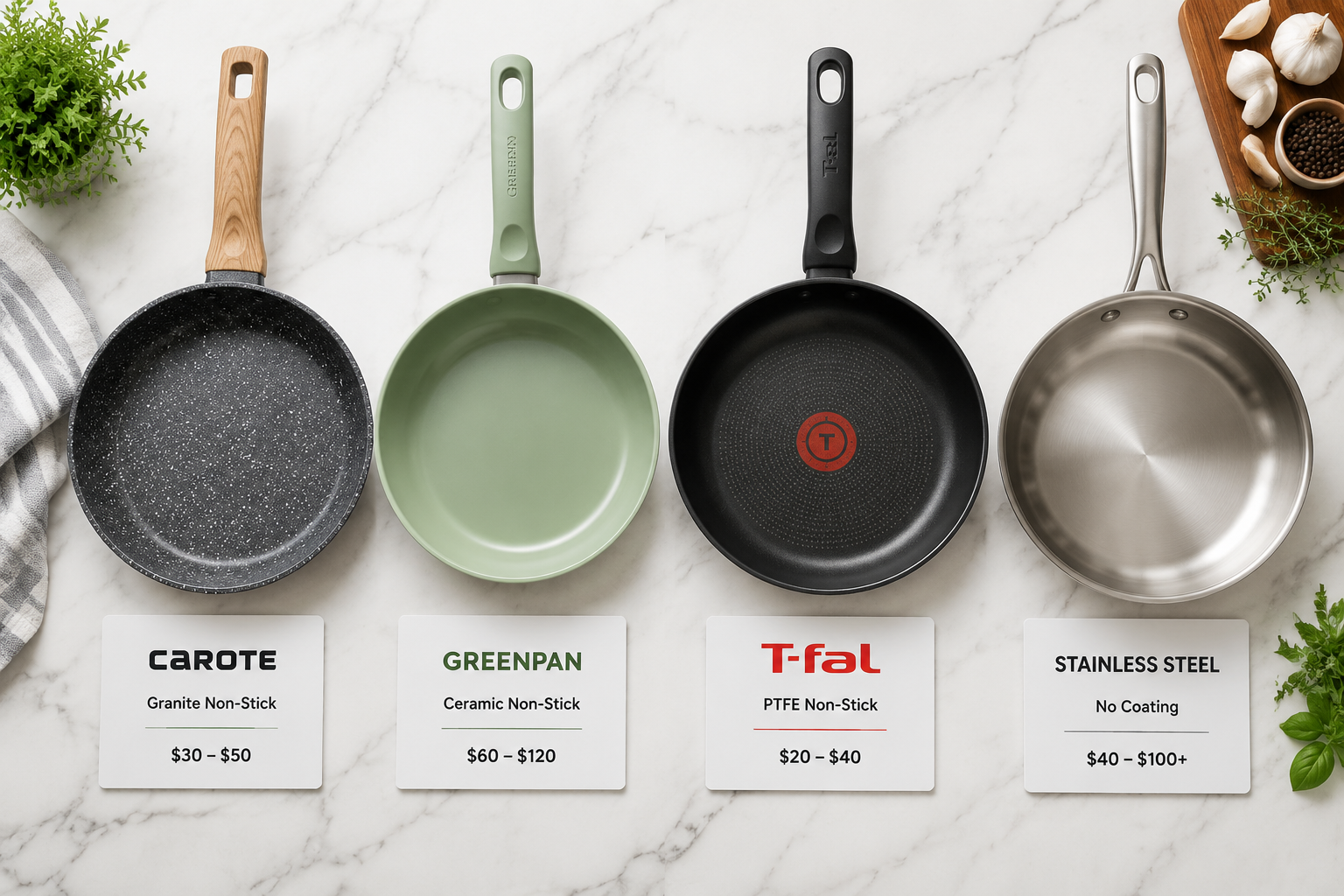
The best cookware material depends on what you cook and how much care you want to give the pan. Carote’s aluminum-based nonstick cookware emphasizes easy food release and lighter handling. Stainless steel, cast iron, and ceramic-coated cookware each offer a different mix of cooking performance, maintenance, and material characteristics.
The table below compares common cookware types rather than claiming that every Carote product has the same construction. It can help you decide whether a nonstick aluminum pan fits your kitchen or whether another material better suits your cooking style.
Source: sp-ao.shortpixel.ai
Choose aluminum nonstick for convenience
It can suit eggs, pancakes, and quick meals when easy release and simple cleanup matter most.
Choose stainless steel for versatility
It can handle browning and pan sauces well, although food may stick if temperature and technique are poorly managed.
Choose cast iron for heat retention
It holds heat well but is heavy and usually needs specific care to maintain its seasoning.
Choose ceramic-coated cookware for a specific coating preference
Confirm the exact coating type and expected care needs. Ceramic-coated pans can also lose nonstick performance over time.
Which Material Is Best for Your Kitchen?
For a busy household that often cooks eggs, grilled cheese, or delicate fish, an intact nonstick pan may save time. For high-heat browning or making a pan sauce, stainless steel may be more useful. Cast iron can be a good fit for cooks who want strong heat retention and do not mind its weight and care routine.
You do not need to use one material for every meal. Many kitchens work well with a small mix of cookware: a nonstick pan for delicate foods, a stainless steel skillet for browning, and a pot suited to soups or pasta. The goal is to match the pan to the task rather than look for one material that does everything equally well.
For eggs and pancakes
A nonstick surface can make flipping and serving easier.
For searing and sauces
Stainless steel is often useful when you want browning and fond for a pan sauce.
For slow, steady heat
Cast iron can retain heat well, but its weight and maintenance may not suit every cook.
How to Check the Materials Before Buying Carote Cookware
A short product check can prevent confusion about the body, coating, and cooktop compatibility. Start with the exact product name and model number, then compare the official product information with the seller’s description. Do not rely only on photographs or broad terms such as stone, granite, or healthy nonstick.
If the seller’s information conflicts with the official description, ask for clarification before purchasing. Material and chemical claims should be specific enough to answer your actual concern. This is especially important if you are avoiding a particular coating or need cookware for induction cooking.
Source: bakewarepans.org
Step 1: Identify the model
Write down the full product name, set size, and model number if one is available.
Step 2: Confirm the body material
Check whether the pan uses aluminum, stainless steel, or another metal construction.
Step 3: Identify the interior coating
Look for the stated coating type and do not infer chemistry from the surface pattern.
Step 4: Read chemical claims closely
Separate PTFE-free, PFAS-free, and PFOA-free statements instead of treating them as equivalent.
Step 5: Verify use and care
Check induction compatibility, oven limits, dishwasher guidance, and utensil restrictions.
Step 6: Keep the documentation
Save the product page or written support reply so you can refer to the exact claims later.
What If the Product Listing Does Not Say Enough?
Do not fill gaps with assumptions. Contact Carote or the seller and ask for the material specification for the exact item. If the answer does not clarify a concern that matters to you, consider a different pan with a clearer declaration.
A useful product specification should identify the body material, describe the cooking surface, state compatible cooktops, and explain relevant heat and cleaning limits. Independent test reports may provide additional evidence when available, but do not assume that every marketing claim has been independently tested.
Ask a specific question
For example, ask whether the exact pan’s food-contact coating contains PTFE, rather than asking only whether it is safe.
Check the source
Prefer current manufacturer information over an undated third-party listing when the details conflict.
Do not overread labels
A claim about the coating does not necessarily describe the handles, base, lid, or every component of the set.
Common Mistakes to Avoid With Carote Cookware
Many cookware problems begin with assumptions about the material or with habits that slowly damage the surface. A pan may look sturdy yet still need gentle handling because its nonstick layer is designed for easy food release, not rough scraping. The best approach is to use the pan according to its stated purpose and care instructions.
Source: mycarote.com
Mistake: Assuming granite means solid stone
Granite-style usually refers to the finish or coating description. Check the actual material breakdown.
Mistake: Treating PFOA-free as PFAS-free
PFOA is one specific chemical. Ask about the broader chemical group if that is your concern.
Mistake: Using high heat to speed up cooking
Many nonstick pans work well at moderate temperatures. Excessive heat can damage the coating.
Mistake: Scrubbing with abrasive tools
Harsh pads and metal scrapers can damage some coated surfaces. Soak stuck food and clean gently.
Mistake: Assuming every model works on induction
Check the exact model’s base and stated cooktop compatibility before purchasing.
Mistake: Trusting appearance as proof of safety
A speckled finish or premium-looking design cannot confirm a coating’s chemistry or condition.
A Simple Care Routine for Daily Use
Let the pan cool before washing it. A sudden change from a very hot pan to cold water can stress some cookware and may contribute to warping or damage. Use warm water, mild soap, and a soft sponge unless the maker gives different instructions.
Dry the pan before storing it, and avoid stacking pans directly against one another if their surfaces can rub. Keep the cooking temperature within the stated limits and use only utensils approved for the coating. These small habits can help preserve the surface and reduce the need for early replacement.
Before cooking
Check the pan for damage and choose a suitable heat setting.
After cooking
Allow the pan to cool, then clean it with gentle tools.
Before storage
Dry the pan and protect the coating from contact with other cookware.
Frequently Asked Questions
Q
What is Carote cookware made of?
Many Carote nonstick pans have an aluminum body and a nonstick cooking surface often described as granite-style. Other collections may use different constructions, including stainless steel. Check the exact model’s specifications for the full material breakdown.
Q
Is Carote cookware made of real granite?
Granite-style cookware is not generally made from solid natural granite. The term usually refers to a speckled or stone-like appearance associated with a nonstick finish. The actual coating material must be confirmed from the product’s specifications.
Q
Is Carote cookware PTFE-free?
That depends on the exact product and its verified material declaration. A granite-style finish does not prove that a pan is PTFE-free, and a PFOA-free claim is not the same as a PTFE-free claim. Check the current manufacturer’s information for the precise model.
Q
Is Carote cookware free of PFAS?
Some Carote products may be advertised with PFAS-free claims, but those claims should not be assumed to cover every product in the brand’s range. Check the wording for the exact pan and ask the manufacturer if the scope is unclear. A PFOA-free label alone does not establish that a product is free of all PFAS.
Q
Can Carote cookware go in the dishwasher?
Dishwasher suitability varies by model. Even if a product listing permits dishwasher use, handwashing with mild soap and a soft sponge may help protect a nonstick surface. Follow the care instructions supplied with your specific pan.
Q
Can Carote cookware be used on induction stoves?
Some Carote cookware is induction-compatible, but not every aluminum pan works on an induction cooktop. Look for an explicit induction statement or symbol on the product page or packaging. A magnet sticking to the bottom is a useful preliminary check, not a guarantee.
Q
Does Carote cookware contain aluminum?
Many of the brand’s nonstick pans use aluminum for the main body, but other product lines may use different materials. Aluminum helps transfer heat and keeps the pan relatively light. Check the specifications for the exact product rather than assuming every Carote set has the same construction.
Q
When should I replace a Carote nonstick pan?
Check the manufacturer’s advice if the surface peels, flakes, becomes extensively damaged, or no longer works as intended. A loose handle, unstable base, or other structural fault can also make a pan unsuitable for use. Do not attempt to repair a damaged nonstick coating with household products.
✦ Wrapping Up
Conclusion
Carote cookware is commonly made with an aluminum body and a nonstick coating, often sold with a granite-style finish. Aluminum helps distribute heat and keeps many pans light, while the coating helps food release and makes cleaning easier. The brand also offers other cookware constructions, so the material details can differ from one product to another.
The most useful thing to check before buying is the exact model’s material declaration. Look beyond the granite-style name to confirm the coating type, any PTFE or PFAS claims, induction compatibility, and care limits. These details matter more than color or appearance when you want cookware that fits your needs.
For everyday cooking, use moderate heat, choose suitable utensils, clean the pan gently, and inspect the surface over time. If a coating is visibly failing or the pan has a structural defect, seek replacement guidance rather than trying to repair it yourself.
💡 Key Takeaway
Before purchasing Carote cookware, confirm the exact model’s body material, coating chemistry, cooktop compatibility, and care instructions. If the manufacturer does not clearly answer a material or chemical question that matters to you, choose cookware with a more complete specification.