
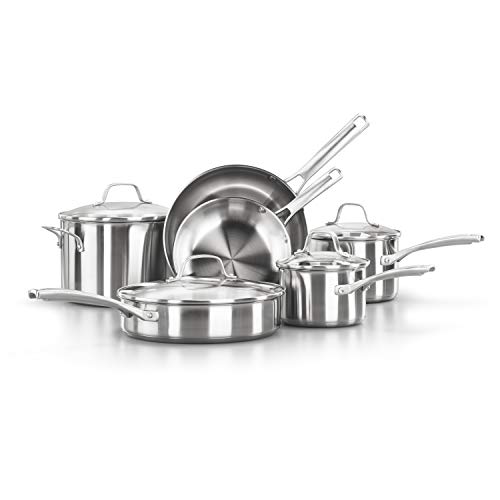

Is Calphalon Classic Stainless Steel Good?
Yes. The Calphalon Classic Stainless Steel Cookware Set is a strong choice for cooks who want durable cookware for many years. The 10-piece set uses stainless steel with an impact-bonded aluminum base. That base helps spread heat across the pan. The set works on gas, electric, glass, and induction cooktops. It is also dishwasher safe and oven safe up to 450°F.
In my stainless steel cookware vs ceramic test, this style felt like the kitchen workhorse. I liked it most for searing meat, browning vegetables, boiling pasta, and making sauces. Stainless steel does need a little more cooking skill. Eggs can stick if the pan is too cold or too hot. Once I learned to preheat the pan and use enough fat, that problem became much smaller.
What Makes It Stand Out / Key Features
- Stainless Steel BodyThe cooking surface is stainless steel, giving the set a tough and long-lasting build.
- Impact Bonded BaseAn aluminum base helps spread heat more evenly across the cookware.
- Induction CompatibleThe set works with induction, gas, electric, and glass cooktops.
- Oven SafeThe cookware is rated for oven use up to 450°F.
- Dishwasher SafeThe set can go in the dishwasher, which makes cleanup easier after busy meals.
- Stay Cool HandlesLong stainless steel handles are designed to stay cooler during stovetop cooking.
- Tempered Glass LidsGlass lids let you watch food while it cooks without lifting the lid.
- Useful Cooking DetailsSelected pieces include measuring marks, pour spouts, and straining covers.
My Recommendation
Consider this set if you want cookware for long-term use and cook foods that need browning, searing, simmering, or high heat. It is especially useful for cooks who want one set that can handle many jobs.
| Best For | Why |
|---|---|
| Home cooks | It covers many daily cooking tasks and should handle regular use well. |
| Induction users | The set works with induction, gas, electric, and glass cooktops. |
| Meal prep cooks | Its larger pots and durable cooking surface suit batch cooking. |
Is CAROTE Ceramic Cookware Good?
It depends on what you cook most. The CAROTE 21-piece ceramic cookware set is a good fit for people who want easy food release and simple everyday cooking. The set uses a ceramic nonstick cooking surface over a reinforced aluminum body. It includes several fry pans, pots, a saute pan, lids, utensils, and other useful pieces. The set is designed for induction and other common stovetops.
In my stainless steel cookware vs ceramic comparison, ceramic made breakfast feel easier. Eggs and pancakes released with less effort, and cleanup took less time. I also liked the lighter feel when moving pans around the stove. The trade-off is care. Ceramic coatings need gentler treatment than bare stainless steel. I would use silicone or wooden tools and wash the pieces by hand to help the coating last.
What Makes It Stand Out / Key Features
- Ceramic Nonstick SurfaceThe smooth ceramic surface helps food release with less oil.
- Reinforced Aluminum BodyThe aluminum body helps the cookware heat quickly and evenly.
- Large 21-Piece SetThe set includes a broad mix of pans, pots, lids, and cooking accessories.
- Induction ReadyThe cookware uses an induction-compatible base and can work with several common stovetops.
- Low-Oil CookingThe nonstick surface can make foods such as eggs and pancakes easier to cook with less oil.
- Glass LidsGlass lids make it easy to check food while it cooks.
- Matching Kitchen LookThe coordinated color and design can give a kitchen a clean, modern feel.
- Useful AccessoriesThe large set includes cooking tools and pan protectors that can add value for new kitchens.
My Recommendation
Consider this set if easy food release matters more than maximum long-term durability. It suits families, new kitchens, and cooks who make eggs, pancakes, vegetables, fish, and other foods that can stick.
| Best For | Why |
|---|---|
| Breakfast cooks | The ceramic surface makes eggs and pancakes easy to release. |
| New kitchens | The 21-piece package includes many common cookware pieces and tools. |
| Low-oil cooking | The smooth nonstick surface needs less fat for many foods. |
stainless steel cookware vs ceramic: Side-by-Side Test
The stainless steel cookware vs ceramic choice comes down to how you cook and how much care you want to give your pans. Stainless steel rewards good technique. Ceramic gives you easy release with less effort.
I would not treat one material as a magic answer for every kitchen. Think of stainless steel as a cast-iron work boot. It is tough and ready for hard work. Ceramic is more like a clean running shoe. It feels easy and light, but it needs more care.
Durability: Which Lasts Longer?
For long-term use, the stainless steel cookware vs ceramic gap is easy to see because stainless steel has no nonstick coating to wear away.
| Feature | Product 1 | Product 2 |
|---|---|---|
| Cooking surface | Stainless steel | Ceramic nonstick |
| Coating wear | No nonstick coating | Coating can wear over time |
| Scratch tolerance | Generally more forgiving | Needs gentler tools |
| Long-term use | Strong choice | Depends on coating care |
⭐ Product A – 9/10 | Product B – 7/10
Stainless steel has the edge for long-term durability.
Food Release: Which Sticks Less?
This is where ceramic has a clear practical advantage in the stainless steel cookware vs ceramic comparison.
| Feature | Product 1 | Product 2 |
|---|---|---|
| Eggs | Needs good heat control | Usually easy to release |
| Pancakes | Can stick without enough fat | Easy release with less oil |
| Fish | Needs careful technique | Easy release on fresh coating |
| Sticky foods | More demanding | More forgiving |
⭐ Product A – 7/10 | Product B – 9/10
Ceramic has the edge when easy food release is the main goal.
Searing: Which Handles High Heat?
When I compare stainless steel cookware vs ceramic for browning and searing, stainless steel is the more natural fit.
| Feature | Product 1 | Product 2 |
|---|---|---|
| Browning meat | Excellent | Good for moderate heat |
| Searing | Excellent | Less suited to hard searing |
| Fond development | Excellent | Less practical |
| High-heat cooking | Strong choice | Needs more care |
⭐ Product A – 9/10 | Product B – 7/10
Stainless steel has the edge for searing and browning.
Cleanup: Which Is Easier?
The stainless steel cookware vs ceramic cleanup battle favors ceramic after sticky foods, while stainless steel has the advantage of dishwasher use.
| Feature | Product 1 | Product 2 |
|---|---|---|
| Food release | Moderate | Very easy |
| Dishwasher use | Yes | Hand washing preferred |
| Burnt residue | Needs soaking or scrubbing | Can be easier to remove |
| Daily cleanup | Easy with proper care | Very easy for most foods |
⭐ Product A – 8/10 | Product B – 9/10
Ceramic has the edge for easy food cleanup, while stainless steel wins for dishwasher convenience.
Stovetop Use: Which Is More Flexible?
Both options can work across common American kitchens, but exact compatibility should always be checked for the model you buy.
| Feature | Product 1 | Product 2 |
|---|---|---|
| Gas | Yes | Yes |
| Electric | Yes | Yes |
| Glass top | Yes | Yes |
| Induction | Yes | Yes |
⭐ Product A – 9/10 | Product B – 9/10
This category is close because both sets support common stovetop types.
Oven Use: Which Goes Further?
For stainless steel cookware vs ceramic, oven performance depends on the exact design, handles, lids, and stated temperature limits.
| Feature | Product 1 | Product 2 |
|---|---|---|
| Oven cooking | Yes, up to 450°F | Check exact model limits |
| Stovetop to oven | Useful for many recipes | Possible within rated limits |
| High heat | Strong for rated use | Coating needs care |
⭐ Product A – 9/10 | Product B – 7/10
Stainless steel has the edge for predictable oven and high-heat use.
Everyday Cooking: Which Feels Easier?
For busy American routines, the stainless steel cookware vs ceramic choice often comes down to skill versus convenience.
| Feature | Product 1 | Product 2 |
|---|---|---|
| Beginner friendly | Takes some practice | Very friendly |
| Eggs and pancakes | Needs technique | Very easy |
| One-pan meals | Excellent | Excellent |
| Cooking variety | Excellent | Very good |
⭐ Product A – 8/10 | Product B – 9/10
Ceramic has the edge for simple everyday cooking, especially for new cooks.
Value: Which Makes More Sense?
Value is not just the price on the box. It also includes how long the cookware performs well and how much care it needs.
| Feature | Product 1 | Product 2 |
|---|---|---|
| Initial value | Strong | Strong |
| Piece count | 10 pieces | 21 pieces |
| Expected coating wear | Not applicable | Possible over time |
| Long-term value | Strong | Depends on care |
⭐ Product A – 9/10 | Product B – 8/10
Stainless steel has the edge when long-term use matters most.
Final Verdict: Which Should You Buy?
The stainless steel cookware vs ceramic decision depends on your cooking style. I would choose the Calphalon stainless steel set for durability, searing, oven cooking, and long-term use. It is the better fit for cooks who want one dependable workhorse.
I would choose the CAROTE ceramic set for easy food release, low-oil cooking, quick cleanup, and a large collection of pieces. It is a friendly choice for busy families and newer cooks. In short, stainless steel is the long-game tool. Ceramic is the easygoing everyday helper.