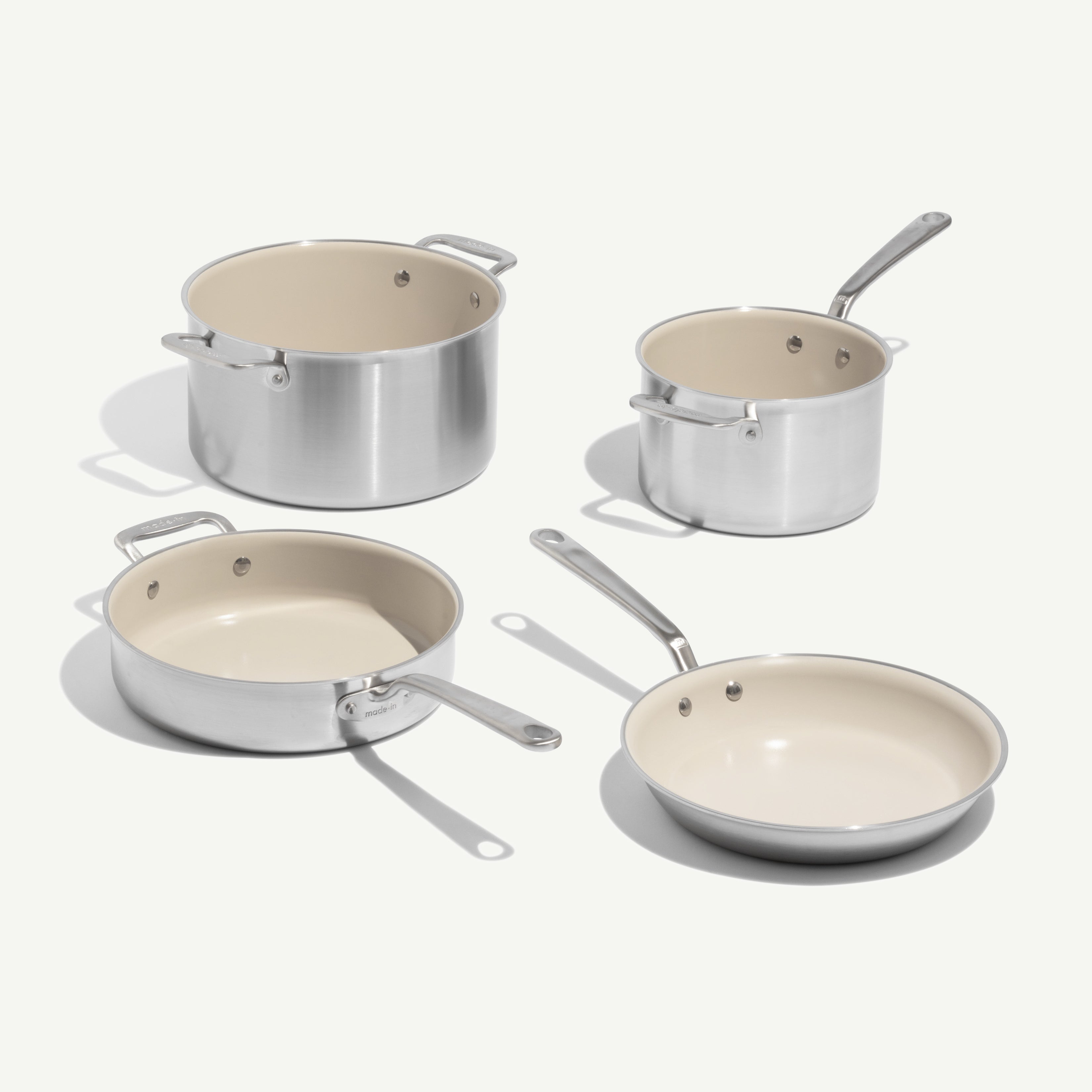
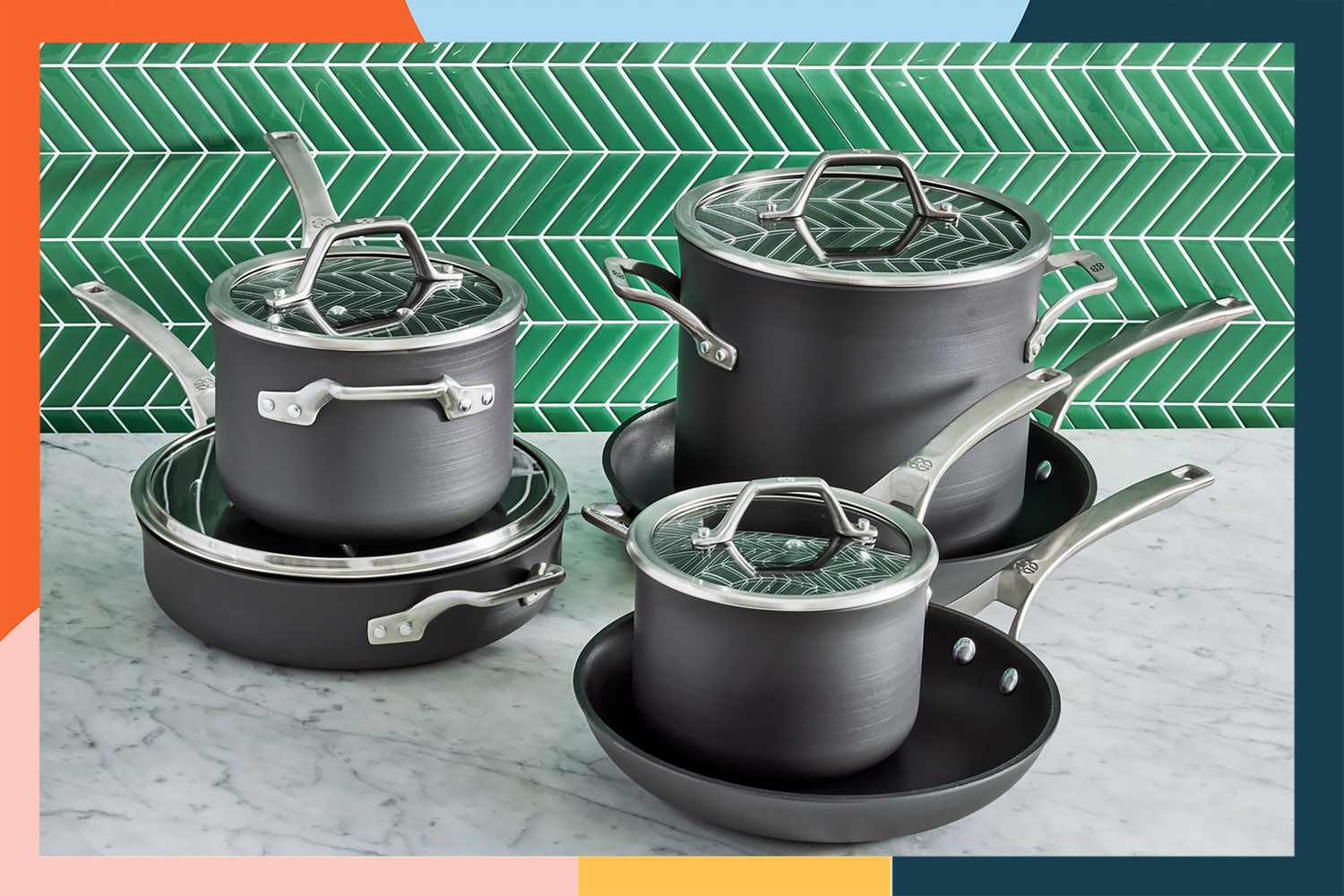
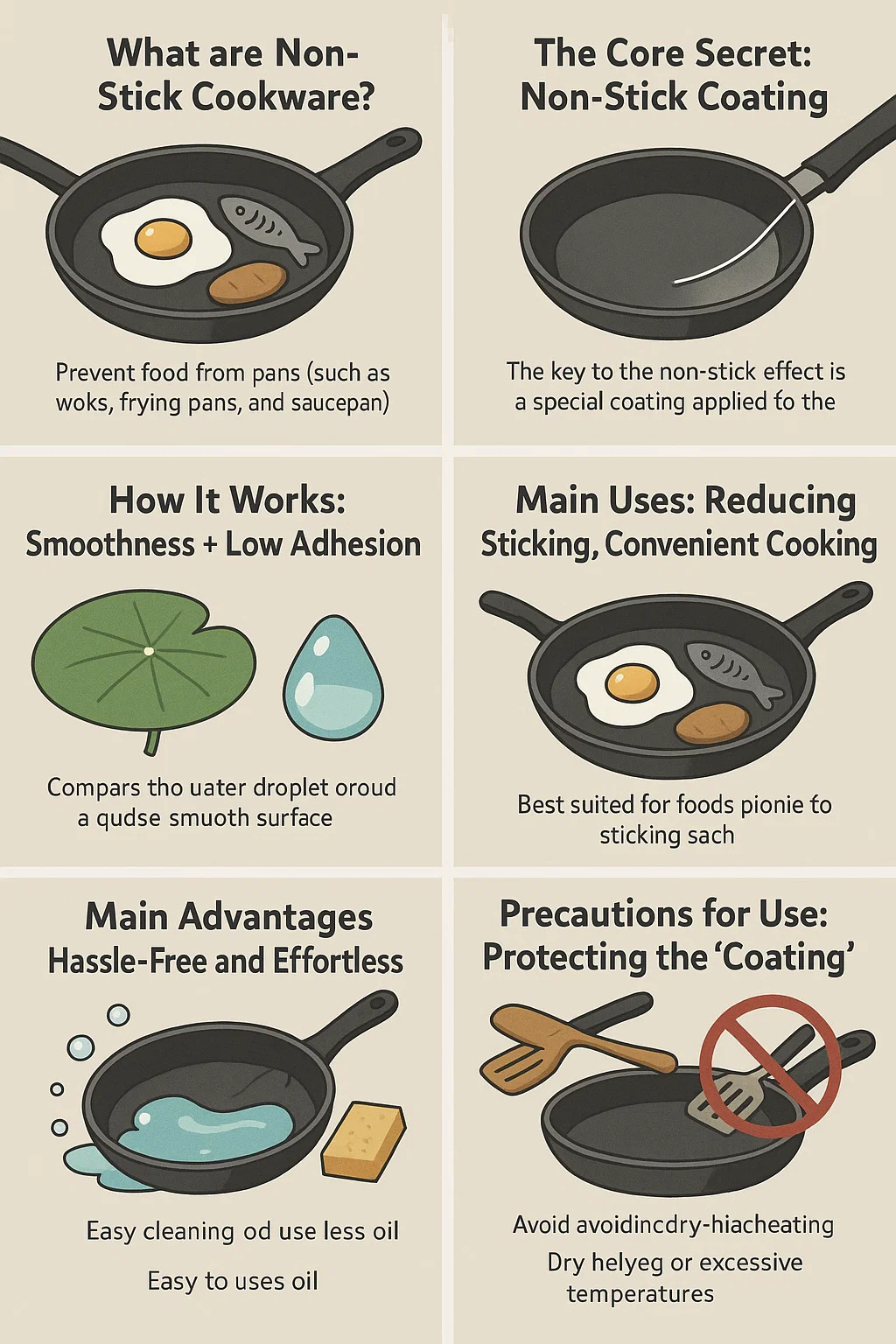
Nonstick cookware is usually made of aluminum or stainless steel with a PTFE or ceramic-based coating that helps food release with less oil.
In American kitchens, nonstick pans are common tools for cooking eggs before work, flipping pancakes on a weekend, and making a quick grilled cheese for lunch. Their smooth surfaces help food slide out with less sticking, which can make cooking and cleanup easier. But the term nonstick describes how a pan works, not what it is made of.
Most nonstick cookware has two main parts: a metal body that spreads heat and a surface coating that helps prevent food from sticking. Many traditional pans use PTFE, a synthetic fluoropolymer often associated with the brand name Teflon. Other pans use a ceramic-based coating, while some rely on seasoned cast iron or carbon steel instead of a factory-applied nonstick layer.
Knowing the difference helps you choose a pan that fits your cooking habits. The base metal affects heat control, weight, and durability, while the coating affects food release, care, and heat limits. Neither the words ceramic nor nonstick alone tell you everything about a pan’s safety or expected lifespan.
Nonstick cookware is generally made from a metal base covered with a thin, smooth coating. The base gives the pan its shape and strength, while the coating reduces the tendency of food to cling to the cooking surface. Some pans use a synthetic polymer coating, while others use a ceramic-based surface or build up a natural layer through seasoning.
Think of a nonstick pan as a house with two main parts. The metal body is the frame, and the cooking surface is the finish that helps make everyday use easier. A pan can have a strong metal body but a worn coating, or a durable coating on a base that heats unevenly.
Manufacturers may also add primers, bonding layers, pigments, and protective topcoats. These layers help the cooking surface adhere to the metal and resist everyday wear. The exact formula differs by brand, product line, and manufacturing process, so a general description cannot identify every ingredient in a particular pan.
Source: sp-ao.shortpixel.ai
The base material
Aluminum is common because it is light and conducts heat well. Stainless steel is sturdy and corrosion-resistant. Some pans use layered metal construction to combine different properties.
The nonstick coating
The cooking surface may use PTFE, a ceramic-based formulation, or another material designed to reduce sticking. Its chemistry affects heat limits, care, and wear.
The handle and other parts
Handles may be made from stainless steel, aluminum, plastic, or silicone. Lids may use glass or metal. These parts have their own heat limits and care needs.
Why Does Nonstick Cookware Need a Coating?
Food sticks when its proteins, sugars, or starches interact with a hot surface and form bonds or deposits. A well-made nonstick coating lowers the surface’s tendency to hold food, making it easier to turn eggs, lift fish fillets, or wipe away cooking residue.
This does not mean food can never stick. A dirty pan, excessive heat, worn coating, or the wrong cooking method can still cause problems. Nonstick cookware works best when you follow the care instructions and match the pan to the task.
Less oil may be needed
The smooth surface often allows you to cook with less added fat than you would need on a surface that readily sticks, though recipes and food types vary.
Cleanup can be easier
Food residue often releases with a soft sponge and mild dish soap, provided the coating remains in good condition.
What Is PTFE Nonstick Cookware Made Of?
Traditional nonstick cookware often uses polytetrafluoroethylene, or PTFE, as its main food-release material. PTFE is a synthetic fluoropolymer made from repeating units derived from tetrafluoroethylene. Its chemical structure gives it a low-friction surface that helps food release with little effort.
PTFE is part of a broader group of substances called fluoropolymers. The material is known for chemical resistance and a low coefficient of friction, which explains why it works well as a coating on frying pans. Teflon is a familiar brand name associated with PTFE-based products, but not every PTFE coating is sold under that brand.
A PTFE-coated pan usually has a metal body and a coating system applied in several stages. The process may include a primer that bonds to the pan, one or more coating layers, and a final surface layer. The number of layers and their formulation depend on the product.
PTFE does not provide the pan’s main structural strength. If the underlying aluminum bends or the pan becomes badly warped, the coating cannot fix that problem. Likewise, a thick metal base does not guarantee that the nonstick layer will last forever.
Source: madeincookware.co.uk
Low-friction surface
PTFE helps reduce the force needed for food to slide across the pan. This is especially useful for eggs, pancakes, delicate fish, and other foods that can tear or break.
Strong chemical resistance
PTFE resists many common chemicals and food ingredients. This property helps it perform during ordinary cooking and cleaning.
A defined heat limit
PTFE cookware must be kept within the manufacturer’s temperature guidance. Excessive heat can damage the coating and, at high enough temperatures, cause harmful fumes.
Is PTFE the Same as PFOA?
No. PTFE and PFOA are different chemicals with different roles. PTFE is the fluoropolymer used in many nonstick surfaces, while PFOA was a processing aid historically used in the manufacture of some fluoropolymer products.
PFOA has been phased out of many U.S. manufacturing processes, but that does not make PTFE and PFOA synonyms. A statement that a pan is PFOA-free addresses a particular substance; it does not automatically mean the product contains no PFAS or other fluorinated materials.
If avoiding PFAS is your priority, look for a clear statement that the finished cookware is PFAS-free and review the manufacturer’s explanation of what that claim covers. A ceramic-coated pan may be a useful alternative, but verify its composition rather than relying on the word ceramic alone.
PTFE
A fluoropolymer used as the main nonstick surface in many traditional coated pans.
PFOA
A substance historically used in the manufacture of some fluoropolymer coatings and subject to major regulatory action and phaseout efforts.
PFAS
A broad group of per- and polyfluoroalkyl substances. The term covers many different substances, including some fluoropolymers, depending on the definition being used.
Is PTFE Safe for Everyday Cooking?
PTFE-coated cookware can be used for everyday cooking when it is made for food contact and used according to its instructions. The main practical concern is overheating. At excessive temperatures, PTFE can break down and release fumes that may cause flu-like symptoms in people and can be especially dangerous to pet birds.
Do not leave an empty nonstick pan heating over a burner, especially on high heat. Use low to medium heat for most routine tasks, add food or suitable cooking fat as directed, and follow the product’s maximum temperature limit. A kitchen exhaust fan or open window can help with ordinary cooking ventilation, but ventilation is not a substitute for avoiding overheating.
If a pan has been severely overheated and produces smoke or unusual fumes, turn off the heat if you can do so safely, move people and pets away from the area, and ventilate it. Seek medical advice if anyone develops symptoms. Bird owners should be especially careful because birds are highly sensitive to certain airborne fumes.
Use moderate heat
Nonstick pans generally do not need the high heat used for some searing tasks. Choose stainless steel or cast iron when a recipe calls for sustained high-temperature searing.
Do not preheat an empty pan for long
An empty pan can heat up quickly. Follow the manufacturer’s instructions for any preheating, and never leave the pan unattended.
Inspect the surface
Replace a pan with severe peeling, extensive flaking, or a coating that has broken down. Minor scratches do not all pose the same risk, but they can signal wear and reduce performance.
What Is Ceramic Nonstick Cookware Made Of?
Ceramic nonstick cookware usually has a metal body with a silica-based coating or a related sol-gel surface. Sol-gel is a manufacturing process that uses liquid precursors to form a solid network. Depending on the formula, the resulting coating can contain silica and other mineral or inorganic ingredients, along with additives that affect color, bonding, hardness, and performance.
The name ceramic can cause confusion because these pans are not usually made from a thick block of pottery. Instead, a thin ceramic-like coating is applied to a metal pan. The base may still be aluminum, stainless steel, or another suitable metal.
Ceramic-based surfaces can provide useful food release when new and may appeal to shoppers who want to avoid PTFE. However, ceramic coatings vary, and their nonstick performance can decline with use. Some formulas lose food release faster than users expect, particularly when exposed to high heat, harsh cleaning, or repeated abrasion.
A ceramic label alone does not establish that a pan is free of every potentially concerning chemical. Read the full material declaration and look for specific claims about PTFE, PFAS, and other substances you want to avoid. Ask the manufacturer for clarification if the wording is vague.
Source: madeincookware.co.uk
Silica-based surface
Many ceramic-style nonstick coatings use silica or related materials formed through a sol-gel process. Exact ingredients differ among manufacturers.
Metal underneath
The coating is usually thin, so the metal body still controls much of the pan’s weight, heat distribution, and structural strength.
Performance can change
A ceramic pan may release food well at first, but its performance depends on the formulation, cooking temperature, cleaning method, and amount of wear.
Ceramic vs. PTFE: What Is the Difference?
The biggest difference is the chemistry of the cooking surface. PTFE is a fluoropolymer, while ceramic-style nonstick surfaces commonly use silica-based sol-gel materials. Both are designed to reduce sticking, but they do not behave exactly alike.
PTFE pans often provide reliable food release over a useful period when cared for well. Ceramic pans can be attractive to people seeking a non-PTFE surface, but food may begin to stick sooner as the coating wears. Actual results depend on the specific product, so broad claims that every ceramic pan is better or worse are not justified.
Neither coating should be treated as indestructible. Both can suffer from rough utensils, abrasive cleaning, overheating, and poor storage. For a pan that will see years of heavy use, a buyer may also consider uncoated stainless steel, cast iron, or carbon steel.
Choose PTFE when
You want a familiar, low-friction surface for eggs and other delicate foods, and you are comfortable following the heat limits and care instructions.
Choose ceramic when
You prefer a ceramic-based coating and have checked the product’s material claims, temperature limits, and care requirements.
Choose uncoated cookware when
You want to avoid a factory-applied nonstick coating and are willing to learn how to preheat, use cooking fat when needed, and clean the pan.
What Metal Is Used Under a Nonstick Coating?
Aluminum is one of the most common metals used to make nonstick pans because it is light, conducts heat well, and can be formed into many shapes. It allows a pan to heat up quickly, which is handy for breakfast foods and fast weeknight meals. Many affordable nonstick pans use aluminum as their main body material.
Stainless steel is another option. It resists corrosion and can provide a sturdy outer shell or cooking body, although stainless steel by itself is not naturally as nonstick as PTFE. Some products combine a stainless steel exterior with an aluminum core to improve heat movement.
Some pans use hard-anodized aluminum. Anodizing is an electrochemical process that changes the aluminum surface to create a harder oxide layer. This treatment can improve surface hardness and corrosion resistance, but a hard-anodized pan may still have a separate PTFE or ceramic coating on its cooking surface.
The base material matters because the coating is thin. A pan with a heavy or layered base may heat more evenly than a very thin pan, while a lighter pan may be easier to lift and store. Look at the full construction rather than assuming that all nonstick pans heat or wear in the same way.
Source: topkitchenadvice.com
Aluminum
Lightweight, responsive to heat, and common in coated cookware. Thin aluminum can be prone to warping, depending on the design and use.
Hard-anodized aluminum
Aluminum treated to create a harder oxide surface. Check whether the interior also has a separate nonstick coating.
Stainless steel
Strong and corrosion-resistant. It may be used alone as a body material or combined with aluminum or other metals in a layered construction.
Multilayer metal construction
Some cookware combines metals to balance heat response, strength, and durability. The exact layer arrangement varies by design.
Does the Metal Base Affect Cooking Safety?
The base affects heat behavior and can influence how the pan responds to temperature changes. It also determines much of the cookware’s weight and structural strength. However, the presence of aluminum or stainless steel alone does not tell you whether the complete product is suitable for your needs.
For coated cookware, the surface condition and intended use matter as well. Use products designed for food contact, follow the manufacturer’s instructions, and avoid using a pan whose body is badly warped or whose handle is loose. If the metal is exposed because the coating has flaked away, replacement is often the simplest practical choice.
Check the cooking surface
Look for peeling, deep damage, or extensive loss of the coating, not just the name of the base metal.
Check stove compatibility
Induction cooktops require a compatible magnetic base. An aluminum pan may need a magnetic stainless steel layer to work on induction.
Are Nonstick Pans Made With PFAS?
Some nonstick pans use PTFE, which belongs to the broader family of fluorinated materials commonly discussed under the PFAS umbrella. The term PFAS covers a large and diverse group of substances, and definitions can differ across scientific, regulatory, and product-labeling contexts. That is why the words nonstick and PFAS-free should not be treated as having the same meaning.
Traditional PTFE cookware and ceramic-based cookware can have different material profiles. A pan advertised as ceramic-coated may use a silica-based cooking surface, but the label alone does not confirm every ingredient in its construction. A pan advertised as PFOA-free may still contain PTFE because PFOA and PTFE are different substances.
For U.S. shoppers, the most useful step is to read the exact manufacturer’s disclosure for the specific product line. Look for explicit information about PTFE and PFAS rather than relying only on broad phrases such as green, natural, clean, or healthy. If the manufacturer does not explain a claim, contact customer support before buying.
A material label is one part of the decision, not a complete measure of risk. Intended use, temperature, product quality, wear, and cooking habits also matter. Avoid claims that a whole category is completely safe or completely dangerous without considering these factors.
Source: m.media-amazon.com
PFOA-free does not mean PFAS-free
The claim addresses PFOA specifically. It does not, by itself, rule out PTFE or all other PFAS.
Ceramic does not automatically mean chemical-free
Ceramic-based coatings have their own formulations and may include additives. Review the full product disclosure.
Ask for specific details
If a claim is unclear, ask whether the finished pan contains PTFE, other fluoropolymers, or PFAS under the manufacturer’s stated definition.
What Does PFOA-Free Actually Tell You?
PFOA-free tells you that the manufacturer claims the product does not contain PFOA under the scope of that claim. It does not tell you whether the product contains PTFE, whether it uses a ceramic coating, or whether every substance in its manufacturing process has been eliminated.
This distinction matters because labels often sound broader than they are. If your goal is to avoid a particular material, search for that material by name in the manufacturer’s technical information. If your goal is to avoid all PFAS, ask for an explicit PFAS-free statement and clarification about the definition used.
Start with the exact product name
A company’s claims can differ between product lines, even when the pans look alike.
Read beyond the front label
Look for material specifications, care guidance, and explanations of any environmental or chemical-related claim.
How to Use Nonstick Cookware Safely
Safe use starts with controlling heat and preventing damage. A nonstick pan is designed to release food, not to withstand every temperature a stovetop can produce. Use it for the tasks listed in its instructions and choose another pan when a recipe calls for intense, sustained heat.
For everyday cooking, low or medium heat is often enough. Follow the product manual because temperature limits differ across coatings, handles, lids, and overall pan designs. A pan marked oven-safe may still have a limit that applies to the handle or lid rather than the coating alone.
Cleaning and storage matter too. Metal tools, scouring pads, harsh abrasives, and stacking pans without protection can shorten the useful life of a coating. Gentle care cannot make a pan last forever, but it can help prevent avoidable damage.
Source: kitchendeets.com
Use the right heat
Avoid high-heat cooking unless the manufacturer specifically permits it. Do not leave an empty pan on a hot burner.
Choose suitable utensils
Wood, silicone, and other utensils approved by the manufacturer can help reduce scratches. Do not assume that a metal-utensil claim means the surface is damage-proof.
Clean gently
Let the pan cool, then wash it with mild dish soap and a soft sponge. Follow the care label before using a dishwasher.
Store with care
Use pan protectors or a soft cloth between stacked pans to reduce abrasion from metal-to-metal contact.
Replace badly damaged cookware
If the coating is extensively peeling, flaking, or breaking down, stop using the pan and follow the manufacturer’s replacement advice.
What Should You Do If a Nonstick Pan Is Scratched?
A scratch does not always mean the pan must be discarded immediately, but its depth, size, and the coating type matter. A light surface mark may affect appearance more than function, while deep scratches or widespread peeling can expose the base metal and make the surface less reliable.
Check the manufacturer’s guidance for damaged cookware. If the coating is lifting, flaking into food, or visibly breaking down across a large area, replacing the pan is a sensible choice. Avoid scraping at the damaged area or trying to repair a factory coating at home.
Prevention is easier than repair. Use suitable utensils, avoid abrasive cleaning, do not nest pans without protection, and keep heat within the product’s stated limits.
Minor mark
Check the manual and monitor the surface. Stop using utensils or cleaning tools that may be causing more damage.
Deep scratch or peeling
Follow the manufacturer’s advice and replace the pan when the coating is badly damaged or continues to shed.
Overheated pan
Turn off the heat if safe, move away from unusual fumes, ventilate the area, and seek medical advice if symptoms occur.
How to Choose the Right Nonstick Cookware
The right nonstick pan depends on what you cook, what materials you want to avoid, and how much care you are willing to provide. A person who cooks eggs every morning may value easy food release above all else, while someone who often sears steaks may get more use from stainless steel or cast iron.
Start by deciding whether you want a PTFE coating, a ceramic-based coating, or an uncoated pan. Then check the base material, stove compatibility, maximum cooking temperature, handle design, cleaning instructions, and replacement policy. These details are more useful than a broad label such as premium or healthy.
Price alone is not a reliable measure of coating life. A more expensive pan may offer a sturdier base or better construction, but no coating is immune to wear. Compare the manufacturer’s instructions and warranty terms, and be realistic about how you cook.
Source: people.com
For eggs and delicate foods
A well-maintained PTFE or ceramic-coated pan can make it easier to cook foods that tend to stick. Choose the surface that matches your material preferences.
For high-heat searing
Consider uncoated stainless steel, cast iron, or carbon steel when the recipe calls for high heat that may exceed a coated pan’s limit.
For induction cooktops
Check the product specifications for induction compatibility. The base must be magnetic, even if the visible cooking surface is aluminum or coated with another material.
For avoiding PTFE
Look for a clear statement about the coating composition. A ceramic-based pan may fit this goal, but confirm the claim for the exact model.
For long-term use
Consider whether you would prefer uncoated cookware that can remain useful for many years with suitable care, even if it takes more skill to prevent sticking.
Nonstick Cookware Materials Compared
The table below compares common cooking surfaces and base materials. It is a general guide rather than a rating of every product, because coating formulas and pan construction vary widely.
PTFE-coated aluminum
A common combination that offers a light pan, responsive heat, and strong food release. It requires careful temperature control and protection from coating damage.
Ceramic-coated aluminum
Often chosen by shoppers seeking a ceramic-based surface. Its food-release performance can decline with use, so follow the care instructions closely.
Hard-anodized nonstick
Uses treated aluminum for the body and may include a separate nonstick coating. Check the interior coating instead of assuming anodizing means the pan is uncoated.
Uncoated stainless steel
Has no factory nonstick layer and can handle many cooking tasks. Food may stick if the pan is used without suitable preheating or cooking technique.
Seasoned cast iron or carbon steel
Develops a cooking surface through seasoning with oil. These pans need different care, but they avoid the need for a factory-applied PTFE or ceramic nonstick coating.
Common Myths About Nonstick Cookware Materials
Many claims about nonstick cookware come from mixing up the metal body, the cooking surface, and the chemicals used during manufacturing. Once these parts are separated, it becomes easier to judge labels and make a practical choice.
One common mistake is assuming that every nonstick pan is made from Teflon. Another is assuming that a ceramic coating is made from solid pottery or contains no other ingredients. Product materials vary, so check the exact pan rather than applying one description to every model.
Source: nblecj.com
Myth: Every nonstick pan contains PTFE
Many traditional nonstick pans use PTFE, but ceramic-based coatings and other nonstick technologies also exist. Seasoned cast iron and carbon steel can develop food-release properties without a factory-applied coating.
Myth: PFOA-free means PFAS-free
These terms describe different things. A PFOA-free claim does not automatically rule out PTFE or every other PFAS.
Myth: Ceramic cookware is made entirely of ceramic
Most ceramic-coated nonstick pans use a thin ceramic-like layer on a metal body. They are not generally solid ceramic vessels.
Myth: A more expensive pan cannot wear out
All coated surfaces can deteriorate. Construction, use, cleaning, storage, and temperature affect service life.
Myth: A scratch always proves the pan is toxic
The meaning of damage depends on the coating, its condition, and the manufacturer’s guidance. Extensive peeling or a badly degraded surface is a good reason to replace the pan.
Can You Recycle Old Nonstick Cookware?
Recycling options depend on your local program and the pan’s construction. A metal body may be recyclable as scrap metal, but many curbside programs do not accept whole cookware items because the coating, handles, and mixed materials complicate processing.
Check with your local recycling center or scrap-metal service before putting an old pan in a recycling bin. Some services accept metal cookware, while others do not. If the pan is still usable and safe, donation may be possible, but do not donate cookware with badly damaged coatings or loose handles.
Ask before recycling
Confirm whether the local facility accepts coated cookware and whether handles or lids must be removed.
Avoid unsafe reuse
Do not keep a badly damaged pan just because the metal body still looks sturdy.
Frequently Asked Questions
Q
Is nonstick cookware made of aluminum?
Many nonstick pans use aluminum as the main body because it is light and conducts heat well. The cooking surface is usually a separate coating, such as PTFE or a ceramic-based material. Other pans use stainless steel or layered metals, so aluminum is common but not universal.
Q
Is Teflon the same as nonstick cookware?
No. Teflon is a brand name associated with PTFE-based nonstick products, while nonstick cookware is a broad category. Some pans use PTFE, others use ceramic-based coatings, and uncoated cast iron or carbon steel can develop a nonstick-like surface through seasoning.
Q
Is ceramic nonstick cookware safer than PTFE?
Neither category can be declared universally safer in every situation. Ceramic-based coatings commonly avoid PTFE, while PTFE cookware can be used for ordinary cooking when the pan is in good condition and kept within its temperature limits. Compare the exact material claims, follow the instructions, and avoid overheating any coated pan.
Q
Does PFOA-free cookware contain PTFE?
It can. PFOA and PTFE are different substances, so a PFOA-free claim does not automatically mean that a pan is PTFE-free or PFAS-free. Check the product’s full material information if you want to avoid a specific coating.
Q
When should I replace a nonstick pan?
Consider replacing it when the coating peels, flakes, or breaks down extensively, when food release has seriously deteriorated, or when the pan is warped or unsafe to handle. Follow the manufacturer’s guidance for minor scratches, since the significance of damage depends on the coating and its condition.
Q
Can nonstick cookware go in the oven?
Some nonstick pans are oven-safe, while others are intended for stovetop use only. The permitted temperature can depend on the coating, handle, lid, and other components. Check the manual for the exact model rather than assuming that all nonstick cookware has the same oven limit.
Q
Can I use metal utensils on nonstick cookware?
Use metal utensils only if the manufacturer explicitly permits them for that pan. Even when a product is marketed as metal-utensil-safe, repeated scraping can still cause wear. Wood or suitable silicone utensils are a cautious everyday choice for many coated pans.
✦ Wrapping Up
Conclusion
Nonstick cookware is usually made from a metal base, such as aluminum or stainless steel, with a coating that helps food release. PTFE is common in traditional nonstick pans, while ceramic-style cookware often uses a silica-based coating formed through a sol-gel process. The exact materials depend on the product, so the label and manufacturer’s specifications matter.
For everyday use, choose a pan that matches your cooking style and material preferences. Keep coated cookware within its heat limits, use suitable utensils, clean it gently, and replace it when the surface is badly damaged. If you want to avoid PTFE or all PFAS, look for a clear, product-specific statement instead of relying on terms such as PFOA-free or ceramic alone.
No single material is ideal for every kitchen. PTFE and ceramic-coated pans can make delicate foods easier to cook, while stainless steel, cast iron, and carbon steel offer alternatives without a factory-applied nonstick coating. Understanding these trade-offs makes it easier to select cookware that suits your needs.
💡 Key Takeaway
Before buying a nonstick pan, check three things: the base metal, the exact coating material, and the manufacturer’s temperature and care instructions. If avoiding PFAS is important to you, verify an explicit PFAS-free claim for the specific product.