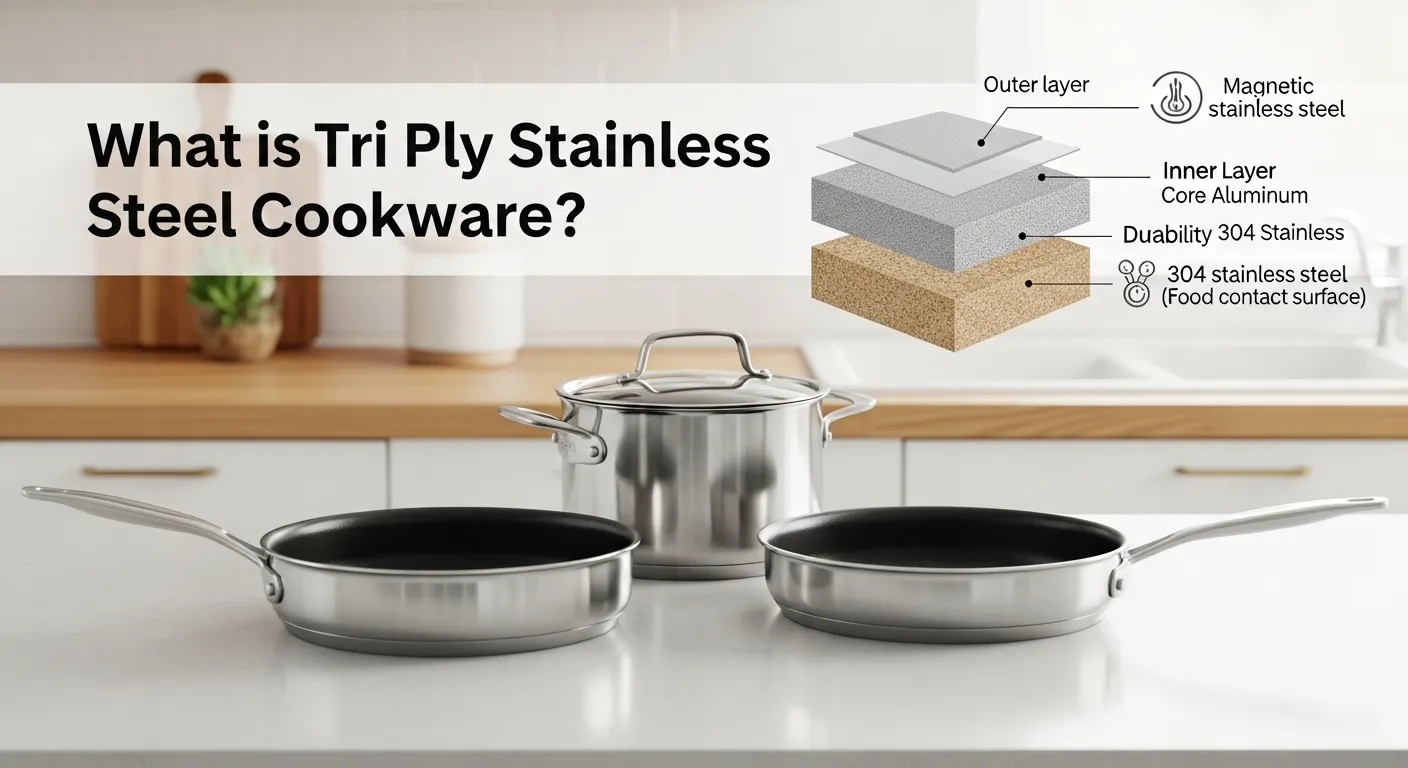
Tri ply stainless steel cookware has three bonded metal layers that help spread heat, improve cooking control, and provide a durable cooking surface.
If you cook dinner in a US kitchen, you may use a skillet for eggs, a saucepan for oatmeal, and a stockpot for pasta. The right cookware can make these daily tasks easier. Tri ply stainless steel cookware is one option because it combines stainless steel with a heat-conducting metal core. This design helps a pan heat more evenly than many basic, thin stainless steel pans.
The term tri ply means three layers. In many fully clad pans, stainless steel forms the inner and outer surfaces, while aluminum sits between them. The steel offers a durable cooking surface, and the aluminum helps spread heat. However, not every tri ply pan has the same design, and the label alone does not guarantee top performance.
Understanding these layers helps you choose cookware for your stove, cooking habits, and budget. It also helps you spot the difference between a fully clad pan and one with a layered base only. Both designs can be useful, but they do not distribute heat in quite the same way.
Tri ply stainless steel cookware is made by bonding three layers of metal into one pan. A common design uses stainless steel on the inside, aluminum in the middle, and stainless steel on the outside. The layers work together to provide a balance of cooking performance, strength, and ease of care.
The inner steel layer touches your food. The middle layer helps move heat across the cooking surface. The outer steel layer protects the structure and may provide magnetic properties for induction cooking. Together, these materials can offer more even heating than a pan made from a single thin sheet of stainless steel.
You may also see this design called tri-ply, three-ply, or tri-ply clad cookware. The word clad refers to layers of different metals bonded together. Always check the product details, because some brands use different metals or apply the layered construction only to the bottom of the pan.
Source: m.media-amazon.com
Tri ply
Three bonded layers of metal designed to work together during cooking.
Stainless steel
A corrosion-resistant steel alloy commonly used for the cooking surface and exterior.
Aluminum core
A middle layer that conducts heat well and helps reduce temperature differences across the pan.
Clad construction
A design in which the metal layers are bonded together rather than simply placed loosely inside one another.
Is Tri Ply the Same as Stainless Steel?
No. Stainless steel describes a material, while tri ply describes how several layers of metal are arranged. A stainless steel pan may have a single-layer body, a thick aluminum disk in its base, or a fully clad three-layer structure.
This distinction matters because two pans that both say stainless steel can behave differently on the stove. A thin single-layer pan may develop hot spots, while a well-made clad pan can spread heat across a wider area. Construction and thickness matter alongside the material name.
Single-layer steel
Often simple and durable, but thin versions may heat unevenly.
Tri ply steel
Combines steel with a conductive core for better heat distribution.
Stainless steel with an aluminum base
Adds a conductive disk to the bottom without necessarily extending it up the sides.
How Do the Three Layers Work?
Each layer serves a different purpose. The stainless steel surface provides a durable place to cook, the aluminum core transfers heat, and the outer layer adds strength and helps the pan work with compatible cooktops. The exact result depends on the metals, their thickness, and how well the manufacturer bonds them.
Think of the layers as a team. Stainless steel handles the daily wear, while aluminum helps carry heat across the pan. Neither material has to do every job alone. This combination is a major reason tri ply cookware is popular for home kitchens.
Source: m.media-amazon.com
Inner stainless steel
Provides a hard, corrosion-resistant cooking surface when properly maintained.
Middle aluminum
Conducts heat efficiently and helps limit temperature differences across the pan.
Outer stainless steel
Protects the body and can provide a magnetic surface for induction when the alloy is suitable.
Why Is Aluminum Used in the Middle?
Aluminum transfers heat much more readily than stainless steel. A bonded aluminum core can carry heat from the burner across the pan’s base and, in fully clad cookware, up its sides. This helps reduce the sharp hot spots that can occur in thin steel pans.
Aluminum also adds less weight than some alternative core metals. However, it does not make every tri ply pan equally responsive. Core thickness, burner size, heat level, and the shape of the pan all affect the final result.
Better heat spread
Helps more of the cooking surface reach a useful temperature.
Responsive temperature changes
Can help the pan respond when you raise or lower the burner, although the full pan still stores heat.
Protected core
The bonded steel layers keep the aluminum separated from direct food contact in an intact clad pan.
Does the Stainless Steel Grade Matter?
Yes. Stainless steel comes in different grades with different compositions and properties. Some cookware uses a 300-series stainless steel cooking surface, while the exterior may use a different grade selected for its magnetic properties or other manufacturing needs.
Do not assume that all tri ply cookware uses the same steel grade. Check the manufacturer’s specifications if the grade, nickel content, or induction compatibility matters to you. The number of layers alone does not reveal every material detail.
Cooking surface
Look for a clearly stated food-contact material and follow the manufacturer’s care instructions.
Exterior layer
Its composition can affect magnetic response, appearance, and compatibility with induction.
What Are the Benefits of Tri Ply Cookware?
The main benefit of tri ply stainless steel cookware is its combination of heat distribution, durability, and versatility. It can handle many common cooking tasks, from browning meat to simmering sauces. Unlike coated nonstick cookware, a bare stainless steel cooking surface does not depend on a delicate nonstick layer.
Still, the benefits depend on the specific pan. A well-made tri ply skillet can perform better than a poorly made one, but a thick, well-designed pan with a different construction may also cook very well. Look beyond the tri ply label when comparing options.
Source: bergnerhome.in
More even heating
The conductive core helps spread heat across the pan, which can improve browning and reduce some hot spots.
Long service life
Uncoated stainless steel does not wear out through the loss of a nonstick coating, although the pan can still scratch, warp, or become damaged.
Versatile cooking
Many tri ply pans can sear, sauté, fry, simmer, and make pan sauces.
Oven use
Many models are oven-safe, but the maximum temperature depends on the handles, lids, and manufacturer’s specifications.
No routine seasoning requirement
Unlike traditional bare cast iron, stainless steel does not need a seasoning layer to protect it during normal use.
Potential induction compatibility
Many tri ply designs use a magnetic stainless steel exterior that works on induction cooktops.
Is Tri Ply Good for Everyday Cooking?
Yes, tri ply cookware can suit everyday cooking because one pan can perform several jobs. A skillet can brown chicken, cook vegetables, and make a quick pan sauce. A saucepan can heat soup, cook grains, or reduce a sauce.
The main learning curve is food release. Stainless steel does not behave like a coated nonstick pan, so eggs and delicate fish may stick if the surface is not heated and oiled properly. With a little practice, the pan can become a useful part of a daily cooking routine.
For searing
A tri ply skillet can develop good browning when the pan, oil, and food are at suitable temperatures.
For sauces
Browned food bits can be loosened with liquid to add flavor to a pan sauce.
For boiling
A stainless steel pot works well for pasta, vegetables, and other foods cooked in water.
What Are the Drawbacks of Tri Ply Stainless Steel Cookware?
Tri ply cookware has limits. It can cost more than basic stainless steel pans, and it usually takes more attention to prevent food from sticking than a good nonstick pan. It can also develop discoloration, water spots, or heat tint during normal use.
The metal core helps distribute heat, but it does not make the pan immune to overheating. A pan left empty over high heat may become too hot, discolor, or warp. Good cooking technique and suitable heat levels still matter.
Source: i5.walmartimages.com
Food can stick
Bare stainless steel needs proper preheating, suitable oil, and the right cooking temperature.
Higher initial cost
Well-made clad pans may cost more than basic cookware, though the value depends on use and lifespan.
Cleaning may take effort
Burnt residue and cooked-on oil may require soaking or a suitable stainless steel cleaner.
Potentially heavy construction
The total weight varies by size, core thickness, handle design, and the number of layers.
Not automatically nonstick
The cooking surface is generally bare steel unless the manufacturer specifically adds a coating.
Can Tri Ply Cookware Replace Nonstick Pans?
It can replace a nonstick pan for many tasks, but not every cook will prefer it for every food. Stainless steel is useful for browning meat, sautéing vegetables, and building sauces. A coated nonstick pan can be easier for delicate eggs, pancakes, and foods that tend to tear when they stick.
You do not have to choose one material for the whole kitchen. A practical setup may include a tri ply skillet for searing and a smaller nonstick pan for foods that benefit from easy release. This approach matches the cookware to the task instead of expecting one pan to do everything.
Choose tri ply
When browning, durability, and versatile cooking matter most.
Choose coated nonstick
When easy release and simple cleanup for delicate foods are the main goals.
Tri Ply vs. Five Ply Cookware
Tri ply cookware has three metal layers, while five ply cookware has five. The extra layers may use different combinations of stainless steel and conductive metals. However, more layers do not automatically mean faster heating, better cooking, or longer life.
A five-ply pan may have a thicker body or a different balance of metals. A tri ply pan may be lighter and easier to handle. To compare them fairly, look at the total thickness, heat distribution, weight, handle design, and cooking performance rather than counting layers alone.
Source: bergnerhome.in
Tri ply
Often offers a practical balance of heat spread, durability, weight, and cost.
Five ply
May use extra metal layers to change heat distribution, body thickness, or structural properties.
Neither is always better
Material quality, construction, pan shape, and the cooktop can matter more than layer count.
Does Five Ply Heat More Evenly Than Tri Ply?
Not in every case. Heat distribution depends on the conductivity and thickness of the core, the overall shape, and the heat source. A well-designed tri ply pan can distribute heat more evenly than a poorly designed five-ply pan.
If you cook on a small gas burner or an electric coil, burner size and contact with the base can affect the result. On induction, the magnetic layer and the cooktop’s heating pattern also play a role. Compare the actual construction details before paying more for additional layers.
Check core thickness
A thicker conductive core can influence heat spread, but weight and response may change too.
Check sidewall construction
Fully clad designs extend their layered structure up the sides, unlike base-only designs.
Check your cooking style
High-heat searing, delicate sauces, and long simmering place different demands on cookware.
Fully Clad Tri Ply vs. a Tri Ply Base
One of the most useful distinctions when shopping is whether the three layers cover the entire body or only the base. Fully clad cookware has its bonded metal structure running across the bottom and up the sides. Base-only cookware has a layered disk attached to the bottom, while the sides may consist of a different construction.
Fully clad pans can distribute heat through the sidewalls as well as the base. This can help when you stir food around the pan or cook with sauces that touch the sides. A layered base can still work well for boiling water, making soup, or other tasks where most heat transfer happens through the bottom.
Neither construction is automatically wrong. A base-only pot may be a sensible choice for a household that mainly boils pasta or heats soup. A fully clad skillet may be more useful for sautéing, searing, and reducing sauces.
Source: 5.imimg.com
Fully clad
The bonded layers extend from the bottom up the sidewalls for broader heat distribution.
Layered base
The bottom contains a multi-metal disk, but the sides are not necessarily clad with the same layers.
What to check
Look for terms such as fully clad or tri-ply clad, then confirm the construction in the product specifications.
How Can You Tell Which Design You Are Buying?
Start with the manufacturer’s description. Look for a clear statement that the cookware is fully clad, with layers extending through the base and sidewalls. Product photos can help, but an exterior image alone may not show how the layers are arranged.
If the listing only says encapsulated base or bonded base, do not assume that the sidewalls have the same three-layer structure. When the description is unclear, check the technical specifications or ask the manufacturer before buying.
Read the construction details
Confirm whether the three layers cover the whole pan or only its base.
Compare the cross-section
A reliable cutaway diagram can show the layer arrangement more clearly than a standard product photo.
Is Tri Ply Stainless Steel Cookware Safe?
Tri ply stainless steel cookware is generally suitable for normal food preparation when it is made for food contact, remains in good condition, and is used according to the manufacturer’s instructions. The steel cooking surface provides a barrier between food and the aluminum core in an intact clad pan.
Stainless steel can release small amounts of certain metals into food under some cooking conditions. The amount can depend on the alloy, food acidity, cooking time, and condition of the pan. People with a known nickel sensitivity may want to review the steel grade and discuss suitable cookware choices with a qualified health professional if needed.
The aluminum core is normally enclosed within the bonded structure. Do not use cookware with a badly separated layer, deep structural damage, or other signs that its construction has failed. Contact the manufacturer if you are unsure whether a damaged pan remains suitable for use.
Source: buymeonce.co.uk
Use food-contact cookware
Choose products intended for cooking and follow the stated use and care instructions.
Avoid overheating an empty pan
Excessive heat can cause discoloration, warping, or damage to some cookware components.
Inspect damaged cookware
Stop using a pan with significant layer separation or structural damage until the manufacturer clarifies whether it is safe.
Consider known sensitivities
Check material details if nickel exposure is a concern, since stainless steel grades differ in composition.
Does Stainless Steel React With Acidic Foods?
Stainless steel is generally suitable for cooking acidic foods such as tomato sauce. However, prolonged cooking or storage of highly acidic food can increase the release of some metals from certain stainless steel surfaces. The amount varies with the alloy and conditions.
For ordinary cooking, use the pan as directed and avoid long-term storage of acidic leftovers in cookware unless the manufacturer says this is appropriate. A separate food-storage container is a practical option for leftovers.
For tomato sauces
Normal cooking in suitable stainless steel cookware is generally acceptable.
For long storage
Transfer leftovers to a suitable food-storage container rather than leaving them in the pan for extended periods.
Is Tri Ply Cookware Free of Chemical Coatings?
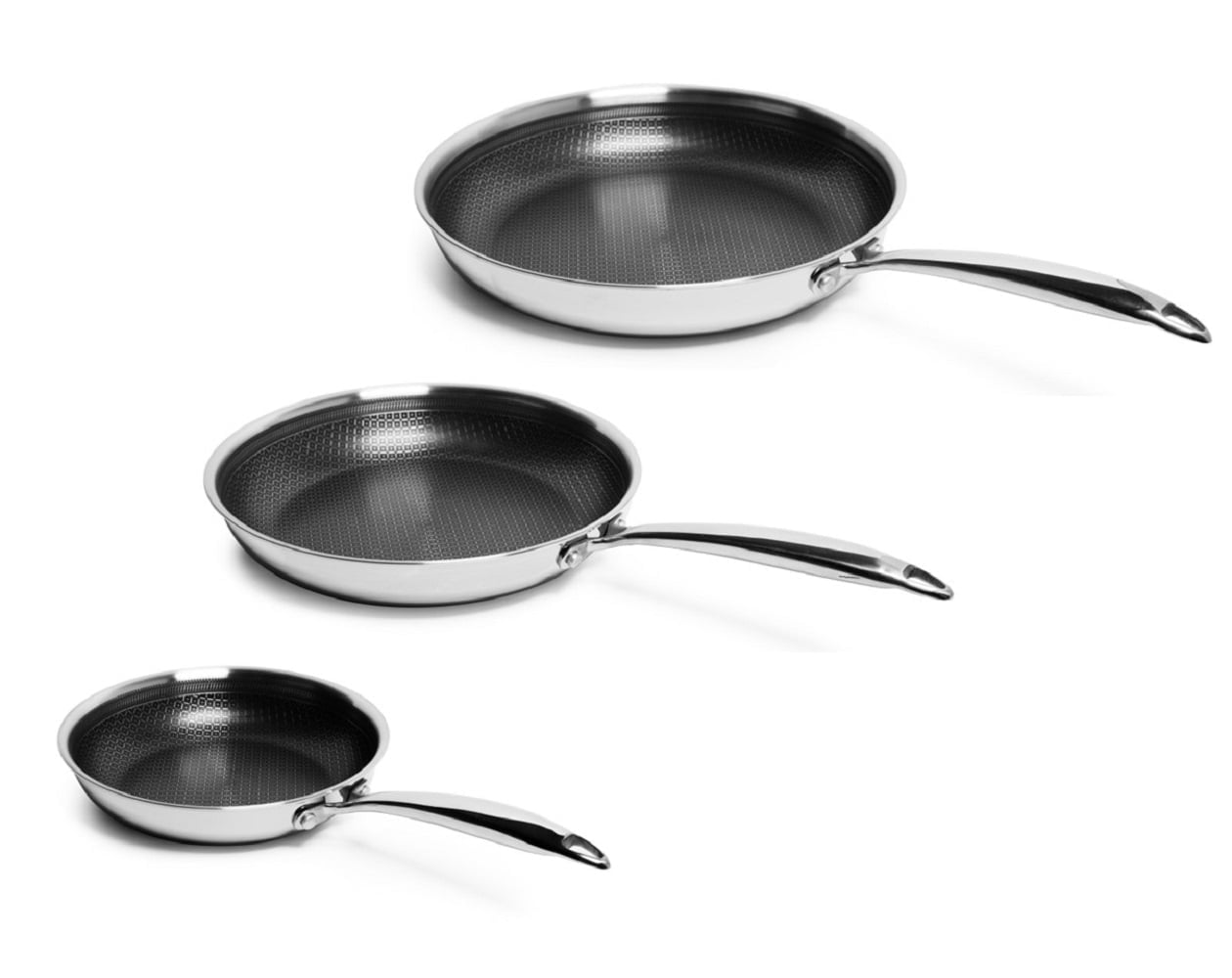
Traditional tri ply stainless steel cookware usually has a bare stainless steel cooking surface rather than a synthetic nonstick coating. But the term tri ply describes the metal construction, not every finish or coating a product may have.
Some products combine stainless steel construction with a separate nonstick layer. If avoiding a coating matters to you, read the full material description and confirm that the food-contact surface is uncoated stainless steel.
Bare stainless steel
The cooking surface is steel without a separate nonstick coating.
Coated tri ply
A pan may use a layered metal body with a separate nonstick cooking surface.
How to Cook With Tri Ply Stainless Steel Pans
Good technique makes a major difference with stainless steel. The aim is to heat the pan gradually, add an appropriate amount of oil, and give the food time to brown before trying to move it. You do not need to use maximum heat to get good results.
Start with medium or medium-low heat for most tasks, then adjust as needed. High heat can be useful for some cooking jobs, but it is not the default setting for every stainless steel pan. Always follow any heat limits listed by the manufacturer.
Source: tramontina.com
Preheat gently
Warm the pan over a suitable burner setting rather than leaving it empty over high heat.
Add oil
Use a cooking oil suitable for the temperature and the food you are preparing.
Dry food before searing
Pat meat or vegetables dry when browning is the goal, since excess surface moisture slows browning.
Avoid crowding
Leave enough space for moisture to escape and for food to brown instead of steam.
Wait before turning
Food often releases more easily after a crust forms. If it resists, give it a little more time rather than forcing it.
How to Reduce Sticking
Sticking often happens when the pan is too cool, the cooking surface is too hot, the food is wet, or the food is moved before it has browned. Start with a clean, dry pan and heat it gradually. Add oil before the food, and adjust the heat so the oil does not smoke heavily.
Eggs need more care than many foods because their proteins can bond to the steel. Use a moderate temperature, enough fat for the recipe, and a pan that is not overheated. If eggs are your daily breakfast, a dedicated nonstick skillet may still be the easier option.
If meat sticks
Let it brown before turning it, and check whether the pan is crowded or the burner is too hot.
If oil smokes quickly
Lower the heat and let the pan cool to a suitable cooking temperature before continuing.
If eggs tear
Try a lower heat setting, enough oil or butter, and a dedicated nonstick pan if easy release is essential.
How to Clean Tri Ply Cookware
Let the pan cool somewhat before cleaning. Avoid pouring cold water into an extremely hot pan because a sudden temperature change can contribute to warping. Add warm water and a little dish soap to loosen stuck food.
For stubborn residue, simmer a little water in the pan, let it cool to a safe handling temperature, and use a nonabrasive scrubber. Follow the manufacturer’s instructions before using stronger cleaners or scouring products.
For water spots
A suitable stainless steel cleaner or a small amount of diluted vinegar may help remove mineral marks; rinse well afterward.
For browned residue
Soak the pan or simmer water to loosen food before scrubbing.
For exterior discoloration
Use a cleaner approved for the pan’s finish and avoid harsh methods that may damage polished surfaces.
For storage
Dry the cookware fully before stacking it to limit water marks and protect neighboring surfaces.
How to Choose the Right Tri Ply Cookware
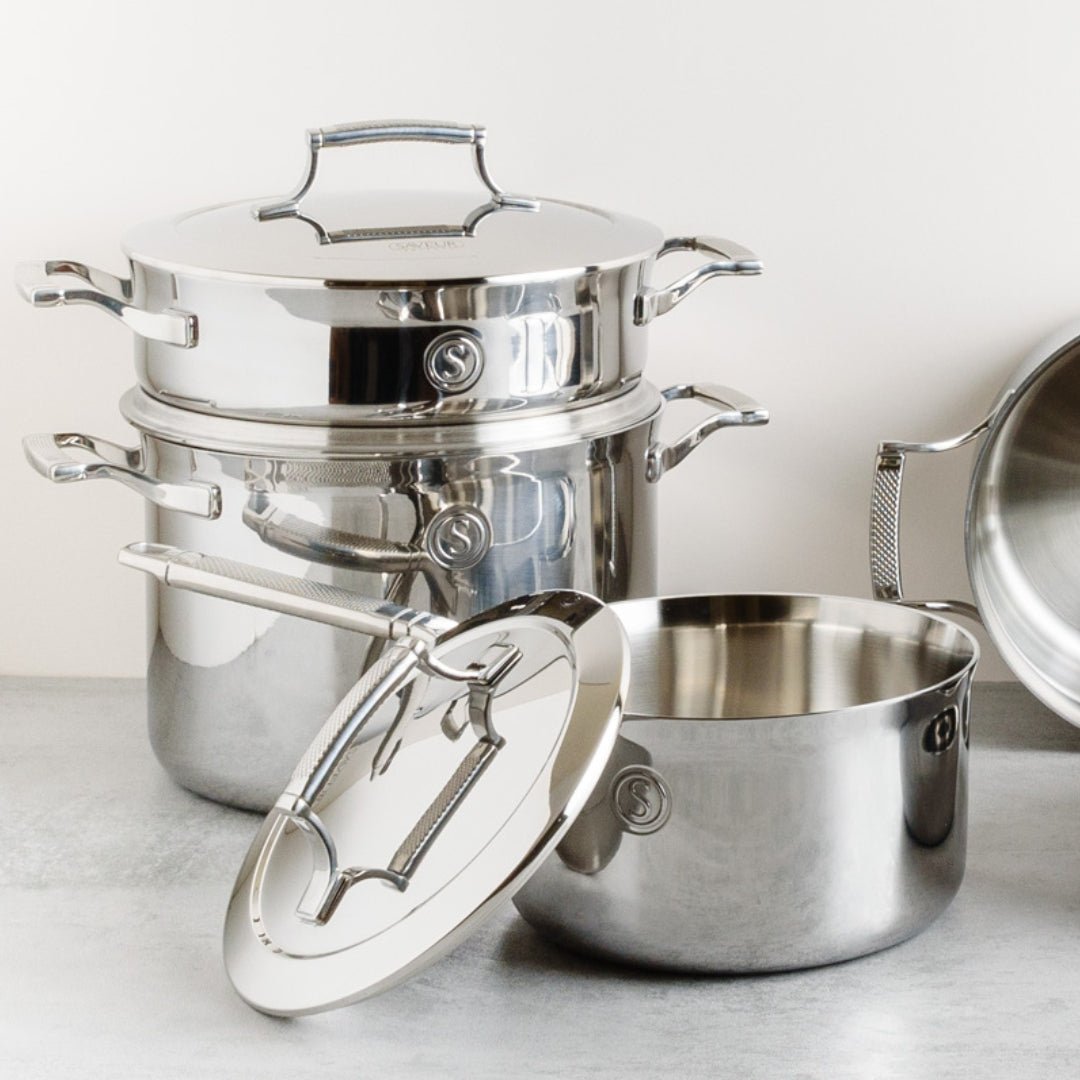
Choose tri ply cookware by matching its construction to your stove and the meals you make most often. A large set may look like a good deal, but it can include pans you rarely use. A few well-chosen pieces may serve a household better.
For many home cooks, a skillet, saucepan, and medium or large pot cover a wide range of meals. Check the diameter, capacity, handle shape, lid fit, and weight before purchasing. These details can affect daily use more than the number of pieces in the box.
Source: m.media-amazon.com
Stove compatibility
Confirm that the pan works with your cooktop, especially if you use induction.
Construction
Decide whether you want fully clad cookware or a pan with a layered base only.
Weight and balance
Choose a pan you can lift, pour from, and clean comfortably.
Oven-safe rating
Check the limits for the pan, handle, lid, and any attached accessories.
Warranty and care
Review the manufacturer’s warranty, cleaning guidance, and restrictions on dishwasher use.
Is Tri Ply Cookware Compatible With Induction?
Many tri ply pans work on induction cooktops, but not every pan does. Induction requires a suitable magnetic material in the base. A stainless steel exterior may be magnetic, but the label stainless steel alone does not guarantee compatibility.
Check the manufacturer’s induction statement before buying. You can also test an existing pan with a magnet: if the magnet attaches firmly to the bottom, the pan is more likely to work on induction. This simple test is useful, but the manufacturer’s compatibility information remains the better guide.
Gas
Most suitable metal cookware works on gas, but keep the flame within the pan’s base to reduce unnecessary handle heating.
Electric coil
A flat, stable base helps maintain good contact with the heating element.
Use cookware with a flat base and avoid dragging it across the surface.
Induction
Confirm magnetic compatibility and follow the cooktop manufacturer’s guidance on pan size.
Should You Buy a Set or Individual Pieces?
A cookware set can cost less per piece when you will use most of the included items. However, a set may take up more cabinet space and include several pans with overlapping uses. Individual pieces make it easier to spend money on the shapes and sizes you need.
Before buying a set, list the pots and pans you already own. Then identify the gaps. If you already have a good stockpot and nonstick skillet, adding a tri ply saucepan and frying pan may be more useful than replacing every item at once.
Choose a set
When you need several matching pieces and expect to use most of them.
Choose individual pans
When you want to control cost, weight, storage, and the exact size of each item.
Common Myths About Tri Ply Stainless Steel Cookware
The name tri ply describes a construction method, not a guarantee of quality. Several common assumptions can lead shoppers to pay more for features they do not need or overlook details that matter for everyday cooking.
Source: tramontina.com
Myth: More layers always mean better cookware
Reality: The quality, thickness, and arrangement of the metals matter. A well-made tri ply pan can outperform a poorly designed pan with more layers.
Myth: All tri ply pans are induction-ready
Reality: The base must contain a suitable magnetic material. Check the manufacturer’s compatibility statement.
Reality: Bare stainless steel can release food well with proper technique, but it does not have the same low-friction surface as a nonstick coating.
Myth: Tri ply cookware cannot warp
Reality: Extreme heat, rapid temperature changes, and poor construction can still lead to warping.
Myth: Every tri ply pan has three visible layers on its side
Reality: Some cookware has a layered base only. Fully clad construction must be confirmed separately.
Myth: Tri ply cookware never needs special care
Reality: It needs normal cleaning, reasonable heat control, and attention to the manufacturer’s use and care limits.
What Matters More Than the Tri Ply Label?
Look at the complete design. A pan should have a stable base, secure handles, a useful shape, and construction suited to the foods you cook. A clear warranty and detailed material specifications also make it easier to judge the product.
For shoppers comparing similar pans, prioritize the details that affect actual use. A comfortable handle may matter more than a small difference in layer count, while a fully clad body may be valuable if you frequently sauté or make pan sauces.
Build quality
Check the handle attachment, rim, base, lid fit, and finish.
Cooking needs
Choose the pan shape and capacity that fit your usual meals.
Practical care
Make sure the cleaning and oven-use limits fit your routine.
Tri Ply Cookware Comparison Table
Use this table to compare common cookware designs. These are general construction differences, not test results for specific brands. Actual performance depends on the pan’s materials, thickness, shape, and quality.
Source: bergnerhome.in
Which Cookware Construction Fits Your Needs?
The most useful choice is the one that balances cooking performance, care, cost, and the foods you prepare. Tri ply is a strong general-purpose option, but it is not the only construction worth considering.
Tri ply stainless steel
A versatile option for browning, sautéing, simmering, and everyday cooking when you want an uncoated metal surface.
Five ply stainless steel
Worth comparing when you want a particular body thickness or construction, but additional layers alone do not prove better performance.
Single-layer stainless steel
Can suit simple tasks and lower budgets, especially when the pan is adequately constructed for its intended use.
Nonstick cookware
Useful for delicate foods and easy release, though the coating requires care and may eventually need replacement.
Cast iron
Stores substantial heat and can be useful for searing, but it is generally heavier and requires different care.
Who Should Choose Tri Ply Stainless Steel Cookware?
Tri ply cookware suits people who want durable, versatile pans for regular home cooking. It can be especially useful for cooks who brown meat, sauté vegetables, make sauces, and move cookware from the stovetop to the oven when the model allows it.
It may be less suitable for someone who wants every meal to release from the pan with little oil or attention. In that case, a mix of stainless steel and coated nonstick cookware may be more practical than an all-stainless set.
Source: chancescook.com
Good fit for regular cooks
Useful for people who want one pan to handle several cooking methods.
Good fit for sauce-making
The stainless steel surface can support browning and deglazing to build flavor.
Good fit for long-term use
An uncoated steel surface avoids the routine wear limits of a nonstick coating, though the pan still needs proper care.
May not suit every beginner
New users may need practice with preheating, oil, and heat control to reduce sticking.
What Is a Practical Starter Collection?
A practical starter collection does not need to contain every possible pot and pan. A skillet, a small or medium saucepan, and a larger pot can cover many common meals. Add specialty pieces only when your cooking habits call for them.
Think about the number of people you cook for, the size of your burners, and your storage space. A pan that is too large for the burner may heat unevenly, while a pot that is too small can crowd food and make cooking less convenient.
Skillet
For searing, sautéing, browning, and many one-pan meals.
Saucepan
For sauces, grains, oatmeal, and smaller portions of soup.
Stockpot or large pot
For pasta, broth, vegetables, and larger batches of food.
Frequently Asked Questions
Q
What is tri ply stainless steel cookware made of?
Tri ply stainless steel cookware is made from three bonded metal layers. A common design places an aluminum core between inner and outer stainless steel layers. The exact alloy and construction can vary by manufacturer, so check the product specifications.
Q
Is tri ply stainless steel cookware better than regular stainless steel?
It can be better at spreading heat than a thin, single-layer stainless steel pan because the conductive core helps reduce hot spots. However, the result depends on the quality and thickness of the pan. A well-designed pan with another construction may also perform very well.
Q
Can I use tri ply stainless steel cookware on an induction stove?
Many tri ply pans work on induction, but compatibility depends on the magnetic properties of the base. Look for an explicit induction-compatible label. A magnet that attaches firmly to the bottom is a useful preliminary check, but the manufacturer’s instructions are the best source.
Q
Does tri ply cookware contain aluminum?
Many common tri ply designs use aluminum as the middle heat-conducting layer. In fully clad cookware, the aluminum is enclosed between stainless steel layers. Not every product uses the same materials, so review the construction details if you need to know the exact composition.
Q
Is tri ply cookware nonstick?
Traditional tri ply stainless steel cookware usually has an uncoated steel cooking surface, so it is not naturally nonstick like a coated pan. Proper preheating, oil, and temperature control can help reduce sticking. Some products combine tri ply construction with a separate nonstick coating, so check the listing carefully.
Q
Is tri ply cookware safe for cooking acidic foods?
Suitable stainless steel cookware is generally used for acidic foods such as tomato sauce. However, metal release can vary with the steel grade, acidity, and cooking time. Follow the manufacturer’s directions, and avoid prolonged storage of acidic leftovers in the pan when separate food-storage containers are available.
Q
How long does tri ply stainless steel cookware last?
A well-made tri ply pan can last for many years with proper care, but no exact lifespan applies to every product. Construction quality, frequency of use, heat exposure, cleaning methods, and physical damage all affect service life. Inspect handles, the base, and any signs of layer separation as the pan ages.
Q
Can tri ply stainless steel cookware go in the oven?
Many tri ply pans are oven-safe, but the maximum temperature varies. Handles, lids, knobs, and coatings may have lower heat limits than the metal body. Check the manufacturer’s stated oven-safe temperature before placing the pan in the oven.
Q
Is tri ply cookware dishwasher-safe?
Some tri ply cookware is labeled dishwasher-safe, while other products call for hand washing. Dishwasher detergents and repeated wash cycles may affect the finish or other components. Follow the care instructions for your exact model.
Q
Should I choose tri ply or five ply cookware?
Choose based on construction quality, cooking needs, weight, price, and stove compatibility rather than layer count alone. Tri ply can offer a useful balance of heat distribution and handling. Five ply may have benefits in a particular design, but more layers do not automatically make a pan better.
✦ Wrapping Up
Conclusion
Tri ply stainless steel cookware uses three bonded metal layers to combine a durable steel cooking surface with a heat-conducting core. This design can help spread heat, support browning, and provide versatile performance for everyday meals. It is a practical option for home cooks who want durable cookware without relying on a nonstick coating.
The best choice depends on more than the tri ply label. Check whether the pan is fully clad, whether it works with your stove, how much it weighs, and what care it needs. Remember that stainless steel rewards good heat control, so a little practice can make cooking and cleanup easier.
💡 Key Takeaway
Before buying, confirm the pan’s layer construction, food-contact surface, induction compatibility if needed, oven-safe limit, and care instructions. Choose a skillet or saucepan that fits your daily cooking before investing in a large set.