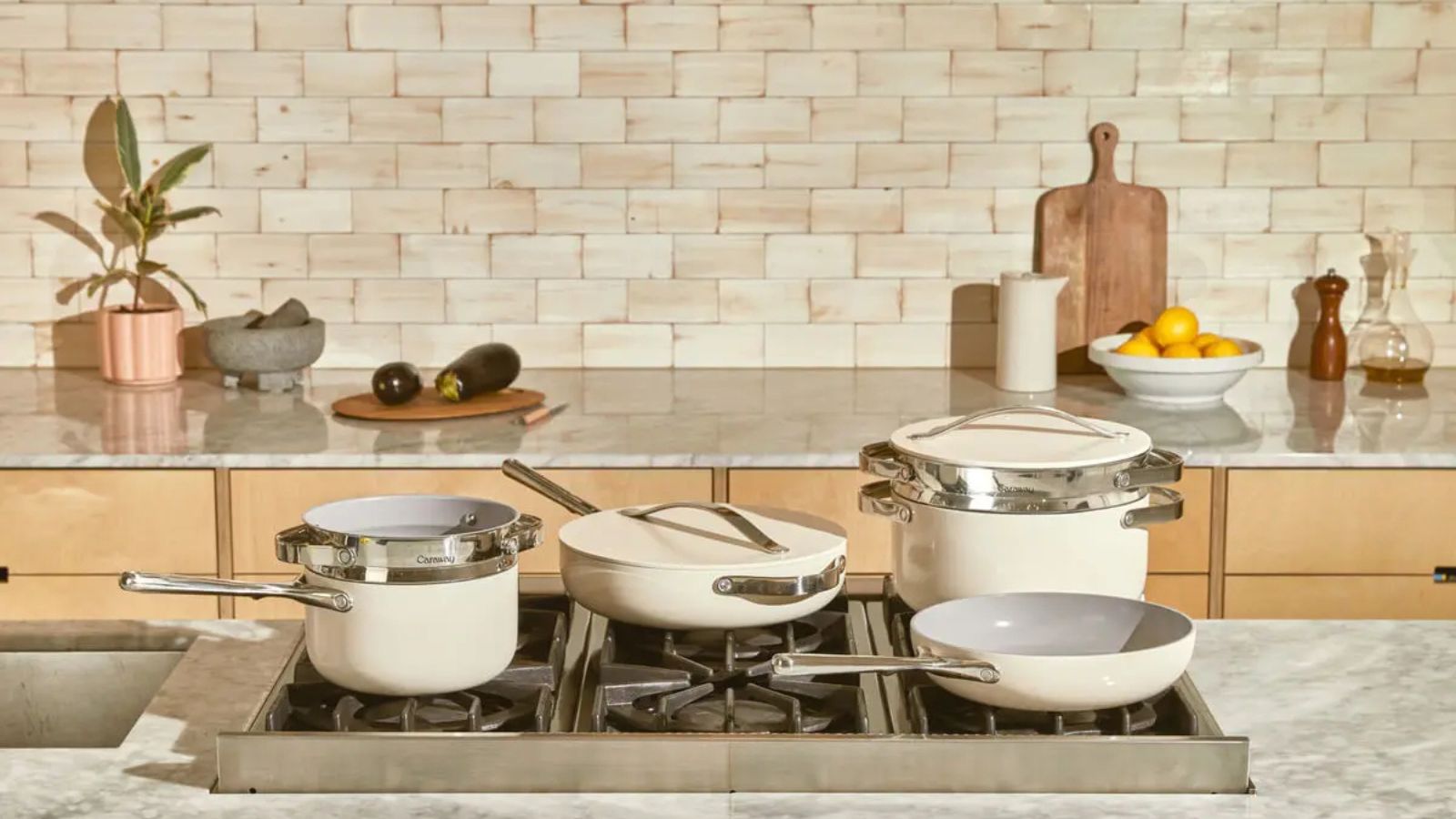
Yes, Caraway is a good cookware brand for people who want attractive, PFAS-free ceramic nonstick cookware, easy cleanup, and convenient everyday cooking. However, its high price and the limited lifespan of ceramic coatings make it less appealing for people who want cookware that lasts for decades.
In American homes, cookware handles everything from quick weekday breakfasts to family dinners and weekend meal prep. A good set should heat food well, clean up without much effort, and hold up to regular use. Caraway has become a popular name in the United States because it combines colorful designs with ceramic-coated cooking surfaces.
The brand is best known for its ceramic nonstick pots and pans. These products use a mineral-based coating made without intentionally added PFAS, including PTFE and PFOA, according to the company. Caraway also sells stainless steel cookware and enameled cast iron, so its range now covers more than one type of cooking need.
But a good-looking pan is not always a good long-term investment. Independent product testing has found strengths in heat distribution and food release, while other long-term reviews have raised concerns about coating wear and the care these pans need. These differences matter when you are deciding whether to spend more on a complete set.
This guide looks at Caraway‘s materials, cooking performance, safety claims, durability, maintenance, price, and alternatives. The goal is to help you decide whether the brand fits your cooking habits rather than simply repeat its marketing claims.
Caraway is an American kitchenware brand that became known for its colorful ceramic-coated pots and pans. The company launched in 2019 with a focus on modern cookware that combines a clean look with a nonstick cooking surface.
Its products are designed for home cooks who want simple food release and easier cleanup without using traditional PTFE-based nonstick coatings. The brand has since expanded into stainless steel cookware, enameled cast iron, bakeware, food storage, and kitchen accessories.
Caraway is not a single-material cookware brand. Its products use different materials and finishes, so the right choice depends on which product line you buy.
This is the brand’s signature range. It uses a ceramic-based nonstick surface over a metal cookware body.
Stainless steel cookware
This range is designed for browning, searing, and everyday cooking without a traditional nonstick coating.
Enameled cast iron
These pieces use an enamel finish over cast iron and are suited to slow cooking, soups, braising, and other recipes that need steady heat.
Kitchen accessories
Caraway also sells storage products, lids, utensils, bakeware, and other items designed to match its cookware collections.
What Makes the Brand Different?
Caraway places a strong focus on appearance, material choices, and kitchen organization. Its pots and pans come in colors such as cream, navy, sage, and other shades that look different from the usual black cookware found in many American kitchens.
The brand also includes storage features with certain sets. Depending on the collection, buyers may receive pan racks and lid holders that help keep cookware organized in a cabinet.
These features add practical value, but they do not automatically make the cookware better at cooking. Material quality, heat control, surface performance, and long-term wear still matter most.
Is Caraway a Good Cookware Brand for Everyday Cooking?
Yes, Caraway can be a good choice for everyday cooking, especially if you prepare eggs, vegetables, pancakes, fish, and other foods that benefit from a nonstick surface. Its ceramic-coated pans are designed to release food easily and reduce the effort needed to clean up after meals.
Independent testing offers useful support for some of these benefits. Consumer Reports has reported excellent cooking evenness and food release for its tested ceramic-coated nonstick cookware. Its durability test also found that the tested pan performed very well under a controlled abrasion test.
Other testing has produced less favorable results. Good Housekeeping reported mixed nonstick performance during its cooking evaluations, while the Guardian’s 2026 review highlighted coating sensitivity and reduced food release during extended use. This shows why short-term performance and long-term ownership should be judged separately.
For a person who cooks simple meals at home, Caraway can make daily tasks easier. However, someone who cooks at high heat or expects one nonstick pan to remain slippery for many years may be disappointed.
Source: inkl.com
Easy food release
The ceramic surface can help eggs, pancakes, and delicate foods move out of the pan with less sticking.
Convenient cleanup
Food residue often comes off with warm water, dish soap, and a soft sponge when the pan is used correctly.
Good everyday versatility
The available pots and pans cover common home cooking tasks, from boiling and simmering to frying and sauteing.
Care requirements
The ceramic surface needs more attention than bare stainless steel or cast iron. High heat, metal tools, and abrasive cleaning can shorten its useful life.
How Well Does Caraway Cook Different Foods?
Caraway’s ceramic frying pans are most useful for foods that tend to stick. Eggs, omelets, pancakes, tofu, and delicate fish are examples of meals that can benefit from a fresh ceramic nonstick surface.
The pans can also handle vegetables, chicken, and other everyday ingredients. However, they are not always the best option for developing a deep brown crust. Ceramic nonstick cookware generally works best with controlled heat rather than repeated high-temperature cooking.
For soups, sauces, pasta, and grains, the larger Caraway pots can be useful. These tasks depend less on a slippery surface and more on capacity, heat control, and the shape of the pot.
Best uses
Eggs, pancakes, vegetables, fish, tofu, and gentle sauteing.
Less suitable uses
Frequent high-heat steak searing, intense browning, and cooking that requires very high temperatures.
What Materials Does Caraway Use?
Caraway uses different materials across its product lines. The most recognizable cookware uses a metal body with a ceramic-based nonstick coating, while its stainless steel and enameled cast iron collections use different cooking surfaces.
The signature ceramic coating is the main reason many shoppers consider Caraway. It is designed to provide nonstick performance without intentionally added PFAS, PTFE, or PFOA, according to the company’s materials information.
The company describes its ceramic coating as being made from inorganic ingredients. It also states that the coating undergoes third-party testing for more than 600 types of PFAS-related chemicals. These are manufacturer disclosures, not proof that every possible chemical or exposure concern has been ruled out.
The distinction between a ceramic coating and a solid ceramic pan is important. Caraway’s signature cookware is not made entirely from ceramic. It uses a metal body with a ceramic-based surface.
Source: wiser.eco
Metal cookware body
The metal body provides the structure and helps transfer heat to the cooking surface.
Ceramic-based coating
This layer creates the smooth nonstick surface that helps food release and makes cleaning easier.
Stainless steel
Caraway’s stainless steel line offers a different cooking experience without relying on the signature ceramic nonstick surface.
Enameled cast iron
This material combines the heat retention of cast iron with a smooth enamel finish.
Is Caraway Ceramic Coating the Same as Traditional Nonstick?
No. Traditional PTFE nonstick cookware uses a fluoropolymer coating, while Caraway’s signature nonstick cookware uses a ceramic-based coating.
PTFE coatings are known for their slippery surface and easy food release. Ceramic coatings use a different material system and are often chosen by people who want to avoid intentionally added PFAS in their cookware.
Both types can lose nonstick performance with wear. Neither should be treated as damage-proof, and both need to be used according to the manufacturer’s instructions.
The practical difference is that Caraway gives shoppers a ceramic alternative to traditional nonstick cookware, but it does not remove the need for careful use.
Does Caraway Use Aluminum?
The metal construction can vary across Caraway product lines and individual models. Buyers should check the specifications of the exact pan or pot instead of assuming every item has the same construction.
Some product descriptions and independent cookware testing identify aluminum as part of the construction of Caraway’s ceramic-coated cookware. Its stainless steel and enameled cast iron products have different material structures.
If aluminum content is a concern, review the exact product’s material disclosure. A ceramic coating also does not mean that the cookware body is made entirely from ceramic.
Is Caraway Cookware Safe to Use?
Caraway’s ceramic-coated cookware is a reasonable option for shoppers who want to avoid intentionally added PFAS in their cooking surface. The company states that its ceramic coating is made without PTFE, PFOA, PFAS, lead, and cadmium.
Its materials information also describes third-party testing for more than 600 types of PFAS-related chemicals. This provides useful information about the brand’s material standards, but readers should understand the limits of any testing claim.
A claim that cookware is made without intentionally added PFAS is not the same as a guarantee that a product is completely free of every possible chemical. Testing methods, detection limits, materials, and the specific product tested all matter.
Safe use also depends on how cookware is handled. Avoid overheating an empty pan, damaging its surface, or using tools that the manufacturer does not recommend. Even cookware made without PTFE needs sensible heat control and regular inspection.
Source: happy-mothering.com
PFAS-free coating claim
Caraway states that its signature ceramic coating is made without intentionally added PFAS, including PTFE and PFOA.
Third-party testing
The manufacturer reports testing for more than 600 types of PFAS-related chemicals. Check the available product testing documents for the exact scope.
Lead and cadmium
Caraway states that these metals are not used in its ceramic coating. This claim should be understood within the scope of its disclosed materials and testing.
Correct cooking temperature
Use low to medium heat for routine ceramic nonstick cooking and follow the temperature limits for the exact product.
Does Caraway Release Toxic Fumes?
Caraway’s ceramic-coated pans do not use the PTFE coating found in conventional Teflon-style cookware, according to the manufacturer. This makes them an option for households that want to avoid the particular overheating concerns associated with PTFE.
That does not mean any pan should be heated without limits. Excessive heat can damage cookware, burn food, and create smoke from oils and food residues.
Use a suitable burner setting, avoid leaving an empty pan on a hot stove, and ventilate the kitchen when cooking produces smoke. These habits are useful with every cookware material.
Can You Use Caraway Every Day?
Yes, its ceramic cookware is designed for routine home use. You can prepare breakfast, lunch, and dinner with it as long as you follow the care instructions and stay within the stated temperature limits.
Inspect the cooking surface from time to time. If the coating becomes badly chipped, begins to peel, or no longer performs as intended, stop using the affected piece and contact the manufacturer about replacement options.
How Durable Is Caraway Cookware?
Durability is one of the biggest questions to consider before buying Caraway. Its metal cookware body can provide useful structural strength, but the ceramic cooking surface has a limited lifespan that depends on heat, utensils, cleaning, and how often you cook.
A new Caraway pan can have very good food release. However, the nonstick effect may decline with regular use. Once the surface becomes less slippery, eggs and other delicate foods may start to stick even when the pan looks acceptable.
Independent reviews show different results. Consumer Reports reported very good abrasion resistance in its controlled durability test, while some long-term product reviewers reported a decline in nonstick performance after months of regular cooking.
These findings are not necessarily contradictory. A controlled abrasion test measures resistance under a specific laboratory method. Everyday use also involves repeated heating, cooling, cooking oils, cleaning, and accidental contact with utensils.
For this reason, I would not treat Caraway’s ceramic nonstick pans as lifetime cookware. They are better viewed as convenient nonstick tools that may need replacement sooner than stainless steel or cast iron.
Source: differencesonly.com
Coating wear
Repeated use and poor care can reduce the slippery quality of the ceramic surface.
Scratch risk
Metal utensils, rough cleaning pads, and careless stacking can damage the cooking surface.
Heat exposure
Frequent high-heat cooking can speed up the loss of nonstick performance.
Long-term value
The initial purchase price should be considered alongside the possibility of replacing a ceramic pan when its nonstick function declines.
How Long Does Caraway Cookware Last?
There is no reliable universal lifespan for every Caraway pan. Actual service life depends on the product, cooking frequency, heat level, cleaning method, and storage habits.
A pan used occasionally at low heat may retain its nonstick properties longer than one used several times a day. A person who cooks eggs every morning may notice changes sooner than someone who mainly uses the pan for occasional vegetables.
Be careful with claims that every Caraway pan will last a fixed number of years. The available independent reviews show different experiences, and a controlled test cannot predict the exact lifespan in every kitchen.
If long service life is your main goal, consider using stainless steel or cast iron for most cooking and keeping one ceramic nonstick pan for foods that need easy release.
Does Caraway Come With a Warranty?
Warranty coverage depends on the product and the terms in effect when you buy it. Independent product information has listed a one-year warranty for the tested Caraway ceramic-coated cookware model.
Do not assume that a warranty covers normal nonstick wear. Cosmetic changes, accidental damage, misuse, and gradual loss of the coating may be excluded from coverage.
Before purchasing, read the warranty for the exact product. Keep the receipt and order confirmation, and take photos if a manufacturing defect appears.
Check coverage
Confirm the warranty length and which product components are included.
Review exclusions
Look for terms about coating wear, scratches, improper use, and accidental damage.
Keep purchase records
Save proof of purchase and contact customer support promptly if a product develops a defect.
Pros and Cons of Caraway Cookware
Caraway has several real advantages, but it also has limits that matter when you compare it with other cookware brands. Its biggest strengths are its ceramic nonstick surface, appearance, and convenient everyday design.
Its biggest disadvantages are the care requirements, purchase price, and uncertainty around long-term coating performance. These trade-offs make it a more suitable choice for some households than others.
Source: coconutsandkettlebells.com
Pros: PFAS-free material approach
The signature ceramic coating is made without intentionally added PFAS, PTFE, and PFOA according to Caraway.
Pros: Attractive appearance
The cookware comes in coordinated colors that can make a kitchen look more organized and visually appealing.
Pros: Easy food release
The ceramic surface can make cooking eggs, pancakes, and delicate foods easier.
Pros: Simple cleanup
Hand washing with mild soap and a soft sponge is usually enough for normal food residue.
Pros: Cooktop compatibility
The signature cookware is designed for gas, electric, and induction cooktops.
Cons: Expensive purchase
Caraway generally costs more than basic nonstick cookware, so the price needs to be justified by its design and features.
Cons: Delicate coating
The nonstick surface needs gentle utensils, careful cleaning, and controlled heat.
Cons: Limited high-heat use
The ceramic nonstick line is not the best choice for regular high-temperature searing.
Cons: Replacement concerns
If the nonstick surface wears out, replacing the pan can add to the long-term cost.
Cons: Hand washing
The manufacturer recommends hand washing to help protect the coating, which adds work after cooking.
How Does Caraway Compare With Other Cookware Brands?
Caraway competes with brands that offer ceramic nonstick, traditional nonstick, stainless steel, and hybrid cookware. The best comparison depends on what matters most to you: material preferences, cooking performance, price, or expected service life.
A ceramic nonstick pan and a stainless steel pan do not perform the same job. One makes delicate foods easier to release, while the other offers greater freedom for browning and high-heat cooking.
The table below compares common cookware choices by their main strengths and limitations. It is a material-based comparison, not a claim that every product from each brand performs equally.
Source: insidehook.com
Caraway vs. GreenPan
GreenPan is another well-known ceramic nonstick cookware brand. Both brands appeal to shoppers who want alternatives to traditional PTFE-coated pans.
Caraway places a strong focus on coordinated design and storage accessories. GreenPan offers a wider range of cookware styles and product collections at different price levels.
The better option depends on the exact models. Compare the coating care instructions, pan construction, warranty, and independent test results instead of choosing by brand name alone.
Caraway vs. All-Clad
All-Clad is known for stainless steel cookware, which offers a different balance of performance and maintenance. Stainless steel can handle browning, searing, and many cooking methods without relying on a ceramic nonstick surface.
Caraway is easier for beginners who want simple food release. All-Clad stainless steel takes more attention to preheating and oil use, but it can remain useful for many years with proper care.
If you want low-maintenance nonstick cooking, Caraway may be more convenient. If you want long-term versatility, stainless steel may be the stronger investment.
Caraway vs. HexClad
HexClad uses a hybrid cooking surface that combines stainless steel features with a nonstick cooking area. It is designed to offer a different balance of browning, food release, and durability.
Caraway is a more traditional ceramic nonstick option. HexClad and Caraway should not be treated as identical products simply because both offer nonstick features.
Compare the exact model’s construction, cooking results, cleaning instructions, and price before choosing either one.
Caraway vs. Other Cookware Materials
The material you choose can matter more than the brand name. Caraway’s ceramic nonstick line is useful for easy food release, but other materials may provide better performance for certain cooking styles.
Before spending money on a complete set, consider how you cook each week. A household that makes eggs and pancakes most mornings has different needs from one that regularly sears meat and cooks over high heat.
Caraway vs. Stainless Steel
Stainless steel is a strong choice for people who want versatile cookware with a long service life. It works well for searing meat, browning vegetables, making pan sauces, and cooking foods that need higher heat.
Unlike Caraway’s ceramic nonstick line, bare stainless steel does not have a nonstick coating that gradually wears away. However, food can stick if the pan is not preheated correctly or if the cooking technique is poor.
Caraway is easier for delicate foods, while stainless steel is more versatile for cooks who enjoy browning and building flavor.
Caraway vs. Cast Iron
Cast iron is known for heat retention and its ability to handle high-temperature cooking. It can be used for searing, frying, baking, and many other tasks.
Bare cast iron needs seasoning and proper drying to prevent rust. Enameled cast iron avoids the need for seasoning but is usually heavier and requires careful handling.
Caraway ceramic cookware is lighter and easier for quick cleanup, while cast iron is a better option for people who want long-lasting cookware that can handle demanding cooking tasks.
Caraway vs. Traditional PTFE Nonstick
Traditional PTFE nonstick pans can provide excellent food release and are widely used for eggs and other delicate foods. Caraway offers a ceramic alternative for buyers who want to avoid intentionally added PFAS.
Both types need proper temperature control and care. Ceramic coatings can lose their nonstick qualities over time, while PTFE cookware also has a limited useful life.
The decision is not simply about one material being perfect and the other being unsafe. Consider the exact coating, the manufacturer’s instructions, your cooking habits, and how you plan to replace worn cookware.
Caraway Cookware Price and Overall Value
Caraway is generally positioned above basic budget cookware. Its price reflects the product design, ceramic coating, coordinated colors, and storage features included with certain collections.
However, a higher price does not guarantee better long-term performance. If the ceramic surface loses its nonstick qualities after regular use, the original purchase cost may be harder to justify.
The best way to assess value is to compare the cost of the exact pieces you need with how often you will use them. A complete set may look like a good deal, but it can include pans and pots that remain unused.
Prices and promotions can change throughout the year. Check the current price, included accessories, return terms, and warranty before placing an order.
Worth the price for design-focused buyers
If coordinated cookware and built-in storage features matter to you, Caraway may provide value beyond basic cooking performance.
Less attractive for budget shoppers
A lower-priced ceramic nonstick pan may provide similar everyday food release without the extra design cost.
Consider individual pieces
Buying only the pieces you use can reduce unnecessary spending and help you avoid paying for a large set.
Think about replacement costs
Ceramic nonstick cookware should not be treated as a lifetime purchase. Include possible replacement costs when comparing brands.
Should You Buy a Complete Caraway Set?
A complete set can make sense if you are replacing most of your cookware and want matching pieces. It can also be useful if you value the storage accessories that come with certain collections.
But a full set is not always the smartest choice. Many home cooks use only a frying pan, saucepan, and larger pot for most meals.
If you already own good stainless steel cookware, buying one Caraway frying pan may be a more practical way to enjoy ceramic nonstick cooking without paying for an entire collection.
Buy a set if
You need several matching pots and pans, want coordinated storage, and are comfortable with ceramic coating maintenance.
Buy individual pieces if
You already own cookware or only need a nonstick pan for eggs and delicate foods.
How to Make Caraway Cookware Last Longer
Good care can help preserve Caraway’s ceramic nonstick surface. The most useful habits are simple: use moderate heat, choose gentle utensils, wash by hand, and store pans without allowing their surfaces to rub against one another.
These steps matter because ceramic nonstick cookware can lose its easy-release performance when the coating experiences repeated heat stress, scratches, and abrasive cleaning.
Use low or medium heat
Avoid unnecessary high temperatures. Let the pan heat gradually and follow the manufacturer’s cooking temperature guidance.
Choose safe utensils
Use wood, silicone, or other manufacturer-approved utensils instead of metal tools that can scratch the cooking surface.
Wash by hand
Use warm water, mild dish soap, and a soft sponge. Avoid abrasive scrubbers and harsh cleaning products.
Allow the pan to cool
Do not place a very hot pan under cold water. Sudden temperature changes can stress cookware materials.
Avoid cooking sprays
Follow the brand’s guidance on oils and sprays. Some aerosol cooking sprays can leave residue that becomes difficult to remove.
Store pans carefully
Use pan protectors or the supplied storage racks to reduce contact between cooking surfaces.
What Should You Do When Food Starts Sticking?
Food sticking does not always mean the pan is damaged. First, check whether the pan has built-up oil residue, whether the heat is too high, or whether you are using too little cooking fat for the recipe.
Let the pan cool and clean it with warm, soapy water and a soft sponge. Avoid scraping stuck food with metal tools or using harsh cleaning pads.
If food continues to stick after proper cleaning and correct cooking, the coating may have lost some of its nonstick performance. A worn ceramic surface cannot be restored to its original condition simply by adding more oil.
If the coating is peeling or visibly damaged, stop using the pan and contact the manufacturer about the appropriate next step.
Who Should Buy Caraway Cookware?
Caraway is a better match for people who value attractive cookware, easy cleanup, and a ceramic nonstick cooking surface. It is especially useful for households that prepare simple meals and are willing to follow careful maintenance instructions.
It is not the strongest choice for every kitchen. People who cook at high heat, use metal utensils, or want cookware that can last for decades may prefer stainless steel or cast iron.
Good for beginner home cooks
The easy-release surface can make everyday cooking less stressful for people who are still learning to use different pans.
Good for design-conscious households
The range of colors and matching accessories can help create a coordinated kitchen.
Good for PFAS-conscious shoppers
The signature ceramic coating is made without intentionally added PFAS, according to the manufacturer.
Less suitable for professional-style high-heat cooking
People who frequently sear steaks, brown large cuts of meat, or cook over intense heat may prefer stainless steel or cast iron.
Less suitable for careless cookware users
People who regularly use metal utensils, stack pans without protection, or put cookware in the dishwasher may find the care requirements inconvenient.
Less suitable for lifetime cookware buyers
Anyone seeking a long-term investment with no nonstick coating to wear away should consider stainless steel or cast iron.
Is Caraway a Good Choice for Small Apartments?
Caraway can work well in apartments because its coordinated storage accessories may help organize a limited cabinet space. A matching set can also make a small kitchen feel more orderly.
However, a complete set can take up more space than expected. Check the dimensions of the pans, lids, and storage racks before ordering, especially if your apartment has narrow cabinets.
For a small household, buying a frying pan and saucepan separately may be more useful than purchasing a large collection.
Is Caraway Good for Induction Cooktops?
Caraway’s standard cookware is designed to work with induction, gas, and electric cooktops. Its stainless steel base allows compatible models to work with magnetic induction heating.
However, compatibility does not guarantee identical performance on every induction range. Some independent reviewers have reported noticeable buzzing or humming sounds when using Caraway on certain induction cooktops.
Check the exact model’s compatibility information and your cooktop’s instructions. Start with a moderate heat setting and avoid using a burner that is much larger than the pan’s base.
What Are the Best Alternatives to Caraway?
The best alternative depends on which Caraway feature matters most to you. If you want another ceramic nonstick option, compare GreenPan. If long-term versatility matters more, consider stainless steel from brands such as All-Clad or Tramontina.
There is no need to replace one full cookware set with another full set. A mixed collection can be more useful because each material serves a different purpose.
GreenPan
A useful alternative for shoppers who want ceramic nonstick cookware. Compare specific models, coating care, and independent performance results.
All-Clad
A strong option for shoppers who prefer stainless steel and need cookware for browning, searing, and regular high-heat cooking.
Tramontina
An option worth comparing for stainless steel cookware, particularly when value and practical everyday performance matter.
Lodge
A practical choice for people who want traditional cast iron with strong heat retention and a long service life when properly maintained.
Made In
An alternative for cooks interested in professional-style stainless steel cookware and other performance-focused materials.
Should You Mix Different Cookware Materials?
Yes. A mixed cookware collection can be more practical than buying one large set made from a single material.
For example, you could use a ceramic nonstick pan for eggs, a stainless steel skillet for searing, and a cast iron Dutch oven for slow cooking. Each piece handles the job it does best.
This approach can also reduce replacement costs. If your nonstick pan eventually loses its easy-release qualities, you only need to replace that piece rather than an entire cookware set.
What Do Recent Independent Reviews Tell Us About Caraway?
Independent reviews do not give one simple answer about Caraway’s performance. Some testing finds strong food release and even heating, while other evaluations identify inconsistent nonstick results and concerns about long-term coating wear.
Consumer Reports has published positive laboratory findings for its tested ceramic-coated model, including excellent food release and even cooking. Its results are useful because they assess specific cooking and durability measures under controlled conditions.
Good Housekeeping’s 2026 evaluation used laboratory work and home cooking assessments. Its findings included attractive design and generally even heating, but also reported inconsistent nonstick performance and maintenance concerns.
The Guardian’s June 2026 review also highlighted the care needed to protect the ceramic surface. Its reviewer reported that food began sticking more during extended everyday use, even with careful handling.
Food Network’s earlier review reported positive results after more than three years of testing. These different experiences show that the performance of ceramic nonstick cookware can vary with the model, testing method, cooking frequency, and care routine.
The fairest conclusion is that Caraway has genuine strengths, but no review should promise that every pan will remain nonstick for a fixed number of years. A short cooking test and a long-term ownership review answer different questions.
Documented laboratory findings
Consumer Reports has reported strong food release, cooking evenness, and very good abrasion-test performance for its tested ceramic-coated cookware.
Reported home-use limitations
Some reviewers have reported reduced food release, surface sensitivity, or inconsistent performance after extended use.
Manufacturer material information
Caraway publishes material disclosures and testing claims about its ceramic coating. These should be evaluated separately from cooking performance.
Important limitation
Laboratory abrasion tests do not establish how long every pan will remain nonstick in an ordinary home kitchen.
What Questions Do Other Caraway Reviews Leave Open?
A useful buying decision needs more than a list of attractive features. Readers also need to understand replacement costs, the effect of daily cooking, and what happens when the coating stops releasing food properly.
The reviewed 2026 coverage provides useful information about laboratory performance, everyday cooking, and coating care. However, no single test establishes a universal service life for every model and household.
The following gap map separates questions directly observed in recent review coverage from reasonable next questions a buyer should ask. It does not claim to measure search volume or prove that these are the most popular searches.
Frequently Asked Questions
Q
Is Caraway a high-quality cookware brand?
Caraway is a good-quality cookware brand in terms of design, material options, and everyday cooking convenience. Its ceramic-coated pans have received positive laboratory results for food release and heat distribution. However, the nonstick coating needs careful maintenance and may lose performance over time, so it is not the best choice for everyone.
Q
Is Caraway cookware worth the money?
Caraway can be worth the money if you value attractive cookware, a ceramic nonstick surface, and convenient storage accessories. It is less appealing if your main goal is long-lasting cookware at the lowest possible cost. Compare individual pieces and consider replacement costs before buying a complete set.
Q
Is Caraway better than traditional Teflon cookware?
Caraway may be a better fit for shoppers who want to avoid intentionally added PFAS, including PTFE. Its ceramic coating provides a different nonstick option. Traditional PTFE pans can also offer excellent food release, so the better choice depends on material preferences, correct use, maintenance, and expected lifespan.
Q
Can Caraway cookware go in the dishwasher?
Caraway recommends hand washing its ceramic nonstick cookware with warm water, dish soap, and a soft sponge. Avoid the dishwasher because repeated cleaning and harsh detergents may reduce the life of the coating. Always check the care instructions for the exact product.
Q
Can you use metal utensils on Caraway pans?
It is best to avoid metal utensils on Caraway’s ceramic nonstick pans. Metal tools can scratch or damage the cooking surface. Use wood or silicone utensils instead, and follow the care instructions supplied with your cookware.
Q
Is Caraway cookware oven-safe?
Caraway states that its standard cookware is oven-safe up to 550 degrees Fahrenheit. However, the exact temperature limit can depend on the product, lid, and handle materials. Check the individual product instructions before placing any piece in the oven. Do not assume that oven-safe cookware is also safe for broiler use.
Q
Does Caraway cookware work on induction stoves?
Yes, Caraway’s standard cookware is designed for induction, gas, and electric cooktops. Its stainless steel base supports induction compatibility. However, some reviewers have reported buzzing on certain induction cooktops, so check the specific model and use moderate heat when starting out.
Q
Does Caraway cookware contain lead or cadmium?
Caraway states that its signature ceramic coating is made without lead and cadmium. The company also reports third-party testing of its materials. Buyers who need detailed material information should review the testing documents for the exact product rather than relying only on general brand claims.
Q
Does Caraway cookware scratch easily?
The ceramic nonstick surface can be scratched or damaged by metal utensils, abrasive cleaners, and careless storage. Use soft utensils, hand wash the pans, and place protectors between stacked pieces. These habits can help reduce surface damage.
Q
Is Caraway better than GreenPan?
Neither brand is automatically better for every buyer. Both offer ceramic nonstick cookware, but their models, prices, construction, and care requirements differ. Compare the exact products and look at independent cooking and durability tests before deciding.
✦ Wrapping Up
Conclusion
So, is Caraway a good cookware brand? Yes, it can be a good choice for home cooks who want stylish ceramic nonstick cookware, easy food release, and a cooking surface made without intentionally added PFAS. Its range also includes stainless steel and enameled cast iron for people who need other cooking options.
However, Caraway is not perfect. Its ceramic coating needs careful handling, its price is higher than many basic cookware options, and independent reviews report mixed results over extended use. The brand is less appealing if you want cookware that can take repeated high heat or last for decades without a coating replacement.
My overall assessment is that Caraway is worth considering for everyday low- and medium-heat cooking, especially if appearance and material preferences matter to you. But I would not recommend buying a full set just because it looks good. Choose the pieces that match your actual cooking habits.
For the best long-term value, consider building a mixed cookware collection. Use Caraway for eggs and delicate foods, stainless steel for searing and browning, and cast iron for dishes that need strong heat retention. This gives you more flexibility without depending on one nonstick surface for every meal.
💡 Key Takeaway
Before buying Caraway, compare the exact model’s materials, warranty, care instructions, oven limit, and current price. If you mainly cook eggs, pancakes, and simple meals, one ceramic nonstick pan may be enough. If you want cookware for decades of varied cooking, consider stainless steel or cast iron as your main investment.