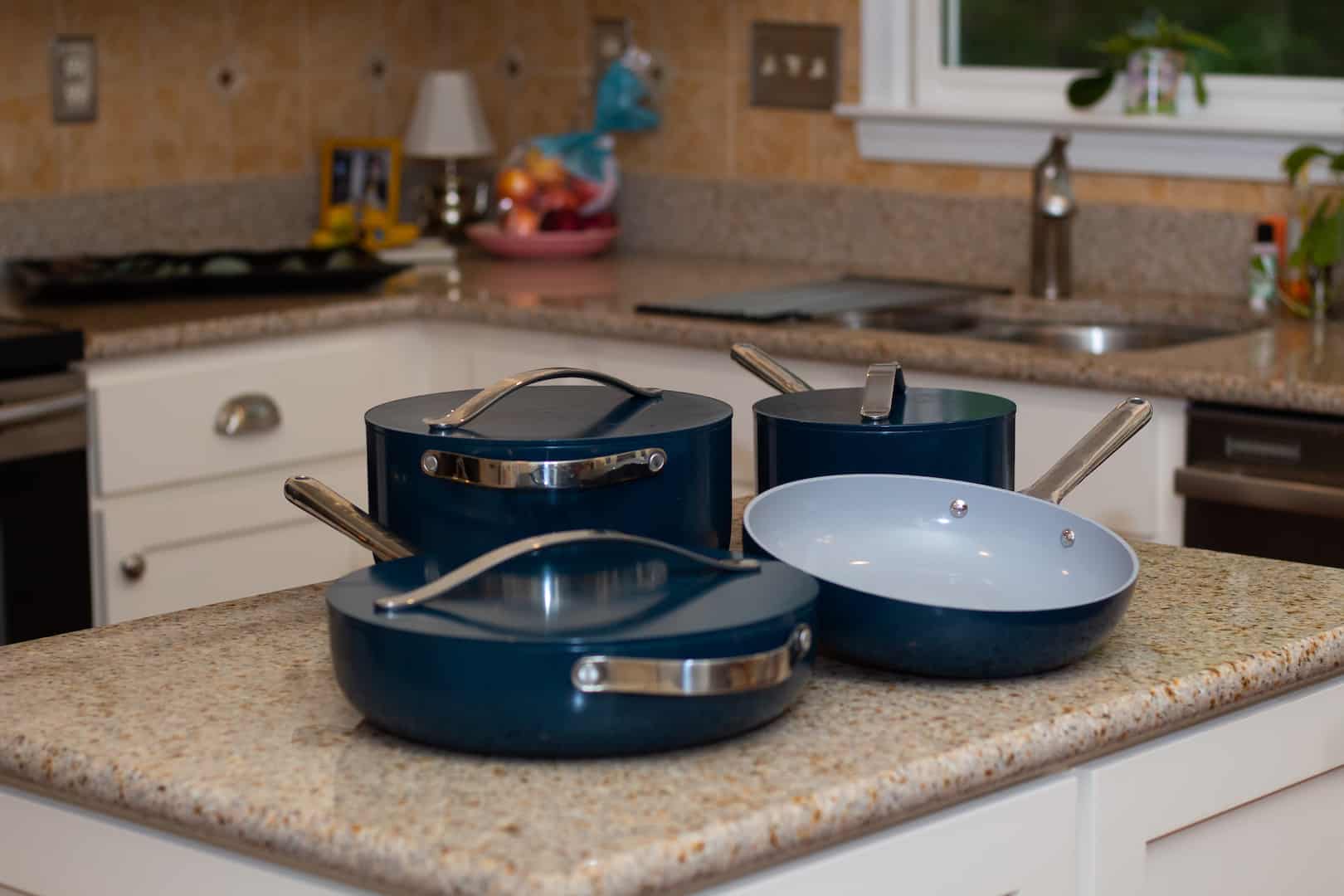
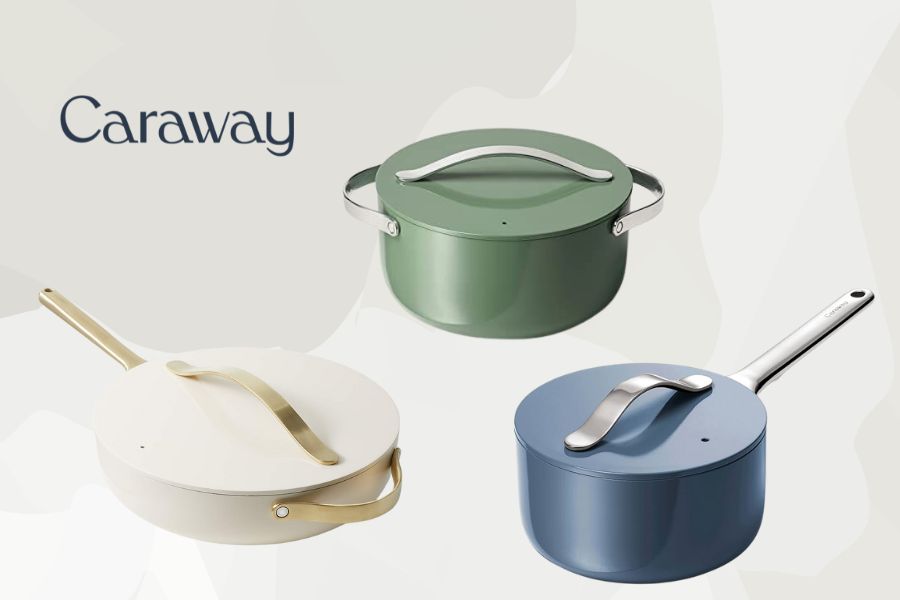
Caraway cookware is made with an aluminum body and a ceramic-based nonstick coating, with stainless steel handles and other metal components depending on the product.
If you are shopping for pots and pans in the United States, you may have seen Caraway cookware in online stores, home goods shops, or kitchen gift guides. Its smooth finish and bright colors make it stand out, but the materials beneath that finish matter more than the color. Understanding those materials helps you decide whether the cookware fits your cooking habits, budget, and care routine.
Caraway is best known for its ceramic-coated nonstick cookware. The aluminum body helps the pan heat up, while the coating creates a surface that helps food release with less oil. The brand describes its cookware as free of PTFE and other PFAS, but that claim should be understood as a statement about its specified product materials, not proof that every ceramic-coated pan is free from every possible chemical or that it cannot be damaged.
Caraway’s signature pots and pans have an aluminum body and a ceramic-based nonstick coating. The handles, fasteners, and lids use additional materials that vary by product. This combination gives the cookware a metal structure for cooking and a smooth surface designed to reduce sticking.
The aluminum body is the main structural part of the pan. The ceramic coating sits over the cooking surface and helps separate food from the metal beneath it. These layers perform different jobs, much like a wall with a strong frame and a protective finish.
Caraway sells more than one kind of kitchen product, so its material details should not be treated as universal. Its standard ceramic-coated cookware differs from stainless steel products, bakeware, and accessories. Check the product page and care guide for the exact item you plan to buy.
Source: static.thedaringkitchen.com
Aluminum body
Forms the main pan structure and helps it heat up quickly.
Ceramic-based nonstick coating
Creates a smooth cooking surface that helps food release and makes cleanup easier.
Metal handles and fittings
Provide support and grip. Their precise composition can vary by model.
Lid materials
Depend on the cookware set or individual item. Check the product specifications rather than assuming every lid has the same construction.
Why Does Caraway Use Aluminum?
Aluminum is useful in cookware because it transfers heat well and is relatively light compared with many other metals. A pan made with aluminum can respond quickly when you change the burner setting. This is helpful when cooking eggs, vegetables, sauces, and other foods that benefit from steady heat control.
Bare aluminum can react with some foods and is not the same as a finished nonstick pan. Caraway’s coated cooking surface covers the area where food meets the pan. The coating and the underlying body therefore need to be considered as a combined design.
Quick heating
Aluminum warms rapidly, which can reduce the wait before cooking.
Manageable weight
An aluminum body is generally easier to lift than a similarly sized, very heavy pan.
Coating matters
The cooking surface is not bare aluminum, so care instructions for the finished pan are important.
What Does the Ceramic Coating Do?
The ceramic-based coating provides the nonstick surface. In ceramic nonstick cookware, the finish is generally made from a silica-based material that forms a hard, smooth layer. The precise formulation and manufacturing process can differ among brands, and the complete formula is not always disclosed to consumers.
This surface helps foods such as eggs and pancakes release with less oil when the pan is in good condition. It is not the same as traditional PTFE-based nonstick coating, even though both types aim to reduce sticking. Ceramic coatings can lose their nonstick performance over time, so the term ceramic does not mean the surface will last forever.
Food release
Helps reduce sticking when the surface is clean and undamaged.
Smooth finish
Makes routine washing easier than cleaning many foods from an uncoated metal surface.
Limited lifespan
Nonstick performance can decline through use, heat exposure, and surface wear.
Is Caraway Cookware Made With PTFE or PFAS?
Caraway states that its signature ceramic-coated cookware is made without PTFE and PFAS. PTFE is a fluoropolymer commonly used in traditional nonstick coatings. PFAS is a broad family of substances with varied chemical structures and uses, so the terms are related but not interchangeable.
The distinction matters because some shoppers want to avoid fluorinated nonstick coatings. Caraway’s stated material approach uses a ceramic-based coating instead of a PTFE-based cooking surface. If avoiding particular chemicals is a priority, review the current claims for the exact product and look for clear definitions of what the manufacturer means by free from PFAS.
A manufacturer’s claim is useful evidence about its intended product composition, but it is not the same as an independent test of every component or every production batch. The absence of PTFE does not, by itself, prove that a product contains no other chemicals of concern. Likewise, the term ceramic does not automatically establish that a pan is safer in every cooking situation.
Source: almostpractical.com
PTFE
A fluoropolymer used in many conventional nonstick coatings. Caraway says its signature ceramic cookware does not use PTFE.
PFAS
A large group of fluorinated substances. Claims about PFAS should be read in the context of the manufacturer’s stated scope and testing.
Ceramic-based coating
A different nonstick coating approach that generally relies on silica-based chemistry rather than a PTFE cooking layer.
Does PFAS-Free Mean Completely Chemical-Free?
No. All manufactured cookware is made from materials with chemical compositions. Aluminum, stainless steel, glass, and ceramic coatings are all made of substances with defined chemical structures. The phrase PFAS-free means that the relevant product is claimed to exclude a particular family of chemicals; it does not mean the item contains no chemicals.
It is also important to distinguish a product claim from an independently verified result. A test can only support conclusions about the substances tested, the sample, and the method used. If a manufacturer provides a certificate or test report, check whether it identifies the exact product and explains the scope of the testing.
Read the exact wording
Look for a clear explanation of which substances the claim covers.
Check the product version
Do not assume that claims for one pan or product line apply to every item sold under the same brand.
Avoid absolute safety claims
No single label proves that cookware is risk-free under every condition.
Is Ceramic Nonstick the Same as Traditional Nonstick?
Both coatings aim to reduce sticking, but they use different material systems. Traditional nonstick cookware often relies on PTFE, while ceramic nonstick cookware uses a ceramic-based finish. Neither label alone tells you how long the surface will perform well in your kitchen.
Ceramic-coated pans can be appealing to shoppers who prefer a non-PTFE option. PTFE-coated pans may offer different release performance and wear characteristics depending on the product. The sensible comparison is between the exact coatings, care instructions, and expected use rather than assuming that one category is always better.
Often selected by shoppers seeking a non-PTFE coating, with careful heat and cleaning habits needed to maintain performance.
PTFE nonstick
Uses a fluoropolymer coating and should be used according to the manufacturer’s heat limits and care guidance.
Is Caraway Cookware Safe to Cook With?
Caraway cookware can be used for everyday cooking when it is in good condition and used according to its instructions. Its aluminum body and ceramic-based coating serve different purposes, and both should be considered when assessing the finished product. The key practical steps are to avoid overheating an empty pan, protect the cooking surface, and replace cookware when the coating becomes badly damaged.
The word safe needs context. It can refer to the materials used in a product, the chance of unwanted substances moving into food, or the risk of burns and damage during cooking. A material claim alone does not answer all of these questions, and a coating that is described as free of a particular chemical still needs proper care.
For routine home use, follow the current manufacturer guidance on heat, utensils, cleaning, and oven use. If the coating is peeling, flaking, or showing significant damage, stop using that pan until you have checked the brand’s replacement advice. Do not scrape off the finish or try to repair it with a homemade coating.
Source: kitchenbap.com
Use moderate heat
Ceramic nonstick pans generally do not need the highest burner setting for normal cooking. Excessive heat can shorten coating life.
Protect the cooking surface
Use utensils recommended by the manufacturer and avoid sharp tools that can scratch the finish.
Inspect the coating
Look for peeling, flaking, deep scratches, or other damage that affects the cooking surface.
Follow model-specific limits
Oven temperatures, broiler restrictions, and other limits can differ across product lines.
Can Caraway Cookware Release Harmful Fumes?
The risk depends on the coating, the temperature, and the conditions of use. PTFE coatings can release hazardous fumes if severely overheated. Caraway’s ceramic-based coating is different, but that difference is not a reason to heat an empty pan to extreme temperatures or ignore the care instructions.
Use the burner setting needed for the food rather than leaving an empty pan over high heat. Keep a close eye on preheating, especially on powerful gas and electric ranges. If a pan starts smoking, turn off the heat and ventilate the area if you can do so safely.
Do not leave pans unattended
An empty pan can heat up faster than one filled with food or liquid.
Avoid extreme heat
Use the heat range stated in the manual instead of assuming every nonstick pan can tolerate maximum burner output.
Respond to smoke
Turn off the heat, avoid breathing the smoke, and let the cookware cool before handling it.
Does the Aluminum Core Touch Food?
In an intact coated pan, food contacts the ceramic-based cooking surface rather than bare aluminum across the coated area. If the coating is badly damaged, the surface may no longer behave as intended, and the exposed area may require the manufacturer’s guidance on continued use.
Aluminum is widely used in cookware because it transfers heat well. The practical question is not simply whether a pan contains aluminum, but how the finished product is constructed and whether its food-contact surface remains intact.
Intact coating
Provides the intended food-contact surface across the coated cooking area.
Damaged coating
Should be assessed according to the manufacturer’s instructions rather than covered up or repaired at home.
How Do Caraway’s Materials Affect Cooking Performance?
The aluminum body helps the pan heat quickly, while the ceramic coating helps food release. Together, these features make the cookware suitable for many daily tasks, such as cooking eggs, sautéing vegetables, warming leftovers, and preparing delicate foods. Results still depend on the recipe, burner, temperature, and condition of the pan.
Ceramic nonstick cookware is not a direct replacement for every type of pan. It may be convenient for foods that tend to stick, but a stainless steel or cast-iron pan can be more suitable for certain high-heat cooking tasks. The best choice depends on what you cook most often and how much care you want to give your cookware.
A pan’s performance also changes with age. Even if the body remains structurally sound, the nonstick surface can lose some of its release ability. This is why material quality and coating longevity should be considered separately.
Source: cb.scene7.com
Eggs and pancakes
The nonstick surface can help these foods release with less sticking when the pan is properly heated and maintained.
Vegetables and everyday meals
The aluminum body heats quickly, making the pan useful for common stovetop tasks.
Searing at very high heat
A ceramic-coated pan may not be the best choice if a recipe calls for prolonged, intense heat. Consider an uncoated pan designed for that task.
Long-term use
Coating wear can affect food release even when the underlying metal body is still usable.
Does Caraway Cookware Heat Evenly?
Aluminum is a good heat conductor, which helps the pan warm efficiently. However, even heating depends on more than the material alone. Pan thickness, base design, burner size, and how well the pan sits on the burner all affect the temperature across the cooking surface.
For best results, choose a burner that is close to the size of the pan’s base and allow the cookware to warm gradually. If one area of the food browns much faster than another, lower the heat and adjust the pan’s position when safe to do so.
Match the burner
A burner that is much smaller or larger than the base can contribute to uneven cooking or excess heat at the edges.
Preheat gently
Use moderate heat and follow the manufacturer’s instructions for preheating.
Avoid empty high-heat preheating
This can cause rapid temperature changes and unnecessary stress on the coating.
Is Caraway Cookware Compatible With Induction?
Compatibility depends on the exact model. Aluminum itself is not magnetic, so a pan made only from aluminum generally will not work on a standard induction cooktop. Some cookware uses a magnetic base or other construction that allows induction heating.
Do not assume every Caraway item has the same compatibility. Check the specifications for the particular pan or set and look for an explicit induction-compatible statement. If the instructions are unclear, ask the manufacturer before purchasing a full set for an induction range.
Check the model
Read the product specifications for the exact item rather than relying on a general brand description.
Look for induction support
The finished pan must include a suitable magnetic cooking base to work on an induction cooktop.
Verify before buying
Compatibility can affect the usefulness of an entire cookware set.
How to Care for Caraway Ceramic Cookware
Gentle care is one of the best ways to preserve a ceramic nonstick surface. Use moderate heat, avoid rough tools, and clean the pan with a soft sponge after it has cooled. These steps help limit the wear that can make food stick over time.
Always check the care guide supplied with your model. Instructions for dishwasher use, oven use, and maximum temperatures can vary by product. When in doubt, hand-washing and careful storage are sensible ways to reduce unnecessary wear.
Source: myfire.place
Use soft utensils
Wood, silicone, or other utensils approved by the manufacturer can help protect the coating.
Let the pan cool
Avoid sudden temperature changes, such as putting a very hot pan under cold water.
Wash gently
Use warm water, mild dish soap, and a nonabrasive sponge.
Store with care
Keep pans from scraping against each other. Use a suitable pan protector if stacking is necessary.
How to Clean Stuck-On Food
Let the cookware cool before cleaning it. Add warm water and a little dish soap, then allow the residue to soften before wiping the surface with a soft sponge. Avoid steel wool, abrasive scouring pads, and harsh cleaning products unless the manufacturer specifically approves them.
If food remains stuck, repeat the soak rather than scraping aggressively. Stuck food can result from high heat, a dirty surface, or a coating that has lost some of its nonstick ability. Cleaning may remove residue, but it cannot restore a worn coating to its original condition.
Soften the residue
Warm soapy water can loosen food without the need for forceful scraping.
Wipe gently
Use a soft sponge and avoid abrasive tools that can damage the finish.
Check for wear
If sticking continues after cleaning, inspect the coating instead of using stronger abrasives.
What If the Coating Starts to Peel?
Peeling or flaking is different from ordinary food residue. Stop using the pan while you check the manufacturer’s instructions and replacement options. Do not sand, scrape, or repaint the cooking surface, because a home repair cannot reliably restore its original food-contact properties.
A coating that has become less slippery is not always visibly peeling, but reduced release can be a sign of wear. Review your cooking temperatures and cleaning methods, then consider replacing the pan if it no longer performs as intended.
Stop and inspect
Look for loose flakes, deep scratches, or areas where the finish has separated from the surface.
Check support guidance
Contact the manufacturer about warranty coverage and whether the item should be replaced.
Do not attempt a coating repair
Use a replacement pan instead of applying an unapproved finish.
Caraway Cookware Compared With Other Materials
Caraway’s ceramic-coated aluminum construction is one of several common cookware designs. Stainless steel, cast iron, carbon steel, and traditional nonstick pans each have different strengths. Comparing their materials helps you choose a pan based on the meals you prepare rather than on a single marketing label.
The table below gives a broad comparison of common cookware types. Exact results vary with construction, coating quality, thickness, and care, so the table should be used as a starting point rather than a guarantee for every product.
Source: images.ctfassets.net
Caraway-style ceramic nonstick
Combines an aluminum body with a ceramic-based nonstick surface. It is useful for everyday cooking and foods that tend to stick, but the coating can wear.
Stainless steel
Usually offers an uncoated metal cooking surface and can handle a broad range of tasks. Food may stick more readily without suitable heat control and cooking fat.
Cast iron
Holds heat well and can last for many years with proper care. It is heavy and often needs seasoning when uncoated.
Carbon steel
Can develop a useful seasoned surface and works well for many high-heat tasks. It requires maintenance and can rust if left wet.
PTFE nonstick
Uses a fluoropolymer coating for food release. It requires careful temperature control and compliance with the manufacturer’s instructions.
Which Material Is Best for Everyday Home Cooking?
For eggs, pancakes, and quick meals, ceramic nonstick cookware can be convenient because food may release with little oil. For pan sauces, browning meat, or cooking techniques that benefit from a durable uncoated surface, stainless steel may be more suitable. Cast iron and carbon steel are useful when heat retention or high-heat cooking matters more than light weight.
Many home cooks do not need one material for every task. A small combination of pans can offer more flexibility than a large matching set. For example, a ceramic nonstick skillet for eggs and a stainless steel skillet for browning can cover different needs.
Choose for the food
Consider whether you often cook eggs, sear meat, simmer sauces, or prepare meals that need high heat.
Consider care demands
A low-maintenance coated pan and a pan that needs seasoning offer different ownership experiences.
Think about replacement
A coated pan may need replacing when its cooking surface wears, while an uncoated metal pan may remain useful for much longer with proper care.
Is Caraway Cookware Worth It Based on Its Materials?
Whether Caraway is worth buying depends on how you cook, how you care for pans, and what you expect from a nonstick surface. Its aluminum body and ceramic-based coating offer a practical mix of quick heating and easy food release. Shoppers who want a non-PTFE cooking surface may also value the brand’s stated material claims.
The main trade-off is coating wear. Ceramic nonstick surfaces can lose their release performance with use, so a higher purchase price does not guarantee that the pan will remain nonstick indefinitely. A pan’s appearance, matching accessories, and storage features may matter to some households, but they do not replace the need to assess construction and expected lifespan.
Before purchasing, compare the exact model’s specifications, warranty, care instructions, and compatibility with your cooktop. If you often cook over intense heat or want cookware that can tolerate rough handling, an uncoated stainless steel or cast-iron pan may be a better fit for those tasks.
Source: thekitcheneye.com
A good fit for
Home cooks who value easy food release, a lightweight pan, and a ceramic-based nonstick surface.
A less suitable fit for
People who regularly use maximum heat, prefer metal utensils, or want to avoid replacing coated pans as their surface wears.
What to verify
Check the current material claims, induction compatibility, oven limits, cleaning directions, and warranty for the exact item.
What Should You Check Before Buying?
Start with the material description and confirm that the product is the ceramic-coated version you intend to purchase. Read the care guide and check whether the pan works with your stove, especially if you have an induction cooktop. These details are more useful than relying on a general claim about the brand.
Next, consider how you cook. If you mainly make eggs, vegetables, and quick weekday meals, nonstick convenience may be worth the cost. If you often make high-heat dishes or prefer cookware that can be scrubbed firmly, compare uncoated options before choosing a complete set.
Read the specifications
Confirm the body, coating, handle materials, cooktop compatibility, and oven limits.
Review care requirements
Make sure you are comfortable using moderate heat and gentle cleaning methods.
Compare individual pieces
A single skillet may meet your needs without requiring a full set.
Check current warranty terms
Coverage and exclusions can change, so read the terms for the product and region you are buying in.
Frequently Asked Questions
Q
What is Caraway cookware made of?
Caraway’s signature ceramic nonstick cookware uses an aluminum body with a ceramic-based cooking surface. Handles, lids, and other components use additional materials that may vary by product. Check the current specifications for the exact item to confirm its construction.
Q
Does Caraway cookware contain Teflon?
Caraway states that its signature ceramic-coated cookware is made without PTFE, the fluoropolymer used in Teflon-branded nonstick coatings. Check the product’s current material information if you are evaluating a particular pan or a different Caraway product line.
Q
Is Caraway cookware PFAS-free?
The brand describes its signature ceramic cookware as PFAS-free. Because PFAS refers to a broad family of substances, readers who need specific chemical assurances should review the exact wording and supporting documentation for their product.
Q
Is Caraway cookware made from pure ceramic?
No. The signature cookware is not a solid ceramic pot or pan. It uses a metal body, primarily aluminum, with a ceramic-based nonstick coating on the cooking surface. This construction differs from solid ceramic cookware.
Q
Can Caraway cookware be used on an induction stove?
Compatibility depends on the exact model and its base construction. Aluminum alone does not work on a standard induction cooktop, which needs a suitable magnetic cooking surface. Check the manufacturer’s specifications for the individual pan or set before buying.
Q
Does Caraway cookware scratch easily?
Like other coated nonstick cookware, Caraway’s cooking surface can be damaged by rough utensils, abrasive cleaners, or careless storage. Use the utensils recommended by the manufacturer, wash with a soft sponge, and avoid stacking pans without protection.
Q
How long does Caraway ceramic cookware last?
There is no single lifespan that applies to every household. Service life depends on cooking frequency, temperature, cleaning, storage, and the condition of the coating. Gentle care may help preserve food release, but it cannot prevent all wear.
Q
Can Caraway cookware go in the oven?
Oven use and maximum temperature depend on the exact product and its components. Check the current manual before placing a pan or lid in the oven, and follow any limits for handles, lids, and accessories. Do not assume every item in a cookware collection has identical heat limits.
Q
Is Caraway cookware better than stainless steel?
Neither material is best for every cooking task. Caraway’s ceramic-coated pans can make foods such as eggs easier to release, while uncoated stainless steel is useful for browning and pan sauces and does not rely on a nonstick coating. Your cooking habits and care preferences should guide the choice.
✦ Wrapping Up
Conclusion
Caraway’s signature cookware is made with an aluminum body and a ceramic-based nonstick coating, along with other materials for handles, lids, and fittings. Aluminum helps the pan heat efficiently, while the coating helps food release with less sticking. The brand states that its ceramic cookware is made without PTFE and PFAS, which may matter to shoppers looking for an alternative to traditional fluoropolymer nonstick surfaces.
The material choice also comes with trade-offs. Ceramic nonstick coatings can wear down, and their performance depends on heat control, cleaning, utensils, and storage. Before buying, confirm the specifications for your exact product, especially if you need induction compatibility or have strict requirements about chemical content.
💡 Key Takeaway
Before choosing Caraway cookware, verify the product’s current material claims and stove compatibility, then decide whether the convenience of ceramic nonstick cooking fits your daily routine and care habits.