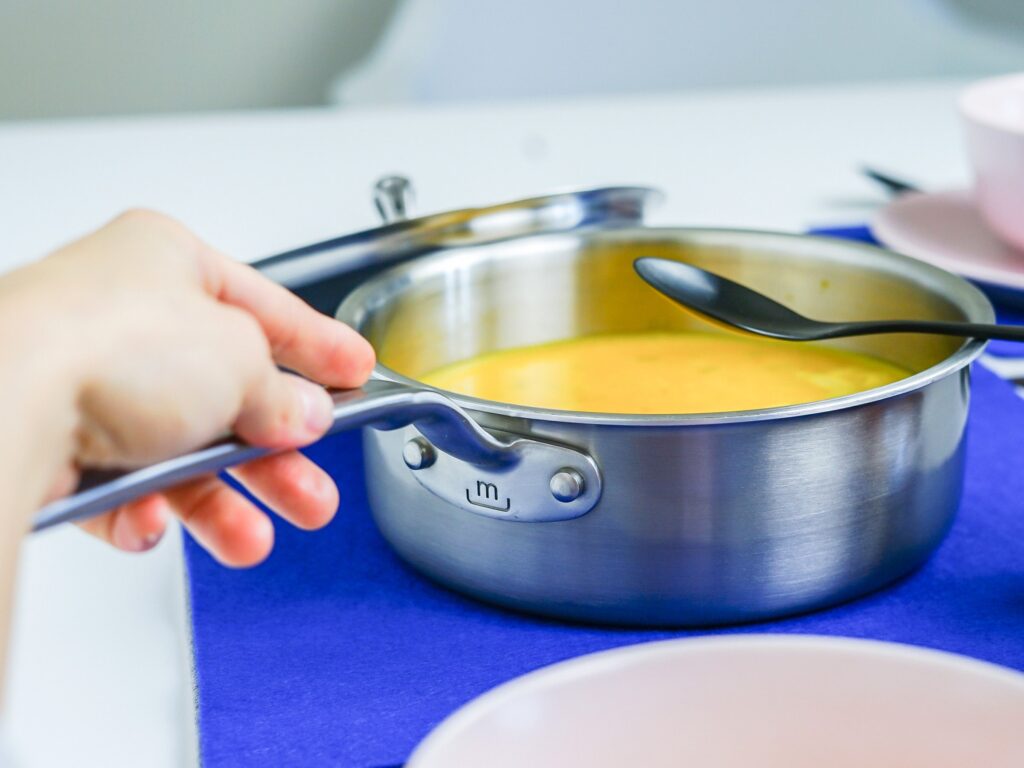
Made In cookware is manufactured primarily in Italy and the United States, with other product categories made in countries such as France and Sweden.
If you are shopping for cookware in the United States, you may have seen Made In pans in home kitchens, restaurant supply stores, and online cookware guides. The brand has built its reputation around professional-style kitchen tools and manufacturing partnerships in established cookware-producing regions.
However, Made In is not an entirely American-made cookware brand. Its products come from several countries, and the manufacturing location depends on the type of cookware you purchase. Stainless clad cookware is associated primarily with Italy, while some stainless and nonstick products are manufactured in the United States. Other materials have different origins.
This guide explains where Made In cookware is manufactured, which countries produce its main product lines, and how American shoppers can check the origin of a specific pan before buying. It also explains why a company’s headquarters, product design location, and manufacturing location are three different things.
Made In cookware is manufactured mainly in Italy and the United States. The company also works with producers in other countries, including France and Sweden, depending on the product category. Its official help center identifies the manufacturing origins of its main collections.
The brand is based in Austin, Texas. Its American roots are tied to a family business in the kitchen supply industry, but its manufacturing model is international. This lets the company work with factories that have experience in specific materials and production methods.
For example, Italian factories produce its Stainless Clad cookware, while Swedish production is used for its carbon steel line. French makers produce certain copper and enameled cast iron pieces. These locations are not interchangeable, and a product’s origin should be checked separately.
Source: westbendcompany.com
United States
Some Stainless Clad and nonstick cookware is manufactured in the United States using domestic and imported components.
Italy
Italy is a key manufacturing location for the Stainless Clad cookware collection and other kitchen products.
France
French manufacturing is used for products such as copper cookware and enameled cast iron.
Sweden
Made In identifies Sweden as the country of manufacture for its carbon steel cookware.
Is Made In an American Company?
Yes. Made In is an American cookware brand headquartered in Austin, Texas. Its American business background and product development are separate from the locations where individual products are manufactured.
Think of it like an American clothing company that works with factories in several countries. The company can be American even when some of its products are made overseas. The same principle applies to Made In.
For US shoppers, this distinction matters when comparing brands that advertise American design, American ownership, or American manufacturing. These claims describe different things and should not be treated as equal.
Company location
Made In is based in Austin, Texas.
Manufacturing network
The brand works with manufacturing partners in the United States and several European countries.
Product origin
The actual country of manufacture depends on the individual cookware collection and product.
Does Made In Manufacture All Its Cookware in One Factory?
No. Made In uses a network of manufacturing partners rather than relying on one factory for its entire product range. Different factories have different equipment, skills, and experience with particular materials.
This approach is common in cookware manufacturing. Producing a five-ply stainless steel pan requires different processes from making a carbon steel skillet or an enameled cast iron Dutch oven.
The brand’s published manufacturing information supports a product-by-product approach to country of origin. It does not establish that every item in a collection comes from the same factory or that every component has the same origin.
Specialized production
Different factories can focus on stainless steel, carbon steel, copper, or cast iron.
International sourcing
Raw materials and components may come from more than one country.
Product-level details
The exact origin should be checked on the listing for the item being purchased.
Where Is Each Made In Cookware Collection Made?
Made In uses different countries for different cookware materials. The following table summarizes the locations listed in the company’s published manufacturing information. It is a category-level guide, not a guarantee that every item or component has an identical origin.
The main point is simple: the country changes with the product. A stainless steel skillet and a carbon steel pan from the same brand may come from different countries.
Source: prudentreviews.com
Stainless Clad cookware
Made in Italy and the United States from domestic and imported components.
Nonstick cookware
Made in Italy and the United States, depending on the product.
Carbon steel cookware
Made in Sweden according to the company’s general manufacturing guide.
Copper cookware
Made in France.
Enameled cast iron
Made in France.
Stainless Clad Cookware: Italy and the United States
Made In identifies Italy and the United States as manufacturing locations for its Stainless Clad cookware. Its flagship Stainless Clad collection is specifically described on the company’s product pages as crafted in Italy.
This cookware uses a multi-layer metal construction. The layers combine stainless steel with conductive metals to help heat spread through the cooking surface. The manufacturing process requires precise bonding and forming, which is why specialized production facilities matter.
The company also states that some stainless products use domestic and imported components. Therefore, a general statement that Stainless Clad cookware is made in Italy and the United States does not mean every individual pan is manufactured in both countries.
Main production location
Italy is the stated origin of the flagship Stainless Clad collection.
Additional production
Some products or production arrangements involve the United States.
Construction
The collection uses five layers of metal bonded together.
Nonstick Cookware: Italy and the United States
Made In lists both Italy and the United States as manufacturing locations for its nonstick cookware. The exact origin can depend on the particular pan or product version.
Nonstick cookware has a different production process from uncoated stainless steel. Manufacturers must form the pan body and apply a cooking surface coating under controlled conditions. The coating process and the pan’s underlying metal construction are separate parts of production.
If American manufacturing is a deciding factor, do not assume that every nonstick pan is made in the United States. Check the exact product listing and its stated origin.
Country variation
Nonstick products may come from Italy or the United States.
Check the exact item
Look for the country-of-origin information on the specific product page.
Carbon Steel Cookware: Sweden
Made In identifies Sweden as the manufacturing location for its carbon steel cookware. This is a separate product category from its stainless steel collection.
Carbon steel pans are valued for their ability to respond to changes in heat and develop a seasoned cooking surface. The metal must be formed and finished for cooking use, and the final pan may require seasoning before regular use.
Swedish origin describes where the product is made. It does not, by itself, prove that a pan performs better than a similar pan made in another country. Construction, thickness, handle design, and care also affect the cooking experience.
Follow the product instructions for seasoning, drying, and storage.
Copper Cookware: France
Made In lists France as the manufacturing location for its copper cookware. Copper is known for its strong response to changes in heat, which can make it useful for tasks that need careful temperature control.
Copper cookware may use a different metal on its cooking surface, depending on its design. Buyers should read the product specifications to identify the interior lining and care requirements rather than assuming that every copper pan has the same construction.
French manufacturing is a country-of-origin detail. It should not be used as the only measure of quality, since copper thickness, lining, handle construction, and maintenance also matter.
Country of manufacture
France.
Key material
Copper, with the exact interior construction determined by the product.
Enameled Cast Iron: France
Made In states that its enameled cast iron cookware is made in France. Its craftsmanship information describes production in Northeast France, a region with a long history of cast iron manufacturing.
Enameled cast iron has a cast iron body covered by a glass-like enamel layer. The enamel helps protect the iron and provides a cooking surface that does not need the same seasoning routine as bare cast iron.
Although the country of manufacture is useful information, buyers should also check the item’s weight, enamel care instructions, lid design, and oven-use limits.
Country
France.
Material
Cast iron with an enamel finish.
Care
Avoid impacts and follow the manufacturer’s instructions to protect the enamel.
Where Are Other Made In Kitchen Products Manufactured?
Made In sells more than pots and pans. Its wider product range includes knives, bakeware, flatware, glassware, plates, and kitchen accessories. These products may come from countries that are not used for its main cookware collections.
This matters because shoppers sometimes use the origin of one Made In product to describe the entire brand. That can lead to incorrect claims. A French-made knife does not mean that a stainless steel skillet is also made in France.
Source: cookeryspace.com
Knives
Made in France and Japan, depending on the knife.
Bakeware
Made in France.
Flatware
Made in Italy.
Glassware
Made in Germany.
Plateware
Made in England.
Accessories
Different accessories may be made in Hungary, India, Japan, Mexico, Thailand, and Vietnam.
Why Do Made In Knives Come From France and Japan?
Made In uses French and Japanese manufacturing partners for its knives. The company highlights Thiers, France, as an important location for its French knife production.
These countries have established knife-making industries, but the country alone does not tell you everything about a blade. Steel type, heat treatment, edge geometry, handle design, and sharpening needs all affect performance.
When comparing a Made In knife with another kitchen knife, use the product’s specifications and care instructions along with its stated origin.
French knives
Some knives are produced in Thiers, France.
Japanese knives
Other products in the knife range are made in Japan.
Where Are Made In Plates and Glasses Made?
Made In lists England as the manufacturing location for its plateware and Germany for its glassware. Its craftsmanship information identifies Stoke-on-Trent, England, as the home of its plateware production.
These products belong to the brand’s tabletop range, not its cookware range. Their origins should be considered separately when comparing dinnerware, drinking glasses, or kitchen sets.
Plateware
England, with production identified in Stoke-on-Trent.
Glassware
Germany.
Flatware
Italy.
How to Check Where Your Made In Pan Was Manufactured
The most reliable way to check a Made In product’s origin is to look at the individual product page. The brand says it identifies manufacturing information on its product listings, so shoppers do not need to rely only on general brand descriptions.
This is especially useful when a collection has more than one manufacturing location. It can also help when product versions or manufacturing arrangements change over time.
Source: usalovelist.com
Start with the exact product
Find the specific pan, pot, or cookware set you plan to purchase rather than relying on a general collection page.
Read the origin statement
Look for wording such as Made in Italy, Made in France, or Made in the USA.
Check component details
Look for statements about domestic and imported components when the product uses parts from different sources.
Ask customer support
If the product page does not answer your question, contact the company and provide the exact product name or item number.
Check the delivered item
Compare the packaging and product markings with the information you reviewed before ordering.
What Does Made in the USA Actually Mean?
Made in the USA is a specific origin claim, not a general statement that an American company designed or sells a product. The Federal Trade Commission says an unqualified Made in USA claim generally requires that the product be all or virtually all made in the United States.
That standard considers where the product was assembled, where its components came from, and how much of its production took place in the country. A product made with imported components may need a qualified claim rather than an unqualified American-origin claim.
Made In’s description of some cookware as being made in the United States from domestic and imported components should therefore be read as written. It does not mean that every component is American-made.
American company
Describes the business’s national identity or location.
American-designed
Describes where design work takes place, not necessarily where the product is made.
Made in the USA
Describes product origin and is subject to the FTC’s applicable origin-claim standards.
What If the Product Page Does Not Show the Country?
Do not guess based on the brand’s headquarters or another pan in the same collection. Manufacturing information can differ by item, and a broad category description may not answer a question about a particular product.
Contact Made In’s customer service with the product name, size, and item number. Ask for the country of manufacture of the finished product and whether any major components have a different origin.
If you are buying from a third-party retailer, compare its listing with the manufacturer’s current product page. Retailer descriptions may be brief or may not reflect the latest product information.
Avoid assumptions
Do not use the country of origin of a different product as proof.
Keep written confirmation
Save the manufacturer’s response if country of origin is a key part of your buying decision.
Why Does Made In Manufacture Cookware in Different Countries?
Made In uses different manufacturing locations because cookware materials and production methods require different skills and equipment. A factory experienced in bonding multiple metal layers may not specialize in casting and enameling iron.
The company’s published craftsmanship story describes partnerships with multigenerational manufacturers. It says the brand works with makers that have deep experience in particular product categories and regions.
This model can give a cookware company access to specialized production knowledge. However, the country of manufacture alone does not prove that one pan is better, safer, or more durable than another.
Source: i.ytimg.com
Material expertise
Different production facilities may specialize in stainless steel, carbon steel, copper, cast iron, or ceramic-related processes.
Specialized equipment
Cladding, forming, casting, coating, and enameling require different production methods.
Established craft traditions
The company works with manufacturers in regions that have experience producing certain kitchen goods.
International supply chains
Finished products and their components may involve more than one country.
Does European Manufacturing Mean Better Cookware?
Not automatically. Italy, France, and Sweden have established manufacturing industries, but a country’s reputation cannot replace an examination of the actual pan.
A useful cookware comparison looks at the material, thickness, construction, handle attachment, cooking surface, warranty, and care requirements. These details have a more direct connection to how the product is made and used.
For example, a well-built stainless steel pan from the United States may be a better fit for one household than a European-made pan with a different size or design. The right choice depends on the product and the cook’s needs.
Look at construction
Check whether the pan is fully clad, has a bonded base, or uses another construction method.
Check material details
Read the stated steel grade, metal layers, coating, and other relevant specifications.
Does the Manufacturing Country Affect Quality Control?
Manufacturing country can provide useful context, but it does not tell you the full quality-control process. Quality depends on the factory’s production standards, material checks, inspection methods, and the brand’s requirements.
A responsible comparison should look for documented product specifications, warranty terms, and clear information about manufacturing. Do not assume that a product is defect-free because it comes from a particular country.
Made In’s use of specialist manufacturing partners is part of its published business approach. It should not be treated as independent proof that every product will perform the same way or last for a specific number of years.
Factory standards
The production process and inspection rules matter more than a country label alone.
Material consistency
The materials and construction should match the specifications for the product.
Warranty coverage
Read the actual warranty terms to understand which manufacturing defects are covered.
Is Made In Cookware Made in China?
Made In’s published manufacturing guide identifies several countries for its main cookware collections, including Italy, the United States, Sweden, and France. China is not listed as the manufacturing location for those core cookware categories in that guide.
However, the brand sells accessories and other kitchen products with a wider range of origins. Its general help information lists Hungary, India, Japan, Mexico, Thailand, and Vietnam for accessories and other items. Country information should therefore be checked for each product rather than applied to the entire brand.
The absence of China from a particular cookware category’s published list should not be expanded into an unsupported claim about every item, component, supplier, or future product. The product page is the best source for a specific purchase.
Source: sungloryind.com
Core cookware
The published general origins include Italy, the United States, Sweden, and France, depending on the collection.
Other products
Accessories and related items have additional manufacturing origins.
Best verification method
Check the exact product listing or ask the company about its current country of manufacture.
Should You Avoid Cookware Made in China?
A country label alone is not a reliable way to judge cookware quality or safety. Products made in many different countries can vary in materials, construction, factory standards, and regulatory compliance.
Instead of making a decision based only on the country, look at the product’s construction and food-contact materials. For coated cookware, read the care instructions and follow the manufacturer’s temperature limits. For stainless steel, examine the grade and construction details.
If country of origin is important to you for personal or purchasing reasons, use the stated origin as one buying factor. Keep it separate from claims about product performance or safety.
Quality
Judge the actual construction, materials, and inspection information.
Safety
Look for relevant material disclosures and reliable testing information.
Origin
Verify the specific item’s country rather than relying on assumptions about a brand.
Is Made In Cookware Worth Considering for US Buyers?
Made In may be worth considering if you want cookware with clearly stated product origins and access to several types of construction. Its range includes stainless steel, nonstick, carbon steel, copper, and enameled cast iron.
The brand’s international manufacturing model is neither a benefit nor a drawback on its own. The more useful question is whether the specific pan suits your cooking habits, budget, stove, and care routine.
For US households, it is also useful to compare shipping, returns, warranty coverage, and replacement options. These practical details can matter as much as the manufacturing country over the life of a cookware purchase.
Source: diningtokitchen.com
Consider stainless steel
A useful option for cooks who want an uncoated cooking surface and versatile everyday cookware.
Consider carbon steel
A potential fit for cooks who are comfortable seasoning and maintaining a metal pan.
Consider enameled cast iron
A useful format for slow cooking and heat retention, provided its weight and care needs suit your kitchen.
Compare nonstick options
Check the coating details, heat limits, utensils, and cleaning guidance before buying.
What Should You Check Before Buying?
Start with the kind of food you cook most often. A stainless steel skillet is useful for browning and pan sauces, while a nonstick pan can make delicate foods easier to release. Carbon steel and cast iron serve different cooking needs and require different care.
Next, check whether the pan works with your stovetop. Induction cooktops need compatible magnetic cookware, and oven-safe temperatures can vary by product, handle, lid, and component.
Finally, review the warranty and return policy on the current US product page. Do not assume that every item has identical coverage or that policies remain unchanged over time.
Cooking style
Choose a material and shape that suit the meals you make most often.
Stovetop compatibility
Confirm induction compatibility when using an induction range.
Oven limits
Check the exact temperature rating for the pan and its lid.
Maintenance
Consider whether you are comfortable with seasoning, handwashing, or coating care.
Origin
Confirm the country of manufacture if it is important to your purchase.
Is Made In the Same as Made in the USA?
No. Made In is the brand name, while Made in the USA is a country-of-origin claim. The similar wording can cause confusion when shoppers first encounter the company.
Made In sells products manufactured in several countries. Some items are made in the United States, but others are produced in Italy, France, Sweden, Germany, England, and additional countries.
The safest way to interpret the brand is to treat Made In as a company name, not as a promise that all its cookware is American-made.
Brand name
Made In is the company’s name.
Country claim
Made in the USA describes a product’s origin under applicable labeling standards.
Practical check
Read the country statement for the exact cookware item.
Common Mistakes When Researching Made In Cookware Origins
The biggest mistake is treating the manufacturing location of one product as the origin of the whole brand. Made In has multiple product categories and a varied supply chain, so a single country cannot describe everything it sells.
Another mistake is confusing a company’s headquarters with the factory that makes a pan. An American business can manufacture products overseas, just as an overseas business can operate factories in the United States.
A careful buyer checks the exact item and reads the origin statement in context. This small step can prevent confusion when comparing cookware brands or shopping for American-made products.
Mistake: All Made In cookware is made in Italy
Correction: Italy is a major production location, but the company also identifies US manufacturing for some cookware.
Mistake: Made In is 100% American-made
Correction: The brand is American, but its products come from multiple countries.
Mistake: Every product has the same country of origin
Correction: Manufacturing locations vary by material and product category.
Mistake: Country of origin proves quality
Correction: Construction, materials, production standards, and product specifications also matter.
Mistake: A retailer’s general description is always current
Correction: Verify important origin details on the manufacturer’s current product page.
A Practical Country-of-Origin Checklist
Before placing an order, confirm the exact product name, its material, and its stated country of manufacture. If the listing refers to imported and domestic components, check whether it explains the origin of the finished product.
For a high-value purchase, save the product page or ask customer support for written clarification. This is especially useful if you are buying cookware because of an American-made requirement.
Product name
Make sure the origin information matches the exact model and size.
Country
Read the stated finished-product origin.
Components
Check for domestic and imported material disclosures.
Current information
Use the manufacturer’s current listing rather than an old article or retailer summary.
Frequently Asked Questions
Q
Is Made In cookware made in the USA?
Some Made In cookware is manufactured in the United States, but not all of it. The company identifies Italy and the United States as manufacturing locations for its Stainless Clad and nonstick collections. Check the individual product page to confirm the origin of a particular pan.
Q
Is Made In stainless steel cookware made in Italy?
Yes. Made In describes its flagship Stainless Clad collection as crafted in Italy. Its broader manufacturing information also identifies the United States for some stainless cookware and domestic and imported components. The exact listing is the best source for a specific item.
Q
Who owns Made In cookware?
Made In is an American cookware company associated with co-founders Chip Malt and Jake Kalick. Its business background is connected to a multigenerational kitchen supply family business. Ownership and company location should be distinguished from the countries where products are manufactured.
Q
Is Made In cookware manufactured in China?
The company’s published general manufacturing guide lists Italy, the United States, Sweden, and France for its main cookware categories. It does not list China as a manufacturing location for those core collections. Since the brand also sells accessories and other kitchen goods, check the origin of each individual product rather than making a claim about every item.
Q
Where is Made In carbon steel cookware made?
Made In’s general help center identifies Sweden as the manufacturing location for its carbon steel cookware. Check the current product listing for the exact item and its care instructions before buying.
Q
Where is Made In copper cookware made?
Made In lists France as the manufacturing location for its copper cookware. Product specifications should also be checked for the interior lining, construction, and care requirements.
Q
Where is Made In enameled cast iron made?
Made In identifies France as the manufacturing location for its enameled cast iron cookware. Its craftsmanship information points to production in Northeast France.
Q
Is Made In cookware considered high quality?
Country of manufacture alone cannot establish cookware quality. Evaluate the construction, materials, thickness, handle design, heat compatibility, care instructions, warranty, and product-specific specifications. These details give a more useful basis for comparison.
✦ Wrapping Up
Conclusion
Made In cookware is manufactured in several countries, primarily Italy and the United States for its main stainless and nonstick collections. Its carbon steel cookware is made in Sweden, while copper cookware and enameled cast iron come from France. The company’s wider kitchen range also includes products made in England, Germany, Japan, and other countries.
Made In is an American company based in Austin, Texas, but it is not an entirely American-made cookware brand. Its international manufacturing network allows it to work with specialized producers for different materials and products.
For US shoppers, the most reliable approach is to check the individual product page before ordering. Look at the country of manufacture, component details, construction, warranty, and care requirements. That gives you a clearer picture than relying on the brand name or a broad country-of-origin claim.
💡 Key Takeaway
Before buying Made In cookware, open the exact product page and verify its country of manufacture. If American-made cookware is your priority, ask customer support to confirm the finished product’s origin and the source of its major components.