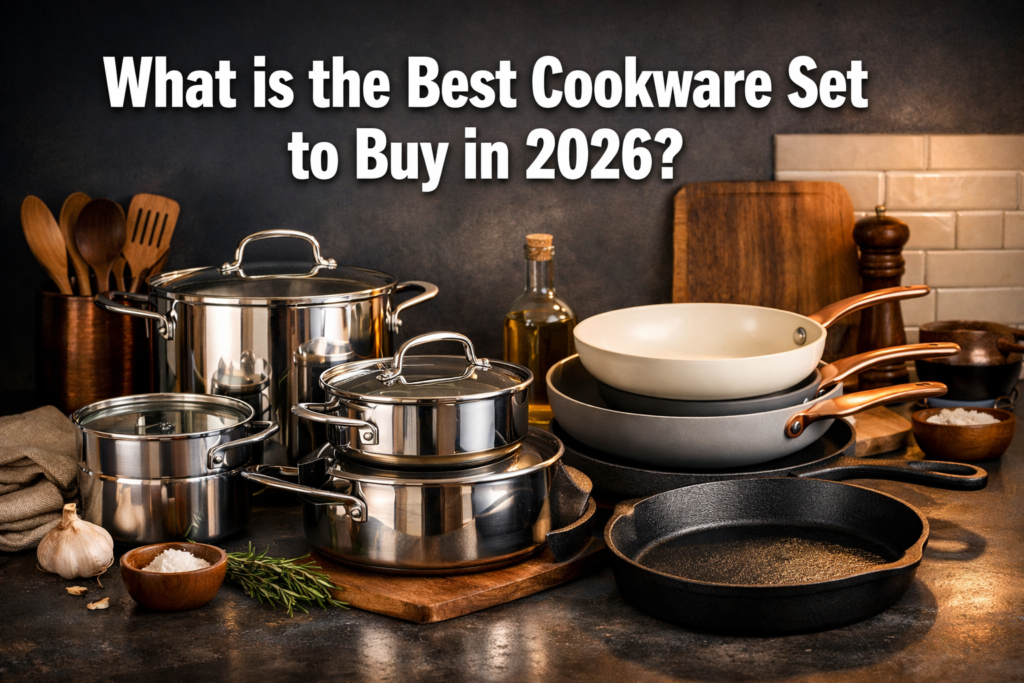
For most American home cooks, stainless steel is the best all-around cookware choice. Add a nonstick skillet for eggs and a cast iron pan for searing if your budget allows.
If you are setting up a kitchen in a new apartment, replacing worn pans, or shopping for your first cookware set in the United States, the choices can feel endless. Big-box stores, online shops, and kitchen supply stores sell pans made from stainless steel, cast iron, aluminum, copper, and several types of coated metal. Each material has its own strengths, costs, and care needs.
The best choice depends on what you cook, how often you cook, your stove type, and how much time you want to spend cleaning. You do not need a cabinet full of matching pots and pans to make good meals. A few well-chosen pieces can handle weekday dinners, weekend breakfasts, soups, sauces, and many other everyday tasks.
This guide compares common cookware materials, explains their benefits and limits, and helps you choose pieces that suit your home. It also covers induction compatibility, food safety, maintenance, and the difference between buying a full set and building a small collection. The goal is to help you spend money on useful tools rather than features you may never use.
Start with stainless steel cookware if you want one material that can handle many jobs. It works well for browning meat, cooking vegetables, simmering sauces, and preparing pasta. It can also last for years when you choose sturdy pieces and care for them properly.
However, stainless steel is not the best tool for every task. Eggs and pancakes may stick if the pan is not heated and used correctly. That is why many home cooks benefit from adding one nonstick skillet rather than trying to make a single pan do everything.
If you enjoy steaks, roasted vegetables, cornbread, or skillet meals, cast iron can be another useful addition. You can build a capable kitchen with three pieces instead of buying a large set right away.
Source: Pinterest
One stainless steel skillet or frying pan
Choose a medium or large skillet for browning, sautéing, and making pan sauces. A fully clad or thick-base model can help distribute heat more evenly.
One nonstick skillet
Use it for eggs, omelets, pancakes, and other foods that tend to cling to metal. Avoid overheating it and follow the care instructions for its coating.
One saucepan with a lid
A saucepan is useful for oatmeal, rice, small portions of soup, reheating food, and making sauces.
One stockpot or Dutch oven when needed
Choose a larger pot if you often cook pasta, chili, stew, broth, or meals for a family. You can wait to buy one if you usually cook small portions.
Why a Small Cookware Collection Often Works Better
A small collection is easier to store, wash, and maintain. It also lets you learn how each pan behaves before spending more money. For someone who cooks most meals at home, a skillet, saucepan, and larger pot can cover a wide range of recipes.
Think about your normal week. If you make eggs each morning and pasta twice a week, a nonstick skillet, saucepan, and pasta pot may be more useful than a specialist grill pan or several tiny saucepans. Buy for your habits, not for an imagined kitchen.
For one or two people
Start with a 10-inch skillet, a small saucepan, and a medium pot. Add larger cookware only when your meals require it.
For families
A 12-inch skillet, a medium saucepan, and a larger pot may be more useful for cooking several portions at once.
Compare the Main Types of Cookware
Cookware materials differ in heat response, weight, durability, price, and care. The right material is the one that suits your cooking style and fits the limits of your kitchen. A high price alone does not make a pan the best choice.
The table below gives a practical overview of common options. Exact performance depends on the pan’s thickness, construction, cooking surface, and design, so two pans made from the same material may still behave differently.
Source: pinterest.com
Stainless steel
Best for everyday versatility, browning, sauces, and long-term use. Food can stick without suitable heat control or enough cooking fat.
Nonstick coated cookware
Best for eggs and delicate foods. The coating can wear, scratch, or lose performance over time.
Cast iron
Best for strong heat retention, searing, frying, and oven cooking. It is heavy and needs protection from prolonged moisture.
Enameled cast iron
Best for stews, braises, soups, and slow cooking. It is heavy, can be expensive, and its enamel can chip if mishandled.
Carbon steel
Best for high-heat cooking and cooks willing to season the pan. It needs care similar to traditional cast iron.
Aluminum
Best for lightweight cookware that heats quickly. Anodized, coated, or clad designs differ in surface properties and maintenance.
Copper
Best for cooks who value fast, responsive heat control. It often costs more and may need polishing or special care.
Ceramic-coated nonstick
Best for people who want a nonstick surface without a conventional PTFE-based coating. Performance and coating life vary by product.
Quick Comparison by Everyday Use
Use this comparison to narrow your choices before you shop. Heat response describes how quickly a pan reacts when you raise or lower the burner. Heat retention describes how well it stays hot after food enters the pan.
A pan that heats quickly is not always the best at holding heat, and a pan that retains heat well may take longer to warm up. Both qualities matter, but the right balance depends on the food you prepare.
For quick heat changes
Copper and many aluminum pans respond quickly to burner adjustments.
For strong heat retention
Cast iron and enameled cast iron hold heat well, making them useful for searing and slow cooking.
For everyday flexibility
Stainless steel is a strong general-purpose choice, especially when the construction provides good heat distribution.
For easy food release
Nonstick coatings can help release eggs and other delicate foods with less effort.
Is Stainless Steel the Best Cookware to Buy?
Stainless steel is one of the most useful choices for a home kitchen because it can handle many cooking methods without a fragile nonstick coating. You can use it to brown chicken, sauté onions, cook vegetables, reduce sauces, and make gravy from pan drippings. Many stainless steel pans can also move from the stovetop to the oven when their handles and other parts are rated for that use.
Stainless steel does not usually release food as easily as a fresh nonstick pan. For better results, preheat the pan appropriately, add cooking oil or another suitable fat, and avoid moving food too early when searing. This simple approach can reduce sticking, though it will not make stainless steel behave exactly like a coated pan.
The construction matters as much as the label. Some pans have a stainless steel cooking surface with an aluminum or copper layer beneath it. These layers help spread heat, while stainless steel provides a durable cooking surface.
Source: careers.swapinthecityuk.co.uk
Main benefits
Stainless steel can be durable, versatile, and suitable for many everyday cooking tasks. It does not require seasoning like traditional cast iron.
Main drawbacks
Food may stick, and thin or poorly designed pans may develop hot spots. Some stainless steel cookware is also heavier or more expensive than basic aluminum.
Best buyers
Choose it if you want dependable cookware for regular meals and are willing to learn basic heat control.
What to Check When Buying Stainless Steel
Look for sturdy construction, a comfortable handle, a stable base, and a size that fits your burner. Fully clad cookware has heat-conducting layers extending through the sides as well as the base. Disc-bottom cookware concentrates its layered base at the bottom and can also work well, depending on its design.
The number of metal layers alone does not guarantee better results. Construction quality, thickness, balance, and the way you cook all affect performance. If possible, lift the pan in a store or check its listed weight before ordering online.
Check the cooking surface
Confirm that the food-contact surface is stainless steel and review the manufacturer’s material information.
Check the base
A broad, stable base can improve contact with the burner. Induction users should verify that the pan is specifically compatible.
Check the handle and lid
Look for a secure grip and clear oven-temperature limits for the whole pan, including its lid and handle.
Should You Buy Nonstick or Ceramic Cookware?
Choose nonstick cookware if easy food release is your top concern. It can make eggs, omelets, pancakes, and delicate fish easier to cook and clean. For most people, one nonstick skillet is more useful than an entire nonstick set.
Traditional nonstick cookware often uses a coating based on polytetrafluoroethylene, or PTFE. Ceramic-coated nonstick pans usually use a different coating system, often described as a sol-gel ceramic coating. The word ceramic here generally refers to the surface coating, not a pan made entirely from ceramic.
Neither type is automatically the right choice for every meal. Nonstick surfaces are not ideal for every high-heat searing task, and their performance may decline with wear. Ceramic-coated pans can also lose their easy-release qualities with use, even if the surface still looks intact.
Source: bakewarepans.org
Choose conventional nonstick for
Eggs, pancakes, quick breakfasts, and low- to medium-heat cooking where easy release matters most.
Choose ceramic-coated nonstick for
A nonstick option with a ceramic-based coating system, provided you accept that coating performance can decline over time.
Avoid either type for
Tasks that require prolonged extreme heat or metal-tool use unless the maker expressly permits the intended method.
How to Care for Nonstick Cookware
Use low to medium heat unless the manufacturer’s instructions allow otherwise. Empty nonstick pans can heat very quickly, so do not leave one on a hot burner while you prepare other ingredients. Follow the maker’s advice about preheating, oils, utensils, and cleaning.
Wooden, silicone, or other approved utensils can help protect the surface. Let a hot pan cool before washing it, and avoid abrasive pads unless the instructions specifically allow them. If the coating is peeling, flaking, or badly damaged, replace the pan rather than trying to repair the surface.
Do not overheat an empty pan
Excessive heat can damage cookware coatings. PTFE coatings can release hazardous fumes if severely overheated, so keep the pan within its stated temperature limits and ventilate the kitchen.
Do not assume all coatings are alike
Read the exact product specifications. Labels such as ceramic, stone, granite, or diamond do not by themselves establish the full coating composition or performance.
Replace worn cookware when needed
Persistent sticking, peeling, or other clear damage can signal that the pan has reached the end of its useful life.
Is Cast Iron Worth Buying?
Cast iron is worth considering if you like seared meat, crisp-edged potatoes, cornbread, fried foods, or meals that move from the stove into the oven. It retains heat well, which can help maintain a hot cooking surface when you add food. It is also available in relatively simple designs that can last a long time with proper care.
The trade-off is weight and maintenance. Cast iron can be difficult to lift when full, and traditional uncoated cast iron needs a layer of seasoning to help protect it from rust and improve food release. Seasoning is a thin layer of polymerized oil formed through heating; it is not the same as a factory-applied nonstick coating.
If you often make tomato sauce, wine-based sauces, or other acidic dishes, long cooking in traditional cast iron can affect the seasoning and may add iron to the food. An enameled cast iron pot avoids the need for routine seasoning and is often more convenient for braising or simmering acidic foods.
Source: pinterest.com
Best uses
Searing steaks, pan-frying, baking cornbread, roasting vegetables, and cooking dishes that benefit from steady heat.
Care requirements
Dry traditional cast iron thoroughly after washing and apply a very thin layer of suitable cooking oil when needed. Follow the product instructions for enameled cookware.
Reasons to skip it
You may prefer another material if you have difficulty lifting heavy cookware, need rapid temperature changes, or want minimal maintenance.
Cast Iron vs. Carbon Steel
Cast iron and carbon steel share some useful traits, including strong heat retention and the ability to develop a seasoned cooking surface. Carbon steel pans are often thinner and lighter than cast iron pans of similar size, so they may be easier to toss or move around the stove.
Both materials need suitable care to prevent rust. Carbon steel can respond more quickly to changes in heat because of its construction, while a thick cast iron pan can hold warmth for longer. Choose based on the pan’s weight, shape, and the food you cook rather than assuming one material is always better.
Choose cast iron
If heat retention is a priority and you do not mind a heavier pan.
Choose carbon steel
If you want a seasoned pan with a lighter feel and are comfortable managing its care.
Which Cookware Works Best on Your Stove?
Your stove type should influence your cookware purchase before you choose a brand or set. Gas, electric coil, radiant glass, and induction cooktops transfer heat in different ways. A pan that works well on one surface may perform poorly or fail to work on another.
Gas stoves use a flame, while conventional electric coil and radiant cooktops heat the cookware through a hot element or surface. Induction cooktops use a magnetic field to heat compatible cookware directly. This means induction requires a magnetic cooking base, not simply a pan that looks metallic.
Source: housekeepingmaster.com
Gas stove
Most common cookware materials can work on gas, but choose stable pans with suitable handles. Avoid allowing flames to climb around the sides of the pan.
Electric coil stove
A flat, stable base helps maintain good contact with the element. Follow the stove and cookware instructions to avoid damage.
Radiant glass cooktop
Choose cookware with a smooth, flat base. Lift pans instead of dragging them across the glass to reduce the risk of scratches.
Induction cooktop
Buy cookware labeled induction-compatible or test whether a magnet sticks firmly to the base. A magnetic base is necessary, though pan construction and size still affect performance.
How to Test a Pan for Induction
If you already own pans and are unsure whether they work with induction, place a magnet against the bottom. If it sticks firmly, the pan is likely to be compatible, but the manufacturer’s information is still the better final check.
Do not assume that all stainless steel is induction-ready. Some stainless steel alloys are not magnetic, while many aluminum and copper pans need a compatible magnetic base to work on an induction surface. If the cooktop does not recognize the pan, check its size, placement, and compatibility before replacing it.
Check the full base
Look for induction compatibility on the product label or manual rather than relying on the material name alone.
Match pan size to the cooking zone
A base that is too small or unsuitable for the zone may not be detected properly.
What Cookware Is Best for Health and Food Safety?
For everyday cooking, focus on cookware that is intended for food contact, is in good condition, and is used within its stated temperature limits. No single material is automatically the safest option for every person, food, and cooking method. The coating, metal composition, product quality, and way you use the pan all matter.
Stainless steel, cast iron, enamel-coated cookware, and properly used nonstick pans can all serve useful roles. The key is to understand their limits. Avoid damaged surfaces, unverified products with unclear material information, and cookware used in ways the manufacturer warns against.
If you have a nickel sensitivity, stainless steel composition may matter because some grades contain nickel. If you need to manage iron intake or have a medical concern about iron, discuss your cookware choices with a qualified healthcare professional rather than assuming that one pan will treat or prevent a condition.
For products sold in the United States, look for clear manufacturer information about the cooking surface, coating, intended use, and care. Be cautious with broad marketing claims such as completely toxin-free when the seller does not explain the materials or conditions behind the claim.
Source: artofit.org
Use coated pans as directed
Avoid overheating nonstick cookware, especially an empty pan. Replace cookware with peeling or severely damaged coatings.
Keep cast iron dry
Dry traditional cast iron after washing to limit rust. Avoid prolonged storage of wet food in the pan.
Inspect enamel and other surfaces
Stop using cookware for food preparation if its cooking surface is damaged in a way the manufacturer identifies as unsafe.
Read product-specific information
Check the material declaration, care instructions, and any temperature limits instead of relying on vague safety slogans.
Does More Expensive Cookware Mean Safer Cookware?
Not necessarily. A high price may reflect construction, brand positioning, design, or included accessories, but price alone does not prove that a pan is safer or performs better. A well-made, moderately priced pan can be a sensible choice when its materials and intended uses are clear.
Spend more when the added feature solves a real problem, such as a better heat-spreading base, a more comfortable handle, or a construction that suits frequent use. If the only difference is a vague health claim, look for better evidence before paying extra.
Prioritize material transparency
Choose products with clear descriptions of the cooking surface and coating.
Prioritize suitable use
Match the pan to your cooking temperature, stove, and cleaning habits.
Should You Buy a Cookware Set or Individual Pans?
Buy individual pans if you know what you cook and want to control your spending. This approach lets you choose stainless steel for everyday cooking, nonstick for eggs, and cast iron for high-heat meals without paying for several pieces that may stay in a cabinet. It also gives you the freedom to replace one worn pan without replacing the rest.
A cookware set can be a good value if you are furnishing a new kitchen or need several matching pieces at once. Sets often include saucepans, skillets, lids, and larger pots. Before buying, check the exact contents, pan sizes, material construction, and whether each item suits your stove.
Do not judge a set only by its piece count. A lid may count as an item, and a set with many small pans may offer less practical value than one with fewer, better-sized pieces. Compare the cost of the items you will use rather than the advertised number of pieces.
Source: longroadhomeproject.com
Choose a set if
You need several pots and pans, have enough storage space, and find the included sizes useful for your normal meals.
Choose individual pieces if
You already own some cookware, prefer different materials for different jobs, or want to buy gradually.
Check the warranty
Read what the warranty covers and excludes. Normal coating wear, misuse, and accidental damage may be treated differently from manufacturing defects.
A Practical Starter Set for a U.S. Home Kitchen
For a simple setup, start with a skillet, a saucepan with a lid, and a medium or large pot. Add a nonstick skillet if you cook eggs or pancakes often. If you regularly prepare braised meat, soups, or one-pot meals, consider a Dutch oven as a later purchase.
The best size depends on portions and storage. A large skillet may be useful for family meals, while a smaller pan is easier to handle when cooking for one. Measure your storage space and consider your stove’s burner sizes before ordering.
Everyday skillet
A 10- or 12-inch pan is a useful starting point for sautéing, browning, and preparing meals for one or more people.
Saucepan
A 2- to 3-quart saucepan suits many small cooking tasks, including sauces, grains, and reheating.
Large pot
A 6- to 8-quart pot may suit pasta, soup, and batch cooking, depending on your household size.
Optional Dutch oven
A 5- to 6-quart Dutch oven can be useful for braises, stews, and meals that start on the stove and finish in the oven.
How Much Should You Spend on Cookware?
Set your cookware budget before shopping, then spend it on the pieces you use most. A basic kitchen does not require a premium matching set. The useful comparison is not the price of one pan against another alone, but the expected service, ease of care, and fit for your cooking habits.
Prices vary with size, construction, brand, finish, and sales. Since prices change across U.S. retailers, treat any price range you see as a current listing rather than a lasting rule. Compare products of similar size and construction, and check the final price rather than the suggested retail price alone.
A low-cost pan may be fine for occasional use, while someone who cooks daily may value a more durable stainless steel skillet or a well-built pot. Nonstick cookware may need replacement sooner than some uncoated pans, so consider its likely service life and care requirements when comparing costs.
Source: blogspot.com
Spend on the pieces you use most
If you cook daily, prioritize a comfortable handle, sound construction, and a suitable base over decorative finishes.
Avoid paying for unused extras
Skip specialty pans and large sets if they do not fit your recipes or storage space.
Compare replacement needs
Include the potential cost of replacing coated cookware when assessing the value of a complete collection.
A Simple Way to Compare Long-Term Value
You can estimate cookware value by dividing its purchase price by the number of years you expect to use it. This is only a planning tool, not a promise about how long a pan will last. Actual life depends on construction, frequency of use, heat, utensils, cleaning, and storage.
For example, a hypothetical $60 pan used for six years costs $10 per year before considering other expenses. A hypothetical $30 pan used for two years costs $15 per year. These figures do not establish which product will last longer; they simply show why purchase price alone can be misleading.
Compare like with like
Use similar pan sizes and intended cooking tasks when comparing costs.
Include maintenance
Consider whether the pan needs seasoning, special cleaning, or eventual coating replacement.
Common Cookware Buying Mistakes to Avoid
The most common buying mistake is choosing cookware based on appearance or a long list of features rather than daily use. A shiny set may look attractive, but the wrong sizes, uncomfortable handles, or poor stove compatibility can make it frustrating to use.
Another mistake is assuming every pan in a set has the same performance or oven limit. Lids, handles, and coatings may have different restrictions, so check the instructions for each item. If a product’s care details are unclear, contact the seller or manufacturer before buying.
Source: Pinterest
Buying a set that is too large
A large set can waste money and storage space if you only need a few basic pieces.
Ignoring stove compatibility
Check induction support or the base requirements for your cooktop before you buy.
Expecting nonstick cookware to last forever
Coatings can wear with use. Follow care instructions and replace damaged pans when needed.
Using metal tools on every surface
Some uncoated metal pans tolerate metal utensils, but many coated surfaces can be scratched. Follow the manufacturer’s guidance.
Overheating cookware
High heat can damage coatings, discolor metal, and create avoidable risks. Use the temperature range recommended for the material and pan.
Forgetting weight and storage
A heavy pan can be hard to lift, and tall lids or bulky handles may not fit your cabinets. Check dimensions before ordering.
What to Check Before You Place an Order
Review the pan dimensions, material, weight, stove compatibility, oven limits, lid construction, and care instructions. Look for clear product information rather than relying only on marketing images. If you shop in person, check whether the handle feels secure and the pan sits flat.
For online orders, inspect the return policy and warranty terms. Confirm whether the seller accepts returns after inspection and whether shipping costs apply. These details matter when the pan is heavier, larger, or different from what you expected.
Before buying
Confirm the material, dimensions, compatibility, and temperature limits.
After delivery
Inspect the pan for damage, loose handles, rough defects, or other issues before first use.
Before cooking
Read the care instructions and follow any required preparation steps.
How to Choose Cookware for Your Cooking Style
The best cookware material becomes easier to choose when you start with your usual meals. Think about the foods you prepare most often, how much heat control they need, and how much cleaning you can manage. A pan that suits your routine is more valuable than one designed for a cooking method you rarely use.
The following examples are practical starting points, not strict rules. You can mix materials to suit different jobs, and there is no need to buy every type listed.
Source: pinterest.com
If you cook eggs every morning
Start with a nonstick skillet that is easy to handle and simple to clean. Keep the heat within the maker’s recommended range.
If you sear meat often
Choose stainless steel, cast iron, or carbon steel based on the weight, care, and heat retention you prefer.
If you make soups and stews
A stainless steel stockpot or enameled Dutch oven is a useful choice. Choose the size based on your usual batch.
If you cook delicate sauces
A stainless steel saucepan can work well, while a responsive aluminum or copper design may help when fast heat changes matter.
If you want low-maintenance cookware
A stainless steel skillet and saucepan offer versatility without routine seasoning. Add a nonstick pan only if easy food release is important to you.
If you have limited storage
Choose a few nesting pieces or individual pans with practical sizes. Check whether handles and lids fit your available cabinet space.
What If You Are Replacing Old Cookware?
You do not need to replace every pan at once. Start by checking the cooking surface, handle attachment, base stability, and any visible damage. Replace pieces with damaged coatings or structural problems, and keep sound pans that still suit your needs.
If your old cookware sticks, heats unevenly, or no longer fits your stove, identify the specific problem before shopping. A better-sized pan or improved construction may solve the issue without requiring an entirely new set.
Keep serviceable pans
A sound pan can remain useful even if it does not match your new cookware.
Replace damaged pieces first
Prioritize cookware with peeling coatings, loose handles, serious warping, or other damage that affects safe use.
Choose one upgrade at a time
Replace the pan that causes the most trouble, then assess what your kitchen still needs.
Frequently Asked Questions
Q
What is the best cookware material for everyday cooking?
Stainless steel is a strong all-around choice for everyday cooking because it can handle browning, sautéing, simmering, and many oven recipes when the pan is rated for oven use. It is durable and does not need seasoning. A separate nonstick skillet can make eggs and other delicate foods easier to cook.
Q
What cookware should a beginner buy?
A beginner can start with a medium stainless steel skillet, a saucepan with a lid, and a pot sized for regular meals. Add a nonstick skillet if you make eggs or pancakes often. This small collection covers many basic recipes without requiring a large initial expense.
Q
Is stainless steel better than nonstick cookware?
Neither is better for every task. Stainless steel is versatile and suited to browning and pan sauces, while nonstick cookware helps release delicate foods and makes cleanup easier. Many kitchens benefit from keeping both types and using each for the job it handles well.
Q
What cookware is best for an induction stove?
Induction cooktops need cookware with a magnetic base. Many cast iron and magnetic stainless steel pans work, while some aluminum, copper, and stainless steel designs do not unless they include a compatible base. Check the product label or test the base with a magnet before buying.
Q
Is ceramic cookware safer than traditional nonstick cookware?
Ceramic-coated and conventional nonstick cookware use different coating systems, but the word ceramic does not guarantee that a product is safer in every situation. Check the exact materials, follow the temperature and care instructions, and replace cookware with damaged cooking surfaces. Product quality and proper use matter more than broad labels.
Q
Should I buy a complete cookware set or separate pans?
Buy a set if you need several pots and pans at once and will use the included sizes. Buy separate pans if you already own cookware or prefer different materials for different tasks. Compare the actual contents and construction rather than choosing a set based only on its advertised piece count.
Q
How long should cookware last?
Cookware life varies by material, construction, frequency of use, and care. Well-made stainless steel and cast iron can serve for many years, while nonstick coatings may lose performance sooner. Inspect your cookware regularly and follow the manufacturer’s replacement guidance when a surface or handle becomes damaged.
Q
Can I use the same cookware on gas and electric stoves?
Many pans work on both gas and conventional electric stoves, provided their bases and handles are suitable. Glass cooktops benefit from smooth, flat cookware bases, and induction requires a magnetic base. Always check the pan and cooktop instructions before use.
✦ Wrapping Up
Conclusion
If you are still asking what type of cookware should I buy, start with stainless steel for everyday versatility. Add a nonstick skillet if you often cook eggs or delicate foods, and consider cast iron if you enjoy searing, frying, or oven cooking. This combination can cover many common meals without filling your kitchen with unused pans.
Before you buy, consider your stove, cooking habits, storage space, budget, and willingness to maintain each material. Read the product details carefully, especially the information about induction compatibility, oven limits, cooking surfaces, and cleaning. You can always expand your collection later when a new pan solves a real need.
💡 Key Takeaway
Make a list of the three meals you cook most often, identify the pans those meals require, and buy the smallest practical collection that meets those needs. For many households, that means one stainless steel skillet, one saucepan, and one nonstick skillet, with a larger pot added when needed.