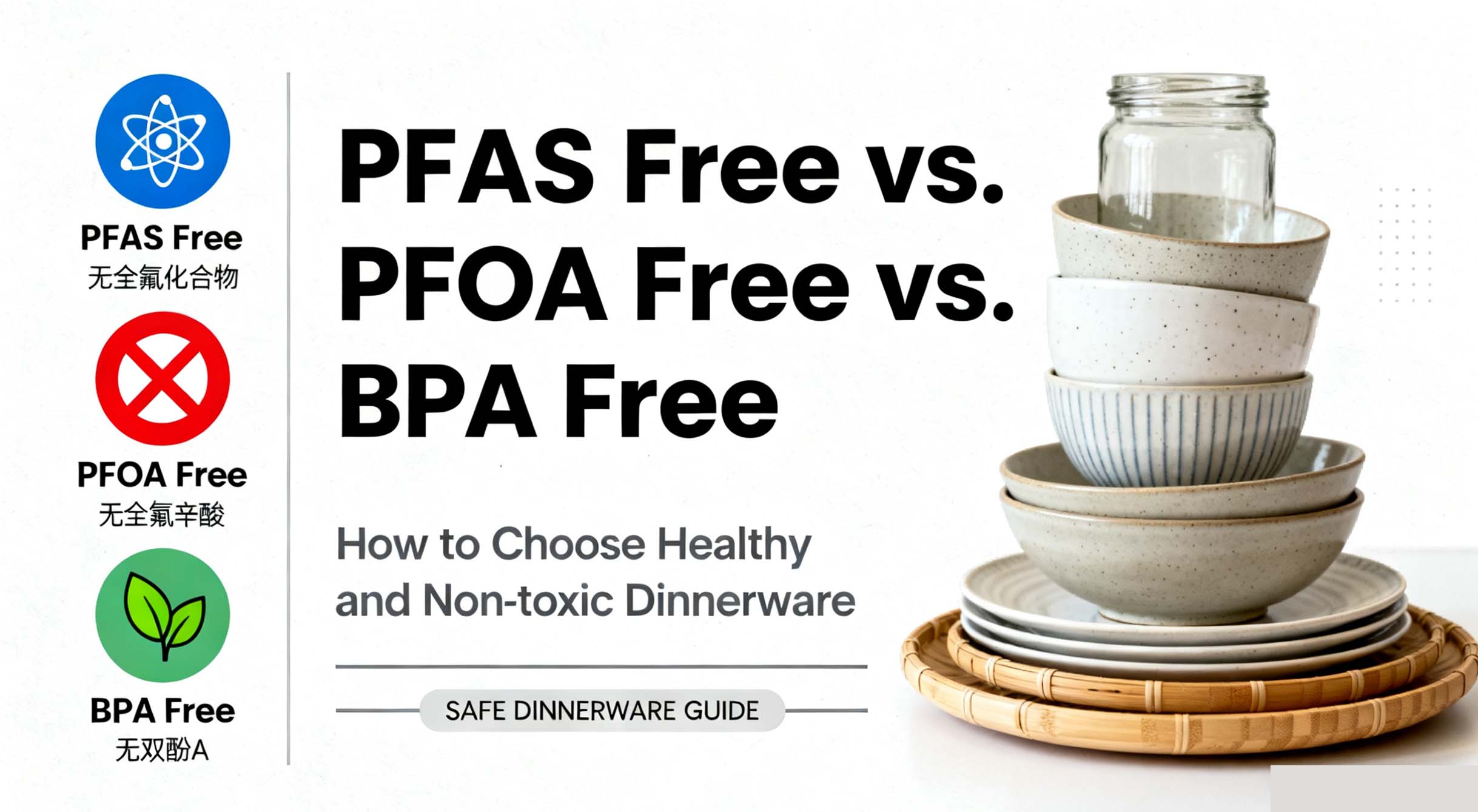
PFAS free cookware is cookware made without intentionally added per- and polyfluoroalkyl substances, a large group of chemicals used in some nonstick coatings. Stainless steel, cast iron, carbon steel, and many uncoated ceramic products are common options.
When you shop for pots and pans in the United States, you may see labels such as PFAS free, PFOA free, non-toxic, and ceramic nonstick. These terms sound alike, but they do not all mean the same thing. If you want to cook eggs before work, make soup for your family, or sear chicken for dinner, knowing the difference can help you choose cookware that fits your needs.
PFAS are a large family of chemicals with properties that make some of them useful in products that resist heat, water, grease, and stains. Certain PFAS have been used to make traditional nonstick coatings, including coatings based on PTFE. Scientists have raised concerns about some PFAS because they can persist in the environment, and exposure to certain members of this chemical family has been linked to health effects.
Choosing cookware without intentionally added PFAS can help you avoid one potential source of exposure. It does not mean that every other product in your kitchen is free of these chemicals, nor does it prove that a pan has no detectable trace contamination. The most useful approach is to understand the material, read the manufacturer’s claims carefully, and choose a pan you can use and maintain as directed.
PFAS free cookware is designed and marketed without intentionally added PFAS. PFAS stands for per- and polyfluoroalkyl substances, a broad family of chemicals used in some industrial processes and consumer products. Their chemical properties can make materials resist water, oil, grease, and heat.
Some nonstick cookware uses a coating made with polytetrafluoroethylene, or PTFE. PTFE belongs to the broader group of fluoropolymers associated with PFAS terminology in many regulatory and scientific discussions. A pan advertised as PFAS free is generally intended to avoid this type of coating, although the exact meaning depends on the manufacturer’s definition and supporting evidence.
The phrase does not describe a single cookware material. A PFAS-free pan might be made from stainless steel, cast iron, carbon steel, or aluminum with a qualifying coating. The base material and the cooking surface are separate parts of the product, so both deserve attention when you compare pans.
The key distinction is between a product designed without intentionally added PFAS and a product proven to contain absolutely none. The first is a manufacturing or formulation claim. The second is a much stronger analytical claim that depends on the chemicals tested, the test method, the sample, and the detection limits.
Source: healnourishgrow.com
PFAS free
Usually means the product is made without intentionally added PFAS, but you should check the manufacturer’s definition and evidence.
PFOA free
Means the product is claimed to be free of perfluorooctanoic acid. It does not establish that all other PFAS, including PTFE, are absent.
PTFE free
Means the product is claimed not to contain polytetrafluoroethylene. It does not, by itself, establish the absence of every other PFAS.
Non-toxic
A broad marketing phrase rather than a complete description of a product’s chemical composition. Look for specific material and coating details.
What Are PFAS Chemicals?
PFAS are a large family of manufactured chemicals with varied structures and uses. Some have been used in stain-resistant fabrics, grease-resistant packaging, industrial applications, and nonstick coatings. Different PFAS have different properties, exposure pathways, and health evidence, so they should not all be treated as identical substances.
Some PFAS can remain in the environment for a long time. Certain well-studied members have been associated with effects on cholesterol, immune response, liver function, and other health outcomes. The strength of evidence differs by chemical and outcome. This is why reducing avoidable exposure can be a sensible choice without claiming that every PFAS has the same risk.
Persistence
Some PFAS break down very slowly, allowing them to remain in water, soil, or living organisms for extended periods.
Wide chemical family
PFAS includes many different substances. A finding about one member should not automatically be applied to every member.
Multiple exposure routes
Food, drinking water, dust, and some consumer products may contribute to exposure, depending on the substance and circumstances.
Is PTFE the Same as PFAS?
No. PTFE is one specific fluoropolymer, while PFAS refers to a much broader family. PTFE has been widely used in nonstick cookware because food tends to release easily from its smooth surface. A traditional PTFE-coated frying pan may therefore be nonstick and PFOA free without being PFAS free.
PFOA has been used historically in the manufacture of certain fluoropolymer products, but it is not the same substance as PTFE. Changes in manufacturing practices and the absence of PFOA do not automatically remove the finished product’s PTFE coating. When avoiding the wider PFAS family is your goal, look for an explicit PFAS-free and PTFE-free claim, then review the supporting details.
PTFE
A fluoropolymer used in many traditional nonstick coatings.
PFOA
A specific PFAS historically used in some manufacturing processes.
PFAS
The broader chemical family that includes many different substances.
Why Do People Choose PFAS Free Cookware?
People often choose PFAS-free cookware to reduce the number of products made with fluorinated nonstick coatings in their homes. Others want to avoid coating wear, prefer traditional cooking surfaces, or seek pans that can last for many years. These are related but distinct goals, and the best choice depends on which matters most to you.
PFAS exposure can come from more than cookware. Drinking water, food packaging, household dust, and other sources may play a role. Replacing a pan therefore cannot guarantee a meaningful change in a person’s total exposure, and the effect will depend on the product being replaced and the rest of the person’s environment.
Cookware choice also involves practical trade-offs. A stainless steel skillet may offer long service life but needs good heat control to prevent sticking. A cast-iron pan can retain heat well but is heavy. A ceramic-coated pan may release eggs with less effort, yet its coating may wear with use.
Source: healnourishgrow.com
Reduce a specific source
Choosing a verified PFAS-free cooking surface can avoid intentionally added PFAS in that part of your kitchen.
Choose a lasting material
Uncoated metal cookware can often be maintained for years without relying on a synthetic nonstick layer.
Match your cooking habits
A good choice should suit your usual meals, stove, cleaning routine, and comfort with cookware maintenance.
Does PFAS Free Mean Completely Safe?
No cookware label can establish that a product is risk-free in every situation. A PFAS-free claim addresses a particular group of chemicals, not all possible hazards. The base metal, surface treatment, manufacturing quality, temperature limits, and condition of the cookware still matter.
For example, uncoated stainless steel is not a PFAS-based nonstick surface, but acidic foods can release small amounts of nickel or chromium from some stainless steel cookware. The amount depends on the alloy, food, cooking time, and condition of the pan. Most people can use suitable stainless steel cookware as directed, while people with particular metal sensitivities may need individualized advice.
Likewise, cast iron can transfer iron into food, and a coated pan can lose its nonstick performance as the surface wears. A careful choice focuses on the whole product and its intended use rather than relying on a single reassuring phrase.
Check the whole product
Consider the cooking surface, base material, handles, coatings, and the manufacturer’s instructions.
Avoid absolute claims
Terms such as completely chemical free or guaranteed non-toxic are too broad to establish safety on their own.
Which Cookware Materials Are Usually PFAS Free?
The simplest way to avoid a PFAS-based nonstick coating is to choose cookware with an uncoated cooking surface made from a known material. Stainless steel, cast iron, and carbon steel are common options. Glass and some fully ceramic cookware may also be suitable, provided the exact product has the intended composition and is rated for your cooking method.
Do not assume that every pan described as ceramic, stone, granite, or mineral-coated has the same construction. These names can describe different products. Some are ceramic nonstick coatings over metal, while others may use different surface systems. Read the product specifications instead of judging by appearance or a color name.
Source: dashanpacking.com
Stainless steel
A durable, versatile option for browning, searing, sauces, and daily cooking. It requires heat control and suitable fat to reduce sticking.
Cast iron
Retains heat well and works for searing and oven cooking when the pan is properly seasoned and the manufacturer permits the intended use.
Carbon steel
Offers a lighter alternative to many cast-iron pans. It generally needs seasoning and care to limit rust.
Ceramic-coated nonstick
May provide easy food release without intentionally added PFAS when the manufacturer verifies that claim. The coating can wear over time.
Glass or fully ceramic cookware
Can avoid PFAS-based coatings, but each product must be suitable for the intended heat source and temperature changes.
Stainless Steel Cookware
Stainless steel is a strong starting point for a PFAS-free kitchen because an uncoated stainless steel cooking surface does not need a fluoropolymer coating to function. It works well for searing meat, browning vegetables, making pan sauces, and cooking acidic foods such as tomato sauce.
Food can stick when the pan is too cool, too hot, or crowded. A practical method is to preheat the pan over moderate heat, add cooking oil, and let the food form a browned surface before trying to turn it. This takes a little practice, but it can reduce the need for a coated nonstick pan.
Some stainless steel cookware contains aluminum or copper layers beneath the cooking surface to improve heat distribution. These layers do not automatically mean the food touches those metals. Look at the product construction and cooking surface, especially if you have a known metal sensitivity.
Best for
Everyday meals, browning, searing, sauces, and long-term use.
Main trade-off
Food release depends more on technique than it does with many nonstick pans.
Cast Iron and Carbon Steel
Cast iron and carbon steel are uncoated metal options that can develop a naturally slick cooking surface through seasoning. Seasoning is a thin layer formed when oil bonds to the metal under heat. It helps protect the pan from rust and can improve food release over time.
These pans are useful for foods that benefit from steady heat, such as potatoes, burgers, cornbread, and seared vegetables. However, they require a different routine from stainless steel. Dry them after washing, follow the care instructions, and apply a light coat of oil if needed to prevent rust.
Cast iron can be heavy, and both materials can react with some acidic foods, particularly when seasoning is new or the food cooks for a long time. For long simmering of tomato-based dishes, stainless steel or suitable enamel-coated cookware may be more convenient. Check the product’s construction because enamel finishes vary and should not be confused with every type of nonstick coating.
Best for
Searing, roasting, frying, and cooks willing to maintain a seasoned surface.
Main trade-off
Weight, seasoning care, and possible rust if the pan remains wet.
Ceramic Nonstick Cookware
Ceramic nonstick cookware often has a metal body covered by a thin, silica-based coating. Manufacturers may describe this surface as ceramic or sol-gel. These coatings can offer easy food release without a traditional PTFE-based coating, but the exact formula varies by product.
A ceramic label alone is not proof that the pan is PFAS free. Ask whether the complete food-contact coating contains intentionally added PFAS or PTFE. If the manufacturer provides a clear statement about the exact model, coating, and scope of the claim, you have more useful information than a vague label on the box.
Ceramic nonstick surfaces often lose some food-release performance as they age. High heat, abrasive cleaners, metal utensils, and repeated rough handling may shorten their useful life, depending on the product. Use low or medium heat unless the manufacturer states otherwise, and replace the pan when it no longer performs as intended or its coating is damaged.
Best for
Eggs, pancakes, and other foods that benefit from easy release with less oil.
Main trade-off
The coating may lose its nonstick performance sooner than a durable uncoated metal pan lasts.
How to Tell Whether Cookware Is Really PFAS Free
Start with the exact product name and model number. A manufacturer’s general statement about a product line may not apply to every pan, lid, accessory, or older version. The most useful evidence describes the specific item you plan to buy and the part that comes into contact with food.
Look for a direct statement that the cookware contains no intentionally added PFAS, and check whether PTFE is also excluded if your goal is to avoid fluoropolymer-based nonstick coatings. If the wording is unclear, contact the manufacturer and request details about the food-contact surface rather than relying on a retailer’s short description.
A third-party test report may provide more information, but only if you understand its scope. A test for one named chemical does not prove that all PFAS are absent. A test may also have detection limits, and a report for one coating or batch may not represent every model made by the company.
Source: exploremat.com
Read the complete claim
Check whether the statement says PFAS free, PFOA free, PTFE free, or only free of certain substances.
Check the coating
Ask what material forms the food-contact surface and whether the coating contains intentionally added PFAS.
Review product-specific evidence
Look for a declaration, technical document, or test report that names the exact model and scope.
Keep the model details
Save the product description and manufacturer response so you can refer to the claim if the item changes or needs replacement.
Questions to Ask the Manufacturer
If the packaging uses broad terms such as healthy, green, clean, or non-toxic, ask for a more precise explanation. A helpful answer identifies the food-contact material and explains what the company means by PFAS free. It should also distinguish intentionally added ingredients from trace contamination and clarify any testing claim.
What is the exact cooking-surface material?
Ask whether it is uncoated stainless steel, seasoned iron, ceramic-coated metal, PTFE, or another material.
Does the complete food-contact coating contain intentionally added PFAS or PTFE?
This question is more useful than asking only whether the product is PFOA free.
Was the claim independently tested?
If yes, request the test scope, tested model, report date, substances covered, and detection limits.
Does the claim apply to every component?
Clarify whether the statement covers the cooking surface, lid, accessories, and all versions of the product.
What Labels and Certifications Can Prove
A label is only as useful as the standard or claim behind it. Some labels refer to environmental practices, manufacturing requirements, or a limited set of substances. They should not be treated as universal proof that a pan contains no PFAS unless the relevant standard explicitly tests or restricts the substances in question.
If a company shares an independent laboratory report, check what the lab actually measured. Analytical testing can detect specified compounds or broader chemical signals, but no single test necessarily covers every member of the PFAS family. The report should match the product you are considering and state the limits of its conclusions.
Useful evidence
A model-specific material declaration and a credible test report with a clear scope.
Weak evidence
A broad marketing phrase with no definition, material details, or supporting documentation.
PFAS Free vs. PFOA Free vs. PTFE Free Cookware
These terms are not interchangeable. PFAS free is the broadest of the three claims when used to mean that no PFAS are intentionally added. PFOA free refers to one particular chemical, while PTFE free refers to one particular fluoropolymer. Understanding this distinction helps you avoid paying more for a pan that does not meet your actual goal.
Consider a hypothetical shopper who wants to avoid all intentionally added PFAS in a frying pan. A label that says only PFOA free does not answer that question. A clear PFAS-free claim that also addresses the coating type is more relevant, while an uncoated stainless steel or cast-iron pan can provide a simpler material choice.
Source: stylewise-blog.com
PFAS free
Addresses a broad chemical family, subject to the manufacturer’s stated definition and evidence.
PFOA free
Addresses one named chemical and does not establish that the pan is PTFE free.
PTFE free
Addresses one fluoropolymer and does not automatically rule out every other PFAS.
Uncoated metal
Offers a straightforward way to avoid a PFAS-based nonstick cooking surface when the surface is confirmed to be uncoated.
Can PFOA-Free Cookware Still Contain PFAS?
Yes. PFOA-free cookware can still use PTFE or another material associated with fluorinated chemistry. PFOA is only one substance within the broader PFAS family. A product can truthfully claim to be free of PFOA while using a PTFE-based nonstick surface.
If your goal is specifically to avoid PFOA, a credible PFOA-free declaration may address that concern. If you want to avoid the wider family, seek a clear PFAS-free statement and ask whether PTFE is present. This small label check can prevent a common misunderstanding.
For a PFOA-specific concern
Read the PFOA claim and its supporting details.
For a broader PFAS concern
Check the complete coating formulation and whether intentionally added PFAS and PTFE are excluded.
How to Choose PFAS Free Cookware for Your Kitchen
The best cookware depends on what you cook most often, how much maintenance you want, and whether you prefer an uncoated surface or easy-release coating. You do not need to replace every pan at once. Start with the pan you use most, check its construction, and replace it when practical if avoiding PFAS is a priority.
For many US households, a basic stainless steel skillet and saucepan cover a wide range of meals. A cast-iron or carbon-steel skillet can add strong heat retention for searing, while a verified PFAS-free ceramic nonstick pan can help with eggs and delicate foods. This mix can be more practical than expecting one pan to do everything.
Source: gardenjunkie.co.uk
For everyday cooking
Consider stainless steel for versatility and long-term use.
For high-heat searing
Consider suitable cast iron, carbon steel, or stainless steel, while following the product’s temperature limits.
For eggs and pancakes
Consider a verified PFAS-free ceramic-coated pan or learn to manage heat and oil with stainless steel.
For low maintenance
Choose a material whose cleaning and care requirements fit your daily routine.
A Simple Comparison of Common Materials
Use the following table as a starting point. The PFAS status assumes the listed surface is the material described, not an unknown coating added by a particular brand. Always confirm the exact product construction and its intended use.
Stainless steel
PFAS status: generally suitable when uncoated. Food release: depends on technique. Care: usually straightforward. Main trade-off: food can stick.
Cast iron
PFAS status: generally suitable when uncoated and properly seasoned. Food release: improves with seasoning. Care: dry thoroughly and prevent rust. Main trade-off: weight.
Carbon steel
PFAS status: generally suitable when uncoated and seasoned. Food release: improves with seasoning. Care: requires drying and rust prevention. Main trade-off: maintenance.
Ceramic-coated nonstick
PFAS status: depends on the exact coating and manufacturer’s evidence. Food release: often easy when new. Care: avoid damaging the coating. Main trade-off: performance may decline over time.
Fully ceramic or glass
PFAS status: may avoid PFAS-based coatings. Food release: varies by surface. Care: follow temperature and impact limits. Main trade-off: some products are not suitable for direct stovetop use.
What About Induction, Ovens, and Dishwashers?
PFAS-free status does not tell you whether a pan works on an induction cooktop. Induction needs a compatible magnetic base, so check the manufacturer’s compatibility statement or use a magnet as a preliminary check on an uncoated metal pan. The magnet test is useful, but the manufacturer remains the best source for confirmed compatibility.
Oven safety depends on the entire product, including handles, lids, and coatings. A metal pan may tolerate high heat while a plastic handle or lid knob does not. Check the stated maximum oven temperature before moving a pan from the stove to the oven.
Dishwasher safety is another separate issue. Stainless steel may tolerate a dishwasher, while seasoned iron should generally be hand-washed and dried promptly. Many nonstick coatings last longer when cleaned by hand with a soft sponge. Follow the specific care guide instead of assuming that a PFAS-free pan is automatically dishwasher safe.
Induction
Verify that the base is compatible with your cooktop.
Oven use
Check the temperature limit for the full pan and lid assembly.
Dishwasher use
Follow the care instructions for the exact material and finish.
How to Use and Maintain PFAS Free Cookware
Proper use helps your cookware last longer and keeps cooking predictable. The right method depends on the material, but a few habits work across most kitchens: avoid sudden temperature shocks, use suitable utensils, clean the pan according to its instructions, and do not exceed the stated heat limit.
For uncoated stainless steel, preheating and adding oil at the right time can reduce sticking. For cast iron and carbon steel, seasoning and thorough drying help protect the surface. For ceramic nonstick, lower heat and gentle utensils can help preserve the coating.
Source: www.popsci.com
Use suitable heat
Start with moderate heat unless the recipe and cookware instructions call for another setting. Empty pans can heat quickly, so do not leave them unattended.
Choose the right utensils
Wood, silicone, or other manufacturer-approved utensils can help prevent scratches on coated cookware.
Clean with care
Use cleaners and tools suited to the surface. Avoid abrasive pads on coatings that can be damaged by scrubbing.
Store pans carefully
Use pan protectors or separate stacked cookware when needed to reduce scratches and dents.
Can PFAS Free Cookware Be Used at High Heat?
The answer depends on the material and product design. Uncoated cast iron, carbon steel, and many stainless steel pans can handle searing temperatures within their manufacturer’s limits. A ceramic-coated pan may have a lower permitted temperature, and its handles or lid can impose additional restrictions.
Avoid assuming that a pan is suitable for broiling or an extremely hot oven just because it is PFAS free. Read the temperature limits and pay attention to whether they apply to the pan alone or the complete set. If you need high-heat cooking, uncoated metal is often the simpler option.
For searing
Choose a suitable uncoated metal pan and manage heat carefully.
For coated pans
Follow the manufacturer’s maximum heat limit and avoid heating an empty pan for an extended period.
When Should You Replace a Pan?
Replace cookware when it can no longer be used safely or as intended. A loose handle, badly warped base, deep damage, or a cracked cooking surface can affect performance and safe handling. For coated pans, peeling, flaking, or substantial surface damage is a reason to stop using the pan and follow the manufacturer’s replacement advice.
Normal wear does not mean every pan must be replaced on a fixed schedule. An uncoated stainless steel pan can remain useful for many years when cared for properly. A coated pan’s useful life depends on its construction, frequency of use, and maintenance.
Replace damaged cookware
Do not keep using a pan with a compromised handle, cracked coating, or other serious structural damage.
Do not judge by appearance alone
Surface discoloration on stainless steel does not necessarily mean the pan is unsafe. Check the manufacturer’s care advice before replacing it.
Common Mistakes When Shopping for PFAS Free Cookware
The biggest mistake is treating a broad marketing phrase as proof of a product’s full chemical composition. A pan may be labeled non-toxic, eco-friendly, mineral-coated, or PFOA free without clearly explaining whether its food-contact coating contains PTFE or other PFAS. The label should lead you to the material details, not replace them.
Another mistake is choosing cookware only because it has an easy-release surface. Food release matters, but so do durability, heat limits, care requirements, and the evidence behind the PFAS claim. A pan that performs well for a short time may not be the best value if its coating wears quickly and requires early replacement.
Source: healnourishgrow.com
Mistake: Assuming PFOA free means PFAS free
Correction: Check whether the wider PFAS family and PTFE are excluded if that is your goal.
Mistake: Assuming every ceramic pan is PFAS free
Correction: Review the exact coating formulation and the manufacturer’s claim.
Mistake: Believing non-toxic means hazard-free
Correction: Evaluate the actual material, use conditions, and care instructions.
Mistake: Expecting one pan to suit every meal
Correction: Build a small set around your cooking habits, such as stainless steel for sauces and a suitable skillet for eggs.
Mistake: Ignoring the product’s age or model
Correction: Confirm that the material declaration applies to the exact item and version you intend to purchase.
Do You Need to Throw Away Every Nonstick Pan?
Not necessarily. Replacing cookware is a personal decision based on your goals, the condition of the pan, and your budget. If you want to reduce the use of PFAS-based coatings, you can transition gradually instead of discarding every pan immediately.
A practical plan is to replace a worn pan when it reaches the end of its useful life, choose a verified PFAS-free option next, and expand from there if needed. If you continue to use a PTFE-coated pan, follow its instructions, avoid overheating it, and stop using it if the coating is badly damaged.
Start with the most-used pan
Replacing one frequently used item may be easier than buying a complete new set.
Avoid unnecessary waste
A gradual transition can reduce costs and prevent serviceable cookware from being discarded before you are ready.
What Does the Evidence Say About Cookware and PFAS Exposure?
The evidence supports a careful distinction between chemical hazards, actual exposure, and personal health risk. Some PFAS have well-documented persistence and health concerns, but the size of any exposure from a particular pan depends on its construction, use, condition, and the substances involved. A label alone cannot measure a person’s total exposure or predict a health outcome.
Traditional PTFE coatings are generally stable under normal intended cooking conditions. However, severely overheating an empty PTFE-coated pan can cause the coating to break down and release hazardous fumes. Birds are especially sensitive to fumes from overheated nonstick cookware, so keep pet birds away from cooking fumes and follow ventilation and temperature guidance.
This does not mean that every nonstick pan will cause illness or that every PFAS-free pan is automatically safer in all respects. It means that avoiding intentionally added PFAS is one reasonable product preference, while safe use, suitable materials, and good kitchen ventilation remain important. For current health and regulatory details, consult primary sources such as the US Environmental Protection Agency, the US Food and Drug Administration, and the relevant product manufacturer.
Source: healnourishgrow.com
What is established
Some PFAS persist in the environment, and certain well-studied members are associated with adverse health effects.
What depends on conditions
The potential contribution of a particular cookware item to exposure depends on the coating, product condition, use, and relevant chemicals.
What is not established by a label
A PFAS-free statement alone does not prove that a product is free of all chemicals, risk-free, or superior in every aspect of safety.
Does Cooking Food in a PFAS Free Pan Remove PFAS From Food?
No. A PFAS-free pan is not a treatment device for contaminated food or water. Choosing cookware without intentionally added PFAS may help avoid a source associated with that product, but it cannot remove contaminants that are already present in ingredients or drinking water.
If your concern is PFAS in drinking water, use information from your local water utility or a relevant public health agency. If testing identifies a concern, choose a treatment system certified for the specific contaminant and maintain it as directed. A cookware change and a water-treatment decision address different issues.
For cookware
Choose a product with a clear, relevant material declaration.
For drinking water
Check local water information and use treatment designed and verified for the contaminants of concern.
Frequently Asked Questions
Q
What is PFAS free cookware in simple terms?
PFAS-free cookware is designed without intentionally added per- and polyfluoroalkyl substances. It may use an uncoated surface, such as stainless steel or cast iron, or a coating made without intentionally added PFAS. Check the manufacturer’s exact claim because the label does not automatically prove that no trace amount of any PFAS can be detected.
Q
Is stainless steel cookware PFAS free?
Uncoated stainless steel cookware does not need a PFAS-based nonstick coating, making it a practical option for people who want to avoid that type of surface. Check the product description if the pan has a special nonstick finish or another coating. Stainless steel can also release small amounts of certain metals under some cooking conditions, so it should not be described as completely risk-free.
Q
Is ceramic cookware always PFAS free?
No. Many ceramic nonstick pans use coatings formulated without intentionally added PFAS, but the word ceramic alone does not establish the exact chemical composition. Ask the manufacturer whether the complete food-contact coating contains intentionally added PFAS or PTFE and whether the claim applies to the exact model.
Q
Is PFOA-free cookware the same as PFAS-free cookware?
No. PFOA is one chemical in the broader PFAS family. A pan can be PFOA free and still have a PTFE-based nonstick coating. If your aim is to avoid the broader family, look for a clear PFAS-free claim and review the product’s coating details.
Q
What is the best material for PFAS-free cookware?
There is no single best material for every kitchen. Uncoated stainless steel offers versatility and straightforward care, cast iron retains heat well, and carbon steel can provide a responsive seasoned cooking surface. Verified PFAS-free ceramic-coated pans can be useful for eggs and delicate foods, but their coatings may wear with time.
Q
Can PFAS-free cookware go in the oven?
Some PFAS-free pans are oven safe, but the material label alone does not confirm this. Check the maximum temperature for the pan, handles, lid, and other components. Use the manufacturer’s instructions before moving cookware from a stovetop to an oven.
Q
Should I replace my old nonstick cookware right away?
You do not have to replace every pan at once. If you want to avoid PFAS-based coatings, consider a gradual change, starting with the pan you use most often. If an existing pan has a badly damaged coating, loose handle, or other serious defect, stop using it and follow the manufacturer’s replacement advice.
Q
Does PFAS-free cookware make food healthier?
A PFAS-free claim describes the cookware’s chemical formulation, not the nutritional value of a meal. Choosing a pan without intentionally added PFAS can help you avoid that particular product feature, but overall health depends on many factors, including diet, cooking methods, and other sources of exposure. There is no basis for assuming that food cooked in every PFAS-free pan is automatically healthier.
✦ Wrapping Up
Conclusion
PFAS-free cookware is cookware made without intentionally added PFAS, a broad family of chemicals that includes substances used in some nonstick coatings. The label can help you narrow your options, but the wording, product construction, and evidence behind the claim matter. PFOA free is not the same as PFAS free, and ceramic does not automatically mean that a pan is free of every fluorinated coating.
For a simple starting point, choose uncoated stainless steel, cast iron, or carbon steel if you are comfortable with their cooking and care requirements. If you prefer easy-release cookware, look for a ceramic-coated pan whose manufacturer clearly states that the exact food-contact coating contains no intentionally added PFAS. Compare durability, heat limits, and maintenance along with the chemical claim.
You do not need to build a perfect kitchen overnight. Start with your most-used pan, check its material, and make your next purchase based on clear product information rather than broad marketing promises. That approach helps you make a practical choice that fits your cooking habits and budget.
💡 Key Takeaway
Before buying, check the exact model, identify the food-contact surface, confirm whether PFAS and PTFE are excluded, and review the care and temperature limits. When the claim is unclear, ask the manufacturer or choose a suitable uncoated metal pan.