Yes. Our Place cookware is made without PFAS, PTFE, PFOA, lead, and cadmium in its food-contact surfaces, according to the manufacturer’s published information.
If you cook at home in the United States, you may have seen Our Place pans in kitchen stores, online shops, or social media posts. The Always Pan is especially popular because it combines several cooking functions in one pan. But a pretty pan is not enough. You also want to know what touches your food and whether the coating can release unwanted chemicals.
The short answer is that Our Place cookware has several useful safety features. Its ceramic nonstick collection uses a coating called Thermakind, which the company says is made without PFAS, including PTFE and PFOA. The brand also states that its food-contact surfaces are made without lead and cadmium. However, non-toxic does not mean indestructible or risk-free under every cooking condition. The exact model, coating condition, heat level, and care routine all matter.
This guide examines the brand’s published material details, the difference between ceramic and traditional nonstick coatings, and the limits of general safety claims. It also explains how to use and maintain an Our Place pan so you can make a more informed choice for your kitchen.
Yes, based on the manufacturer’s current published material information, Our Place cookware is designed without several chemicals that many cautious shoppers want to avoid. The company says that the surfaces touching food across its cookware lines are made without PFAS, PTFE, PFOA, lead, and cadmium. It also states that its products undergo independent third-party laboratory testing and meet FDA and LFGB food-contact safety standards.
These claims make Our Place a reasonable option for people looking for cookware without traditional PFAS-based nonstick coatings. Still, it is useful to understand exactly what those claims cover. A product being made without named chemicals does not mean it contains no chemicals, has no coating, or can never wear out.
The word non-toxic is often used in cookware marketing. It is not a simple guarantee that a product is harmless under every condition. A better approach is to examine the materials, the food-contact surface, the available testing information, and the care instructions.
Source: fromourplace.com
PFAS-free construction
The company says its ceramic nonstick coating is made without PFAS, including PTFE and PFOA.
No added lead or cadmium in food-contact surfaces
Our Place states that these metals are not used in the food-contact surfaces of its cookware.
Third-party testing
The company reports independent laboratory testing and compliance with FDA and LFGB food-contact standards.
Model-specific materials
The brand sells ceramic, titanium, and enameled cast iron products, so buyers should check the exact product rather than assume every pan has the same construction.
What Does Non-Toxic Mean for Cookware?
In practical terms, non-toxic cookware should not expose food to unsafe levels of harmful substances during normal use. The material should be suitable for food contact, and the cooking surface should remain in good condition when used as directed.
There is no single material that is automatically perfect for every kitchen. Stainless steel, cast iron, enamel, and ceramic-coated aluminum all have different benefits and limits. The important question is how the product is made and how it behaves under normal cooking conditions.
Material safety
The materials that touch food should be suitable for their intended cooking use.
Normal cooking conditions
A pan should be used within its stated temperature limits and according to its care instructions.
Surface condition
A damaged coating may no longer perform as intended and can be a reason to replace the pan.
What Materials Does Our Place Cookware Use?
Our Place does not use one construction method across its entire cookware range. The materials depend on the collection and model. This matters because a ceramic-coated pan behaves differently from a titanium cooking surface or an enameled cast iron pot.
The Always Pan 2.0 is a useful example. Its published construction includes a cast aluminum body, a stainless steel base, and a Thermakind ceramic nonstick coating. The aluminum helps distribute heat, while the ceramic surface provides food release without the brand’s stated use of PFAS.
Other cookware in the range uses different materials. The Titanium Always Pan Pro has a stainless steel exterior, an aluminum core, and a textured titanium cooking surface. The Cast Iron Always Pan uses cast iron with a matte enamel surface.
Source: fromourplace.co.uk
Aluminum
Aluminum is a good heat conductor. In the Always Pan 2.0, it forms the main pan body beneath the ceramic coating.
Ceramic coating
Thermakind is the brand’s ceramic nonstick surface. The company says it is made without PFAS, PTFE, PFOA, lead, and cadmium.
Stainless steel
The stainless steel base on the Always Pan 2.0 supports induction compatibility. Stainless steel is also part of the Titanium Always Pan Pro construction.
Titanium
The Titanium Always Pan Pro uses a textured titanium cooking surface without a conventional nonstick coating.
Enameled cast iron
The Cast Iron Always Pan uses a matte enamel surface over cast iron. It does not need the seasoning routine used for bare cast iron.
Is the Aluminum Body Safe?
Aluminum is widely used in cookware because it transfers heat well and keeps pans relatively light. The main question with a coated aluminum pan is whether food contacts the aluminum directly. In a properly maintained ceramic-coated pan, the coating acts as the food-contact surface.
If the coating becomes badly worn or damaged, the original cooking conditions may change. Do not treat a damaged pan as though its protective surface is still in perfect condition. Follow the manufacturer’s instructions and contact the company if you are unsure whether a particular pan should be replaced.
Good heat transfer
Aluminum heats quickly and can help reduce uneven hot spots.
Coating condition matters
The ceramic surface separates food from the aluminum body during intended use.
Is the Ceramic Coating Made From Natural Materials?
Our Place describes Thermakind as a ceramic coating made mainly from a sand derivative, water, and alcohol. Ceramic nonstick surfaces are commonly made through a process known as sol-gel, which creates a thin glass-like layer on a metal base.
The term ceramic does not mean that the entire pan is made from solid clay. It describes the type of coating used on the cooking surface. This distinction helps explain why a ceramic-coated aluminum pan is lighter and behaves differently from a traditional ceramic baking dish.
Thin surface layer
The ceramic coating provides the nonstick cooking surface rather than forming the entire pan.
Not the same as solid ceramic
The pan body is metal, even when the cooking surface is described as ceramic.
Does Our Place Cookware Contain PFAS or Teflon?
Our Place states that its ceramic nonstick cookware is made without PFAS, including PTFE and PFOA. PTFE is the fluoropolymer commonly associated with the Teflon brand of nonstick coatings. PFOA is a different PFAS chemical that was historically used in the manufacture of some fluoropolymer products.
The distinction matters because PFAS is a broad group of chemicals, not one single substance. PTFE and PFOA are not interchangeable names. A statement that a pan is free of PFOA alone does not establish that it is free of all PFAS.
For the ceramic Thermakind surface, Our Place makes the broader claim that it is made without PFAS. This includes PTFE and PFOA. That is a more useful distinction for shoppers who specifically want a cooking surface without fluoropolymer nonstick coatings.
Source: thegoodnesswell.com
PFAS
A large family of chemicals used in many industrial and consumer applications. Some PFAS have raised concerns because certain members persist in the environment.
PTFE
A fluoropolymer used in many traditional nonstick cooking surfaces. It is commonly known through the Teflon brand.
PFOA
A PFAS chemical historically associated with the manufacture of some nonstick materials. It is different from PTFE.
Why Do People Avoid PFAS Cookware?
Some PFAS have been linked to environmental persistence and health concerns. Their properties and risks differ across the chemical group, so it would be inaccurate to treat every PFAS as having exactly the same effects.
The US Food and Drug Administration explains that certain PFAS have been authorized for specific food-contact applications, including some nonstick cookware coatings. The FDA describes the manufacturing process for those coatings and reports that studies indicate negligible migration of PFAS from the finished polymer coating into food.
This means that the presence of a PFAS-based coating does not automatically establish a dangerous exposure during normal cooking. However, shoppers who prefer to avoid PFAS-based surfaces can choose cookware such as the Our Place ceramic collection, which the manufacturer says is made without them.
Environmental concerns
Some PFAS remain in the environment for long periods.
Different chemical properties
Risk depends on the specific chemical, exposure route, amount, and conditions.
Personal material preference
A PFAS-free ceramic surface offers an alternative for people who prefer not to use fluoropolymer nonstick cookware.
Is Our Place Ceramic Cookware Safe When Heated?
Our Place ceramic cookware is designed for normal cooking when used within the manufacturer’s temperature limits. The Always Pan 2.0 is listed as oven safe up to 450 degrees Fahrenheit. The company recommends low-to-medium stovetop heat and warns against heating the pan while empty.
Heat management is important for any coated pan. An empty pan can heat much faster than a pan containing food or liquid. Excessive heat can damage a nonstick surface and reduce its useful life.
Ceramic coatings do not make a pan suitable for every cooking method. If you need to sear meat over very high heat or use a pan for prolonged high-temperature cooking, an uncoated stainless steel or cast iron pan may be a more suitable tool.
Source: fromourplace.com
Use low-to-medium heat
This follows the brand’s guidance and helps protect the ceramic surface.
Do not heat an empty pan
Add food, liquid, or an appropriate cooking fat before heating.
Respect the oven limit
Check the exact model’s instructions. The Always Pan 2.0 is listed up to 450 degrees Fahrenheit.
Avoid sudden temperature changes
Allow hot cookware to cool before washing it with cool water.
Can You Use Our Place Cookware on High Heat?
High heat is not the best setting for the ceramic nonstick collection. The company recommends low-to-medium heat because excessive temperatures can shorten the useful life of the coating.
For everyday tasks such as eggs, vegetables, pancakes, and gentle sauteing, medium or lower heat is usually enough. For high-heat searing, use cookware designed for that job instead of pushing a ceramic nonstick pan beyond its recommended use.
Suitable tasks
Gentle frying, eggs, sauteing vegetables, simmering, and other routine cooking tasks.
Less suitable tasks
Repeated high-heat searing, empty-pan preheating, and cooking methods that exceed the stated temperature limit.
Does Our Place Cookware Release Chemicals Into Food?
No available information establishes that properly used Our Place cookware releases harmful amounts of chemicals into food. The brand reports third-party testing and says its food-contact surfaces meet FDA and LFGB food-contact standards. However, the full test reports and detailed analytical results are not presented in the general product information reviewed here.
That distinction is important. A manufacturer’s statement about compliance is useful, but it is not the same as an independently reviewed public laboratory report showing every substance tested, the detection limits, and the results for each model.
For a cautious buyer, the practical approach is to use the pan as directed, keep the cooking surface in good condition, and ask the manufacturer for model-specific testing documentation if more detail is needed.
Source: fromourplace.com
Food-contact compliance
Our Place reports compliance with FDA and LFGB food-contact standards.
Independent testing claim
The company says third-party laboratories test its cookware.
Public evidence limitation
A general statement does not reveal every test method, analyte, detection limit, or model-specific result.
What Should You Ask the Manufacturer?
If you want more certainty than a general marketing statement provides, ask Our Place for documentation tied to the exact model and production version. This is especially useful if you are concerned about heavy metals, coating ingredients, or changes made to newer products.
A useful test report should identify the sample, the substances examined, the test method, and the detection limits. It should also clarify whether the testing covers migration into food or simply the presence of selected substances in the material.
Exact product model
Ask whether the report applies to the Always Pan 2.0, a Perfect Pot, or another specific product.
Substances tested
Check whether the report covers PFAS, lead, cadmium, and other relevant substances.
Migration testing
Ask whether the report examines what can move from the cooking surface into food under defined conditions.
How Long Does Our Place Nonstick Coating Last?
The ceramic coating can lose its nonstick performance over time. This is a limitation of ceramic nonstick cookware in general, not proof that the coating is toxic. Daily use, high heat, rough cleaning, metal utensils, and abrasive tools can all contribute to wear.
Our Place advertises its newer Thermakind coating as lasting 50 percent longer than its earlier coating. This is a manufacturer comparison, not a guarantee that every pan will last a specific number of years in every home.
A pan that no longer releases food well may become frustrating to use even if it has no obvious deep scratches. Sticking, discoloration, and visible damage should prompt a closer look at its condition and the manufacturer’s care advice.
Source: m.media-amazon.com
Cooking temperature
Frequent high heat can shorten the useful life of a ceramic coating.
Utensil choice
Metal tools can scratch or damage the cooking surface.
Cleaning method
Abrasive pads and harsh cleaners can wear the surface.
Storage
Stacking pans without protection can lead to scratches from contact with other cookware.
When Should You Replace an Our Place Pan?
Consider replacing a ceramic nonstick pan when the coating is visibly peeling, flaking, deeply scratched, or otherwise breaking down. Also consider replacement if the pan has lost much of its nonstick function and normal cleaning no longer restores it.
A small surface mark does not automatically prove that a pan is dangerous. Look at the depth and extent of the damage, check the product instructions, and contact the manufacturer if you cannot judge the condition. Do not scrape or sand the coating to try to restore it.
Visible peeling
A coating that is lifting or flaking is a strong reason to stop using the pan and seek replacement guidance.
Deep scratches
Deep or widespread damage can compromise the intended cooking surface.
Persistent sticking
A major loss of nonstick performance may mean the pan has reached the end of its useful life.
How to Use Our Place Cookware Safely
Good care is one of the simplest ways to protect a ceramic nonstick pan. You do not need a complicated routine. Use moderate heat, suitable utensils, gentle cleaning tools, and proper storage.
Before the first use, wash the cookware with mild dish soap and a soft sponge. Dry it well, then follow the instructions for the exact model. The original Always Pan and newer Always Pan 2.0 may have different features, so do not assume their instructions are identical.
Source: theholisticvanity.com
Choose the right heat
Use low-to-medium heat for the ceramic nonstick range.
Use safe utensils for the surface
Choose wood, silicone, or other soft nonmetal tools.
Wash by hand
Use mild dish soap and a soft sponge instead of abrasive scrubbers.
Store with care
Use pan protectors or soft cloth between stacked cookware.
Step-by-Step Care Routine
First, inspect the cooking surface before using the pan. If you see peeling, flaking, or serious damage, do not treat it as normal wear. Check the warranty and ask the company whether replacement is appropriate.
Next, add your ingredients or cooking fat before heating. Set the burner to low or medium and avoid leaving the pan empty on the stove. When cooking is complete, let it cool before washing.
Finally, clean the pan with mild soap and a soft sponge. Dry it fully and store it where other pans or metal tools will not scrape the coating.
Before cooking
Inspect the surface, add food or oil, and choose a low-to-medium heat setting.
During cooking
Use soft utensils and avoid overheating or abrasive contact.
After cooking
Allow the pan to cool, wash it gently, and dry it before storage.
Can You Put Our Place Cookware in the Dishwasher?
The brand recommends hand washing its ceramic nonstick cookware. Dishwasher detergents, high water temperatures, and repeated cycles may shorten the useful life of the surface or affect other components.
Hand washing takes a little more time, but it is a simple way to protect the coating. Always check the care label for your specific collection because not every Our Place product has identical instructions.
Best routine
Hand wash with mild soap and a nonabrasive sponge.
Avoid
Harsh scouring pads, abrasive cleaners, and unapproved dishwasher use.
Our Place Ceramic vs. Titanium vs. Cast Iron
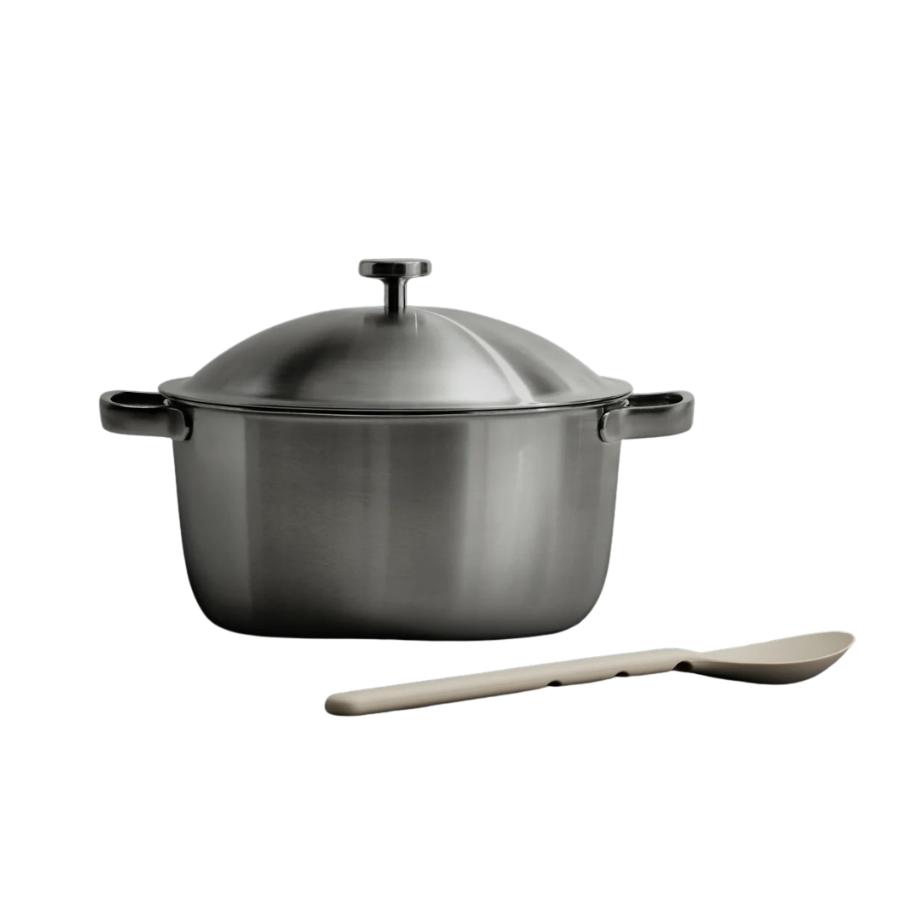
The safest and most useful Our Place option depends on the kind of cooking you do. Ceramic nonstick is convenient for eggs and foods that tend to stick. Titanium offers an uncoated cooking surface, while enameled cast iron provides a different kind of heat retention and cooking experience.
No single material wins every category. The ceramic pan is easier for low-fat cooking and quick cleanup, but it needs more careful handling. Titanium avoids a conventional nonstick coating, while cast iron is heavier and may take longer to heat.
Source: foodandwine.com
Ceramic nonstick
Useful for eggs, pancakes, delicate foods, and easy food release. It needs moderate heat and gentle utensils.
Titanium
An option for shoppers who prefer a cooking surface without a conventional applied nonstick coating. Follow the model’s specific cooking instructions.
Enameled cast iron
Useful for slow cooking, braising, and heat retention. Its enamel surface needs protection from hard impacts.
Which Our Place Material Should You Choose?
Choose ceramic nonstick if your main goal is convenient everyday cooking and you are willing to care for the coating. Choose titanium if you want to avoid a conventional nonstick layer and prefer an uncoated metal cooking surface.
Choose enameled cast iron if you often prepare soups, stews, and braised dishes. If you want a pan that can tolerate years of regular use without relying on a nonstick coating, also compare traditional stainless steel and bare cast iron from other cookware makers.
For eggs and delicate food
Ceramic nonstick may be the most convenient option.
For an uncoated surface
Consider the Titanium Always Pan Pro.
For slow cooking
Consider the enameled cast iron collection.
Is Our Place Cookware Worth Buying for a Health-Conscious Kitchen?
Our Place cookware may suit people who want a modern ceramic nonstick surface without the PFAS chemicals identified in the company’s product claims. The published material information is reassuring for shoppers who want to avoid PTFE, PFOA, lead, and cadmium in their cooking surfaces.
However, safety is only one part of the decision. You should also consider the expected lifespan, cooking style, price, replacement cost, and care routine. A pan that needs gentle handling may not be a good match for someone who cooks over high heat every day.
A useful buying decision starts with the material rather than the brand name. Read the product details, check the exact version, and decide whether the surface suits your normal cooking habits.
The coating needs careful use, hand washing, and replacement if it becomes badly damaged.
Best fit
Home cooks who value easy food release and are comfortable following ceramic cookware care instructions.
Less suitable fit
Cooks who regularly use very high heat, metal utensils, or aggressive cleaning methods.
What Is the Most Important Buying Check?
Check the exact model name and product version before buying. The original Always Pan, Always Pan 2.0, Titanium Always Pan Pro, and Cast Iron Always Pan are not identical products.
Look for the material list, food-contact claims, temperature limits, warranty details, and care instructions. If the manufacturer cannot explain a safety claim clearly, ask for more detailed documentation before relying on it.
Read the materials list
Confirm whether the pan is ceramic-coated, titanium, or enameled cast iron.
Check temperature limits
Make sure the product supports your usual cooking methods.
Review maintenance needs
Decide whether hand washing and soft utensils fit your routine.
Common Mistakes That Can Damage Our Place Cookware
Many cookware problems begin with habits that seem harmless. A pan left empty over a hot burner, a metal fork used to move food, or a rough scrubber used after cooking can shorten the life of a ceramic surface.
The solution is not complicated. Treat a coated pan as a protected cooking surface rather than a piece of bare metal. Small care changes can help preserve its performance.
Heating an empty pan
Avoid this because the pan can heat rapidly and the coating may be damaged.
Using metal utensils
Choose wood or silicone instead.
Using cooking sprays
Follow the brand’s advice to avoid aerosol cooking sprays, which can leave residue and affect cooking performance.
Washing while very hot
Let the pan cool first to avoid sudden temperature changes.
Scrubbing with steel wool
Use a soft sponge rather than abrasive cleaning tools.
Ignoring coating damage
Do not keep using cookware with substantial peeling or flaking without getting replacement guidance.
Research Limits and Questions Worth Checking
The information available for this guide includes Our Place’s published material and care statements, its support information, FDA information about PFAS in food-contact applications, and independent editorial coverage of the Always Pan. These sources provide useful context, but they do not establish that every model has identical construction or that every possible chemical has been tested.
The main unresolved evidence question is the level of public detail available for the company’s third-party test reports. A general statement about independent testing does not let a reader inspect the exact laboratory methods, sample batches, migration conditions, and detection limits.
There is also no single lifespan that applies to every ceramic pan. Actual performance depends on cooking habits, cleaning, storage, and the condition of the coating. A product claim about improved durability should not be treated as a guaranteed service life.
Documented by the manufacturer
The stated materials, named chemical exclusions, model construction, and recommended care practices.
Reported by the manufacturer
Independent laboratory testing and compliance with FDA and LFGB food-contact standards.
Not independently established here
A complete public record of all test results for every cookware model and production batch.
Not established
A universal lifespan or a guarantee that a coating will never wear under normal household use.
Useful Next Questions Before You Buy
The next decision is not simply whether the brand is non-toxic. You should also decide whether ceramic nonstick fits your cooking style and whether you want a coated or uncoated surface. These questions follow naturally from the main safety decision and help prevent a poor purchase.
Does Our Place cookware work on induction?
Check the exact model. The Always Pan 2.0 has a stainless steel base and is listed as induction compatible.
Is Our Place better than stainless steel?
Neither material is universally better. Ceramic offers easier food release, while uncoated stainless steel avoids a ceramic nonstick layer and handles different cooking methods.
Can damaged ceramic cookware be repaired?
A damaged nonstick coating is not something to sand or repaint at home. Contact the manufacturer about replacement.
Can you use Our Place cookware every day?
Yes, the cookware is designed for routine use, provided you follow the model’s care and temperature instructions.
Frequently Asked Questions
Q
Is Our Place Always Pan free of PFAS?
Yes. Our Place states that the Thermakind ceramic coating used on its Always Pan 2.0 is made without PFAS, including PTFE and PFOA. The company also says its food-contact surfaces are made without lead and cadmium.
Q
Does Our Place cookware contain Teflon?
The company’s ceramic nonstick cookware is marketed as PTFE-free. PTFE is the fluoropolymer commonly associated with Teflon nonstick coatings. Check the exact product information when buying a different collection or model.
Q
Is Our Place cookware safe for everyday cooking?
The cookware is designed for regular home cooking when used according to its instructions. Use moderate heat, avoid heating an empty ceramic pan, and protect the cooking surface from scratches and abrasive cleaning.
Q
Does Our Place cookware contain lead or cadmium?
Our Place states that its cookware food-contact surfaces are made without lead and cadmium. The company also reports third-party testing. Buyers who want detailed verification can request the relevant model-specific test documentation.
Q
Is the Our Place Always Pan made of aluminum?
Yes. The Always Pan 2.0 has an aluminum body and a stainless steel base, with a Thermakind ceramic nonstick cooking surface. The aluminum helps the pan heat quickly.
Q
Can Our Place ceramic cookware go in the oven?
The Always Pan 2.0 is listed as oven safe up to 450 degrees Fahrenheit. Check the instructions for your exact model because oven limits and component restrictions can differ across collections.
Q
Is Our Place safer than traditional nonstick cookware?
Our Place ceramic cookware is an option for people who want to avoid PFAS-based nonstick coatings. However, the FDA explains that certain authorized PFAS-based coatings have negligible migration into food under the conditions it reviewed. Safety comparisons should account for the exact material and normal use rather than treating all traditional nonstick pans as equally hazardous.
Q
What should I do if my Our Place pan starts peeling?
Stop using a pan with substantial peeling or flaking and contact the manufacturer for guidance. Do not scrape, sand, or attempt to repair the coating yourself. Ask whether the damage qualifies for warranty support or replacement.
✦ Wrapping Up
Conclusion
So, is Our Place cookware non toxic? Based on the company’s published material information, yes, its cookware is designed without PFAS, PTFE, PFOA, lead, and cadmium in the surfaces that touch food. Its ceramic nonstick collection uses a Thermakind coating over an aluminum body, while other collections use titanium or enameled cast iron.
That makes Our Place a reasonable option for shoppers who want cookware without a traditional PFAS-based nonstick coating. Still, no pan is completely free from maintenance needs. Ceramic surfaces can wear, and high heat, metal utensils, and harsh cleaning can shorten their useful life.
The best decision is to choose the exact model that suits your cooking style, read its current material and care information, and use it within the stated limits. If you want more detailed proof of a safety claim, request the relevant third-party laboratory report rather than relying on a general marketing phrase.
💡 Key Takeaway
Before buying, confirm the exact Our Place model, check its food-contact materials and temperature limits, and follow the care instructions. For a ceramic nonstick pan, use low-to-medium heat, soft utensils, and gentle hand washing.