Yes, ceramic cookware is nonstick. Its smooth ceramic-based coating helps food release with less oil, but its nonstick performance can decline with regular use and poor care.
If you cook breakfast in an American home, you probably want eggs that slide out of a frying pan without leaving half the meal behind. Ceramic cookware can help with that. Its coated surface is designed to reduce sticking, making it useful for eggs, pancakes, fish, vegetables, and other everyday meals.
However, ceramic cookware is not the same as traditional solid ceramic pots or pans. Most products sold as ceramic nonstick cookware have an aluminum or stainless steel body with a thin ceramic-like coating on the cooking surface. This coating creates the smooth finish that helps food release.
There is one detail worth knowing before you buy. Ceramic cookware may offer excellent nonstick performance when new, but its food-release ability can weaken over time. Heat, cooking oil residue, cleaning methods, and daily wear all affect how well the surface works.
This guide explains how ceramic cookware becomes nonstick, what foods it handles well, how it compares with traditional nonstick pans, and how to maintain its surface. It also explains what the word ceramic means on cookware labels so you can make a more informed choice.
Yes. Ceramic cookware is designed to have a nonstick cooking surface. The coating helps reduce the bond between food and the pan, so ingredients can move more easily during cooking.
For example, a fresh ceramic frying pan can cook eggs with only a small amount of butter or oil. Pancakes can also release with less effort, and cooked cheese or sauce may be easier to remove during cleanup.
However, nonstick does not mean that food can never stick. Cooking temperature, moisture, food type, and the condition of the coating all affect the result. Even a new ceramic pan may struggle when used incorrectly.
The most accurate way to describe ceramic cookware is that it offers a nonstick surface with care requirements. It can make daily cooking easier, but it does not provide a permanent guarantee against sticking.
Source: kitchensupports.com
Nonstick food release
The smooth coating helps ingredients move across the cooking surface instead of bonding tightly to it.
Less cooking fat
Many foods can be cooked with less oil or butter than they may need in an uncoated stainless steel pan.
Easier cleanup
Food residue often comes away with warm water, dish soap, and a soft sponge.
Performance changes
The coating can lose some of its food-release ability after repeated overheating, wear, or residue buildup.
What Does Nonstick Mean in Ceramic Cookware?
Nonstick describes a cooking surface that reduces how strongly food attaches to the pan. It does not mean that the surface has zero friction or that ingredients will slide around under every condition.
A ceramic-coated pan uses a smooth finish to help food release. When the surface is clean and in good condition, delicate ingredients are less likely to leave a stubborn layer behind.
Oil is still useful. A small amount can improve cooking results, support even browning, and reduce the chance of food sticking.
Is Ceramic Cookware the Same as Solid Ceramic Cookware?
No. These two terms describe different cookware constructions. Ceramic-coated cookware usually has a metal body covered with a thin ceramic-like cooking layer.
Solid ceramic cookware is made from ceramic material throughout the body. It may have a glazed surface, but its construction and cooking properties differ from those of a metal pan with a ceramic nonstick coating.
This difference matters when shopping. A pan labeled ceramic nonstick is usually not a solid ceramic pan. Always check the construction details instead of relying on the word ceramic alone.
How Does Ceramic Nonstick Cookware Work?
Ceramic nonstick cookware works through a specially applied coating that creates a smooth cooking surface. Most modern ceramic-coated pans use a process called sol-gel technology.
During this process, manufacturers apply a liquid mixture containing silica-based materials and other ingredients to a metal cookware body. The pan is then heated to cure the coating and create a solid ceramic-like layer.
The metal body provides the structure and helps transfer heat. The coating provides the food-release surface. Aluminum is a common base material because it transfers heat well, although some products use other metals.
The coating is usually thin. It is not a thick layer of pottery attached to the pan. Its job is to create a smooth surface while allowing the metal underneath to do much of the heating work.
The Cookware Manufacturers Association describes sol-gel finishes as ceramic coatings. Its technical guide explains that these coatings can have strong initial food release, but their release properties may decline with use because of changes in their surface chemistry.
Source: decorguider.com
Metal cookware body
The aluminum or other metal structure supports the pan and transfers heat to the food.
Ceramic-like coating
The thin outer layer creates the smooth surface used for nonstick cooking.
Curing process
Heat helps turn the applied coating mixture into a solid layer attached to the cookware.
Food release
The finished surface helps reduce sticking and makes many cooking and cleaning tasks easier.
What Is Sol-Gel Technology?
Sol-gel is a method used to create solid coatings from liquid chemical mixtures. The liquid contains materials that react and form a solid network during processing.
In ceramic cookware, this process creates a thin, hard, ceramic-like surface. Silica, which is related to the main material found in sand, is commonly associated with these coating systems.
The term ceramic can sometimes create confusion. A sol-gel coating is not identical to traditional pottery or a thick ceramic vessel. It is a specially made surface applied to another material.
Why Does Ceramic Cookware Release Food?
Food sticks when proteins, sugars, and other ingredients form strong contact with a cooking surface. A smooth nonstick coating helps reduce this contact and makes it easier to move food away from the pan.
Eggs are a useful example. They contain proteins that can attach to an uncoated hot surface. A clean ceramic coating can reduce this problem, especially when the pan is heated gently and lightly greased.
The effect depends on the surface condition. Scratches, burnt oil, and worn areas can create spots where food holds on more firmly.
What Foods Can You Cook in Ceramic Nonstick Pans?
Ceramic nonstick cookware is especially useful for foods that are delicate, soft, or likely to stick. Its smooth surface can make everyday cooking easier without requiring a large amount of cooking fat.
Breakfast foods are among its most practical uses. Eggs, omelets, pancakes, and French toast can cook and release more easily when the coating is clean and the heat is controlled.
It can also handle vegetables, fish fillets, grilled cheese, and small portions of meat. These foods benefit from a surface that makes turning and serving less difficult.
However, ceramic cookware is not ideal for every cooking method. Heavy searing at very high temperatures can shorten the useful life of the coating. An uncoated stainless steel or cast iron pan may be a better choice for repeated high-heat cooking.
Source: alibaba.com
Eggs and omelets
A ceramic frying pan can help eggs release without leaving a thick layer stuck to the bottom.
Pancakes and crepes
The smooth surface makes it easier to turn delicate breakfast foods without tearing them.
Fish fillets
The coating can help reduce sticking when cooking tender fish at a controlled temperature.
Vegetables
Zucchini, peppers, mushrooms, and other vegetables can cook with a small amount of oil.
Grilled cheese
The cooking surface can make it easier to remove toasted sandwiches and melted cheese.
Is Ceramic Cookware Good for Cooking Eggs?
Yes. Eggs are one of the foods that can benefit most from a ceramic nonstick surface. A clean pan with a healthy coating can help scrambled eggs, fried eggs, and omelets release with less effort.
Start with low or medium heat. Add a small amount of butter or cooking oil, then add the eggs once the pan is ready.
Avoid cooking eggs over excessive heat. High temperatures can make the proteins firm too quickly and increase sticking, even on a nonstick surface.
Can You Cook Without Oil in Ceramic Cookware?
Some foods can be cooked without oil in a ceramic pan, especially when the coating is new and the ingredients contain enough natural moisture or fat.
However, oil-free cooking is not guaranteed to work for every recipe. Lean meat, eggs, and delicate foods may stick more easily without some cooking fat.
A small amount of oil is often a better approach. It can improve browning, help food release, and reduce direct contact between ingredients and the cooking surface.
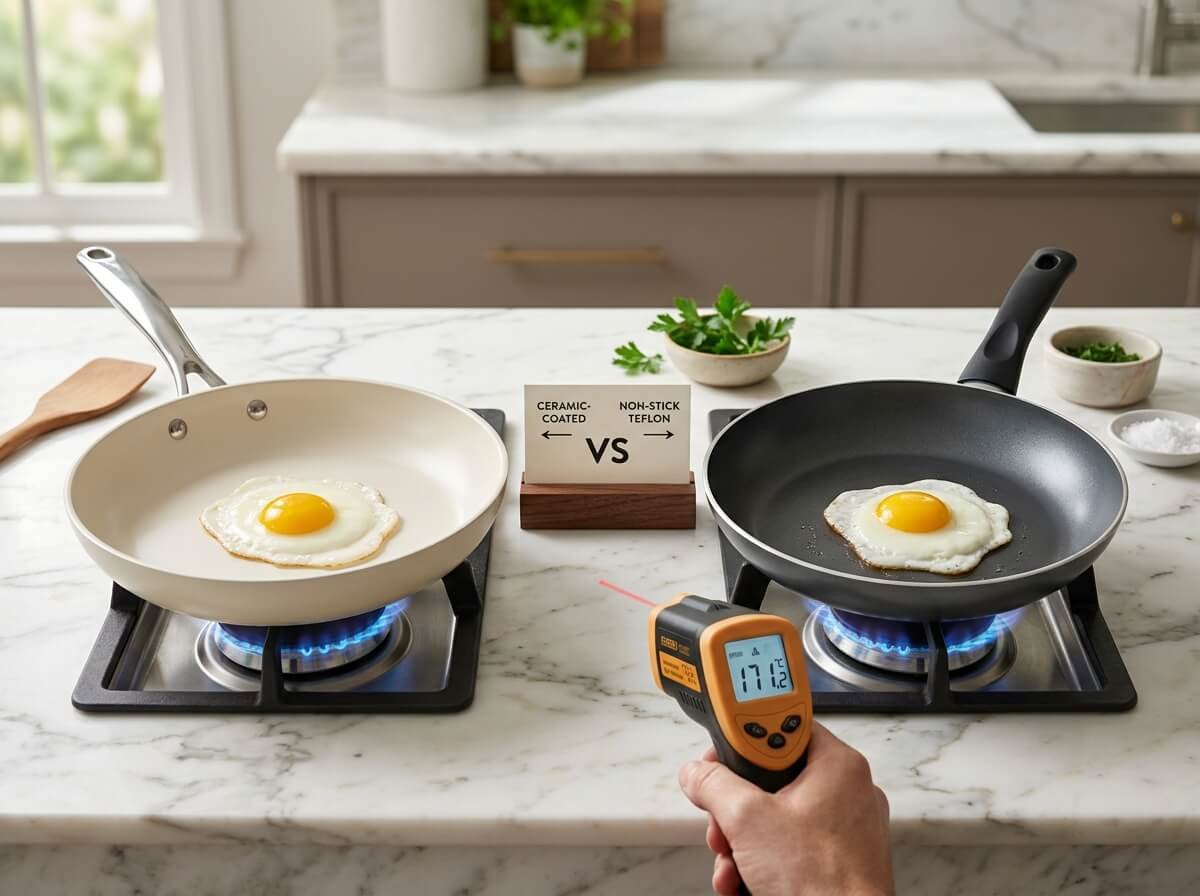
Ceramic Nonstick vs Traditional Nonstick Cookware
Ceramic and traditional nonstick cookware both help food release, but they use different coating technologies. Most traditional nonstick pans use PTFE, a fluoropolymer known for its low-friction surface.
Ceramic nonstick cookware generally uses a sol-gel coating based on ceramic-like materials. Many products are marketed as alternatives to PTFE cookware, particularly for buyers who want a surface made without intentionally added PFAS.
Neither type is automatically better in every kitchen. Ceramic coatings can offer strong initial food release and good stain resistance. PTFE coatings generally maintain their nonstick properties for longer when used and cared for correctly.
The best choice depends on what matters most. Someone who wants to avoid intentionally added fluorinated coatings may prefer a ceramic product with clear material disclosures. Someone who wants long-lasting food release may prefer a well-made PTFE pan.
It is also worth remembering that both types require sensible heat control and proper care. A nonstick pan is not designed to replace every type of cookware.
Source: alibaba.com
Main Differences Between Ceramic and Traditional Nonstick
The following table compares common ceramic-coated and PTFE-coated cookware. These are general material differences, not guarantees for every brand or model.
Coating material
Ceramic nonstick generally uses a sol-gel ceramic-like coating. Traditional nonstick usually uses PTFE.
Initial food release
Both can release food well when new. Ceramic coatings can have particularly strong initial release.
Long-term release
PTFE generally retains its nonstick properties longer under suitable conditions. Ceramic release may decline more noticeably with use.
Heat management
Both benefit from controlled cooking temperatures. Always follow the manufacturer’s heat limits.
PFAS considerations
Many ceramic products are made without intentionally added PFAS, while PTFE belongs to the broader PFAS family of fluorinated materials.
Cleaning
Both benefit from gentle washing and protection against abrasive tools.
Which Type Has Better Nonstick Performance?
For long-term food release, PTFE cookware generally has an advantage. Its low-friction surface can remain effective for a longer period than many ceramic sol-gel coatings.
Ceramic cookware can perform very well when new. However, its food-release ability may gradually decline even when the pan still looks attractive.
This is why buyers should look beyond the first cooking test. A pan that releases eggs perfectly on the first day may not perform the same way after months of frequent use.
Is Ceramic Cookware a Better Choice for Avoiding PFAS?
Ceramic-coated cookware may be a useful option for people who want to avoid intentionally added PFAS in their cooking surface. However, the word ceramic alone does not prove the complete chemical composition of a product.
Check the manufacturer’s material disclosures. Look for clear statements about PTFE, PFAS, and other coating ingredients rather than relying only on broad marketing terms.
The U.S. Food and Drug Administration explains that certain PFAS are authorized for specific food-contact uses, including nonstick cookware coatings. The FDA also reports that the manufacturing process produces highly polymerized coatings with negligible amounts of PFAS capable of migrating to food.
This regulatory information does not mean that every cookware product has the same composition. It is better to evaluate the exact coating and its intended use than to assume that all products in one category are identical.
How Long Does Ceramic Nonstick Cookware Stay Nonstick?
Ceramic cookware does not have a permanent nonstick surface. Its food-release performance can decrease with repeated cooking, especially when the pan is exposed to excessive heat or poor cleaning practices.
There is no single lifespan that applies to every ceramic pan. The coating formula, manufacturing quality, cooking frequency, heat level, and maintenance all affect how long it remains useful.
The Cookware Manufacturers Association’s technical guide explains that sol-gel coatings can have excellent initial release, but their nonstick characteristics may diminish over time. It also notes that proper use and care can affect the rate of decline.
A pan used occasionally for eggs may stay useful longer than one used every day for high-temperature cooking. This is why a fixed lifespan claim should be treated carefully unless it comes from a specific product warranty or documented test.
The practical lesson is simple: ceramic cookware should be treated as a coated cooking tool that needs gentle care. Once food begins sticking regularly despite correct cooking methods and cleaning, the coating may have lost much of its original performance.
Source: ceramices.com
Frequent overheating
Repeated exposure to excessive heat can weaken the coating’s food-release properties.
Empty preheating
Heating an empty pan for too long can expose the coating to unnecessary heat stress.
Abrasive cleaning
Steel wool, harsh scouring pads, and abrasive cleaners can damage the cooking surface.
Oil residue
Burnt or carbonized cooking oil can build up and make a smooth surface feel sticky.
Poor storage
Stacking pans without protection can cause repeated rubbing and surface damage.
Signs That Your Ceramic Pan Is Losing Its Nonstick Ability
A gradual change in cooking performance is often the first sign that a ceramic pan is wearing out. You may notice that eggs no longer slide easily or that food leaves more residue after cooking.
The surface may also become harder to clean. However, sticking does not always mean the coating is permanently damaged. Burnt oil and food residue can create a layer over the original surface.
Food sticks in several areas
Eggs and other delicate foods begin sticking even when you use moderate heat and a small amount of oil.
Cleanup becomes difficult
Normal food residue requires more effort to remove than it did when the pan was new.
Visible coating damage
Peeling, flaking, or deep scratches suggest that the surface may be compromised.
Uneven food release
Some areas release food while other areas repeatedly cause sticking.
Can You Restore a Ceramic Pan That Has Started Sticking?
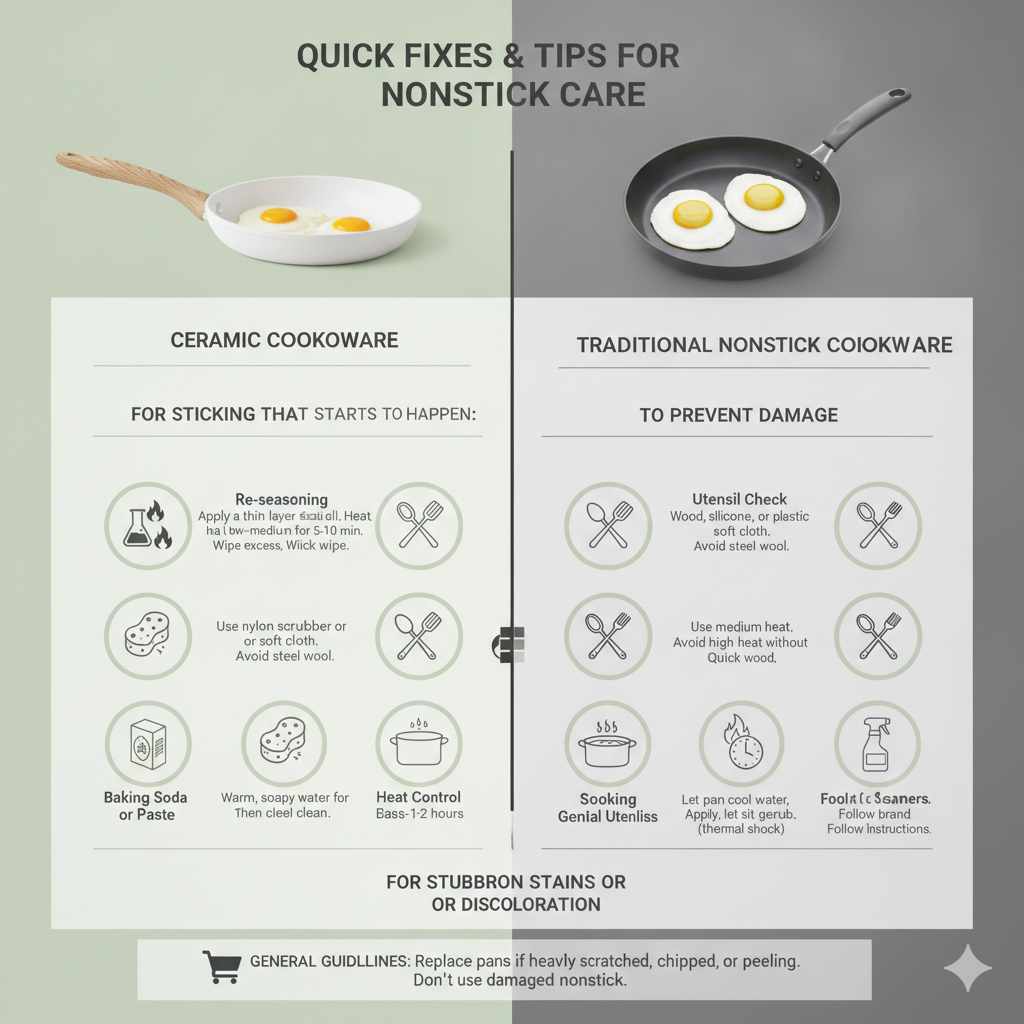
Sometimes. If burnt oil residue is the problem, gentle cleaning may improve food release. Let the pan cool, wash it with warm water and mild dish soap, and use a soft sponge.
Avoid aggressive scrubbing or harsh chemicals. These methods may damage the coating further instead of fixing the problem.
If the coating is peeling, flaking, or visibly damaged, cleaning will not restore the original surface. Follow the manufacturer’s replacement and warranty guidance.
How to Keep Ceramic Cookware Nonstick
The best way to maintain ceramic cookware is to control heat, use suitable utensils, and clean the surface gently. These habits help reduce unnecessary wear and keep food from sticking as quickly.
Ceramic coatings do not need complicated maintenance. A few simple changes to your daily cooking routine can make a meaningful difference.
Start by reading the care instructions for your exact pan. Oven limits, dishwasher guidance, and approved utensils can vary between manufacturers.
Source: safekitchn.com
1. Use Low to Medium Heat
Ceramic nonstick cookware generally works best over low to medium heat. High heat is rarely needed for eggs, pancakes, vegetables, or other common foods.
Excessive heat can damage the coating and reduce its food-release ability. It may also cause food to burn before the center is properly cooked.
For most everyday meals, begin with a moderate setting and adjust the temperature as needed. If cooking oil starts smoking, reduce the heat.
2. Avoid Heating an Empty Pan
Do not leave an empty ceramic pan on a hot burner. An empty pan can heat up quickly, especially on powerful gas or induction cooktops.
Add a little oil, butter, food, or liquid according to the recipe and the manufacturer’s instructions. This helps avoid unnecessary dry heating.
If you accidentally overheat an empty pan, turn off the burner and let the pan cool naturally. Do not place a very hot pan under cold running water.
3. Use Silicone, Wood, or Nylon Utensils
Silicone, wood, and suitable nylon utensils are practical choices for ceramic-coated cookware. They help reduce the chance of scratches caused by sharp metal edges.
Avoid cutting food directly inside the pan. Knives and other sharp tools can damage the coating.
Some manufacturers allow certain metal utensils, but this permission is product-specific. Unless the care guide clearly allows them, softer utensils are the more cautious choice.
4. Wash With a Soft Sponge
Allow the cookware to cool before washing. Use warm water, mild dish soap, and a soft sponge or cloth to remove food and grease.
Do not use steel wool, rough scouring pads, or strong abrasive cleaners. These materials can wear down or scratch the cooking surface.
For stubborn food, soak the cooled pan in warm, soapy water before cleaning. Gentle soaking is usually better than forceful scrubbing.
5. Use Cooking Oil Carefully
A small amount of suitable cooking oil or butter can help food release and improve browning. You do not need to fill the pan with fat to get useful nonstick performance.
Avoid allowing oil to burn repeatedly on the surface. Carbonized oil can form a sticky layer that makes the pan seem less nonstick.
Some manufacturers also advise against aerosol cooking sprays because their additives can leave a residue. Check the care instructions for your particular cookware.
6. Store Pans Without Scratching Them
Do not allow the cooking surface to rub against sharp metal cookware during storage. Repeated contact can cause scratches and surface wear.
If you need to stack pans in a cabinet, place a soft pan protector or clean cloth between them. Keep the coating away from knives and other sharp kitchen tools.
This small storage habit is useful in American kitchens where cabinet space is often limited and cookware is stacked to save room.
Is Ceramic Nonstick Cookware Safe to Use?
Ceramic-coated cookware can be used for everyday cooking when it is made for food contact and handled according to its instructions. However, the word ceramic does not establish the complete safety profile of every pan.
Many ceramic nonstick products are marketed as PTFE-free and PFAS-free. These claims can be useful, but buyers should check the exact product information and distinguish between a coating that contains no intentionally added PFAS and a broad claim about every substance used in manufacturing.
The American Ceramic Society explains that many products marketed as ceramic-coated cookware use sol-gel technology rather than traditional solid ceramic construction. It also discusses concerns about overheating, coating composition, and the fact that some formulas are proprietary.
The practical approach is to use cookware from a manufacturer that provides clear material information, follow its heat limits, and replace a pan when the cooking surface becomes seriously damaged.
Source: mykitchenhints.com
Check the coating description
Look for clear information about PTFE, PFAS, and other materials rather than relying on vague labels.
Follow temperature limits
Use the manufacturer’s recommended cooking and oven temperatures.
Avoid excessive heat
Repeated overheating can damage ceramic-like coatings and reduce their performance.
Replace damaged cookware
Do not continue using a pan with a peeling or flaking cooking surface without checking the manufacturer’s safety guidance.
Does Ceramic Cookware Contain PTFE?
Many ceramic nonstick pans are made without PTFE. Their cooking surface uses a ceramic-like sol-gel coating rather than the fluoropolymer used in traditional nonstick pans.
However, ceramic is a broad marketing term. Check the manufacturer’s technical information for the exact product rather than assuming that every pan labeled ceramic has an identical formula.
If avoiding PTFE is your main concern, look for an explicit PTFE-free statement supported by product documentation.
Does Ceramic Cookware Contain PFAS?
Many ceramic-coated pans are sold as PFAS-free. PFAS refers to a large group of fluorinated chemicals, so the term covers more than one substance.
PTFE is part of the broader PFAS family. A product that is explicitly made without intentionally added PFAS is different from a traditional PTFE-coated pan.
Still, marketing claims should be checked carefully. Ask whether the claim applies to the entire coating, the cooking surface, or only selected ingredients.
Can Ceramic Cookware Release Harmful Fumes?
Do not assume that a ceramic coating can be overheated without consequences. Excessive heat can damage the coating and may cause unwanted changes in its materials.
The exact effects depend on the coating formula and temperature. There is not enough product-specific information to make one universal statement about every ceramic cookware formulation.
Use the pan within its stated temperature limits, avoid prolonged empty heating, and stop using cookware that shows signs of serious coating failure.
Common Reasons Ceramic Cookware Starts Sticking
When ceramic cookware stops releasing food, the problem may be related to cooking technique, residue, or coating wear. Replacing the pan immediately is not always necessary, but the cause should be identified first.
Begin with the simplest checks. Look for burnt oil, change the heat setting, and review how the pan is cleaned. If the surface is visibly damaged, do not try to repair it with aggressive scrubbing.
Source: kitchensupports.com
The pan is too hot
Excessive heat can cause food to burn and can weaken the coating’s nonstick properties. Use a lower setting.
The surface has oil buildup
Repeatedly heated cooking oil may leave a sticky film. Let the pan cool and clean it gently with warm soapy water.
The pan is completely dry
Some foods release more easily with a small amount of oil or butter. Add a little cooking fat when appropriate.
The coating is scratched
Damaged areas may hold food more firmly. Review the manufacturer’s advice and consider replacing the pan.
The food was moved too soon
Some ingredients need time to cook before they release naturally. Use moderate heat and avoid forcing delicate food away from the surface.
How to Troubleshoot a Ceramic Pan That Sticks
If eggs or other foods begin sticking, try a simple sequence before deciding that the coating has failed.
First, let the pan cool and wash it with mild soap and a soft sponge. Next, dry it fully and use a small amount of oil during your next cooking session.
Cook at low or medium heat and allow the ingredients to set before turning them. If food still sticks across several cooking sessions, inspect the coating for scratches, peeling, or other damage.
If the surface is damaged, follow the manufacturer’s replacement guidance rather than trying to restore it with abrasive products.
Check the heat
Lower the burner setting and avoid prolonged empty preheating.
Clean the surface
Remove possible grease buildup with warm water, mild soap, and a soft sponge.
Use a little oil
Apply a thin amount of suitable cooking fat when the recipe needs it.
Inspect the coating
Look for visible peeling, deep scratches, or other signs of deterioration.
Advantages and Disadvantages of Ceramic Nonstick Cookware
Ceramic nonstick cookware has several useful features, but it also has limitations. Understanding both sides can help you decide whether it fits your daily cooking routine.
Its biggest strength is convenient food release. Its main drawback is that the nonstick performance may decline faster than that of many traditional PTFE-coated pans.
Source: decorguider.com
Advantage: Easy food release
The smooth surface helps cook delicate foods such as eggs, pancakes, and fish with less sticking.
Advantage: Easier cleanup
Food residue often washes away with mild soap and a soft sponge.
Advantage: Reduced need for cooking fat
Many meals can be prepared with a smaller amount of oil or butter.
Advantage: Alternative coating technology
Many ceramic products are made without intentionally added PTFE or PFAS, depending on the exact formulation.
Disadvantage: Declining food release
The nonstick surface may lose some of its original performance as the pan ages.
Disadvantage: Heat sensitivity
Repeated overheating can shorten the useful life of the coating.
Disadvantage: Care requirements
Gentle washing, suitable utensils, and careful storage are needed to reduce surface wear.
Disadvantage: Not ideal for every cooking task
Repeated high-heat searing and heavy-duty cooking may be better suited to stainless steel or cast iron.
Who Should Consider Ceramic Cookware?
Ceramic cookware can suit people who prepare everyday meals and want a smooth surface for delicate ingredients. It can be especially convenient for quick breakfasts, light frying, and simple weeknight dinners.
It may also appeal to buyers who want an alternative to PTFE-coated cookware and can find a product with clear material disclosures.
However, people who cook over high heat most of the time or want the longest possible nonstick lifespan may prefer another material.
Who Should Consider Another Cookware Material?
If you often sear steaks, brown meat at high temperatures, or use metal utensils freely, stainless steel or cast iron may be more practical.
These materials do not depend on a thin nonstick coating for their main cooking function. They can also handle cooking methods that are less suitable for many ceramic-coated pans.
The trade-off is that uncoated cookware requires more attention to preheating, temperature, and food release.
How to Choose Ceramic Nonstick Cookware
Choosing ceramic cookware involves more than checking whether the product says nonstick. Look at the construction, coating disclosures, heat limits, cooktop compatibility, and care instructions.
A clear product description helps you understand what you are buying and how to use it. Avoid relying only on phrases such as natural, healthy, green, or nontoxic because these words do not explain the complete material composition.
Source: ceramices.com
Check the base material
Look for information about aluminum, stainless steel, or another material used to make the pan body.
Read the coating disclosure
Check whether the manufacturer identifies the coating as PTFE-free or PFAS-free and explains what those claims cover.
Confirm cooktop compatibility
Make sure the pan is suitable for your gas, electric, glass, or induction cooktop.
Review oven limits
Check the maximum oven temperature for both the pan and its lid or handles.
Read cleaning instructions
Confirm whether the pan requires hand washing and which utensils are allowed.
Review the warranty
Understand what coating wear or manufacturing defects are covered and which conditions are excluded.
Does Ceramic Cookware Work on Induction Stoves?
Some ceramic-coated pans work on induction cooktops, but the ceramic coating itself does not make a pan induction-compatible.
Induction cooking requires a suitable magnetic base. Many ceramic-coated pans use aluminum bodies, so manufacturers may add a magnetic stainless steel plate to the bottom.
Check the product specifications for explicit induction compatibility. A magnet test on the base can also help identify whether the cookware contains a suitable magnetic layer, but the manufacturer’s instructions remain the best reference.
Why the Pan Body Matters
The body material affects heat transfer, weight, and cooking behavior. Aluminum is common because it heats efficiently and is relatively light.
The coating and the pan body perform different jobs. A good coating does not automatically mean that the cookware has a thick, sturdy, or evenly heated base.
For this reason, consider the complete construction instead of judging a pan by its cooking surface alone.
Ceramic Cookware Compared With Stainless Steel and Cast Iron
Ceramic nonstick, stainless steel, and cast iron serve different purposes. Ceramic focuses on easy food release, while stainless steel and cast iron offer durable uncoated cooking surfaces.
Stainless steel is useful for browning meat, making pan sauces, and cooking at higher temperatures when used correctly. Cast iron holds heat well and can develop a naturally seasoned surface with regular use.
Ceramic-coated cookware is often more convenient for delicate foods and quick cleanup. However, its coating has a limited working life and needs more careful handling.
Source: alibaba.com
Ceramic-coated cookware
Best suited to delicate foods and everyday cooking when easy food release is the main priority.
Stainless steel cookware
Useful for browning, searing, pan sauces, and long-term use without a nonstick coating.
Cast iron cookware
Useful for heat retention, browning, frying, and cooking methods that benefit from a heavy pan.
Can Ceramic Cookware Replace All Your Pans?
Ceramic cookware can handle many everyday meals, but it may not replace every pan in a well-equipped kitchen.
A small ceramic frying pan can be useful for eggs and pancakes. A stainless steel skillet can handle searing and pan sauces, while a cast iron pan can provide strong heat retention.
Using different materials for different tasks can be more practical than expecting one coated pan to do everything.
Frequently Asked Questions
Q
Is ceramic cookware naturally nonstick?
Ceramic cookware is designed to have a nonstick surface, but its performance comes from an applied coating rather than from every ceramic material being naturally nonstick. Most ceramic-coated pans use a metal body with a thin sol-gel coating that helps food release.
The surface may perform very well when new, but its nonstick properties can decline with repeated use and overheating.
Q
Does ceramic cookware need oil?
Ceramic cookware does not always need oil, but using a small amount is often helpful. Oil or butter can improve food release, support browning, and reduce direct contact between food and the cooking surface.
For foods such as eggs and lean meat, a little cooking fat can make a noticeable difference. Follow the manufacturer’s care instructions for the best results.
Q
Is ceramic nonstick better than regular nonstick?
It depends on your priorities. Ceramic nonstick cookware can appeal to people who want a coating made without intentionally added PTFE or PFAS, provided the manufacturer confirms the claim.
Traditional PTFE nonstick cookware generally retains its food-release properties longer. Ceramic may offer strong initial release, but its performance can decline sooner. Neither type is automatically the best choice for every household.
Q
Can ceramic cookware go in the dishwasher?
Some ceramic-coated pans are labeled dishwasher safe, while others require hand washing. The answer depends on the specific product and its construction.
Even when dishwasher use is allowed, hand washing with warm water, mild dish soap, and a soft sponge is a gentle option that may help preserve the coating. Always follow the manufacturer’s instructions.
Q
Can ceramic cookware lose its nonstick coating?
Yes. Repeated overheating, scratches, abrasive cleaning, and normal wear can reduce the coating’s food-release performance.
The surface may become less effective even if the pan still looks attractive. If the coating begins peeling or flaking, stop using the pan and follow the manufacturer’s replacement guidance.
Q
Is ceramic cookware safe for cooking eggs?
Yes. Ceramic nonstick pans are commonly used for eggs, omelets, and other delicate breakfast foods. Their smooth surface can help prevent food from sticking.
Use low or medium heat and a small amount of butter or oil. Avoid heating an empty pan for long periods because excessive heat can reduce coating performance.
Q
Can you use metal utensils on ceramic nonstick cookware?
It depends on the manufacturer’s instructions. Some ceramic-coated pans allow selected metal utensils, but others recommend wood, silicone, nylon, or plastic tools.
Softer utensils are generally a cautious choice because they reduce the chance of scratches and surface damage. Avoid knives and sharp-edged tools on the coating.
Q
Why does my new ceramic pan stick?
A new ceramic pan may stick if the heat is too high, the surface is dirty, the food is moved too soon, or the recipe needs a little cooking fat.
Wash the pan before its first use, dry it, and cook at low or medium heat. Add a small amount of oil when appropriate and avoid prolonged empty preheating.
✦ Wrapping Up
Conclusion
Yes, ceramic cookware is nonstick. Its smooth ceramic-like coating helps food release with less oil and makes everyday cooking and cleanup easier. It can be especially useful for eggs, pancakes, fish, vegetables, and other delicate foods.
However, ceramic nonstick cookware is not permanently nonstick. Its performance can decline with frequent overheating, poor cleaning, surface damage, and normal wear. It also does not mean that the entire pan is made from solid ceramic.
The best way to get good results is to use low or medium heat, avoid heating an empty pan, choose gentle utensils, and clean the surface with mild soap and a soft sponge. Check the product’s material disclosures and care instructions before buying or using it.
For people who want easy food release and a coating made without intentionally added PFAS, ceramic cookware may be worth considering. For those who value longer-lasting nonstick performance, a traditional PTFE pan may be a better fit. Stainless steel and cast iron remain useful alternatives for high-heat cooking.
💡 Key Takeaway
Before buying ceramic nonstick cookware, check its coating ingredients, metal base, cooktop compatibility, temperature limits, and care instructions. Once you own it, use moderate heat, a little cooking oil when needed, soft utensils, and gentle cleaning to help maintain its nonstick performance.