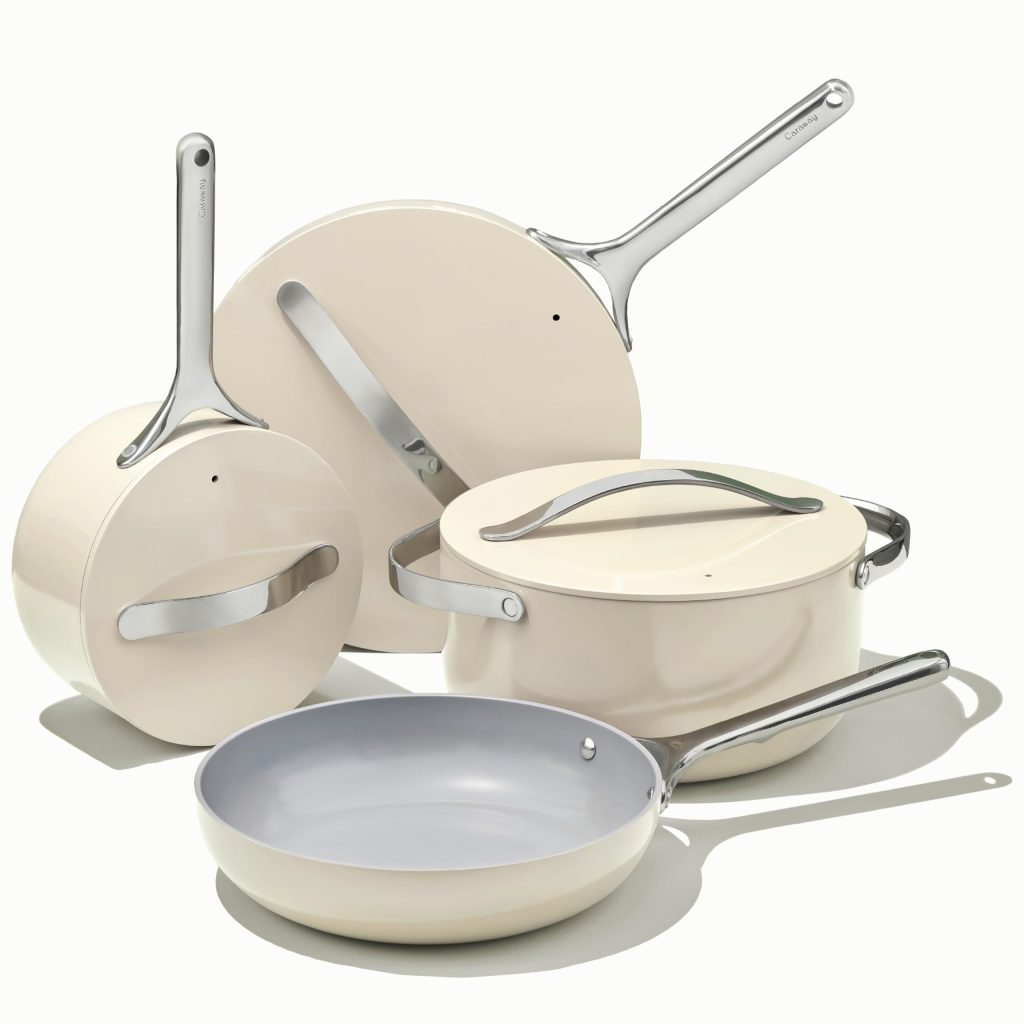
Yes, Caraway cookware is generally considered a safe option for everyday cooking when used and maintained according to the manufacturer’s instructions.
For American families, choosing safe cookware is about more than finding a pan that makes cooking easy. People want to know whether the surface can release harmful chemicals, whether high heat creates dangerous fumes, and whether worn coatings can affect the food they serve. These concerns matter in everyday US kitchens, where people use nonstick pans for eggs, vegetables, meat, and quick weeknight meals.
Caraway cookware uses a ceramic-based nonstick coating over a metal pan body. The company states that its ceramic cooking surfaces are made without intentionally added PFAS, including PTFE and PFOA, as well as lead and cadmium. Caraway also reports that independent laboratories test its food-contact materials. These features make the cookware appealing to people who want a nonstick option without traditional fluoropolymer coatings.
However, safe materials do not mean a pan can withstand every cooking habit. Caraway recommends low to medium stovetop heat, gentle utensils, and hand washing. Excessive heat, rough cleaning, and scratches can reduce the coating’s performance and shorten the useful life of the pan.
This guide examines Caraway’s material claims, ceramic coating, possible health concerns, heat limits, and daily care instructions. It also explains what the available evidence establishes and what shoppers should not assume from marketing terms such as non-toxic or chemical-free.
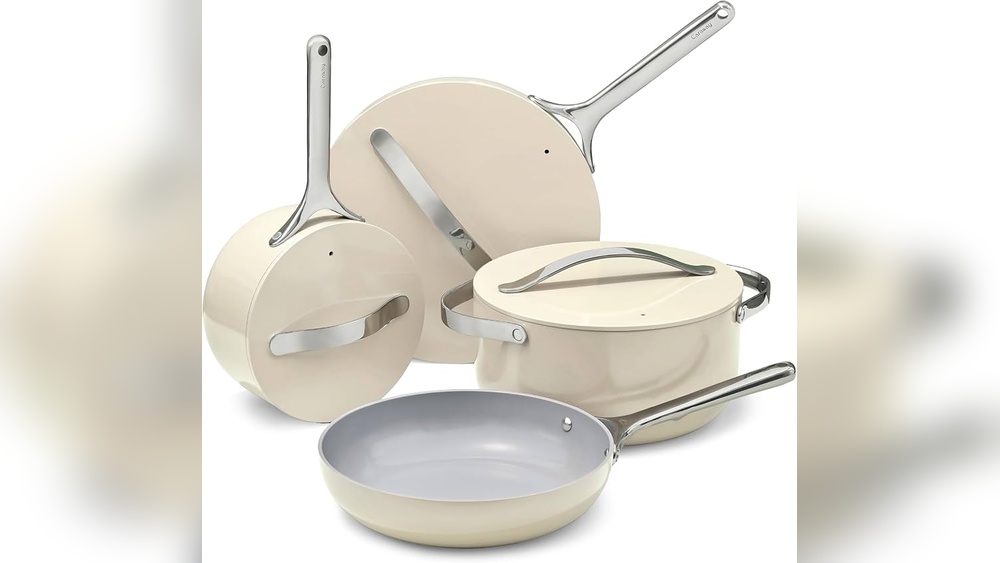
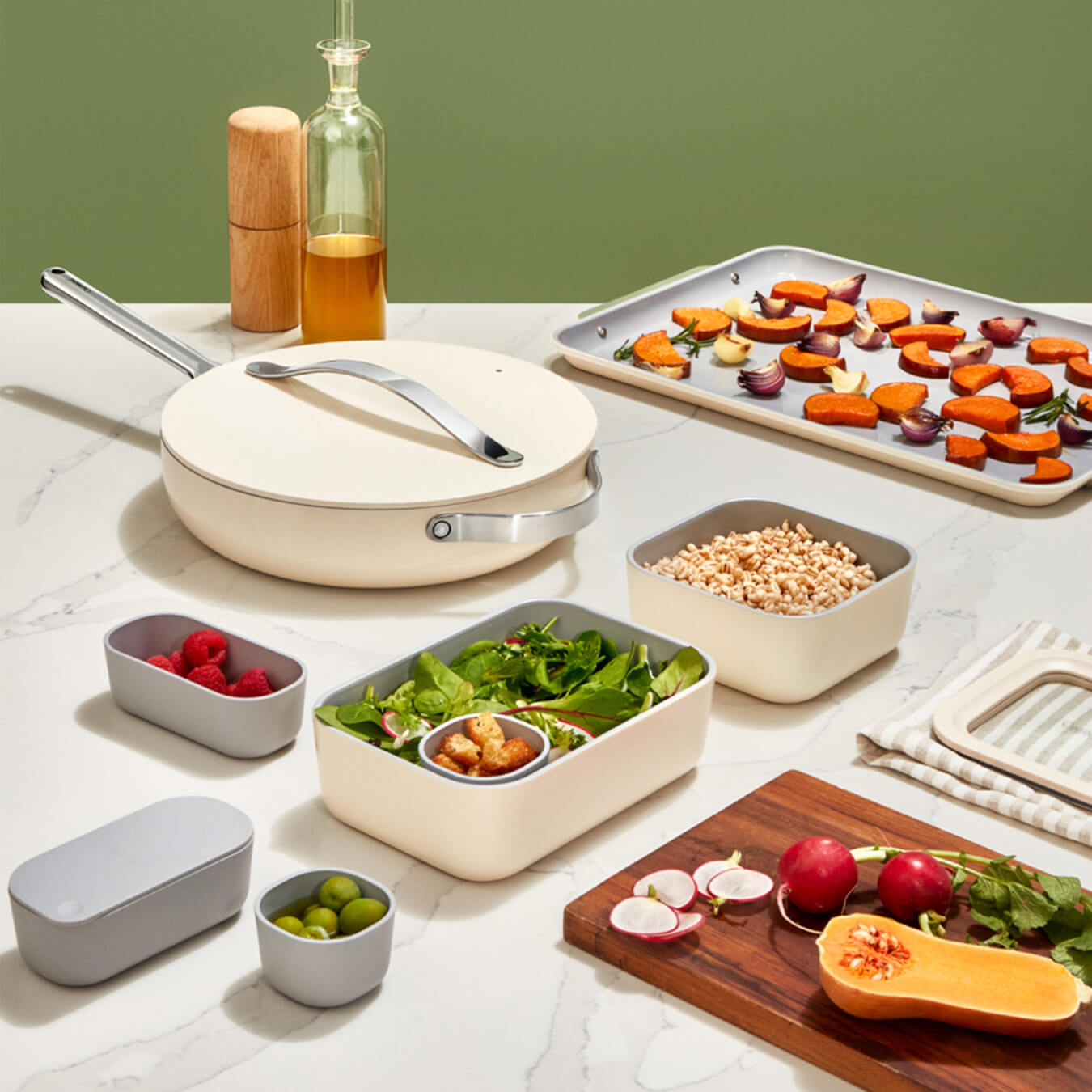
Caraway cookware combines a metal body with a ceramic-based nonstick cooking surface. The standard nonstick collection uses a mineral-based coating designed to make food release easier without relying on traditional PTFE nonstick technology.
The metal body provides the structure needed to hold and distribute heat. The ceramic coating creates the smooth cooking surface that comes into contact with food. These two parts have different jobs, so understanding both helps explain the product’s safety and performance.
According to Caraway’s materials information, the company uses inorganic ingredients in its proprietary ceramic coating. It also states that the cooking surface is made without intentionally added PFAS, PTFE, PFOA, lead, and cadmium.
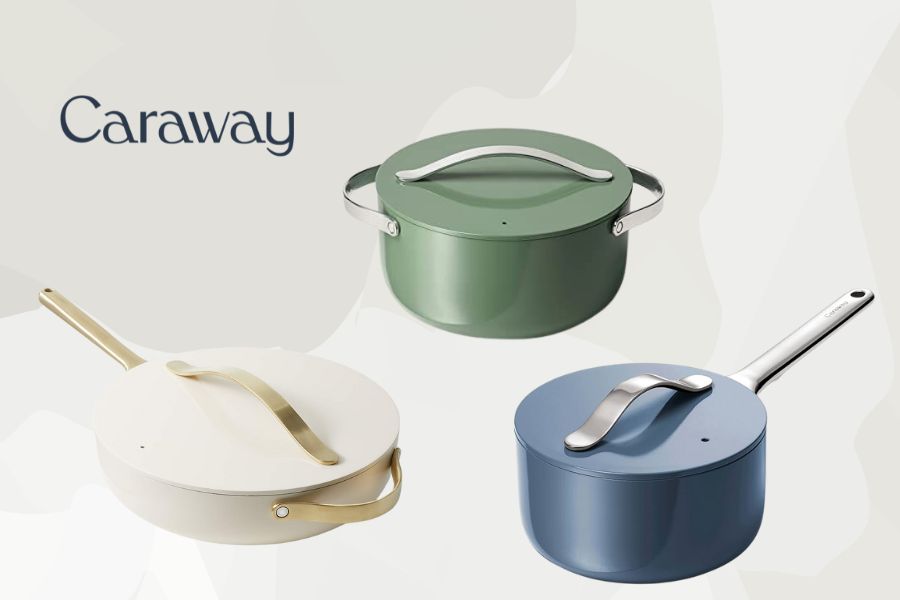
The brand also sells other cookware materials, including stainless steel and enameled cast iron. These products have different construction methods and should not be confused with its signature ceramic-coated nonstick pans.
Source: cookwareguider.com
Metal body
Provides the main structure of the pan and helps transfer heat from the stovetop to the food.
Ceramic nonstick surface
Creates a smooth cooking layer that helps food release with a smaller amount of oil or butter.
Stainless steel components
Used in parts such as handles and other structural components, depending on the product.
Glass lids
Allow cooks to monitor food while keeping heat and moisture inside the pan.
Is Caraway Ceramic Coating Real Ceramic?
Caraway’s coating is a ceramic-based nonstick finish, not a thick piece of solid ceramic like a traditional ceramic baking dish. It is a thin surface layer applied to the metal cookware body.
This distinction matters because ceramic-coated cookware behaves differently from solid ceramic cookware. The coating can gradually lose its nonstick performance through repeated heating, cooking, washing, and contact with utensils.
The term ceramic describes the type of cooking surface. It does not mean the entire pan is made from clay, porcelain, or solid ceramic.
Ceramic-coated metal
A metal pan with a ceramic-based nonstick finish.
Solid ceramic cookware
A different cookware category made from ceramic material throughout the main cooking vessel.
Does Caraway Contain Aluminum?
Caraway’s standard cookware uses a metal construction, and aluminum may be part of the body or heat-distribution structure, depending on the collection and model. Shoppers should check the exact product specifications rather than assume every Caraway pan has the same internal construction.
The presence of aluminum in a pan does not automatically make it unsafe. The cooking surface and the way the product is manufactured are important parts of the safety assessment.
A properly manufactured and intact food-contact coating separates food from the underlying metal during normal use. If the coating becomes badly damaged, stop using the pan and ask the manufacturer about the correct replacement options.
Is Caraway Cookware Free From PFAS, PTFE, and PFOA?
Caraway states that its ceramic nonstick cooking surfaces are made without intentionally added PFAS, including PTFE and PFOA. This is one of the main reasons people consider the brand when looking for an alternative to conventional nonstick cookware.
PFAS stands for per- and polyfluoroalkyl substances. It is a broad group of chemicals used in many products because of their resistance to heat, water, oil, and stains. Some traditional nonstick coatings use fluoropolymers that belong to this broad chemical group.
PTFE is a fluoropolymer commonly associated with traditional nonstick pans. PFOA is a different PFAS chemical that was historically used in the production of some fluoropolymer products. These terms are related, but they do not mean the same thing.
Caraway says its ceramic coating does not use these substances. The company also provides information about third-party testing and links to laboratory reports for its food-contact materials. This offers shoppers more information than a simple marketing statement, although readers should review the actual report and its product scope when evaluating a specific item.
Source: images.ctfassets.net
PFAS
A large family of chemicals with different properties and uses. Caraway says its ceramic coating is made without intentionally added PFAS.
PTFE
A fluoropolymer used in many traditional nonstick surfaces. Caraway says it does not use PTFE in its ceramic coating.
PFOA
A chemical historically associated with certain fluoropolymer manufacturing processes. Caraway says its coating is made without PFOA.
Lead and cadmium
Toxic metals that can pose health concerns if they migrate into food. Caraway states that its cooking surfaces are made without these substances.
Why Does PFAS-Free Cookware Matter?
PFAS is a large chemical family, and different members have different properties and uses. Some PFAS have raised environmental and health concerns because certain chemicals can persist in the environment and remain in the human body for long periods.
Choosing a cookware surface made without intentionally added PFAS can help consumers avoid a category of materials they prefer not to use in their kitchens. It is a reasonable material preference, especially for people who want ceramic nonstick cookware.
Still, PFAS-free does not mean that a product has no chemicals or that every possible health concern has been eliminated. Ceramic coatings are manufactured materials, and safety depends on their composition, quality, and intended use.
Does Caraway Release Toxic Fumes When Heated?
Caraway’s ceramic coating is not based on PTFE, so it avoids the specific overheating concern associated with severely overheated PTFE-coated cookware. The company also says its ceramic surface does not release harmful fumes during normal cooking.
However, no pan should be heated without care. Excessive heat can damage a ceramic coating, burn cooking oil, and create smoke from food residue. These problems can affect indoor air quality even when the cookware itself does not contain PTFE.
For this reason, use low to medium heat and avoid leaving an empty pan over a hot burner. If food or oil begins to smoke, lower the heat and improve kitchen ventilation.
Does PFAS-Free Mean Completely Chemical-Free?
No. Everything made from physical materials contains chemicals in the scientific sense. Water, salt, glass, metals, and ceramic materials all have chemical compositions.
The useful question is whether a product contains substances of concern, whether those substances can migrate into food, and whether the product remains safe under its intended conditions of use.
A more precise description of Caraway is PFAS-free ceramic-coated cookware, based on the manufacturer’s stated formulation and testing information. Calling it completely chemical-free would be inaccurate.
What Does Third-Party Testing Say About Caraway Cookware Safety?
Third-party testing is useful because it gives buyers information beyond the manufacturer’s own product description. Caraway has a dedicated testing page that says independent laboratories test materials that come into contact with food.
The company reports that its cookware and bakeware are made without PFAS, including PTFE and PFOA. Its materials page also describes testing for hundreds of types of chemicals and provides access to laboratory testing information.
This is a positive sign for shoppers who want to check material claims. However, a testing statement should always be read within its proper scope. A laboratory report may cover specific samples, substances, and test conditions rather than every product in every production batch.
A report that finds certain chemicals below a laboratory’s detection limits does not prove that every possible substance is absent. It also does not establish that a pan will remain undamaged under misuse or that its nonstick properties will last forever.
The most useful approach is to examine the manufacturer’s published test reports, confirm the product or material covered, and read the testing method. This is more reliable than depending only on broad phrases such as clean, green, or non-toxic.
Source: myfire.place
Look for the tested product
Check whether the report covers the exact cookware material or product category you plan to purchase.
Check the substances tested
A PFAS test does not automatically cover every heavy metal, contaminant, or chemical that could be relevant.
Read the test method
The testing method helps explain what a result can establish and which conditions it does not cover.
Check the report date
Recent documentation can help shoppers understand whether the information applies to the current product formulation.
Does the FDA Approve Caraway Cookware?
It is important to distinguish a manufacturer’s statement about FDA-compliant ingredients from an FDA endorsement of a finished cookware brand. These are not the same thing.
The US Food and Drug Administration regulates substances used in food-contact applications and can take action when cookware presents a food safety concern. Its rules and guidance help establish requirements for materials that come into contact with food.
Caraway describes its ceramic coating ingredients as FDA-approved. That statement should not be interpreted as proof that the FDA has independently certified every Caraway pan or endorsed the brand as a whole.
Consumers can use FDA information to understand food-contact safety rules while using the manufacturer’s test reports to evaluate the specific product claims.
What Can Independent Testing Actually Prove?
Testing can provide evidence about the presence or absence of specific substances in the samples examined. It can also help determine whether a material meets a particular testing standard or limit.
Testing cannot automatically predict every condition that might occur after years of cooking. It does not replace proper care, product instructions, or an inspection of a worn cooking surface.
For a practical safety decision, combine material information, test documentation, product condition, and correct use. No single marketing claim should replace these checks.
Is Caraway Cookware Safe at High Temperatures?
Caraway cookware is suitable for everyday stovetop cooking when used within its recommended heat range. The company advises using its ceramic-coated pans on low to medium heat rather than relying on high heat for faster cooking.
According to Caraway’s care instructions, its ceramic-coated cookware has a maximum oven temperature of 550°F. This rating applies to the cookware category described in the manufacturer’s instructions, but buyers should always confirm the limits for their exact model, lid, and accessories.
The oven rating should not be confused with the recommended stovetop setting. A pan that can tolerate a specified oven temperature is not necessarily designed for prolonged high-heat frying on a burner.
Ceramic cookware can retain heat well. A moderate burner setting is often enough to cook eggs, vegetables, fish, chicken, and other everyday foods. High heat can damage the nonstick surface and reduce its useful life.
Source: bunny-wp-pullzone-nvkqn8qorh.b-cdn.net
Low heat
Useful for gently warming food, melting butter, and preparing delicate dishes.
Medium heat
Suitable for many common cooking tasks, including eggs, vegetables, and everyday sautéing.
High heat
Not recommended for regular stovetop use with Caraway’s ceramic nonstick cookware because excessive heat can damage the coating.
Oven use
The manufacturer lists a maximum oven temperature of 550°F for its ceramic-coated cookware. Check the exact product instructions before use.
Can You Use Caraway Cookware on a Gas Stove?
Yes. Caraway states that its cookware is compatible with gas, electric, and induction stovetops. The important point is to control the flame and avoid allowing it to extend beyond the bottom of the pan.
An oversized gas flame can heat the sides and exterior more than needed. It can also make handles and nearby surfaces hotter. Use a burner that matches the size of the cookware whenever possible.
Keep the pan centered on the burner and use a moderate flame. These simple steps help control heat and protect the cookware.
Can You Use Caraway Cookware on an Induction Stove?
Caraway states that its cookware is induction compatible. Its metal base is designed to work with induction heating, which uses a magnetic field to heat suitable cookware.
However, compatibility can depend on the specific product and cooktop. Check the cookware’s product details and the induction stove manufacturer’s instructions before cooking.
For safe use, begin with a low setting and increase the heat gradually. This is especially useful when cooking with a ceramic nonstick surface.
Can You Put Caraway Pans in the Oven?
Yes, the manufacturer lists an oven limit of up to 550°F for its ceramic-coated cookware. This makes the pans useful for recipes that begin on the stovetop and finish in the oven.
Before using a pan in the oven, check the instructions for the exact model. Lids, handles, and accessories may have different limits, and not every Caraway product belongs to the same cookware collection.
Always use oven mitts when handling hot cookware. Metal handles can become very hot, even when they look cool or have a familiar shape.
Can Scratched or Damaged Caraway Cookware Be Dangerous?
A scratched ceramic pan deserves attention, but a small surface mark does not automatically mean that the food is toxic. The main concern is that damage can weaken the cooking surface, reduce nonstick performance, and expose more of the underlying pan body.
Ceramic nonstick coatings can wear down through daily cooking. Repeated use of metal utensils, abrasive cleaning pads, high heat, and sudden temperature changes can speed up that process.
A pan with severe peeling, flaking, or exposed metal should not remain in regular use. Although Caraway states that its coating is made without certain chemicals of concern, that claim does not mean a badly damaged pan should be used indefinitely.
The safest practical response is to inspect the cooking surface regularly. If the finish has begun to break apart or pieces are coming loose, stop cooking with the pan and contact the manufacturer about replacement options.
Source: thefascination.com
Light surface marks
May be cosmetic, but inspect the area carefully and avoid using sharp utensils or abrasive cleaners.
Loss of nonstick performance
Food begins sticking more often, suggesting that the coating may be wearing down.
Visible peeling
A reason to stop using the pan and seek guidance from the manufacturer.
Exposed metal
Indicates significant surface damage and is a good reason to retire the pan from cooking.
Loose coating particles
Stop using the cookware rather than attempting to repair or cover the damaged area.
What Happens When Ceramic Coating Wears Away?
When a ceramic nonstick surface wears down, food can begin sticking to the pan. This makes cooking less convenient and can make cleaning more difficult.
The underlying metal may become exposed in damaged areas. The safety implications depend on the pan’s construction and the condition of the remaining surface, so it would be inaccurate to claim that every scratch releases harmful substances.
If the surface is flaking or peeling, replacement is the sensible option. Do not sand, scrape, or attempt to recoat the pan at home.
How Often Should You Replace Caraway Cookware?
There is no fixed replacement schedule that applies to every household. A pan used occasionally with gentle utensils may retain its coating longer than one used every day over high heat.
Replace a pan when the coating is visibly breaking down, peeling, or exposing the underlying material. Persistent sticking alone may indicate wear, even when the surface looks mostly intact.
A replacement decision should depend on the actual condition of the cookware, not an arbitrary number of months or years.
How to Use Caraway Cookware Safely Every Day
The best way to protect Caraway cookware is to follow a few simple habits. Gentle heat, suitable utensils, and careful cleaning help maintain the ceramic surface and reduce unnecessary wear.
You do not need complicated equipment or special chemicals to care for these pans. Most of the work involves avoiding habits that can damage any ceramic nonstick coating.
Source: i.ytimg.com
Wash before the first use
Use warm water, mild dish soap, and a soft sponge to remove dust or residue from manufacturing and shipping.
Preheat gently
Follow the manufacturer’s guidance for short preheating on low to medium heat. Avoid leaving an empty pan on a hot burner.
Use a small amount of oil
A light coating of suitable cooking oil or butter can help food release and support everyday cooking.
Choose soft utensils
Use silicone, wood, nylon, or suitable plastic tools instead of sharp metal utensils.
Let the pan cool
Allow the cookware to cool before washing to reduce the risk of damage from sudden temperature changes.
Wash by hand
Clean with warm, soapy water and a non-abrasive sponge, then dry before storing.
Which Cooking Utensils Are Safe for Caraway Pans?
Wooden and silicone utensils are among the best choices for ceramic nonstick cookware. They can turn eggs, stir sauces, and move vegetables without the rough contact that sharp metal tools may create.
Nylon utensils are another practical option when they are rated for the cooking temperature. Plastic tools should also be heat-resistant and suitable for cookware use.
Avoid knives, metal forks, sharp-edged spatulas, and tools that scrape against the surface. Cutting food directly inside the pan is also a bad habit because it can damage the finish.
Wood
A gentle option for stirring and turning food.
Silicone
Flexible and useful for scraping food without sharp edges.
Nylon
Suitable for many everyday tasks when rated for the cooking temperature.
Metal
Best avoided because rough or sharp edges can damage the ceramic coating.
Is Caraway Cookware Dishwasher Safe?
Caraway recommends hand washing its ceramic-coated cookware. Although a dishwasher may seem convenient, strong detergents, repeated hot-water exposure, and contact with other dishes can wear down the finish over time.
Hand washing is simple. Let the pan cool, rinse away loose food, and clean it with warm water, mild dish soap, and a soft sponge.
For stubborn food, the manufacturer recommends using warm soapy water and gently cleaning the affected area. Avoid steel wool, harsh scouring pads, and abrasive powders.
Should You Use Cooking Spray on Caraway Pans?
Caraway advises against oil sprays and cooking aerosols on its ceramic nonstick cookware. Some sprays can leave a residue that becomes difficult to remove and may affect the surface’s nonstick performance.
A small amount of liquid cooking oil or butter is a better choice. Spread it lightly across the cooking surface rather than using a heavy coating.
You do not need to use excessive oil to make the pan work. Gentle heat and a properly maintained surface are more important.
How Should You Store Caraway Cookware?
Storage matters because pans can scratch when they rub against each other. This is especially relevant when stacking several pieces in a small kitchen cabinet.
Use soft pan protectors or the storage accessories supplied with the cookware. Avoid placing heavy metal items inside the cooking surface.
Store pans in a dry location and avoid dropping them or dragging them across rough shelves. Gentle handling helps protect both the ceramic finish and the exterior.
Caraway Cookware vs Traditional Nonstick and Other Safe Options
Caraway is not the only cookware option for people who want to reduce concerns about nonstick coatings. Stainless steel, cast iron, enameled cast iron, and traditional nonstick pans all have different strengths and limitations.
The best choice depends on how you cook. Someone who makes eggs every morning may value easy food release, while someone who sears meat at high temperatures may prefer stainless steel or cast iron.
Caraway’s ceramic surface offers a middle ground. It provides nonstick convenience without intentionally added PFAS in the company’s stated formulation, but it requires more care than many people expect from a durable everyday pan.
Source: kitchenbap.com
Caraway ceramic-coated cookware
Useful for everyday low to medium heat cooking when a PFAS-free nonstick surface is a priority.
Stainless steel
A strong option for high-heat cooking, browning, and long-term use without a nonstick coating.
Cast iron
Suitable for high-heat cooking and long service life, but it is heavy and needs appropriate care.
Enameled cast iron
Offers a smooth cooking surface and a durable body, although it is heavier than many other pans.
Traditional PTFE nonstick
Provides easy food release when used within its temperature limits, but contains a fluoropolymer coating.
Caraway vs Stainless Steel
Stainless steel is a good choice for people who want cookware without a nonstick coating. It can handle a wide range of cooking tasks and is useful for searing, browning, and making pan sauces.
However, stainless steel requires more cooking skill. Food can stick when the pan is not heated or oiled correctly, especially when preparing eggs or delicate fish.
Caraway is easier for certain low to medium heat tasks because of its nonstick surface. Stainless steel is usually the more practical choice for people who frequently cook over high heat.
Caraway vs Cast Iron
Cast iron is valued for its heat retention and long service life. A properly maintained seasoned surface can become naturally nonstick, although it does not behave exactly like a ceramic coating.
Caraway is generally lighter and easier to handle for many everyday meals. Cast iron is heavier and may need more attention to seasoning and moisture control.
Both can be useful in a home kitchen. The better option depends on cooking style, physical comfort, and maintenance preferences.
Caraway vs Traditional PTFE Nonstick
Traditional PTFE cookware is designed to offer easy food release. The US FDA explains that certain authorized PFAS-based nonstick coatings are polymerized and tightly bound to cookware, with studies indicating negligible migration of PFAS into food from those coatings under the evaluated conditions.
This means it would be inaccurate to claim that every PTFE pan is automatically dangerous during normal use. However, PTFE cookware must be protected from severe overheating and used according to its instructions.
Caraway offers a different material approach. Its ceramic coating is made without intentionally added PTFE or other PFAS, according to the company. Buyers can choose between these options based on their material preferences, cooking habits, and maintenance needs.
Who Should Choose Caraway Cookware?
Caraway cookware can be a suitable option for people who want ceramic nonstick convenience and prefer a cooking surface made without intentionally added PFAS. It works particularly well for everyday meals that do not require very high stovetop heat.
It is also worth considering for people who enjoy cooking eggs, pancakes, vegetables, and delicate proteins. The smooth surface can make these foods easier to handle and reduce the need for large amounts of cooking fat.
However, the cookware is not ideal for every household. People who frequently sear steaks, use very high heat, or want a surface that can tolerate rough metal utensils may prefer stainless steel or cast iron.
Good fit for everyday cooks
People who prepare regular meals using low to medium heat may find the ceramic surface practical.
Good fit for PFAS-conscious shoppers
The manufacturer’s stated material formulation may appeal to people who want cookware made without intentionally added PFAS.
Less suitable for high-heat cooking
People who regularly use very high burner settings may benefit more from stainless steel or cast iron.
Less suitable for rough handling
Households that frequently use metal utensils or abrasive cleaning tools may struggle to maintain the coating.
Less suitable for dishwasher-dependent kitchens
People who prefer putting all their cookware in the dishwasher may find the recommended hand washing inconvenient.
Is Caraway Worth Buying for a Health-Conscious Kitchen?
Caraway can make sense for a health-conscious kitchen when the main goal is to use ceramic nonstick cookware without intentionally added PFAS. Its published material information and third-party testing details give shoppers useful information to review.
Still, cookware is only one part of a healthy kitchen. Food quality, cooking methods, ventilation, kitchen hygiene, and proper storage also matter.
A safe pan cannot make an unhealthy diet healthy, just as a good diet does not remove the need for safe cookware. The most useful approach is to choose suitable materials and maintain them properly.
Is Caraway a Good Choice for Families With Children?
Caraway may be a reasonable choice for families who want ceramic nonstick cookware with the material characteristics described by the manufacturer. Its low to medium heat guidance can also encourage controlled cooking habits.
Parents should still use normal kitchen safety practices. Keep hot pans away from children, turn handles away from the edge of the stove, and never leave cooking food unattended.
The cookware’s material claims do not remove the risk of burns, hot oil splashes, or accidental contact with a heated handle. Supervision remains essential.
Common Safety Mistakes to Avoid With Caraway Cookware
Most problems with ceramic nonstick cookware come from poor handling rather than normal everyday cooking. A few small changes can help protect the surface and reduce avoidable damage.
The most important rule is to follow the manufacturer’s care instructions instead of treating a ceramic pan like heavy-duty stainless steel or cast iron.
Heating an empty pan for too long
An empty pan can become excessively hot. Use the recommended low to medium heat and avoid prolonged empty preheating.
Using metal utensils
Sharp edges and rough contact can scratch or damage the ceramic surface.
Cleaning with steel wool
Abrasive cleaning tools can wear down the finish and reduce its nonstick performance.
Putting hot cookware under cold water
Sudden temperature changes can create thermal stress and damage the cookware.
Using cooking aerosols
Sprays can leave residue that becomes difficult to remove and may affect food release.
Ignoring peeling or flaking
Visible coating damage should not be ignored. Stop using severely damaged cookware.
Assuming every Caraway product has the same limits
Different collections and accessories may have different care instructions and temperature ratings.
What Should You Do if Your Caraway Pan Starts Smoking?
If a Caraway pan begins smoking, turn down or switch off the burner. Move the pan away from the heat only when it is safe to do so, and improve ventilation by using a range hood or opening a window.
Check whether cooking oil, butter, or food residue is burning. These materials can produce smoke even when the cookware surface itself is not releasing harmful fumes.
Allow the pan to cool naturally before cleaning it. If the coating shows signs of serious damage, contact the manufacturer rather than continuing to cook with it.
What Should You Do if Food Starts Sticking?
Food sticking does not always mean that the pan is unsafe. It can happen because of excessive heat, residue buildup, insufficient oil, or gradual coating wear.
Let the pan cool, wash it gently, and inspect the surface. For the next cooking session, use a moderate heat setting and a small amount of liquid cooking oil.
If food continues to stick and the coating looks worn or damaged, consider replacing the pan. Persistent sticking can be a sign that the nonstick surface is nearing the end of its useful life.
What Does the Available Evidence Establish About Caraway Safety?
The available manufacturer documentation supports the conclusion that Caraway’s ceramic nonstick cookware is designed without intentionally added PFAS, PTFE, PFOA, lead, and cadmium. The company also reports independent third-party testing of food-contact materials.
The manufacturer’s care guide provides clear instructions about heat, utensils, cleaning, and temperature changes. Following these instructions is important because ceramic coatings can lose performance through misuse and repeated wear.
Independent product testing provides a separate perspective on practical performance. Good Housekeeping has published evaluations of Caraway cookware that examine cooking performance, cleaning, heat distribution, and long-term usability. Such testing is useful for understanding product limitations, but it should not be confused with a toxicological safety certification.
The FDA’s food-contact guidance also provides useful context. Its information explains that some PFAS-based nonstick coatings are authorized for specific food-contact uses and that the migration potential of certain polymerized coatings is negligible under evaluated conditions. This does not establish that every nonstick product is identical or that all PFAS have the same safety profile.
A balanced assessment is therefore more useful than a blanket claim that Caraway is completely risk-free. Its stated ceramic formulation is appealing to people who want to avoid intentionally added PFAS, while its long-term performance still depends on careful use and maintenance.
Documented manufacturer claim
Caraway says its ceramic coating is made without intentionally added PFAS, PTFE, PFOA, lead, and cadmium.
Documented testing information
Caraway publishes information about third-party testing and provides access to laboratory reports.
Documented care limits
The company recommends low to medium stovetop heat, gentle utensils, and hand washing.
Independent performance evidence
Product evaluations can help explain real-world cooking performance and durability, but they do not establish universal chemical safety.
Not established
The available information does not prove that every pan will remain nonstick forever or that all possible contaminants are absent under every condition.
Research Method and Evidence Limitations
This guide uses Caraway’s published materials information, care instructions, third-party testing information, US FDA food-contact guidance, and independent product evaluations. The research was reviewed on November 1, 2026, with the United States as the target market.
The primary search intent was to determine whether Caraway’s ceramic nonstick cookware is a reasonable option for everyday food preparation. Related questions about PFAS, PTFE, overheating, scratches, and cleaning were included because they directly affect that decision.
The research did not include laboratory testing of a Caraway pan, chemical analysis of a purchased sample, or hands-on durability testing. Therefore, this article does not claim to have independently verified the brand’s laboratory results.
Manufacturer statements are identified as manufacturer claims. FDA information is used only to explain relevant food-contact guidance. Independent product evaluations are treated as performance evidence rather than proof of chemical safety.
Primary evidence
Caraway materials, third-party testing, and care documentation.
Regulatory evidence
FDA information about PFAS in food-contact applications and lead in foodware.
Independent evidence
Good Housekeeping product evaluations and reported cooking performance.
Research limitation
No independent laboratory analysis or first-hand product testing was performed for this article.
Reader Question Gap Map
The following map identifies useful follow-up needs based on the main safety question. These are editorial assessments, not verified search-volume findings or claims about live Google search demand.
Does Caraway contain PFAS?
Reader stage: Before purchase. Basis: Directly related to the primary safety question. Competitor coverage: Generally answered, but often without a clear distinction between PFAS, PTFE, and PFOA. Priority: High. Placement: Material safety section.
Is Caraway safe when scratched?
Reader stage: During ownership. Basis: Inferred next need from coating maintenance. Competitor coverage: Varies and may be shallow. Priority: High. Placement: Damaged cookware section.
Can Caraway be overheated?
Reader stage: During cooking. Basis: Inferred next need from nonstick cookware use. Competitor coverage: Care instructions are available, but stovetop heat and oven ratings can be confused. Priority: High. Placement: Temperature section.
Does Caraway have independent safety testing?
Reader stage: Before purchase. Basis: Manufacturer testing documentation. Competitor coverage: Often reduced to broad safety claims. Priority: High. Placement: Testing section.
How do you extend ceramic coating life?
Reader stage: After purchase. Basis: Manufacturer care instructions. Competitor coverage: Usually includes basic cleaning advice, but may omit the reasons behind heat and utensil limits. Priority: Medium. Placement: Daily care section.
Frequently Asked Questions
Q
Is Caraway cookware safe for everyday cooking?
Yes. Caraway’s ceramic-coated cookware is generally considered a suitable option for everyday cooking when used according to the manufacturer’s instructions. Its stated formulation avoids intentionally added PFAS, PTFE, PFOA, lead, and cadmium.
Use low to medium heat, avoid sharp metal utensils, and wash the pans by hand. Inspect the coating regularly and stop using cookware that shows serious peeling or flaking.
Q
Is Caraway cookware really non-toxic?
Caraway describes its cookware as non-toxic because its ceramic coating is made without intentionally added substances such as PFAS, PTFE, PFOA, lead, and cadmium. The company also reports third-party testing of food-contact materials.
However, non-toxic is a broad marketing term rather than a guarantee that a product contains no chemicals or presents zero risk under every condition. It is more accurate to evaluate the materials, testing reports, and intended use.
Q
Is Caraway safer than traditional nonstick cookware?
Caraway offers a different coating technology from traditional PTFE-based nonstick cookware. Its ceramic surface is made without intentionally added PFAS, according to the company, which may appeal to people who prefer to avoid fluoropolymer coatings.
Traditional PTFE cookware can also be used safely under its recommended conditions. The better choice depends on personal material preferences, cooking habits, temperature control, and maintenance.
Q
Can Caraway cookware go in the oven?
Caraway lists a maximum oven temperature of 550°F for its ceramic-coated cookware. Always check the instructions for the exact product because lids and accessories may have different limits.
Use oven mitts when handling hot pans and avoid exceeding the manufacturer’s temperature rating.
Q
Is it safe to use Caraway cookware if the coating is scratched?
A small surface mark does not automatically mean that food is unsafe. However, significant scratches, peeling, flaking, or exposed metal indicate that the cooking surface has been damaged.
Stop using a severely damaged pan and contact Caraway about replacement options. Do not attempt to repair the coating at home.
Q
Does Caraway cookware contain aluminum?
Caraway uses metal construction in its cookware, and aluminum may be part of the body or heat-distribution structure depending on the model. Check the exact product specifications for its construction.
Aluminum in cookware does not automatically make a pan unsafe. The cooking surface, product quality, and intended use also matter.
Q
Does Caraway cookware release toxic fumes?
Caraway’s ceramic coating is made without PTFE, according to the manufacturer. This avoids the specific overheating concern associated with severely overheated PTFE-based nonstick cookware.
Still, excessive heat can burn oil and food residue and create smoke. Use moderate heat, avoid prolonged empty preheating, and maintain good kitchen ventilation.
Q
Is Caraway cookware safe for babies and children?
Caraway’s stated ceramic material formulation may appeal to families who want cookware made without intentionally added PFAS and certain heavy metals. However, the cookware should still be handled with normal kitchen safety precautions.
Keep hot pans away from children, turn handles away from the edge of the stove, and never leave cooking food unattended. Material claims do not eliminate the risk of burns or hot oil splashes.
Q
Can you put Caraway cookware in the dishwasher?
Caraway recommends hand washing its ceramic-coated cookware. Warm water, mild dish soap, and a soft sponge are the preferred cleaning method.
Dishwasher detergents and repeated exposure to harsh cleaning conditions can shorten the useful life of the nonstick surface.
Q
How long does Caraway cookware last?
There is no guaranteed lifespan for every household. Actual durability depends on cooking frequency, temperature, cleaning methods, utensil choice, and storage.
With gentle care, the cookware may remain useful for years, but ceramic nonstick coatings gradually lose performance. Replace a pan when its surface becomes severely worn, peels, or exposes the underlying material.
✦ Wrapping Up
Conclusion
So, is Caraway cookware safe? Yes, Caraway’s ceramic nonstick cookware is generally a reasonable choice for everyday cooking when used and maintained properly. Its stated PFAS-free formulation, including the absence of intentionally added PTFE and PFOA, makes it an appealing alternative for people who prefer ceramic-coated cookware.
The company’s third-party testing information adds useful support to its material claims, although shoppers should examine the actual reports rather than treat broad marketing terms as proof of zero risk. The available evidence also does not mean that the cookware is immune to damage or that every pan will retain its nonstick performance forever.
The biggest practical concern is protecting the ceramic coating. Avoid high stovetop heat, use gentle utensils, wash by hand, and allow hot cookware to cool before cleaning. If the cooking surface begins peeling or showing serious damage, stop using the pan.
Caraway is a good option for people who value PFAS-free ceramic nonstick cookware and mostly prepare everyday meals. For frequent high-heat cooking or a surface that can tolerate rough use, stainless steel or cast iron may be a better fit.
💡 Key Takeaway
Before buying or using Caraway cookware, check the exact product’s material and temperature instructions, review the manufacturer’s third-party testing information, and commit to low or medium heat, soft utensils, and hand washing. Replace any pan with serious coating damage.