Non-toxic cookware is cookware made and used in ways that limit harmful chemical exposure and unwanted metals in food. Stainless steel, cast iron, carbon steel, and sound enameled cookware are common options.
Cooking at home is part of daily life across the United States. You might fry eggs before work, simmer soup for dinner, or prepare meals for the week. The pan you use matters, but its material, condition, and care matter just as much as its label.
When people ask what is non toxic cookware, they usually want pots and pans that do not release concerning levels of chemicals or metals into food during normal use. There is no single material that is automatically safest for every dish. The best choice depends on the coating, the quality of the product, the food you cook, and how you care for it.
Stainless steel, cast iron, and carbon steel are useful choices for people who want to avoid synthetic nonstick coatings. Enameled cast iron can also work well when its interior coating is intact and made to meet applicable food-contact requirements. Ceramic-coated pans need a closer look because the word ceramic can describe several different products.
This guide explains the main cookware materials, the risks worth understanding, and the labels that deserve a closer look. It also explains when an old pan needs replacing and why a simple, well-maintained pan can be a better choice than one advertised with broad safety claims.
Non-toxic cookware is a common term for pots, pans, and cooking vessels designed to limit exposure to substances that could harm health. These substances may include certain coating chemicals, unwanted metals, or contaminants that can migrate from a cooking surface into food.
The phrase does not have one universal definition that guarantees a pan is entirely free of hazardous substances. All materials have chemical properties, and even familiar metals can interact with food under certain conditions. A more useful question is whether a specific pan is suitable for its intended use and whether it releases substances at concerning levels.
For example, stainless steel can release small amounts of nickel or chromium into food under some cooking conditions. Cast iron can add iron to food. These effects depend on factors such as the pan’s composition, the acidity of the food, and cooking time. The presence of a chemical or metal alone does not establish that a product is dangerous.
A sensible approach focuses on known materials, reliable manufacturers, food-contact suitability, and clear care instructions. Instead of searching for a pan that promises absolute purity, look for one with a transparent composition and a surface that remains in good condition during normal cooking.
Source: euvitalab.com
Material transparency
Choose cookware with a clearly stated cooking surface, coating type, and construction. Avoid relying on vague terms such as natural, green, or clean.
Food-contact suitability
Look for products intended for cooking and food contact. Decorative vessels and products with unknown glazes may not be suitable for preparing meals.
Proper use
Follow the stated heat limits, utensil guidance, and cleaning instructions. Safe use depends partly on how the pan is handled.
Does Non-Toxic Mean Chemical-Free?
No. Every cooking material consists of chemicals, including stainless steel, glass, iron, and ceramic materials. The useful distinction is between the material’s basic composition and the potential for harmful exposure under real conditions.
A pan may contain a substance without releasing a meaningful amount into food. Conversely, a poorly made or damaged product may create a concern even if its marketing uses reassuring language. Exposure level, route, frequency, and the substance involved all affect risk.
Look beyond absolute claims
Treat statements such as completely chemical-free or 100% toxin-free with caution unless the seller provides a clear, verifiable basis.
Which Cookware Materials Are Good Choices?
Stainless steel, cast iron, carbon steel, and intact food-safe enamel are among the most practical choices for everyday cooking. Each has strengths and limits, so the best option depends on the meals you make and how much care you want to provide.
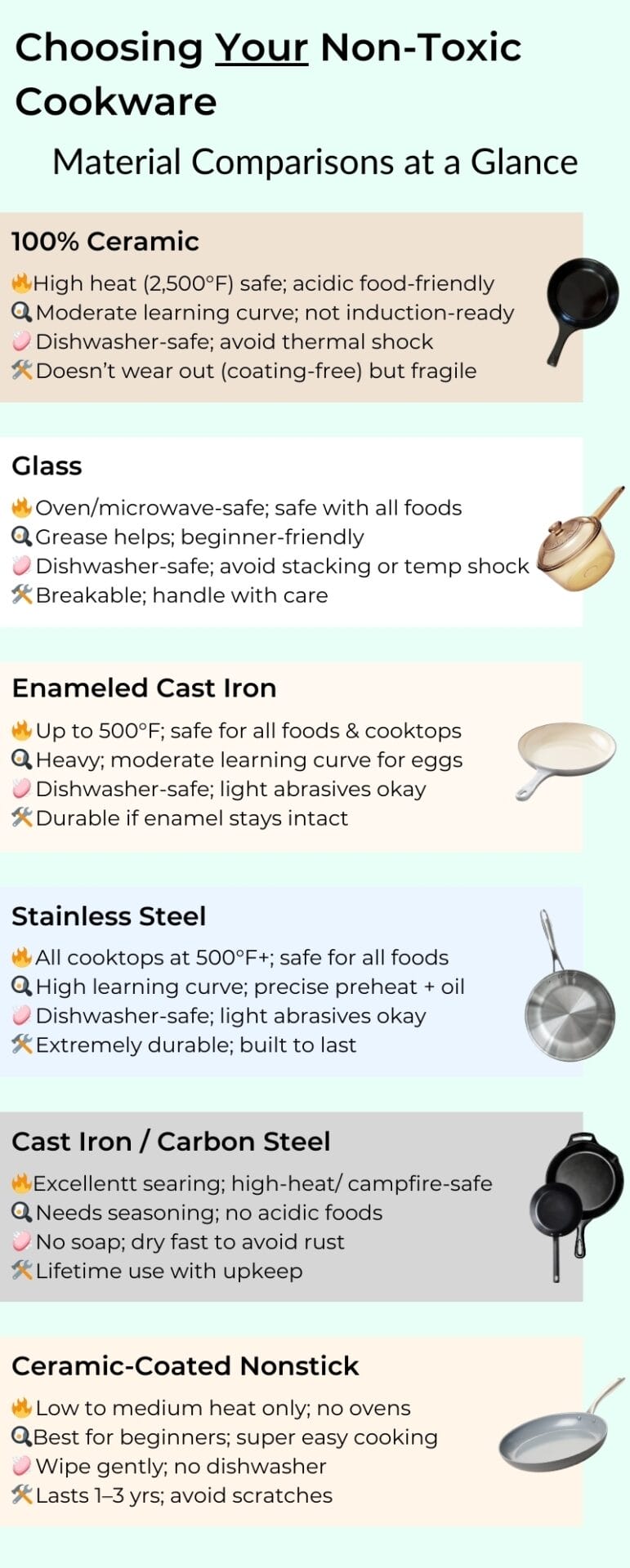
The table below compares common materials by their construction, useful qualities, and main precautions. It is a practical guide rather than a claim that one material is universally safest for every person or cooking task.
Source: umbelorganics.com
Stainless steel
A durable, versatile option for searing, sautéing, boiling, and simmering. People with a nickel sensitivity may need to consider the alloy and their own tolerance.
Cast iron
A durable iron cooking surface that works well for searing and oven cooking. It can transfer iron to food, especially acidic dishes cooked for long periods.
Carbon steel
A lighter alternative to many cast iron pans. It needs seasoning and careful drying to prevent rust.
Enameled cast iron
An iron body covered by a glass-like enamel layer. Keep the cooking surface intact and avoid using chipped vessels when the exposed or damaged area makes safe use uncertain.
Glass cookware
Suitable glass products can be useful for baking and some oven dishes. Only use cookware specifically rated for the appliance and temperature involved.
Stainless Steel: A Versatile Everyday Option
Stainless steel is made from iron mixed with other elements, commonly chromium and sometimes nickel. Chromium helps the metal resist corrosion, while nickel can improve durability and other properties in certain stainless steel grades.
Its main advantage is a durable cooking surface without a synthetic nonstick coating. It can handle many everyday tasks, from browning chicken to boiling pasta, and a quality pan may last for many years with proper care.
Food may stick if the pan is too cold, too hot, or used without enough fat for the recipe. Preheating appropriately and allowing food to release before turning it can improve results. If you have a known nickel allergy or sensitivity, ask a qualified clinician whether the cookware’s alloy and your intended use warrant special precautions.
Best for
Everyday cooking, browning, pan sauces, soups, vegetables, and recipes that benefit from a durable surface.
Cast Iron and Carbon Steel: Durable but Different
Cast iron retains heat well, making it useful for searing steaks, roasting vegetables, and baking cornbread. Carbon steel heats and responds to temperature changes more quickly in many common pan designs, although performance depends on thickness and construction.
Both materials often use seasoning, a thin layer of polymerized oil that helps protect the metal and create a more release-friendly surface. Seasoning is not the same as a synthetic factory-applied nonstick coating.
These pans need a little attention. Dry them after washing, maintain the seasoning when needed, and avoid storing wet food in them. Long cooking times with highly acidic ingredients can wear down seasoning and increase iron transfer, so an enameled pot or stainless steel pan may be more convenient for tomato sauce.
Best for
Searing, frying, roasting, skillet meals, and cooks willing to maintain a seasoned surface.
Enameled Cookware: A Smooth Surface Without Seasoning
Enameled cookware usually has a metal base, often cast iron, covered with a glass-like coating. The coating separates food from the underlying metal while it remains intact and the product is suitable for cooking.
It is useful for stews, beans, braises, soups, and acidic foods. Unlike bare cast iron, it does not normally require seasoning. However, the enamel can chip or crack if the pan is struck, dropped, or exposed to severe temperature changes.
Check the manufacturer’s care instructions and inspect the cooking surface before use. If the interior has significant chips, cracks, or unexplained deterioration, stop using the vessel for food until the manufacturer confirms that it remains suitable.
Best for
Slow cooking, acidic recipes, and cooks who want an easy-to-clean surface without seasoning.
Is Ceramic Cookware Non-Toxic?
Ceramic cookware can be a reasonable choice, but the word ceramic covers different products. Traditional ceramic cookware is made from fired clay or similar materials, often with a glaze. Ceramic-coated metal pans typically have a thin coating marketed as a ceramic-based nonstick surface.
These products should not be treated as identical. A ceramic-coated aluminum pan may have a metal body and a manufactured surface coating, while a traditional ceramic pot may be made mainly from a fired mineral material. Their durability, heat limits, and potential chemical exposure can differ.
Many ceramic-coated pans are marketed as PFAS-free. That claim may be useful if avoiding PFAS is your goal, but it does not establish that the pan is free of every chemical of concern or that the coating will last indefinitely. Ask what the manufacturer means by ceramic and whether the product has clear food-contact and care information.
Traditional glazed pottery deserves special care because certain glazes and decorative finishes can contain lead or cadmium. Risk can be higher when an item is old, handmade, imported from an uncertain source, or intended for decoration rather than food use. Use cookware sold for food preparation and follow relevant safety guidance.
Source: viagiulian.com
Check the exact coating
Read the product specifications rather than assuming every ceramic-branded pan has the same construction.
Avoid damaged surfaces
Replace or stop using a ceramic-coated pan if the cooking surface flakes, peels, or breaks down in a way that conflicts with the manufacturer’s instructions.
Do not rely on appearance alone
A colorful glaze or natural-looking finish does not prove that a product is free of lead, cadmium, or other unwanted substances.
Ceramic-Coated Versus Traditional Ceramic Cookware
Ceramic-coated pans are often selected for their easy food release and lack of intentionally added PTFE in products whose manufacturers make that claim. Their main trade-off is that the nonstick performance may decline with wear, overheating, or abrasive cleaning.
Traditional ceramic cookware can be durable, but its suitability depends on the body, glaze, and intended use. A reputable product designed for food preparation is a more reliable choice than an unverified decorative bowl or pot.
Neither label alone proves that a product has undergone independent testing for every possible contaminant. Look for transparent manufacturing information and credible test documentation when chemical composition is a key concern.
Practical choice
Select a ceramic product when its construction, care requirements, and expected lifespan fit your cooking routine.
What About PTFE and Other PFAS in Nonstick Pans?
PTFE is a fluoropolymer used in many traditional nonstick cooking surfaces. PFAS is a broad group of per- and polyfluoroalkyl substances, and PTFE is commonly discussed within this larger category. PFOA is a different PFAS chemical that was historically used in some manufacturing processes.
These terms are related, but they do not mean the same thing. A claim that a pan is PFOA-free does not automatically mean it contains no PTFE or no other PFAS. Likewise, PFAS-free claims should be read in the context of the manufacturer’s definition and the product’s actual construction.
Traditional PTFE nonstick cookware is not automatically unsafe when used according to its instructions. The main practical concern at home is severe overheating, especially when a coated pan is left empty on a hot burner. At very high temperatures, PTFE coatings can break down and release fumes that can cause flu-like symptoms in people and may be fatal to pet birds.
For everyday use, keep nonstick pans at the recommended heat level, avoid heating them empty for extended periods, and ventilate the kitchen. Do not use a pan that has deteriorated beyond the manufacturer’s stated conditions. If your goal is to avoid fluorinated coatings altogether, choose a clearly specified uncoated material such as stainless steel or cast iron instead.
Source: organicauthority.com
PFOA-free
This addresses PFOA specifically. It is not proof that the product is free of all PFAS or other coating ingredients.
PFAS-free
This can help identify products intended to avoid the broader chemical group, but the precise claim and scope still matter.
PTFE nonstick
Follow the manufacturer’s heat limits, avoid prolonged empty-pan heating, and keep pet birds away from cooking fumes.
Should You Throw Away Every Nonstick Pan?
Not necessarily. A pan’s safety depends on its materials, condition, and use, rather than the word nonstick alone. A PTFE-coated pan that is in good condition and used as directed is different from one that has been badly overheated or whose coating is visibly deteriorating.
If you prefer to reduce uncertainty about synthetic coatings, you can replace pans gradually. Start with the pan you use most often, then add stainless steel, cast iron, or another suitable material as your needs and budget allow.
Avoid making a decision based on fear alone. A planned replacement gives you time to identify the materials you want and choose cookware that suits your stove, cleaning routine, and typical meals.
Replace based on condition and preference
Follow the manufacturer’s replacement advice and switch materials if you want to avoid a particular coating.
Cookware Materials to Approach With Care
Some cookware deserves extra scrutiny because its composition is uncertain, its surface is damaged, or its intended use is unclear. The key is not to label every product in a broad category dangerous, but to identify the conditions that can make a particular item unsuitable for food preparation.
Old, handmade, imported, or decorative items can require additional checks when the glaze or metal composition is unknown. A product’s country of origin alone does not establish its safety. Reliable documentation and the condition of the food-contact surface are more useful indicators.
Source: m.media-amazon.com
Unverified glazed pottery
Avoid using pottery with unknown food-contact suitability, especially when its glaze or decoration may contain lead or cadmium.
Damaged coatings
Do not ignore peeling, flaking, deep cracks, or other damage that conflicts with the product’s care instructions.
Unknown metal alloys
Avoid cookware with no reliable information about its composition when the metal could contain unwanted contaminants.
Decorative copper
Copper cookware intended for cooking often uses a lining. Avoid cooking acidic foods in unlined copper because copper can migrate into food in excessive amounts.
Unverified aluminum
Aluminum can transfer into food, especially under certain acidic or salty cooking conditions. Anodized aluminum has a treated surface, while other products may have a lining or coating. Check the exact product rather than assuming all aluminum cookware is the same.
Is Aluminum Cookware Safe?
Aluminum is widely used in cookware because it conducts heat well and is relatively light. Small amounts can transfer into food, with the amount influenced by factors such as acidity, salt, temperature, cooking time, and the condition of the surface.
For most household decisions, the useful question is how the aluminum is constructed and what the manufacturer recommends. An intact anodized surface or a suitable food-contact lining can reduce direct contact between food and the underlying metal.
If you prefer to avoid direct contact with aluminum, stainless steel or enameled cookware may be more suitable for your routine. This is a material preference, not proof that every aluminum pan causes harm.
Useful distinction
Check whether the pan is bare aluminum, anodized, lined, or coated before deciding how it fits your needs.
Why Lead and Cadmium Deserve Special Attention
Lead and cadmium are toxic metals that can pose health risks when exposure is high enough. They may be present in certain glazes, pigments, or other materials, making unknown food-contact ceramics a concern.
Do not assume a pottery item is safe because it looks clean or has been washed many times. Washing does not reliably remove metals embedded in a glaze, and home lead test kits may not establish whether a vessel is safe for repeated cooking.
Choose products intended for food preparation and seek manufacturer documentation or appropriate testing when there is a specific reason for concern. If an item is suspected of containing lead or cadmium, stop using it for food until its suitability is established.
Safer practice
Avoid using uncertain decorative ceramics for food, especially with hot, acidic, or long-cooked dishes.
How to Choose Non Toxic Cookware for Your Kitchen
The easiest way to choose safer cookware is to start with the meals you cook most often and the materials you want to avoid. You do not need a complete new set to make a thoughtful change. One well-chosen skillet or pot can cover several common tasks.
Before buying, read the product specifications, confirm that the pan is designed for your stove, and check its care requirements. A product that is unsuitable for your cooking method or difficult to maintain may wear out sooner and create more waste.
Source: tasteslovely.com
Step 1: Set your priorities
Decide whether you want to avoid PFAS, reduce contact with a particular metal, minimize upkeep, or buy cookware that can last for many years.
Step 2: Identify the cooking surface
Look for precise material descriptions, including the body metal, any lining, the coating type, and the interior finish.
Step 3: Verify intended use
Check whether the cookware is suitable for your cooktop, oven temperature, and intended cooking methods.
Step 4: Review care instructions
Confirm whether the pan needs seasoning, hand washing, special utensils, or limits on high heat.
Step 5: Inspect the product
When possible, check the interior for defects, damaged coating, cracks, or poor finishing before use.
Questions to Ask Before Buying
A trustworthy product description should explain what touches the food and how the pan should be used. If a seller relies on broad wellness claims but does not disclose the cooking surface, consider a different product.
Independent testing can help answer specific questions, but its value depends on what was tested. A test for lead does not establish that a product is PFAS-free, and a PFAS-related test does not establish that every metal or coating component has been assessed.
What is the exact cooking surface?
Find out whether it is bare metal, enamel, a ceramic-based coating, PTFE, or another material.
What does the safety claim cover?
Check whether a claim refers to PFOA, the broader PFAS group, lead, cadmium, or a different substance.
Who made the product?
Look for a traceable manufacturer, clear product specifications, and accessible care guidance.
How long is the surface expected to last?
Review the warranty and replacement guidance, while recognizing that a warranty does not independently prove chemical safety.
A Simple Starter Set
For many households, a small mix of materials works better than a large matching set. A stainless steel saucepan can handle oatmeal, rice, soup, and sauces. A stainless steel skillet can brown vegetables or meat, while a seasoned cast iron or carbon steel pan can provide a strong sear.
If you often make eggs or other delicate foods, you may prefer a separate nonstick pan. Choose a clearly specified product and use it within its temperature and care limits. You can also learn to cook delicate foods in stainless steel with suitable preheating and fat, though the technique takes practice.
Everyday foundation
Start with a stainless steel saucepan and skillet if you want versatile cookware without a synthetic nonstick cooking surface.
For high-heat searing
Consider cast iron or carbon steel if you are comfortable with seasoning and drying.
For slow-cooked meals
Choose intact food-safe enameled cookware if you frequently prepare soups, stews, or acidic sauces.
How to Use and Maintain Cookware Safely
Even a suitable pan needs proper care. Heat, abrasion, corrosion, and accidental damage can affect how well cookware performs and whether its surface remains suitable for food preparation.
Read the manual for your specific product because temperature limits and cleaning advice vary. A rule that works for stainless steel may damage a nonstick coating, and a method suitable for bare cast iron may be inappropriate for enamel.
Source: kitchenbap.com
Avoid unnecessary overheating
Do not leave an empty nonstick pan heating unattended. Use the manufacturer’s heat limits and turn down the burner when food starts smoking unexpectedly.
Use suitable utensils
Follow the utensil guidance for coated surfaces. Metal tools may damage some coatings, while wooden or heat-resistant silicone tools are often suitable alternatives.
Clean with care
Use cleaning tools and products that suit the surface. Avoid abrasive pads on coatings that the manufacturer says are not abrasion-resistant.
Dry reactive metals
Dry cast iron and carbon steel after washing, and maintain seasoning when needed to limit rust.
Inspect before cooking
Look for peeling, deep cracks, rust that cannot be cleaned appropriately, or other signs that conflict with the manufacturer’s guidance.
When Should You Replace a Pan?
Replace cookware when its condition makes safe use uncertain or when the manufacturer says it should no longer be used. For coated pans, visible peeling, flaking, or severe surface breakdown is a reason to stop using the pan and consult the product guidance.
A few superficial marks do not prove that a pan is toxic. The meaning of a scratch depends on the material, its depth, and whether it exposes or damages another layer. When the construction is unknown or damage is severe, replacing the pan is a reasonable precaution.
Stainless steel can often remain useful despite discoloration or cosmetic marks if the cooking surface and structure are intact. Bare cast iron may develop rust that can sometimes be addressed with suitable cleaning and reseasoning. Cracked cookware, unstable handles, or damaged food-contact coatings require more caution.
Stop using it when
The food-contact surface is peeling, the vessel is cracked, the structure is unstable, or the manufacturer identifies the damage as a reason for replacement.
Can You Reduce Exposure Without Buying New Cookware?
Yes. If your current cookware is suitable for food preparation, in good condition, and used as directed, you may not need to replace everything at once. Improving ventilation, avoiding overheating, and following cleaning instructions can reduce common misuse risks.
You can also use different pans for different foods. For example, stainless steel is a practical option for acidic sauces, while a well-maintained cast iron pan may be more convenient for searing. This approach can help extend the useful life of your existing kitchen equipment.
If you have a specific concern about a recalled product, a suspected contaminant, or an unknown glaze, general care advice may not be enough. Check official safety notices and manufacturer guidance, and stop using the item when its suitability cannot be established.
Replace selectively
Prioritize cookware that is damaged, poorly identified, or unsuitable for your intended use instead of discarding every pan based on its age alone.
Common Myths About Non-Toxic Cookware
Cookware marketing often uses simple labels for complicated material questions. Understanding the limits of those labels helps you make a more informed decision without unnecessary fear or expense.
Myth: Natural materials are always safer
Natural origin does not guarantee safe composition. Unknown glazes, unlined copper, and contaminated materials can still pose risks.
Myth: Every nonstick pan is dangerous
Different coatings have different properties. Traditional PTFE cookware can be used as directed, but severe overheating should be avoided.
Myth: PFOA-free means PFAS-free
PFOA is one chemical in a much larger group. A claim about one substance does not establish the absence of the entire group.
Myth: Ceramic-coated cookware lasts forever
Ceramic-based nonstick coatings can lose their food-release performance over time. Follow care instructions and replace cookware when its condition warrants it.
Myth: More expensive cookware is always safer
Price alone does not prove composition, testing quality, or suitability. Clear specifications and appropriate use matter more.
Myth: A scratch always makes a pan toxic
The risk depends on the material and the damage. Follow product-specific advice instead of assuming all scratches have the same effect.
What Do Safety Labels Actually Prove?
A label is useful only when its meaning and scope are clear. PFAS-free, PFOA-free, lead-free, and food-safe address different questions, and none should be treated as a universal guarantee about every component or every possible exposure.
If a manufacturer provides test results, check the tested product, the substances assessed, the testing method, and the limits reported. A result for one sample or one contaminant does not automatically establish the safety of all products in a range.
In the United States, the Food and Drug Administration oversees relevant food-contact uses under its legal authority, while the Consumer Product Safety Commission addresses certain consumer-product hazards. The Environmental Protection Agency also regulates aspects of chemicals and environmental exposure. These agencies have different roles, so a claim that a product is approved by an agency should be verified against the specific product and applicable requirement.
Best practice
Treat marketing labels as starting points. Seek precise product information and applicable evidence for the specific concern you want to address.
Which Non-Toxic Cookware Is Best for Different Cooking Needs?
The best material depends on what you cook, the heat you use, and how much maintenance you accept. This comparison can help narrow the choices without treating any one material as the right answer for every kitchen.
For everyday cooking
Stainless steel is a strong all-purpose option because it is durable and can handle many cooking methods without a synthetic nonstick coating.
For searing and browning
Cast iron or carbon steel can provide useful heat retention and a durable cooking surface when properly maintained.
For soups and tomato sauces
Stainless steel or intact food-safe enamel avoids many of the practical limitations of bare cast iron with prolonged acidic cooking.
For low-effort food release
A suitable nonstick pan can make delicate foods easier to cook. Select the coating you are comfortable using and follow its heat limits.
For baking
Choose glass, ceramic, metal, or enameled bakeware specifically rated for the oven and temperature you plan to use.
A Quick Material Comparison
Use the table as a starting point. Construction varies within each category, so the exact product description and care instructions still matter.
Stainless steel
Main strength: versatility and durability. Main consideration: possible nickel or chromium transfer under some cooking conditions.
Cast iron
Main strength: heat retention. Main consideration: seasoning, rust prevention, and iron transfer to some foods.
Carbon steel
Main strength: responsiveness and a durable seasoned surface. Main consideration: drying and seasoning.
Enameled cast iron
Main strength: convenient cooking of acidic dishes. Main consideration: avoiding chips, cracks, and thermal shock.
Ceramic-coated metal
Main strength: easy food release without intentionally added PTFE in products that make that specific claim. Main consideration: coating wear and the need to verify the exact formulation.
PTFE-coated nonstick
Main strength: low-stick cooking. Main consideration: avoiding severe overheating and following the product’s care limits.
Food-safe glass
Main strength: a nonmetal cooking surface for suitable oven uses. Main consideration: thermal shock and appliance-specific temperature limits.
A Practical, Evidence-Led Way to Think About Cookware Safety
Cookware safety is not a contest in which one material wins every time. It is a combination of material properties, exposure, manufacturing quality, cooking habits, and product condition. A useful decision should focus on the risk you want to reduce rather than on an undefined promise of purity.
For most people seeking a straightforward starting point, stainless steel offers broad utility, while cast iron and carbon steel suit cooks who are comfortable with seasoning. Intact food-safe enamel can help with acidic dishes, and carefully used nonstick cookware may be convenient for delicate foods.
Some personal factors can change the decision. People with a known metal allergy may need advice specific to the alloy involved, while households with pet birds should take special care to prevent exposure to overheated nonstick cookware fumes. Questions about suspected lead or cadmium contamination call for product-specific information rather than general reassurance.
There is also a sustainability benefit to choosing cookware you can maintain and use for a long time. A durable pan that suits your habits may reduce frequent replacement, though durability alone does not prove that a product has a safer chemical profile.
Start with the food-contact surface
Identify what actually touches the food before evaluating broad claims about the pan’s body or exterior.
Match the pan to the recipe
Use suitable materials for acidic sauces, high-heat searing, delicate foods, and oven cooking.
Use reliable evidence
Prefer clear specifications and relevant testing over unsupported claims or a price-based assumption.
Keep the pan in good condition
Follow care guidance and replace cookware when damage makes continued use unsuitable.
Frequently Asked Questions
Q
What is the safest material for cookware?
There is no single safest material for every person and cooking task. Stainless steel, cast iron, carbon steel, and intact food-safe enameled cookware are practical options for many households. Your choice should reflect the food you prepare, any known material sensitivities, and the care the pan requires.
Q
Is stainless steel cookware non-toxic?
Stainless steel is widely used for food preparation and is a durable option for everyday cooking. Small amounts of nickel or chromium may transfer into food under some conditions, depending on the alloy, food acidity, and cooking time. People with a known nickel sensitivity should consider their individual needs and seek clinical advice when necessary.
Q
Is ceramic cookware safer than Teflon?
Neither label is enough to establish that every product is safer than every other one. Ceramic-coated pans and PTFE-coated pans have different formulations and use requirements. Ceramic-coated products may appeal to people who want to avoid PTFE, but coating wear and other ingredients still matter. PTFE cookware should not be severely overheated.
Q
Does PFAS-free mean a pan is completely non-toxic?
No. PFAS-free is a claim about a group of chemicals, and its meaning depends on the manufacturer’s definition and the evidence available. It does not automatically establish that a pan contains no other potentially harmful substances, such as lead or cadmium, or that every component has been tested.
Q
Is scratched nonstick cookware dangerous?
The answer depends on the coating, the depth of the damage, and the manufacturer’s guidance. A scratch does not automatically prove that a pan is toxic, but peeling, flaking, or severe deterioration is a reason to stop using it and check the replacement advice. Avoid overheating the pan and use utensils suitable for its surface.
Q
Can non-toxic cookware go in the dishwasher?
Some cookware is dishwasher-safe, while other materials need hand washing. Stainless steel may tolerate a dishwasher depending on the product, but seasoned cast iron and carbon steel generally need different care. Coated pans and enamel products also have manufacturer-specific cleaning instructions. Check the manual instead of assuming all cookware can be washed the same way.
Q
Should I replace all my old cookware?
Not necessarily. Prioritize items that are damaged, have an uncertain food-contact surface, or are unsuitable for their intended use. Cookware made from known materials and kept in good condition may remain useful for years. Replace questionable items when their composition or condition creates a concern that cannot be resolved.
Q
How can I tell whether ceramic cookware contains lead?
Appearance alone cannot confirm that a ceramic product is lead-free. Choose cookware intended for food use and seek reliable manufacturer information or appropriate testing when a specific concern exists. Be especially cautious with old, decorative, handmade, or unverified glazed pottery. A basic home test may not establish that a vessel is safe for repeated food preparation.
✦ Wrapping Up
Conclusion
Understanding what is non toxic cookware starts with a simple idea: choose a suitable food-contact material, use it as directed, and pay attention to its condition. Stainless steel, cast iron, carbon steel, and intact food-safe enamel offer practical choices for many American kitchens, while ceramic-coated and PTFE-coated pans require attention to their exact construction and care limits.
Do not let broad marketing claims or alarming headlines make the decision for you. Check what the pan is made of, what a safety label actually covers, and whether the manufacturer provides clear instructions. If you have a specific concern about metal exposure, a damaged coating, or a possible contaminant, seek evidence that addresses that exact issue.
You can make a thoughtful change without replacing every pot and pan at once. Start with the cookware you use most, choose a material that fits your meals and budget, and keep it in good condition.
💡 Key Takeaway
For a simple starting point, choose a well-documented stainless steel skillet and saucepan, add cast iron or carbon steel if you want a seasoned cooking surface, and use intact food-safe enamel for dishes that need long simmering. Check every product’s material details and care instructions before use.