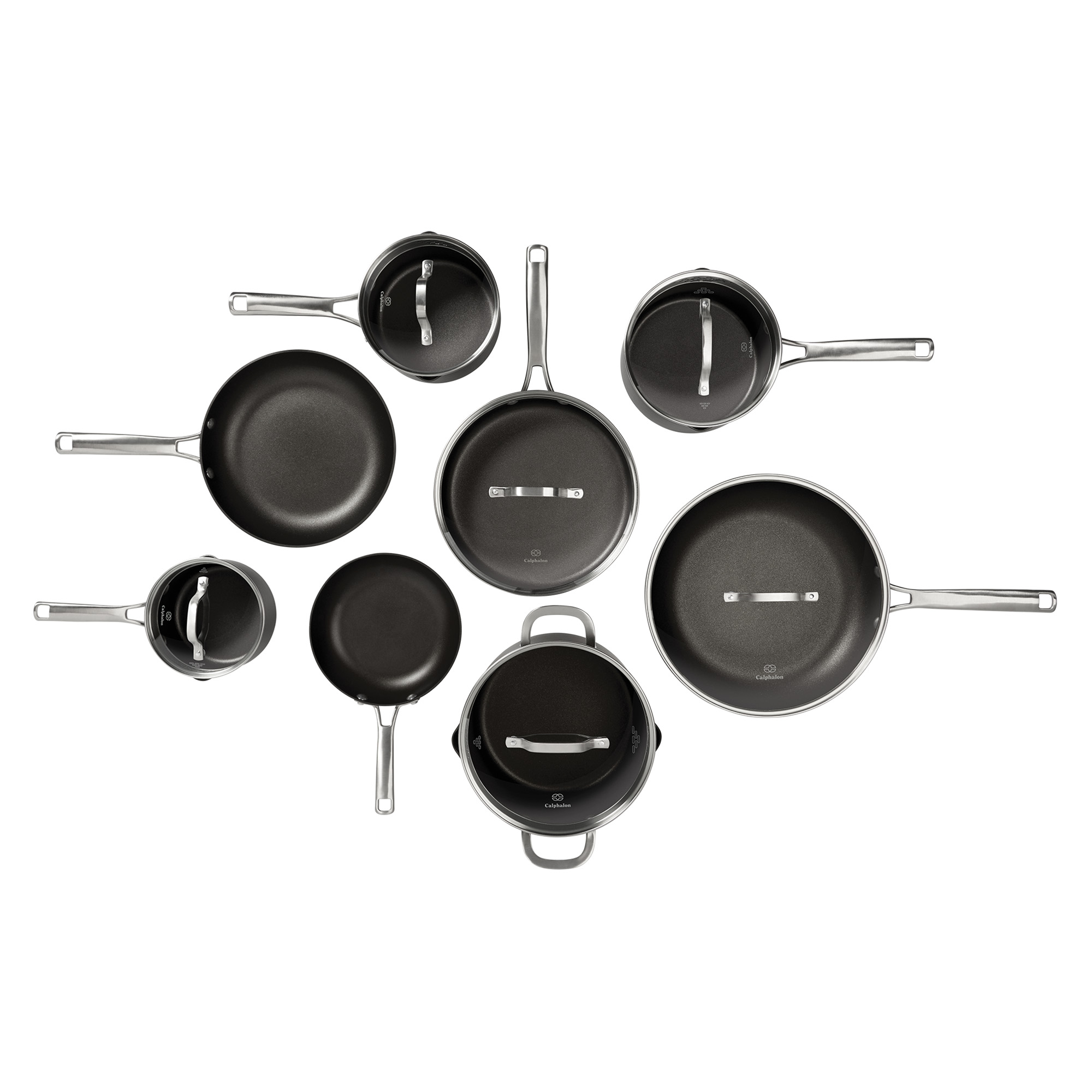
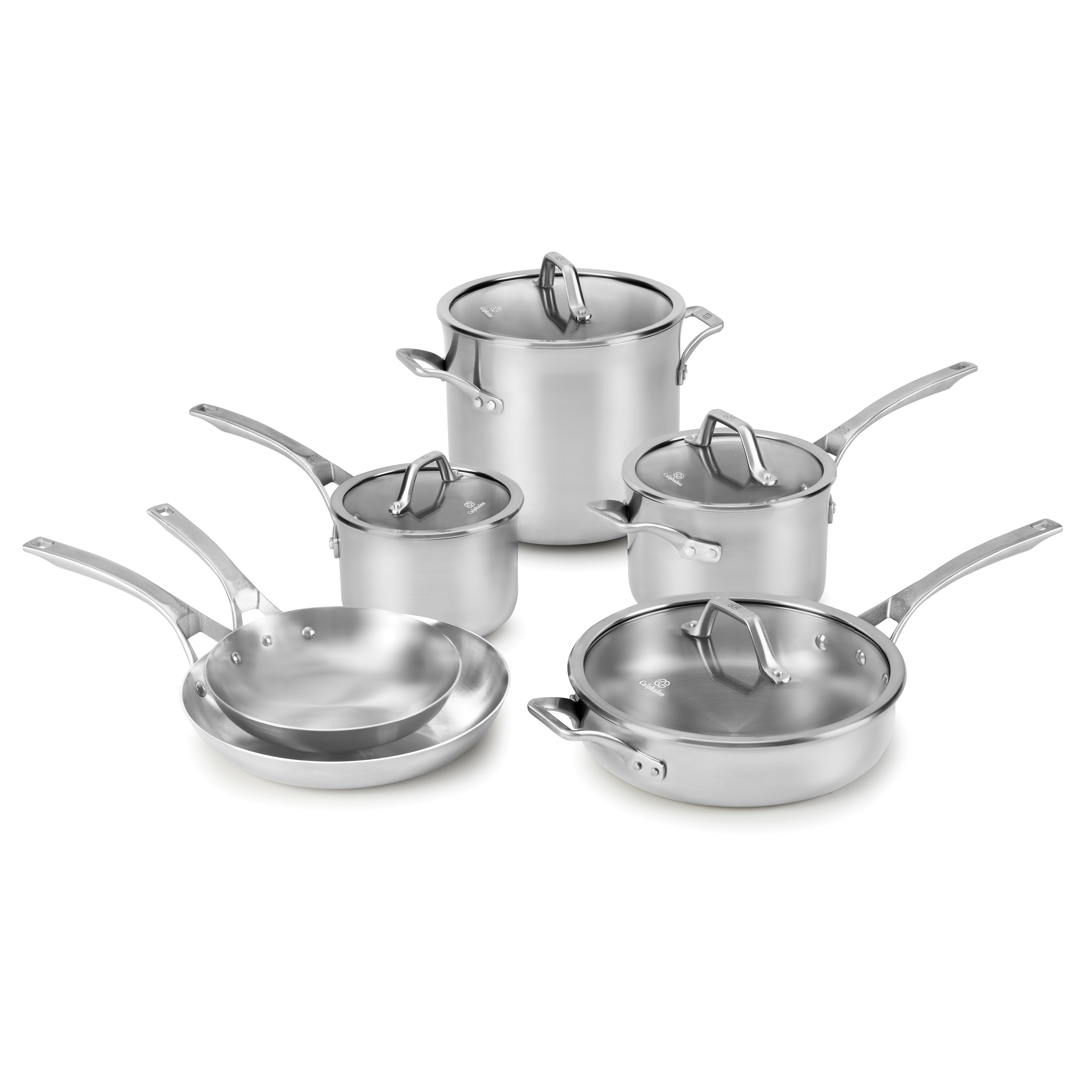
Calphalon cookware is made from materials such as hard-anodized aluminum, stainless steel, and aluminum with a nonstick coating. The exact material depends on the product line and model.
When you shop for pots and pans in the United States, you will find Calphalon cookware in home kitchens, apartment cabinets, and stores that sell everyday kitchen gear. The brand offers several types of cookware, so one simple answer cannot describe every pan in its range.
Many Calphalon pans use aluminum because it heats quickly and spreads heat well. Hard-anodized aluminum has a treated surface that is harder than untreated aluminum, while stainless steel models use steel as a cooking surface and may include an aluminum core for better heat distribution. Some pans also have a nonstick coating to help food release with less sticking.
The key is to identify the exact Calphalon collection before you judge its materials, safety, or care needs. A nonstick frying pan, a stainless steel saucepan, and a ceramic-coated skillet can have very different surface layers even when they carry the same brand name.
Calphalon cookware can be made from hard-anodized aluminum, stainless steel, or aluminum paired with a nonstick cooking surface. Some collections use other coating technologies, so the product label and official specifications are the best way to confirm what a particular pan contains.
Each material serves a different purpose. Aluminum helps transfer heat, stainless steel offers a durable cooking surface, and nonstick coatings help reduce food sticking. Some pans combine these features rather than relying on a single material.
Think of a pan as a small layered system. The outer body affects heating and durability, the cooking surface affects how food behaves, and the handle and lid have their own material and temperature limits.
Source: housekeepingmaster.com
Hard-anodized aluminum
Aluminum treated through an electrochemical process that forms a harder oxide layer on its surface. It is common in cookware designed for everyday cooking.
Stainless steel
A steel alloy used for cookware bodies and cooking surfaces. Some designs add aluminum or another conductive metal to improve heat distribution.
Nonstick coatings
A surface layer designed to help food release. Its composition varies by product, so the term nonstick alone does not identify the coating chemistry.
Glass, silicone, and other parts
Depending on the set, lids, handles, and other components may use glass, metal, silicone, or heat-resistant synthetic materials.
Why Aluminum Is Common in Cookware
Aluminum conducts heat well and is relatively light compared with many other metals used in pots and pans. This helps a skillet warm up quickly and makes a large saucepan easier to lift when it is full.
However, untreated aluminum can react with certain acidic or alkaline foods under some conditions. Cookware makers may use a surface treatment, a coating, or a separate stainless steel cooking layer to manage this issue. The actual design of the pan determines which protections it has.
Fast heat response
Aluminum usually warms up and cools down faster than a thick stainless steel body without a conductive core.
Lower weight
An aluminum body can be easier to handle than a similarly sized pan made entirely from heavier metals.
What Stainless Steel Adds
Stainless steel is valued for its tough cooking surface and resistance to rust and corrosion. It can work well for browning meat, building pan sauces, and cooking foods that benefit from contact with a metal surface.
Steel does not conduct heat as well as aluminum. For that reason, some stainless steel cookware uses a bonded aluminum layer or a conductive base. This construction helps spread heat while keeping stainless steel where food touches the pan.
Durable cooking surface
Stainless steel can withstand normal cooking tools and does not depend on a delicate nonstick film for food release.
Useful for browning
A stainless steel surface can help develop browned bits that can be loosened with liquid to make a pan sauce.
What Is Calphalon Hard-Anodized Aluminum?
Hard-anodized aluminum starts as aluminum, then undergoes an electrochemical treatment that changes its surface. The process creates a thicker, harder aluminum oxide layer than the thin natural oxide layer that forms on ordinary aluminum exposed to air.
This treatment improves surface hardness and corrosion resistance. It does not turn the whole pan into stainless steel, nor does it mean that every hard-anodized pan has a bare metal cooking surface. Some Calphalon hard-anodized products also have a separate nonstick coating over the treated aluminum.
That distinction matters when you read a product description. Hard-anodized describes how the aluminum surface has been treated, while nonstick describes a cooking surface designed to release food more easily. A single pan may have both features.
Source: m.media-amazon.com
The base material
The main body is aluminum, which helps the pan conduct heat.
The anodized layer
The surface treatment forms a hard oxide layer that improves resistance to wear and corrosion.
The cooking surface
Depending on the model, the food-contact surface may be the anodized metal or a separate nonstick coating.
Is Hard-Anodized Aluminum the Same as Nonstick?
No. The two terms describe different things. Hard anodizing is a surface treatment applied to aluminum, while nonstick refers to a surface property that helps food release from the pan.
A hard-anodized pan can have a nonstick coating, but the words hard-anodized do not prove that a pan has one. Read the product description to find out whether the cooking surface is coated and, if so, what kind of coating it uses.
Hard-anodized only
Describes the treated aluminum surface; it does not by itself confirm the presence or absence of an added nonstick layer.
Hard-anodized nonstick
Describes aluminum cookware with a hard-anodized body or surface and an added nonstick cooking layer.
Does the Anodized Surface Prevent All Aluminum Contact?
An intact anodized surface can act as a barrier, but it should not be treated as a guarantee that no aluminum can ever reach food under every condition. The exact construction, wear, damage, and use conditions all matter.
If the pan has a nonstick layer, that coating is another part of the food-contact system. Follow the care instructions and stop using cookware when its surface is badly damaged or the manufacturer says it should be replaced.
Avoid abrasive cleaning
Use the cleaning tools and products approved for the specific pan instead of assuming every metal surface can tolerate scouring pads.
Check for damage
Inspect the cooking surface for deep scratches, peeling, or other changes that may affect its intended use.
What Is the Nonstick Coating on Calphalon Cookware Made Of?
The nonstick coating on a Calphalon pan depends on its product line and model. Some traditional nonstick cookware uses a fluoropolymer coating based on polytetrafluoroethylene, or PTFE, while other products may use a different nonstick technology. You should not assume that every Calphalon nonstick pan has the same formula.
PTFE is a synthetic fluoropolymer that creates a low-friction surface. Food tends to release easily from it, so cooks may need less oil or butter for certain dishes. The coating is thin compared with the metal body and is intended to stay intact during normal use.
A product described as ceramic nonstick is not necessarily made from solid ceramic. The phrase often refers to a ceramic-based coating applied over a metal pan. Likewise, the word nonstick does not tell you whether a product contains PTFE or other fluorinated substances.
Source: i.pinimg.com
How to Tell Which Coating Your Pan Uses
Start with the complete product name, model number, or item number. Look at the original packaging, the instruction booklet, the product label, or the manufacturer’s official product page. A broad search for the brand alone may return details for a different generation or collection.
If the wording does not identify the coating chemistry, contact the manufacturer and ask about that exact model. Terms such as nonstick, reinforced, easy release, and ceramic do not always provide enough detail to identify every chemical component.
Find the model number
Use the number printed on the pan, packaging, manual, or product record whenever available.
Check the official specification
Look for explicit material and coating information rather than relying on a retailer’s short title.
Ask a specific question
If you need to avoid a particular substance, ask the manufacturer whether the exact model contains it and whether the claim applies to all parts or only the cooking surface.
What Does PFOA-Free Mean?
PFOA and PTFE are not the same substance. PFOA is a chemical that has been used in some historical manufacturing processes, while PTFE is a fluoropolymer used in many nonstick coatings. A statement that a pan is PFOA-free does not automatically mean that it is PTFE-free or free of every PFAS-related substance.
PFAS is a broad group of per- and polyfluoroalkyl substances. Definitions and product claims can vary, so a label such as PFOA-free should not be read as a blanket statement about every substance in the wider group.
If your goal is to avoid PTFE or PFAS, seek a clear statement that addresses the specific material you want to avoid. When the wording is unclear, ask the manufacturer rather than relying on assumptions about the word nonstick.
PFOA-free
Addresses PFOA specifically and does not, by itself, confirm that the coating contains no PTFE.
PTFE-free
Addresses PTFE specifically but does not automatically establish that a product contains no other fluorinated chemicals.
PFAS-free
A broader claim whose meaning should be checked against the manufacturer’s definition and the exact product.
Is Calphalon Cookware Safe to Use?
Calphalon cookware safety depends on the exact material, the condition of the pan, and how you use it. A properly used pan with an intact cooking surface is different from one with a badly peeling coating or one that has been heated far beyond its intended limits.
For a nonstick pan, the main practical concern is overheating. PTFE coatings can release hazardous fumes when severely overheated, and birds are especially sensitive to these fumes. Never leave an empty nonstick pan heating unattended, and keep the temperature within the manufacturer’s instructions.
For stainless steel cookware, the main care issues differ. Use suitable heat settings, avoid prolonged storage of very salty or acidic food when the manufacturer’s instructions advise against it, and clean the pan in a way that does not damage its finish.
No single material label proves that a pan is risk-free in every situation. The sensible approach is to identify the cooking surface, follow the care directions, avoid overheating, and replace a pan when the manufacturer recommends doing so.
Source: m.media-amazon.com
Use moderate heat for nonstick cooking
Choose a burner setting suited to the food and pan. Do not preheat an empty nonstick pan for long periods or leave it unattended.
Use suitable utensils
Follow the model’s utensil guidance. Metal tools may damage some nonstick surfaces even if they are acceptable for some uncoated stainless steel pans.
Ventilate the kitchen
Use an exhaust fan or open a suitable window while cooking, especially if a pan is accidentally overheated.
Protect pet birds
Keep birds away from kitchen fumes and cooking areas. If a nonstick pan overheats, turn off the heat if safe, ventilate the area, and move birds to fresh air.
Should You Throw Away a Scratched Nonstick Pan?
A small surface mark does not always mean that a pan must be discarded at once, but deep scratches, peeling, flaking, or a visibly deteriorating coating are reasons to stop and check the manufacturer’s replacement guidance. Do not scrape at the surface to test how firmly the coating is attached.
If the cooking surface is shedding material or the pan is otherwise damaged, replacing it is a sensible precaution. The exact replacement rule depends on the product and the extent of the damage, so do not treat every scratch as equal.
Inspect the whole cooking surface
Look for peeling, flakes, exposed areas, deep grooves, and signs that the coating is separating.
Do not repair the coating at home
Household paints, sealants, and improvised coatings are not suitable ways to restore a food-contact cooking surface.
Is Stainless Steel a Better Choice for Avoiding Nonstick Coatings?
An uncoated stainless steel pan is a practical option for people who want to avoid a traditional nonstick cooking layer. Confirm that the specific model has an uncoated food-contact surface, since stainless steel cookware can also include coated components or mixed-material designs.
Stainless steel usually requires more attention to preheating, fat, and food timing than a well-maintained nonstick pan. That trade-off may be worthwhile if you want a cooking surface that does not rely on a nonstick film.
Best for coating avoidance
Choose a verified uncoated stainless steel model if avoiding nonstick coatings is your main priority.
Expect a different cooking method
Learn to manage heat and allow food to release naturally before turning or moving it.
How Calphalon Stainless Steel Cookware Is Constructed
Calphalon stainless steel cookware uses steel in its construction, but the exact layer arrangement varies by collection. Some cookware has a stainless steel exterior and cooking surface with an aluminum core or bonded base to help spread heat. Other designs may use a different construction, so the phrase stainless steel alone is not a complete materials specification.
A bonded pan joins different metals so that each can perform a useful role. Stainless steel provides a durable cooking surface, while aluminum helps distribute heat across the base and, in some designs, up the sides. This can reduce the uneven heating that a thin steel-only pan may experience.
The number of layers is not enough on its own to prove how well a pan cooks. Thickness, the area covered by the conductive core, burner size, and heat setting all affect performance. Check the model’s construction details rather than assuming that every stainless steel Calphalon pan is fully clad.
Source: m.media-amazon.com
What Does Tri-Ply or Clad Mean?
Clad cookware uses bonded layers of metal. Tri-ply usually means three layers, often with a conductive core between outer metal layers, but the precise materials and arrangement depend on the design.
A layered stainless steel pan can offer the durability of steel and the heat-spreading ability of aluminum. However, not every stainless steel pan is tri-ply, and a thick bonded base is not the same as a fully clad body. Read the product specifications to tell them apart.
Fully clad construction
The bonded layers extend through the sides as well as the base.
Disc or impact-bonded base
The conductive layers are concentrated in the base, while the sides may use a different construction.
Does Stainless Steel Mean the Pan Is Induction-Compatible?
No. Induction cooking requires a suitable magnetic layer at the base. Some stainless steel cookware works on induction, while other stainless steel formulations do not. Aluminum cookware also needs a compatible magnetic base or other induction-ready construction.
Check the manufacturer’s stated cooktop compatibility for the exact model. If you already own the pan, a magnet test at the base can provide a quick clue, but the official compatibility information is more reliable than guessing from the outside finish.
Read the cooktop symbol
Look for explicit induction compatibility in the product details or manual.
Check the base
A magnet that sticks to the cooking base suggests magnetic material is present, though the test does not replace the manufacturer’s specifications.
How to Identify the Material of Your Calphalon Pan
The most reliable way to identify a Calphalon pan’s material is to match its model number to the manufacturer’s product information. Appearance can offer clues, but black, gray, silver, and polished finishes are not enough to establish the exact construction or coating chemistry.
Start with the name printed on the packaging or the product record. If you bought a used pan, search for any stamped model or item number and compare its shape, handle, lid, and base with official images. Older collections may differ from current products with similar names.
If you cannot find a model number, contact Calphalon customer support with clear photos of the pan, its base, handle attachment, and any markings. Ask about the body material, food-contact surface, coating type, cooktop compatibility, and care limits.
Source: surlatable.com
Step 1: Find the product identity
Check the box, manual, receipt, product listing, or markings on the cookware for the full name and model number.
Step 2: Read the material details
Look for terms such as hard-anodized aluminum, stainless steel, bonded aluminum core, PTFE nonstick, or ceramic nonstick.
Step 3: Confirm the cooking surface
Identify the material that touches food, not just the outer body or decorative finish.
Step 4: Verify care and compatibility
Check the instructions for induction use, oven limits, dishwasher use, utensils, and cleaning.
Quick Material Comparison
Use this table as a starting point when comparing common cookware constructions. It describes general material traits, not a guarantee about every Calphalon model.
Hard-anodized aluminum
Lightweight, responsive to heat, and treated to improve surface hardness and corrosion resistance. It may have a separate nonstick coating.
Coated aluminum
Combines aluminum’s heat conduction with a cooking layer designed for easier food release. Care depends on the coating.
Uncoated stainless steel
Offers a durable metal cooking surface suited to browning and pan sauces. Food can stick if heat and cooking technique are poorly managed.
Stainless steel with aluminum core
Combines a steel cooking surface with a conductive layer. The core may cover the base only or extend through the sides.
Ceramic-coated cookware
Usually refers to a metal pan with a ceramic-based nonstick coating, not a pan made entirely of ceramic.
How to Care for Calphalon Cookware by Material
Proper care depends on the body material and cooking surface. A nonstick skillet needs different handling from an uncoated stainless steel saucepan, so avoid using one cleaning routine for every item in a cookware set.
Before washing a pan, let it cool enough to avoid a sudden temperature change. Moving a very hot pan straight into cold water can cause thermal shock, warping, or damage to some finishes. Then follow the model’s instructions for washing, drying, and storage.
Even when a product is described as dishwasher-safe, handwashing may help preserve some finishes and reduce wear from repeated contact with other items. Use the manufacturer’s stated guidance rather than assuming that every pan in a collection has identical limits.
Source: newellbrands.imgix.net
Care for Nonstick Pans
Wash nonstick cookware with a soft sponge and a suitable dish soap unless its instructions say otherwise. Avoid abrasive powders, steel wool, or sharp tools that may damage the coating. Dry the pan before storing it, and avoid stacking cookware in a way that lets metal edges scrape the cooking surface.
Use low to medium heat for most nonstick cooking unless the manufacturer provides different limits for your model. If you need to cook at very high heat to sear food, an appropriate uncoated stainless steel pan may be a better tool.
Use gentle tools
Choose soft cleaning pads and utensils approved for the surface.
Avoid prolonged empty heating
Add food, oil, or other ingredients as directed rather than leaving an empty nonstick pan over high heat.
Protect the finish during storage
Place a suitable pan protector between stacked pans if needed.
Care for Stainless Steel Pans
Stainless steel can usually tolerate more vigorous cleaning than many coated pans, but harsh treatment can still scratch or dull its finish. Use a cleaner suitable for stainless steel and follow the instructions for the exact product.
For stuck-on food, soaking the pan with warm water and using a suitable nonabrasive cleaner can help loosen residue. Avoid sudden temperature changes and dry the pan after washing to reduce water spots.
Manage heat
Preheat gradually and choose a burner size suited to the pan’s base.
Use an appropriate cleaner
Select a cleaner approved for the finish and avoid methods that may damage a bonded or coated component.
Care for Hard-Anodized Surfaces
Hard-anodized aluminum is treated to improve surface hardness, but that does not make every finish immune to scratches or harsh cleaners. A separate nonstick layer, if present, may be more sensitive than the underlying aluminum.
Check whether your model is designed for handwashing or dishwasher use. Do not assume that the phrase hard-anodized guarantees the same cleaning rules across all product lines.
Follow the model instructions
Use the washing method and cleaning products approved for the specific surface.
Keep the pan in good condition
Avoid scraping, dropping, or storing it in a way that can damage the cooking surface.
Common Mistakes When Reading Calphalon Material Claims
A product title can leave out details that matter to a buyer. The most common mistake is treating the brand name or a broad label as proof of a specific metal, coating, or safety claim.
Another mistake is assuming that all pans in one set have identical construction. A set may include skillets, saucepans, stockpots, lids, and handles made from different materials or finished in different ways. Check each item when a particular feature matters to you.
Marketing terms can also create confusion. A pan described as professional, reinforced, premium, or easy release still needs a clear material specification if you want to know what it is made of.
Source: i.pinimg.com
Mistake: assuming every Calphalon pan is aluminum
Correction: aluminum is common, but the brand also offers stainless steel and other constructions.
Mistake: assuming every nonstick pan uses the same coating
Correction: coating chemistry varies by product line and may change across generations.
Mistake: treating PFOA-free as the same as PTFE-free
Correction: these terms refer to different substances and should not be used interchangeably.
Mistake: assuming all cookware works on induction
Correction: induction compatibility depends on the magnetic properties and construction of the base.
Mistake: assuming a durable body means an indestructible coating
Correction: a metal body and a nonstick layer have different wear limits and care needs.
What to Do If the Product Description Is Vague
Do not fill in missing information from photos or reviews alone. Save the exact product name and model number, then check the official specification or manual. If the material claim is still unclear, ask the manufacturer to confirm it in writing.
This step is especially useful if you have a strict requirement, such as avoiding PTFE, confirming induction use, or checking an oven temperature limit. A precise answer about one model is more useful than a general statement about the brand.
Record the exact model
Keep the product name and identifying number together so you do not confuse similar collections.
Ask about the relevant component
Specify whether you mean the cooking surface, pan body, handle, lid, or complete product.
Frequently Asked Questions
Q
Is Calphalon cookware made of aluminum or stainless steel?
It depends on the collection. Many Calphalon pans use hard-anodized aluminum or coated aluminum, while other lines use stainless steel. Some stainless steel models also include an aluminum core or base to improve heat distribution.
Check the full product name and model specifications to confirm the materials in your pan.
Q
Does Calphalon cookware contain Teflon?
Some Calphalon nonstick products may use PTFE-based coatings, and Teflon is a well-known brand name associated with PTFE nonstick technology. However, you should not assume that every Calphalon pan uses that coating or that all nonstick product lines share the same formula.
If you need to know whether a specific pan contains PTFE, check its official material details or ask the manufacturer about the exact model.
Q
Is all Calphalon cookware PFOA-free?
A PFOA-free claim should be confirmed for the exact product rather than assumed across every collection and production period. Product formulations and labels can change, especially across older and newer models.
Also, PFOA-free does not mean PTFE-free or PFAS-free. If you want to avoid a particular substance, ask about that substance directly.
Q
Is hard-anodized Calphalon cookware safe?
Hard-anodized aluminum has a treated surface designed to improve hardness and corrosion resistance. Whether a particular pan has an added nonstick coating is a separate question, and safe use depends on the product’s construction, condition, and care instructions.
Avoid overheating nonstick cookware, use suitable utensils, and follow the manufacturer’s guidance for cleaning and replacement.
Q
Is Calphalon ceramic cookware made entirely of ceramic?
Not necessarily. Ceramic nonstick cookware commonly has a metal body with a ceramic-based coating on the cooking surface. The word ceramic often describes the coating rather than the whole pan.
Check the product specification to identify the base material and the exact type of coating.
Q
Can I use Calphalon cookware on an induction stove?
Only models designed with an induction-compatible base should be used on an induction cooktop. Stainless steel does not always mean induction-ready, and ordinary aluminum cookware generally needs a suitable magnetic base to work with induction.
Check the official compatibility details for your exact model. A magnet sticking to the bottom can be a useful initial clue, but it is not a substitute for the product instructions.
Q
How can I find out what my older Calphalon pan is made of?
Look for a model number, stamped marking, original manual, receipt, or product listing. Compare the pan’s shape and handle design with the manufacturer’s product information, since older models may differ from current products with similar names.
If you cannot identify it, send clear photos and any markings to Calphalon customer support and ask about the body metal, cooking surface, and coating type.
✦ Wrapping Up
Conclusion
Calphalon cookware is made from several materials, with hard-anodized aluminum, stainless steel, and coated aluminum among the main options. Aluminum helps transfer heat, stainless steel provides a durable cooking surface, and nonstick coatings make food release easier. Some products combine these materials to balance heat control, durability, and ease of use.
The brand name alone does not tell you the exact metal or coating in a pan. Hard-anodized is a surface treatment, nonstick describes a cooking property, and ceramic-coated cookware is often made from metal with a ceramic-based surface layer. These differences matter when you compare cookware for daily cooking or have a specific material you want to avoid.
For the most accurate answer, identify your Calphalon model and check the manufacturer’s specifications. Then follow the instructions for heat, cleaning, utensil use, cooktop compatibility, and replacement. This simple check can help you choose the right pan and care for it properly.
💡 Key Takeaway
Find the model number on your Calphalon pan or its packaging, verify the body material and food-contact coating in the official product details, and follow that model’s care instructions.