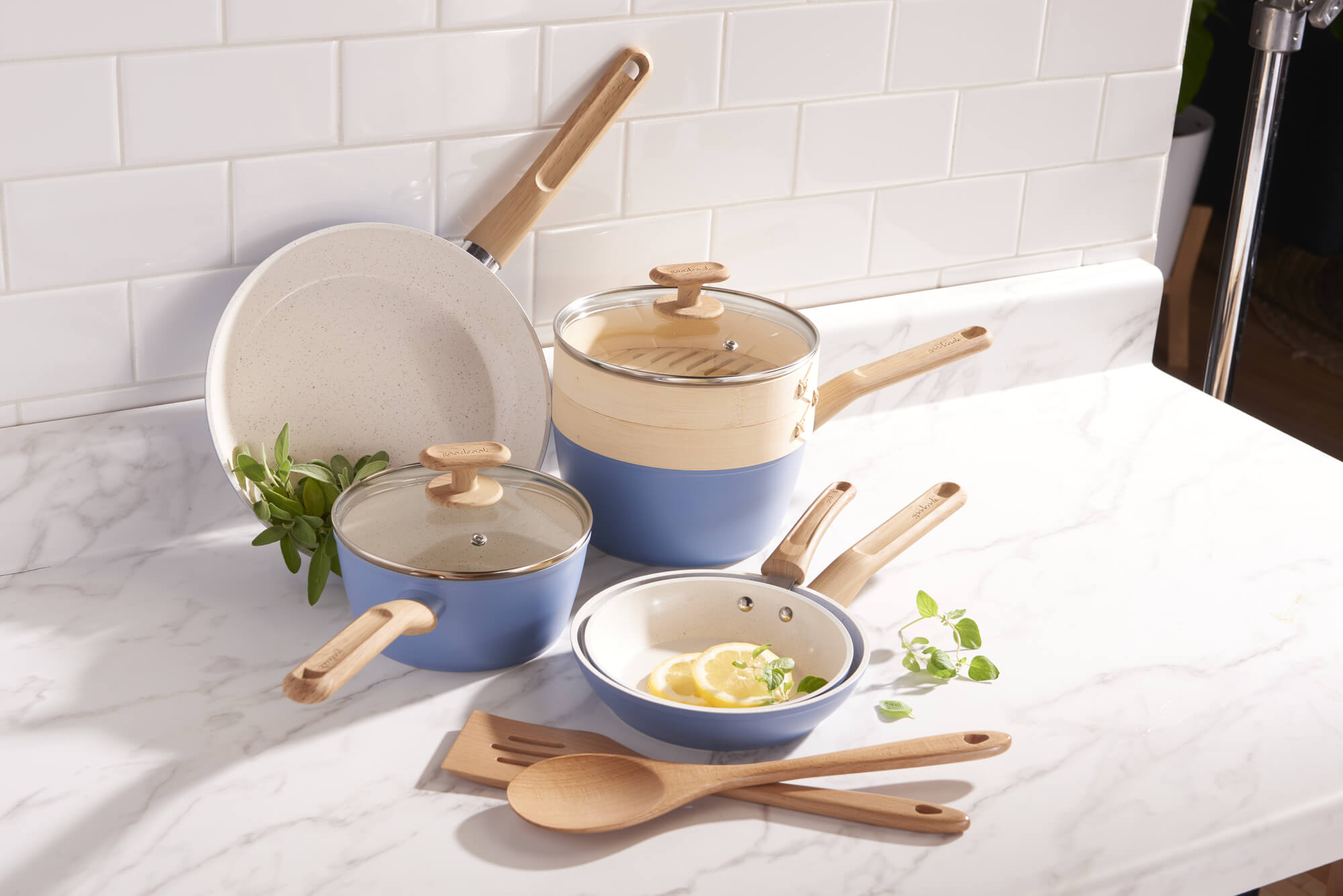
Ceramic cookware is made from either fired clay and mineral materials or a metal pan coated with a thin, silica-based ceramic layer.
In American kitchens, ceramic cookware is common in homes where people want easy cleanup and a smooth cooking surface. You might use a ceramic-coated skillet to cook eggs before work, heat vegetables for dinner, or prepare pancakes on a quiet weekend. Yet the word ceramic can mean two very different things, and that difference matters when you choose a pan.
Some ceramic cookware is made from clay or other mineral materials that are shaped and fired in a kiln. Much of the modern cookware sold as ceramic nonstick, however, has an aluminum or stainless steel body covered with a thin coating made through a process often called sol-gel. The coating commonly contains silica-based materials and other mineral ingredients. The exact formula varies by brand, so the word ceramic alone does not tell you everything about a pan’s construction, durability, or safety.
The simplest way to understand ceramic cookware is to look at the pan body and the cooking surface separately. The body provides structure and helps spread heat, while the surface affects food release, cleaning, and resistance to wear. Once you know these parts, it becomes easier to compare ceramic-coated pans with traditional nonstick, stainless steel, cast iron, and fully ceramic cookware.
Ceramic cookware is made from mineral-based materials, but the exact ingredients depend on the type of pan. Traditional ceramic cookware uses clay and other mineral ingredients that harden during firing. Modern ceramic nonstick cookware usually combines a metal body with a thin coating made from silica-based compounds and other ingredients.
This distinction explains why two pans labeled ceramic may look alike but behave differently. One may be a solid ceramic vessel that heats and holds heat in its own material. The other may be an aluminum skillet whose ceramic coating provides the food-contact surface.
When shopping, look beyond the word ceramic. Check whether the product is described as fully ceramic, ceramic-coated, or ceramic nonstick, and read the manufacturer’s material details.
Source: bradshawhome.com
The pan body
The body may be aluminum, stainless steel, cast iron, clay, or another ceramic material. It determines much of the pan’s weight, heat response, and structural strength.
The cooking surface
A solid ceramic pan has a ceramic surface throughout its body, while a ceramic-coated metal pan has a thin mineral-based layer over metal.
The bonding and finish
Coated cookware may use primers, bonding layers, pigments, or other components. The precise construction depends on the manufacturer’s formulation.
What Does Ceramic Mean in Cookware?
In materials science, ceramics are generally inorganic, nonmetallic materials made firm through heat or other processing. Common examples include pottery, porcelain, glass-like materials, and certain technical ceramics. Traditional cookware ceramics are often based on clay and mineral mixtures, while modern nonstick ceramic coatings use different manufacturing methods.
The term does not mean that every ceramic pan is made from the same substance. Nor does it mean every pan marketed as ceramic contains a thick layer of natural clay. Product labels can use the same broad word for very different structures.
Solid ceramic
The main vessel is made from fired ceramic material. It may be glazed or unglazed, depending on its design and intended use.
Ceramic-coated metal
A metal pan has a thin ceramic-based coating that provides the cooking surface. This is the type commonly marketed as ceramic nonstick cookware.
The Main Materials Used in Ceramic Cookware
The materials in ceramic cookware serve different jobs. The body needs to hold its shape and handle the stresses of cooking, while the surface needs to contact food and withstand repeated heating, cleaning, and utensil use.
In ceramic-coated cookware, aluminum is a common body material because it is relatively light and conducts heat well. Some products use stainless steel or a layered metal construction. The coating itself often relies on silica-based chemistry, along with other compounds that help create the finished surface.
Source: cdn.sanity.io
Aluminum
Aluminum is widely used in ceramic-coated frying pans and saucepans. It transfers heat efficiently, which can help a pan warm up quickly and respond when you adjust the burner. It is also light enough for everyday handling.
The metal body is usually hidden beneath the coating. A coating that wears away does not turn the aluminum body into ceramic; it exposes the underlying metal. If the pan has a damaged or peeling surface, follow the manufacturer’s guidance on whether it should be replaced.
Main benefit
Low weight and efficient heat transfer make aluminum practical for daily cooking.
Main limitation
Aluminum can warp under some conditions, and the pan’s overall durability depends on its thickness, construction, and coating.
Stainless Steel
Some ceramic-coated pans use stainless steel bodies or stainless steel layers combined with other metals. Stainless steel can provide strength and corrosion resistance, while an aluminum or other conductive core can improve heat distribution.
A stainless steel exterior does not automatically mean a pan will work on an induction cooktop. Induction compatibility depends on the magnetic properties and construction of the base, so check the product label.
Main benefit
Stainless steel can provide a durable outer structure and a finish that resists ordinary corrosion.
Main limitation
The exact heating performance depends on the complete base design, not simply the name of the outer metal.
Silica and Other Mineral-Based Ingredients
Many modern ceramic nonstick coatings use silica-based chemistry. Silica is a compound made from silicon and oxygen, and it is found in common natural materials such as quartz and sand. In a coating, silica-based ingredients help form a hard, smooth, glass-like structure after processing.
Manufacturers may combine silica-based ingredients with other inorganic compounds, pigments, binders, and additives. These ingredients help control the coating’s appearance, adhesion, hardness, and performance. A coating’s exact recipe is often proprietary, so it is not accurate to assume that every brand uses the same ingredients.
The finished coating is not simply loose sand spread over a pan. Its ingredients are processed into a bonded layer designed for the intended cookware application.
Silica-based components
These help form the ceramic-like structure of many modern nonstick coatings.
Pigments
These create colors such as white, cream, gray, green, or black. Color alone does not reveal the complete formula.
Other formulation ingredients
Additional compounds can help the coating adhere to the body or achieve its required properties. Their identity and role vary by product.
Clay and Mineral Mixtures in Solid Ceramic Cookware
Solid ceramic cookware is made from clay or other mineral mixtures shaped into a vessel and hardened by firing. Depending on the product, the finished body may be earthenware, stoneware, porcelain, or another ceramic formulation. Some pieces also have a glaze that creates a smoother surface or adds color.
These materials differ from the thin coatings used on metal pans. A solid ceramic baking dish, for example, relies on its ceramic body to contain food and withstand the intended oven conditions. A ceramic-coated aluminum skillet relies on metal for its body and on the surface coating for food contact.
Always check whether a solid ceramic product is intended for stovetop use, oven use, or both. Not every ceramic baking dish can go directly on a burner, and sudden temperature changes may crack some ceramic products.
Clay and minerals
These form the ceramic body after shaping and firing.
Glaze, where present
A glaze may provide a smoother finish, color, or reduced porosity. Its suitability for food contact depends on the materials and manufacturing quality.
How Is Ceramic Nonstick Cookware Made?
Ceramic-coated cookware is typically made by preparing a metal pan body, treating its surface, applying one or more coating layers, and curing the coating under controlled conditions. The exact process differs by manufacturer and product.
Many ceramic nonstick surfaces use sol-gel technology. In simple terms, a liquid mixture containing suitable chemical precursors forms a network as it is processed and cured. The result is a thin, solid coating with ceramic-like properties.
This manufacturing process differs from shaping a clay pot and firing it into a solid ceramic object. It also differs from applying a traditional PTFE-based nonstick coating, even though both types of pan may be sold for similar cooking tasks.
Source: carvercookware.com
Step 1: Prepare the Pan Body
The manufacturer forms the metal body into the shape of a skillet, saucepan, or other cooking vessel. The body may be cast, stamped, or made through another metal-forming process.
The surface must be prepared so the coating can adhere. This may involve cleaning and other surface treatments. The specific method depends on the metal and the coating system.
Purpose
A clean, properly prepared surface helps create a consistent bond between the metal and the coating.
Step 2: Apply the Ceramic-Based Coating
The manufacturer applies the coating mixture to the prepared pan. Depending on the design, the system may include a primer or more than one layer. Application methods and thickness vary.
The coating creates the surface that touches the food. Its formulation affects properties such as smoothness, color, food release, and resistance to everyday wear.
Purpose
The layer provides the intended cooking surface while covering the metal body.
Step 3: Cure and Inspect the Coating
The coated pan is heated under controlled production conditions so the coating can cure and develop its intended structure. The manufacturer then checks the finished product according to its quality requirements.
A coating that looks smooth in a new pan may still change during use. Repeated heating, abrasion, cleaning, and poor heat control can reduce its food-release performance. A new pan’s appearance is not proof of how long it will remain nonstick.
Purpose
Curing and quality checks help ensure that the coating is formed as intended before the cookware reaches consumers.
Is Ceramic Cookware Made Without Teflon or PTFE?
Many ceramic nonstick pans are marketed as alternatives to traditional PTFE-based nonstick cookware. PTFE, or polytetrafluoroethylene, is a fluoropolymer used in many familiar nonstick surfaces. Teflon is a brand name associated with PTFE-based coatings and related products.
A ceramic-based coating is generally made using different chemistry. Many manufacturers describe their ceramic nonstick products as PTFE-free, but you should confirm that claim for the exact product rather than assume every pan labeled ceramic has the same formulation.
The terms PFOA-free and PTFE-free do not mean the same thing. PFOA is a different chemical that was historically used in some fluoropolymer manufacturing processes. A claim that a pan is PFOA-free does not, by itself, prove that the coating contains no PTFE.
If avoiding particular chemicals is important to you, look for a clear statement from the manufacturer about the finished product and its coating. Ask about the exact model if the label does not answer your question.
Source: seriouseats.com
Ceramic Coating Versus PTFE Coating
Both ceramic-based and PTFE-based nonstick pans are designed to help food release with less sticking than an uncoated metal surface under suitable conditions. Their surface chemistry differs, and their long-term performance depends on formulation, construction, use, and care.
Ceramic coatings may lose their easy-release properties with repeated use, even when the pan remains intact. PTFE coatings also wear and can be damaged. Neither type should be overheated beyond its manufacturer’s limits, and neither should be treated as immune to damage.
Ceramic-based nonstick
Often uses silica-based chemistry and is commonly marketed as a PTFE-free option. Exact ingredients vary by product.
PTFE-based nonstick
Uses a fluoropolymer surface known for low friction and nonstick performance. Its care requirements and temperature limits depend on the product.
PFOA-free label
This claim concerns PFOA, not necessarily every other fluorinated compound or the presence of PTFE.
Is Ceramic Cookware Safe for Everyday Cooking?
Ceramic cookware can be suitable for everyday cooking when it is made for food contact and used according to its instructions. However, the word ceramic does not prove that every product is safe under every condition. The complete formulation, manufacturing quality, surface condition, and intended use all matter.
For ceramic-coated metal pans, the coating is the main food-contact surface when it remains intact. If the coating becomes badly damaged, follow the manufacturer’s advice about continued use. Avoid using cookware that is visibly peeling or shedding material into food.
Solid ceramic cookware has different considerations. A glazed ceramic vessel should be made for food use, and its glaze must be suitable for that purpose. Poorly made or improperly formulated glazed ceramics can present concerns about lead or cadmium migration into food. This is a particular reason to buy from a manufacturer that clearly identifies the product’s intended use and provides credible compliance information.
In the United States, the Food and Drug Administration regulates relevant food-contact materials and has guidance addressing lead in ceramicware. A product’s marketing language is not a substitute for applicable requirements or reliable testing. If the manufacturer cannot explain whether a ceramic vessel is suitable for food contact, choose a clearly documented alternative.
Source: xtrema.com
Does Ceramic Cookware Release Chemicals Into Food?
It is not accurate to say that every ceramic pan releases harmful chemicals, or that every ceramic pan is completely free of any possible migration. The answer depends on the actual materials, product quality, food-contact conditions, and temperature.
For a ceramic-coated metal pan, use the temperature limits set by the manufacturer. For solid glazed ceramic cookware, check that the item is intended for food use and comes from a reliable source. The term ceramic alone cannot establish the chemical composition or performance of an individual product.
Choose products intended for food
Decorative ceramic pieces are not automatically suitable for cooking, serving, or storing food.
Follow heat limits
Avoid extreme heat and empty-pan preheating beyond the product’s instructions, especially with coated cookware.
Inspect the surface
Stop using a pan with substantial peeling, flaking, or structural damage until you have checked the manufacturer’s guidance.
What About Lead and Cadmium?
Lead and cadmium are metals that may be present in some ceramic glazes or decorations. Their presence and potential migration depend on the formulation, manufacturing process, and conditions of use. Not all ceramic products contain these metals, and a product’s appearance cannot tell you whether it meets applicable limits.
Buy food-use ceramic cookware from a reputable source and look for relevant compliance information. Do not use decorative pottery for food simply because it resembles a cooking dish. If a product is old, damaged, unmarked, or of uncertain origin, avoid using it for food until its suitability is established.
Practical rule
Use ceramic cookware that is clearly intended for food contact and has credible manufacturing and compliance information.
What Are the Benefits and Limits of Ceramic Cookware?
The main appeal of ceramic-coated cookware is its easy-release surface, which can make cooking and cleanup simpler. Many pans also come in a range of colors and use a metal body that is easy to lift. These features can be useful for everyday meals such as eggs, pancakes, fish, and vegetables.
The main trade-off is that nonstick performance may decline over time. A ceramic coating can become less effective as the surface wears, even if the pan still looks usable. For this reason, it helps to match the pan to your cooking habits instead of expecting one skillet to handle every task.
Source: develokitchenware.com
Advantages of Ceramic-Coated Cookware
A new ceramic-coated pan can release many foods with little sticking when it is used correctly. You may need less cooking oil for some dishes, although the amount depends on the recipe and the condition of the surface. The smooth finish can also make routine cleaning easier.
Easy food release
Useful for delicate foods that tend to cling to bare metal, especially when the surface is in good condition.
Simple cleanup
Food residue often comes away with mild dish soap, a soft sponge, and warm water.
A range of designs
Ceramic-coated cookware is available in different colors, shapes, and body materials.
Alternative coating chemistry
Many products offer a nonstick surface made without intentionally added PTFE, subject to the exact product formulation and manufacturer claim.
Limitations to Consider
Ceramic nonstick cookware is not necessarily the most durable choice for every kitchen. High heat, rough utensils, abrasive cleaning, and repeated thermal stress can shorten the useful life of the coating. Its performance may decline even without obvious peeling.
Ceramic-coated pans are also not automatically suitable for every cooking method. Some cannot be used under a broiler, some have oven temperature limits, and some are not induction-compatible. Always check the exact product instructions.
Nonstick performance can fade
A coating may become less slippery with repeated use, and the loss of food release may not be covered by a warranty.
Heat control matters
Very high heat can damage some coatings or shorten their service life.
Not every pan works on induction
The base must be compatible with induction heating. The word ceramic does not answer this question.
Care instructions vary
Dishwasher safety, oven limits, and utensil recommendations differ across models.
Ceramic Cookware Compared With Other Materials
Ceramic cookware is not automatically better or worse than stainless steel, cast iron, or PTFE-based nonstick cookware. Each material has a different purpose. The right choice depends on what you cook, how much maintenance you want, and whether easy food release or long-term surface durability matters more to you.
The table below compares common cookware types by construction and practical use. These are general material characteristics, not guarantees for every product. Pan thickness, design, coating quality, and care can change the results.
Source: images.ctfassets.net
Ceramic-coated metal
A metal body with a thin ceramic-based cooking surface. Often useful for eggs and other foods that benefit from easy release.
Solid ceramic
A fired ceramic body. Often useful for baking and oven cooking when the specific item is designed for those conditions.
Stainless steel
An uncoated metal cooking surface that can handle many cooking tasks and is useful for browning when properly heated.
Cast iron
A heavy iron pan that retains heat well. Bare cast iron needs seasoning and care to manage rust and food sticking.
PTFE-based nonstick
A metal pan with a fluoropolymer coating that provides low-friction food release. It requires appropriate heat control and surface care.
Which Material Is Best for Different Cooking Tasks?
For eggs, crepes, and delicate fish, a ceramic-coated pan can be convenient while its nonstick surface is in good condition. For browning meat, making pan sauces, or building fond, stainless steel may be more useful because browned bits can be developed on its uncoated surface.
For slow cooking or foods that benefit from strong heat retention, cast iron can be a good fit. For casseroles and oven-baked dishes, an oven-safe ceramic baking dish may be suitable. Check the temperature limits and heat-shock warnings for the specific vessel before use.
Eggs and pancakes
Consider ceramic-coated or PTFE-based nonstick cookware for easier release.
Searing and pan sauces
Consider stainless steel or suitable cast iron if you want a surface that supports browning and fond.
Oven-baked dishes
Choose solid ceramic bakeware that is rated for the intended oven temperature and cooking method.
How to Care for Ceramic Cookware and Extend Its Life
Good care can help ceramic-coated cookware retain its food-release performance for longer. The most useful habits are simple: control heat, avoid rough tools, clean gently, and store the pan so other cookware does not scrape the surface.
Care cannot prevent every form of wear. The coating’s formulation and quality also matter, and a pan that loses its nonstick properties may not recover them through seasoning or aggressive cleaning.
Source: m.media-amazon.com
Use Low to Medium Heat When Practical
Ceramic-coated pans often work well at low or medium heat for everyday cooking. Start with moderate heat and increase it only when the recipe and pan instructions call for it. Avoid leaving an empty pan over a hot burner for long periods.
If food burns quickly or the surface develops unusual discoloration, lower the heat and check the manufacturer’s care guidance. Do not assume that a pan’s ability to withstand a brief temperature spike means it should be used at maximum heat every day.
Helpful habit
Preheat gently and add food or cooking fat as directed by the manufacturer.
Choose Gentle Utensils
Silicone, wood, or other utensils approved by the manufacturer can reduce scratching and abrasion. Avoid cutting food directly in the pan or scraping the surface with sharp metal tools unless the instructions explicitly permit them.
A small scratch may not mean the pan has failed, but widespread peeling or flaking is a reason to stop and seek manufacturer guidance.
Avoid rough handling
Do not bang the pan against hard surfaces or stack unprotected pans where their surfaces rub together.
Wash and Store the Pan Carefully
Let the pan cool before washing it, unless its instructions say otherwise. Sudden temperature changes can stress some cookware. Use warm water, mild dish soap, and a soft sponge rather than steel wool or harsh abrasive cleaners.
Handwashing is often a sensible way to protect a ceramic coating, even if a particular model is labeled dishwasher-safe. Dishwasher detergents, repeated washing, and contact with other items may affect the finish over time.
When stacking pans, place a pan protector or soft cloth between them if the manufacturer recommends it. This reduces direct contact that can scratch or wear the cooking surface.
Do not use harsh abrasives
Steel wool and aggressive scouring pads can damage some ceramic coatings.
Avoid thermal shock
Do not move hot cookware directly into cold water unless the product instructions specifically allow that practice.
Store with care
Use separators between stacked pans to reduce rubbing and scratches.
Common Mistakes When Buying Ceramic Cookware
The most common buying mistake is treating every ceramic label as proof of the same materials, performance, and safety features. A ceramic-coated aluminum skillet is not the same as a solid ceramic casserole dish, and neither is automatically right for every cooking method.
Read the product description and care guide before buying. If an important detail is unclear, ask the manufacturer rather than relying on assumptions based on color, price, or broad marketing terms.
Source: prudentreviews.com
Assuming all ceramic cookware is solid ceramic
Check the listed body material and coating description to see what the pan is actually made of.
Confusing PFOA-free with PTFE-free
These terms describe different things. Look for a clear statement about the exact coating if avoiding PTFE matters to you.
Assuming a smooth surface will last forever
Food release can decline with wear. Consider your cooking frequency, heat habits, and willingness to replace a worn pan.
Ignoring induction compatibility
Check the manufacturer’s compatibility statement for your cooktop rather than judging by appearance.
Using decorative ceramics for cooking
A decorative ceramic item is not necessarily made or tested for food contact, direct heat, or oven use.
Treating price as proof of safety
A higher price does not establish a coating’s composition or a glaze’s compliance. Look for clear specifications and credible documentation.
A Simple Checklist Before You Buy
You do not need a chemistry degree to compare cookware. A short checklist can help you identify the details that affect everyday use and avoid paying for features you do not need.
Confirm construction
Find out whether the pan is solid ceramic or metal with a ceramic-based coating.
Check the coating claim
If you want to avoid PTFE or another specific chemical, look for a clear manufacturer statement about the exact product.
Review cooking compatibility
Check induction use, oven limits, broiler restrictions, and the manufacturer’s recommended heat range.
Read care instructions
Confirm the recommended utensils, cleaning method, and storage practices.
Review food-contact information
For solid ceramic or glazed cookware, choose products clearly intended for food use and backed by credible compliance information.
Frequently Asked Questions
Q
Is ceramic cookware made from real ceramic?
Sometimes. Solid ceramic cookware is made from fired clay or other mineral materials. However, many pans sold as ceramic nonstick cookware have an aluminum or stainless steel body with a thin silica-based ceramic coating. Check the product description to learn which type you are buying.
Q
Is ceramic cookware made of aluminum?
Many ceramic-coated pans have an aluminum body because aluminum transfers heat well and is relatively light. The ceramic-based coating covers the cooking surface. Other pans may use stainless steel, layered metals, or a solid ceramic body, so aluminum is common but not universal.
Q
Does ceramic cookware contain Teflon?
Many ceramic nonstick pans are formulated without intentionally added PTFE, the fluoropolymer used in many Teflon-branded nonstick coatings. However, the word ceramic alone does not establish the exact ingredients. Check the manufacturer’s statement for the specific product, especially if you want to avoid PTFE.
Q
Is ceramic cookware safer than traditional nonstick cookware?
There is no universal answer based only on the word ceramic. Ceramic-based coatings and PTFE-based coatings use different materials, and the safety of a finished pan depends on its formulation, quality, and use. Follow the manufacturer’s heat limits and care instructions, and replace cookware with substantial peeling or damage according to its guidance.
Q
Can ceramic cookware go in the oven?
Some ceramic cookware is oven-safe, but not every pan can handle oven heat. Ceramic-coated pans may have limits based on the coating, handle, lid, or other components. Solid ceramic bakeware also has limits and may be vulnerable to sudden temperature changes. Check the exact model’s instructions before placing it in an oven.
Q
Why does ceramic nonstick cookware lose its nonstick properties?
Repeated heating, abrasion, cleaning, and ordinary wear can change the surface and reduce food release. High heat and rough utensils may speed up that process. Moderate heat, gentle cleaning, and suitable utensils can help preserve the surface, but no coating lasts forever.
Q
Is ceramic cookware safe if the coating gets scratched?
A minor surface mark does not automatically mean the pan is unsafe, but the type and extent of damage matter. If the coating is peeling, flaking, or shedding material, stop using the pan until you have checked the manufacturer’s instructions. A damaged coating may expose the metal body and can signal that the pan has reached the end of its useful life.
Q
Is solid ceramic cookware better than ceramic-coated cookware?
Neither is best for every task. Solid ceramic cookware can be useful for baking and oven cooking when it is designed for those uses. Ceramic-coated metal pans are often lighter and provide an easy-release surface for stovetop meals. Compare the intended cooking method, weight, care needs, and manufacturer’s temperature limits.
✦ Wrapping Up
Conclusion
Ceramic cookware can be made from fired clay and mineral materials or from metal covered with a thin ceramic-based coating. In many modern nonstick pans, the body is aluminum or stainless steel, while the cooking surface uses silica-based chemistry and other ingredients that vary by manufacturer.
The distinction matters because the body and coating affect different parts of the cooking experience. Metal construction influences weight and heat transfer, while the surface influences food release, cleaning, and resistance to wear. Solid ceramic cookware has its own strengths and limits, especially when it comes to oven use and resistance to sudden temperature changes.
For a practical choice, identify the pan’s construction, check any chemical-free claims you care about, and read the heat and care instructions. Use moderate heat when appropriate, choose suitable utensils, and avoid cooking with a surface that is badly peeling or damaged. Those steps give you a clearer basis for choosing cookware than the word ceramic alone.
💡 Key Takeaway
Before buying ceramic cookware, check three things: whether it is solid ceramic or ceramic-coated metal, what the manufacturer says about the coating, and whether the pan suits your cooktop and cooking habits.