Use stainless steel, silicone, wood, or heat-safe nylon utensils with stainless steel cookware. Metal tools are suitable for bare stainless steel pans, while wood and silicone offer a gentle, easy-to-use option for everyday cooking.
In American kitchens, stainless steel pans handle everything from scrambled eggs and weekend pancakes to seared steaks and quick weeknight stir-fries. The right cooking utensil makes these jobs easier, helps you control food as it cooks, and reduces needless wear on your cookware. The good news is that bare stainless steel is one of the most flexible surfaces for choosing kitchen tools.
When choosing what kind of utensils for stainless steel cookware, start with the pan’s cooking surface, the tool’s heat rating, and the task at hand. A sturdy metal spatula can help lift a browned burger, while a wooden spoon works well for stirring soup. Silicone tools are useful for scraping food from curved edges, and heat-safe nylon can be handy for lighter tasks when its temperature limit suits the recipe.
What Kind of Utensils Work Best With Stainless Steel Cookware?
Stainless steel, silicone, and wood are the most useful utensil materials for a typical stainless steel kitchen. Each has a different strength, so you do not need to choose only one. A small set of well-made tools will handle most home cooking tasks.
Bare stainless steel pans have a hard metal cooking surface rather than a soft nonstick coating. This makes them suitable for metal tools during normal cooking. Still, a metal edge can leave visible marks, so the best choice depends on whether you value durability, surface appearance, or a softer touch.
For most households, a stainless steel turner, a wooden spoon, a silicone spatula, and a pair of kitchen tongs provide a useful starting set. Add a whisk, ladle, or slotted spoon if your recipes call for them.
Source: Made In
Stainless steel utensils
Best for turning meat, lifting firm foods, stirring sturdy ingredients, and handling high-heat tasks when the tool is designed for cooking.
Silicone utensils
Best for scraping pan edges, folding delicate mixtures, stirring sauces, and handling foods that benefit from a flexible tool.
Wooden utensils
Best for stirring soups, stews, grains, and sauces without the hard contact of a metal edge.
Heat-safe nylon utensils
Best for light stirring and turning when the tool’s temperature rating is high enough for the cooking method.
Are Metal Utensils Safe for Stainless Steel Pans?
Yes. Metal utensils are generally suitable for bare stainless steel cookware. A stainless steel spatula can slide beneath roasted vegetables, loosen a burger, or help lift a browned piece of chicken. The pan’s cooking surface does not have the soft coating found on many traditional nonstick pans.
However, safe use does not mean the surface will remain free of marks. Metal-on-metal contact can produce scratches, scuffs, and shiny or dull streaks. These marks are often cosmetic, but deep gouges, sharp burrs, or damaged cookware deserve closer inspection.
Use a smooth edge
Choose a spatula or turner without sharp burrs, bent corners, or rough damage that could scrape the pan.
Work with control
Use steady movements rather than striking, chopping, or forcefully scraping the cooking surface.
Check the cookware finish
If the pan has a nonstick coating or another special surface, follow its care instructions rather than the rules for bare stainless steel.
Should You Use Only Stainless Steel Utensils?
No. Stainless steel utensils are durable, but they are not the only suitable option. Wood and silicone can make stirring and scraping easier, especially when working with sauces, soft vegetables, eggs, or foods that stick around the edges.
Think of a utensil drawer as a toolbox. A hammer is useful for one job, but it cannot replace every other tool. In the same way, a metal turner, wooden spoon, and silicone spatula each solve different kitchen problems.
Choose by task
Match a wide turner to flat foods, a spoon to liquids, and a flexible spatula to bowls and curved pan edges.
Choose by comfort
A balanced handle and useful grip can matter more than buying a complete set made from one material.
Stainless Steel Cooking Utensils: Strengths and Limitations
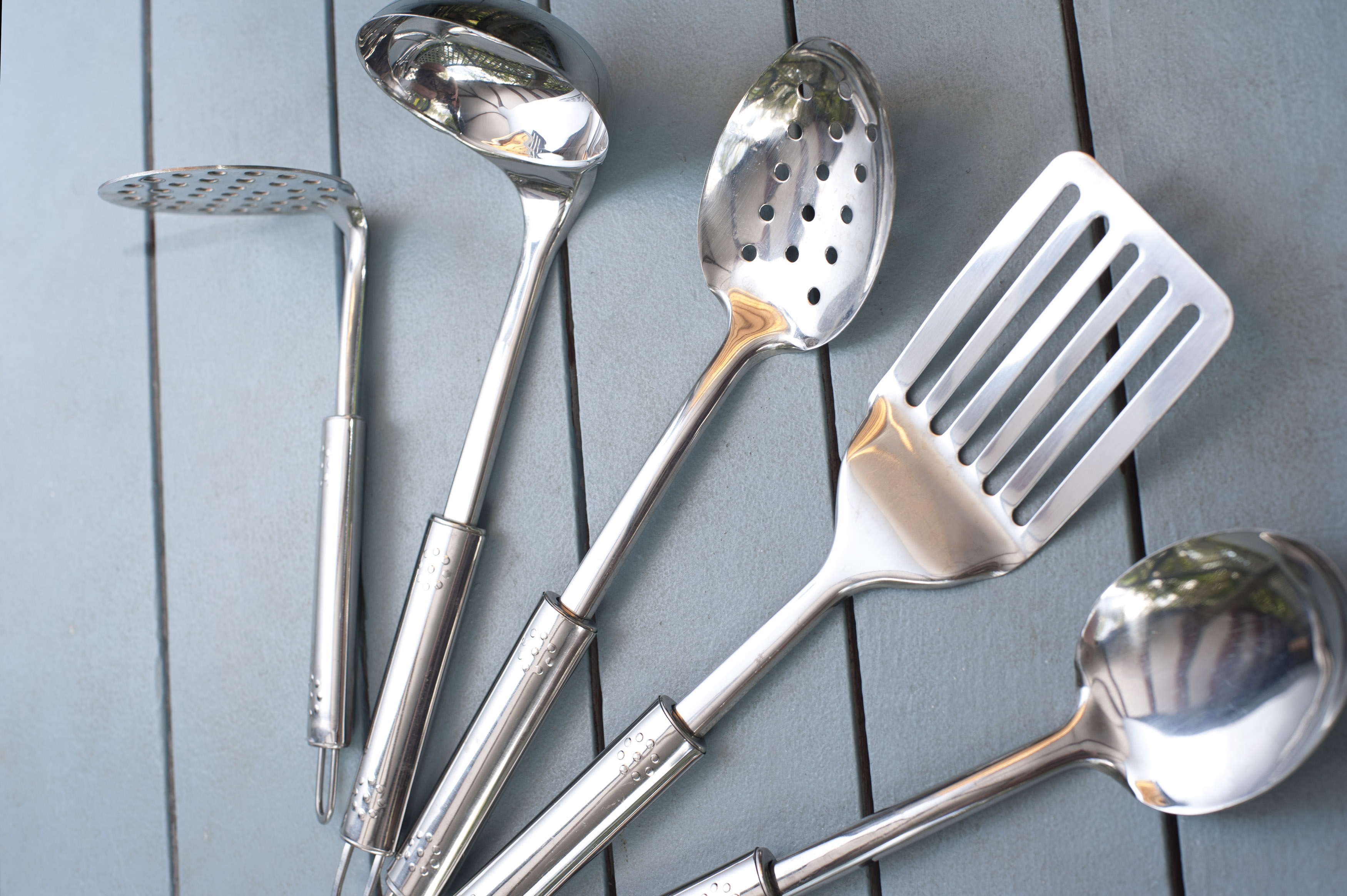
Stainless steel utensils are a strong choice for cooks who want long-lasting tools that can handle frequent use. Many have rigid blades, sturdy handles, and simple designs that are easy to wash. They are especially useful when food needs to be lifted, turned, or moved with precision.
A metal turner is helpful when searing burgers or fish with a firm crust. Tongs can turn chicken pieces, move roasted vegetables, or transfer cooked pasta. A stainless steel whisk can mix eggs, sauces, and dressings in a suitable bowl.
The main drawback is the hard contact between metal surfaces. A metal tool can mark a polished pan, and a rough edge can cause more noticeable damage. Metal utensils can also feel heavy or noisy compared with wood or silicone.
Source: Made In
Advantages
Strong, durable, easy to maintain, and well suited to turning or lifting firm foods.
Limitations
Can leave cosmetic marks, create noise, and feel less gentle when working with soft ingredients.
Best match
Bare stainless steel pans used for searing, browning, sautéing, and other tasks that benefit from a firm utensil.
Best Metal Tools for Stainless Steel Cookware
A stainless steel turner is a practical first choice because its thin edge can slide beneath food. For burgers, pancakes, and some fish fillets, select a blade wide enough to support the food without bending too much.
Tongs are useful for turning meat and moving vegetables. Choose a secure grip and a locking design if you want compact storage. A stainless steel whisk works well for sauces and egg mixtures, but use it in a pan only if its shape and the cookware maker’s instructions suit that use.
Turner or spatula
Use for burgers, roasted vegetables, and other foods that need lifting or turning.
Kitchen tongs
Use to grip and rotate food without piercing it with a fork.
Whisk
Use for mixing eggs, blending sauces, and combining ingredients.
Ladle
Use for serving soup, chili, gravy, and other liquids.
Can Metal Utensils Scratch Stainless Steel?
Yes, metal utensils can scratch or scuff stainless steel. The effect depends on the utensil’s edge, the force used, the pan’s finish, and whether grit or food particles sit between the surfaces. These marks do not automatically mean the pan has become unsafe to use.
To reduce visible wear, keep utensils clean, avoid sharp or damaged edges, and do not use a pan as a chopping board. If you prefer a mirror-like finish, wood or silicone is a sensible everyday choice. If your main goal is cooking performance, light cosmetic marks on bare stainless steel are often less important than proper heat control and cleaning.
Reduce abrasion
Wash away grit before cooking and avoid dragging dirty or damaged tools across the pan.
Avoid excessive force
Use a scraper or suitable utensil gently instead of striking the pan to remove stuck food.
Silicone Utensils for Stainless Steel Cookware
Silicone utensils are useful when flexibility matters more than rigidity. A flexible spatula can scrape sauce from the sides of a pan, fold ingredients together, or remove food from a curved corner. Silicone is also a comfortable option for cooks who want to avoid frequent metal-on-metal contact.
Heat resistance varies by product. A utensil labeled silicone is not automatically safe at every cooking temperature, and handles or internal cores may use different materials. Check the stated maximum temperature and keep the tool away from direct contact with a gas flame or heating element unless its instructions specifically allow that use.
A silicone spoon or spatula is especially useful for sauces, oatmeal, scrambled eggs, and soft vegetables. A very flexible blade may be less effective when lifting a heavy burger or turning a thick steak, so pair it with a firm turner when needed.
Source: Made In
Advantages
Flexible, gentle on the pan’s finish, useful for scraping, and often easy to clean.
Limitations
Can bend too much for heavy foods, and temperature limits differ across products.
Best match
Sauces, eggs, soft foods, curved pan edges, and everyday stirring.
How to Choose a Good Silicone Spatula
Look for a clearly stated heat rating, a secure handle, and a blade that bends without collapsing under light pressure. One-piece designs can reduce gaps where food residue collects, although some multi-part tools are also well made and easy to clean.
Inspect the blade for cuts, tears, sticky patches, or signs of melting. Replace a damaged utensil rather than continuing to cook with material that is breaking down. Follow the product’s washing instructions, especially if the handle contains wood or another material that may not tolerate a dishwasher.
Check the temperature limit
Choose a tool rated for the heat used in your recipes, with a suitable margin for normal cooking.
Inspect the blade
Avoid torn edges and deep cuts that can trap residue or signal material damage.
Choose a useful shape
A narrow spatula suits small pans, while a broad blade helps with larger portions.
Wooden Utensils: A Gentle Everyday Choice
Wooden spoons and spatulas work well with stainless steel cookware because they provide a firm grip without the hard contact of a metal edge. They are handy for stirring soup, mixing a thick sauce, folding cooked vegetables, and moving ingredients around the pan.
Wood does not conduct heat as readily as metal, so the handle often remains more comfortable to hold during normal use. Still, a wooden utensil can become hot if left in a pan for too long, and the handle should not be placed over an open flame.
Wood needs a little more care than stainless steel. Wash wooden tools by hand with warm water and dish soap, then dry them promptly. Long soaking and repeated dishwasher cycles can cause some wooden utensils to swell, crack, or warp.
Source: m.media-amazon.com
Advantages
Comfortable grip, useful strength, and a surface that is gentle on polished cookware.
Limitations
Requires careful drying and inspection, and may absorb odors or stains over time.
Best match
Soups, stews, rice, sauces, vegetables, and general stirring.
How to Care for Wooden Cooking Tools
Wash wooden utensils soon after use so food does not dry onto the surface. Use a soft brush or sponge to remove residue, rinse well, and dry the tool with a towel before letting it finish drying in open air.
Check the wood from time to time. Deep cracks, splinters, rough damaged areas, or persistent residue that cannot be cleaned away are reasons to replace the utensil. Food-safe mineral oil may help maintain some unfinished wooden tools when the maker recommends it, but cooking oils that can turn rancid are not ideal for routine wood care.
Wash by hand
Use mild dish soap and warm water rather than leaving the utensil submerged.
Dry promptly
Remove excess water and store the tool where air can circulate.
Replace damaged wood
Discard tools with deep splits, splinters, or surfaces that are difficult to clean.
Are Nylon Utensils Safe for Stainless Steel Pans?
Heat-safe nylon utensils can work with stainless steel cookware, but their temperature limits matter. Nylon is a type of plastic, and some tools may soften, warp, or melt when exposed to heat above their rating. Do not assume that every black nylon turner or spoon can handle a hot pan.
For routine stirring or turning at moderate heat, a properly rated nylon tool can be practical. For high-heat searing, a metal turner or a suitable high-temperature silicone tool is often a better fit. The exact recommendation depends on the utensil’s design and instructions.
If a nylon utensil has become bent, discolored from heat, melted, or rough at the edge, stop using it. Do not scrape melted plastic from a hot pan while the pan is on the burner. Turn off the heat, let the cookware cool, and follow the cookware maker’s cleaning guidance.
Source: ph-test-11.slatic.net
Advantages
Often lightweight, easy to handle, and available in shapes suited to stirring and turning.
Limitations
Less suited to high heat when the cooking temperature exceeds the tool’s rating.
Best match
Moderate-heat tasks when the utensil’s label confirms suitability.
Nylon Versus Silicone
Nylon and silicone are both used for nonmetal cooking utensils, but they do not behave in exactly the same way. Nylon tools are often more rigid, while silicone tools tend to be more flexible. The product’s construction and temperature rating matter more than the material name alone.
For a spatula that needs to scrape the side of a pan, flexible silicone is often more useful. For a firm turner used at moderate heat, a suitably rated nylon tool may be a reasonable option. If your recipes involve very hot pans, check the exact rating before buying either type.
Choose silicone for flexibility
Useful for scraping, folding, and reaching curved edges.
Choose nylon for firm support
Useful when the tool is well rated for the intended heat and the food needs a stable blade.
Which Utensil Should You Use for Each Cooking Task?
The best utensil depends on the shape and texture of the food, not just the pan material. A wide, firm turner helps lift foods with a flat base, while a spoon works better for liquids and small ingredients. A flexible spatula can reach places that a rigid blade may miss.
Stainless steel pans are often used for browning and searing, so tools that can handle the intended heat are important. At the same time, delicate foods may need a lighter touch. Use the following table as a practical guide, then adjust it to the utensil’s rating and the cookware manufacturer’s instructions.
Source: m.media-amazon.com
For searing meat
Use sturdy stainless steel tongs or a firm metal turner with smooth edges.
For eggs and sauces
Use a wooden spoon or a heat-rated silicone spatula, and manage the pan’s temperature to reduce sticking.
For soups and stews
Use a wooden spoon, silicone spoon, or ladle with a comfortable grip.
For pasta and vegetables
Use suitable stainless steel tongs, a slotted spoon, or a broad turner.
Utensil Selection Table
This table compares common utensils by task and material. It is a general guide rather than a guarantee that every product can handle every cooking temperature.
Burgers and steak
A stainless steel turner or sturdy tongs provide a firm grip and useful control.
Fish fillets
A thin, broad metal turner can help support the fillet; a flexible spatula may help with delicate portions.
Scrambled eggs
A silicone spatula or wooden spoon is useful for gentle stirring, but low to moderate heat and proper technique also matter.
Pan sauces
A wooden spoon or heat-safe silicone spatula can help stir the liquid and loosen browned bits without aggressive scraping.
Soup and chili
A wooden spoon for stirring and a ladle for serving make a useful pair.
Stir-fried vegetables
Stainless steel tongs or a broad metal turner work well when the utensil is suitable for the heat.
Pancakes
A broad turner helps lift and flip the pancake; metal is generally suitable for bare stainless steel.
Thick mixtures
A sturdy wooden spoon or a strong, heat-rated silicone spoon gives better leverage than a very flexible spatula.
Do Utensils Affect Food Sticking to Stainless Steel?
Yes, the utensil can affect how easily you move food, but it is rarely the main reason food sticks to stainless steel. Pan temperature, surface moisture, cooking fat, and timing usually matter more. A metal spatula cannot make a cold pan behave like a properly heated one.
For foods such as eggs, fish, and pancakes, preheating the pan and using the right amount of cooking fat can improve results. Let food develop a browned surface before trying to turn it. When the food is ready to release, a suitable turner can slide underneath with less force.
Avoid treating the utensil as a way to force food off the pan. Scraping aggressively can damage the finish or break delicate food into pieces. If food remains firmly stuck, lower the heat if needed and give it more time before testing the edge again.
Source: realsimple.com
Preheat with care
Warm the pan at a suitable setting for the recipe instead of heating it empty on high for a long period.
Dry food surfaces
Pat ingredients dry when appropriate, especially before searing meat or fish.
Use suitable fat
Add an appropriate cooking oil or fat based on the recipe and cooking temperature.
Wait before turning
Give food time to brown and release naturally instead of forcing a utensil underneath too early.
How to Lift Stuck Food Without Damaging the Pan
First, check whether the food simply needs more time to brown. If it remains stuck, reduce the heat and gently test the edge with a suitable turner. Avoid using a sharp knife or an abrasive metal tool to dig food out of the surface.
For browned bits left after cooking meat, many recipes use liquid to loosen them and create a pan sauce. Add a suitable liquid after the heat is adjusted, then use a wooden spoon or a compatible spatula to release the browned material. Let the pan cool before cleaning if the cooking step is finished.
Do not force the food
Wait briefly and test the edge again before applying more pressure.
Use liquid when suitable
Water, stock, or another recipe liquid can help loosen browned food for a sauce.
Clean after cooling
Follow the cookware instructions and avoid exposing a very hot pan to sudden temperature changes unless the manufacturer permits it.
How to Choose and Maintain a Stainless Steel Utensil Set
You do not need a large utensil set to cook well with stainless steel cookware. Start with a few tools that cover your most common meals, then add specialized pieces only when a recipe calls for them. A small, useful set often saves drawer space and avoids buying tools that rarely leave the holder.
Check the material, handle design, temperature rating, cleaning instructions, and overall construction before buying. A utensil that looks attractive may still be awkward to grip or too flexible for the job. For sets with bonded handles or multiple materials, review the care instructions for the complete tool rather than judging it by the working end alone.
Source: i.pinimg.com
Start with a turner
Choose a broad, sturdy tool for lifting and flipping common foods.
Add a wooden or silicone spoon
Use it for stirring sauces, soups, vegetables, and grains.
Keep a pair of tongs
Use tongs for turning meat, lifting vegetables, and transferring cooked food.
Add a whisk or ladle as needed
Choose these based on the sauces, soups, and other recipes you make most often.
Cleaning Stainless Steel Utensils
Most all-metal cooking utensils are easy to clean with warm water and dish soap. Rinse away food residue, dry the tool when needed, and check the handle joints for trapped debris. Dishwasher use depends on the manufacturer’s instructions and the construction of the utensil.
Silicone tools should be cleaned according to their care labels, with special attention to residue that may collect around a handle or internal core. Wooden tools should generally be washed by hand and dried promptly. Nylon tools should be inspected for heat damage before each use if they have been exposed to high temperatures.
Clean soon after cooking
Remove food residue before it dries and becomes harder to wash away.
Inspect seams and joints
Check for trapped food, loose handles, cracks, or damaged material.
Follow the care label
Do not assume every utensil is dishwasher-safe just because its working end is metal or silicone.
Common Mistakes to Avoid
The most common utensil mistakes involve heat, force, and material confusion. A tool suitable for bare stainless steel may be unsuitable for a coated pan, and a utensil rated for moderate heat may fail during high-heat searing. Small checks before cooking can prevent damage and make the kitchen easier to manage.
Using low-heat nylon in a very hot pan
Check the temperature rating and switch to a tool designed for the intended heat.
Assuming every stainless steel pan is uncoated
Read the cookware instructions because some products combine stainless steel bodies with coated cooking surfaces.
Leaving wooden tools in water
Wash and dry wood promptly to reduce the chance of swelling, cracking, or warping.
Using damaged utensils
Replace tools with sharp burrs, cracks, melted areas, or loose parts.
Scraping food with excessive force
Use suitable heat control and gentle movements rather than treating the pan like a scraping board.
How to Build a Practical Utensil Collection
A useful utensil collection should match the meals you make, the space you have, and the way you cook. A person who sears meat several times a week may want a sturdy metal turner and strong tongs. Someone who mostly makes soups, oatmeal, and pasta may use wooden spoons, a ladle, and a slotted spoon more often.
Before buying a set, look at the tools you already own. Keep the pieces that work well, replace damaged items, and fill only the gaps that affect daily cooking. This approach avoids paying for duplicate tools and makes it easier to store everything within reach.
Source: Made In
Basic collection
One metal turner, one wooden spoon, one heat-safe silicone spatula, and one pair of tongs cover many everyday tasks.
For soup and pasta cooks
Add a ladle and slotted spoon for serving liquids and lifting food from water.
For baking and sauces
Add a whisk and a flexible spatula for mixing and scraping.
For small kitchens
Choose multipurpose tools with useful shapes and handles that fit your storage space.
A Simple Decision Rule
If you want one easy rule, choose the utensil based on the job first and the material second. Use a rigid tool when you need support, a flexible tool when you need to scrape, and a spoon when you need to stir or serve. Then check that the utensil can handle the cooking temperature and is approved for your pan’s surface.
For most bare stainless steel cookware, a mix of metal, wood, and silicone offers the most flexibility. You can use metal where strength matters and reach for wood or silicone when you prefer a gentler touch. There is no need to replace a useful utensil simply because it is made from a different suitable material.
Need strength?
Choose a sturdy stainless steel turner or tongs.
Need flexibility?
Choose a heat-rated silicone spatula.
Need comfortable stirring?
Choose a wooden or suitable silicone spoon.
Need a tool for high heat?
Check the stated heat rating and the cookware instructions before use.
Frequently Asked Questions
Q
Can I use metal utensils on stainless steel cookware?
Yes. Metal utensils are generally suitable for bare stainless steel cookware. They can turn meat, lift vegetables, and help release browned food. However, metal-on-metal contact may leave scratches or scuff marks, so use smooth tools and avoid excessive force.
Q
Are silicone spatulas good for stainless steel pans?
Yes. Silicone spatulas work well for stirring sauces, folding ingredients, and scraping food from curved edges. Check the utensil’s heat rating before using it in a hot pan, because temperature limits and construction vary by product.
Q
Are wooden spoons better than metal spoons for stainless steel cookware?
Neither material is always better. Wooden spoons are useful for gentle stirring and help limit metal-on-metal marks, while metal spoons can be durable and easy to clean. Choose the material that fits the recipe, your preferred grip, and your care routine.
Q
Can I use nylon utensils on a stainless steel pan?
Yes, if the utensil is designed for cooking and its temperature rating suits the recipe. Some nylon tools can soften or melt under high heat. For very hot cooking, choose a suitable metal tool or a heat-rated alternative.
Q
Do metal utensils ruin stainless steel cookware?
Normal use of a suitable metal utensil does not automatically ruin a bare stainless steel pan. It can leave visible marks, especially on polished finishes. Avoid damaged edges, excessive scraping, and sharp tools that could gouge the surface.
Q
What utensils should I avoid with stainless steel cookware?
Avoid utensils that are cracked, splintered, melted, or have sharp damaged edges. Do not use plastic or nylon tools above their rated temperature, and do not assume metal utensils are safe for a stainless steel pan with a nonstick coating. Always follow the cookware and utensil makers’ instructions.
Q
Do I need a special utensil set for stainless steel cookware?
No. A special set is not required for bare stainless steel cookware. A sturdy metal turner, a wooden spoon, a heat-safe silicone spatula, and kitchen tongs are a practical starting point. Add a whisk, ladle, or slotted spoon based on the foods you prepare.
✦ Wrapping Up
Conclusion
The best utensils for stainless steel cookware are the ones that suit your food, cooking heat, and preferred way of working. Stainless steel tools offer strength and durability, wooden spoons provide comfortable stirring, and silicone spatulas help scrape curved edges. Heat-safe nylon can also be useful when its temperature rating matches the job.
For a practical everyday collection, start with a metal turner, a wooden spoon, a silicone spatula, and a pair of tongs. Check your pan’s surface and each utensil’s care instructions before use. With the right tools and good heat control, stainless steel cookware can handle a wide range of meals without requiring a large or expensive utensil set.
💡 Key Takeaway
Start with four tools: a smooth stainless steel turner for firm foods, a wooden spoon for stirring, a heat-rated silicone spatula for scraping, and sturdy tongs for turning ingredients. Confirm that your pan is bare stainless steel and check each tool’s heat rating before cooking.