Yes, T-fal ceramic cookware can be safe for everyday cooking when used and maintained according to the manufacturer’s instructions. However, the exact coating, product model, heat limits, and condition of the cooking surface matter.
For American households, T-fal ceramic cookware offers a convenient way to prepare eggs, vegetables, fish, and other everyday meals with less oil. Its smooth cooking surface helps reduce sticking and makes cleanup easier. Still, the word ceramic does not automatically mean that every pan has the same chemical makeup or safety properties.
T-fal sells several cookware collections, and their materials and features can vary. The company’s US care information describes its ceramic cookware as PFOA-free. However, PFOA-free and PFAS-free are not interchangeable claims. Some nonstick coatings use PTFE, which belongs to the broader PFAS chemical family, while other ceramic coatings use different materials.
The safest way to judge a T-fal ceramic pan is to identify its exact product line, check its coating information, and follow its care instructions. Avoid overheating, use gentle utensils, and replace cookware when the coating becomes badly damaged. These simple steps help protect the cooking surface and support safer daily use.
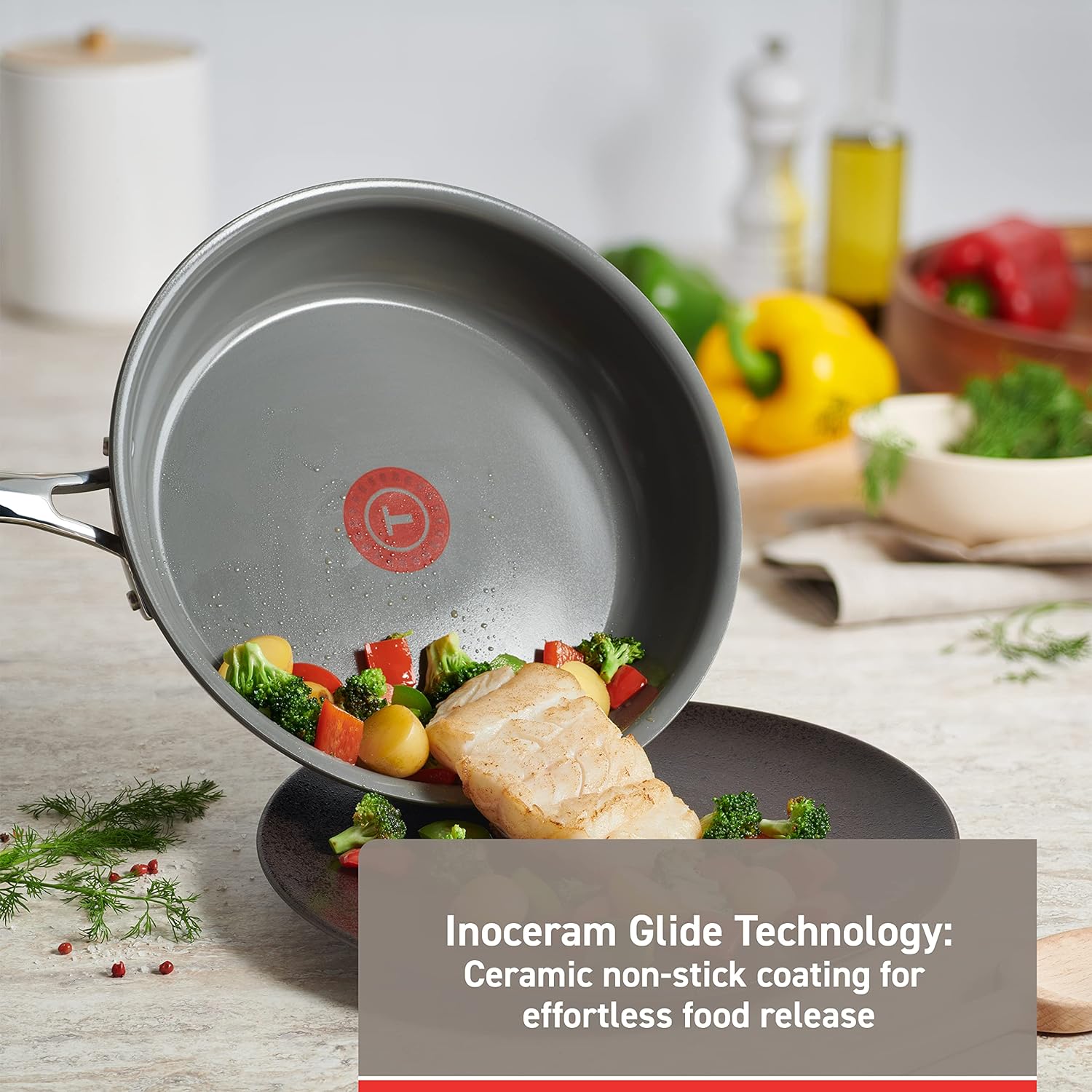
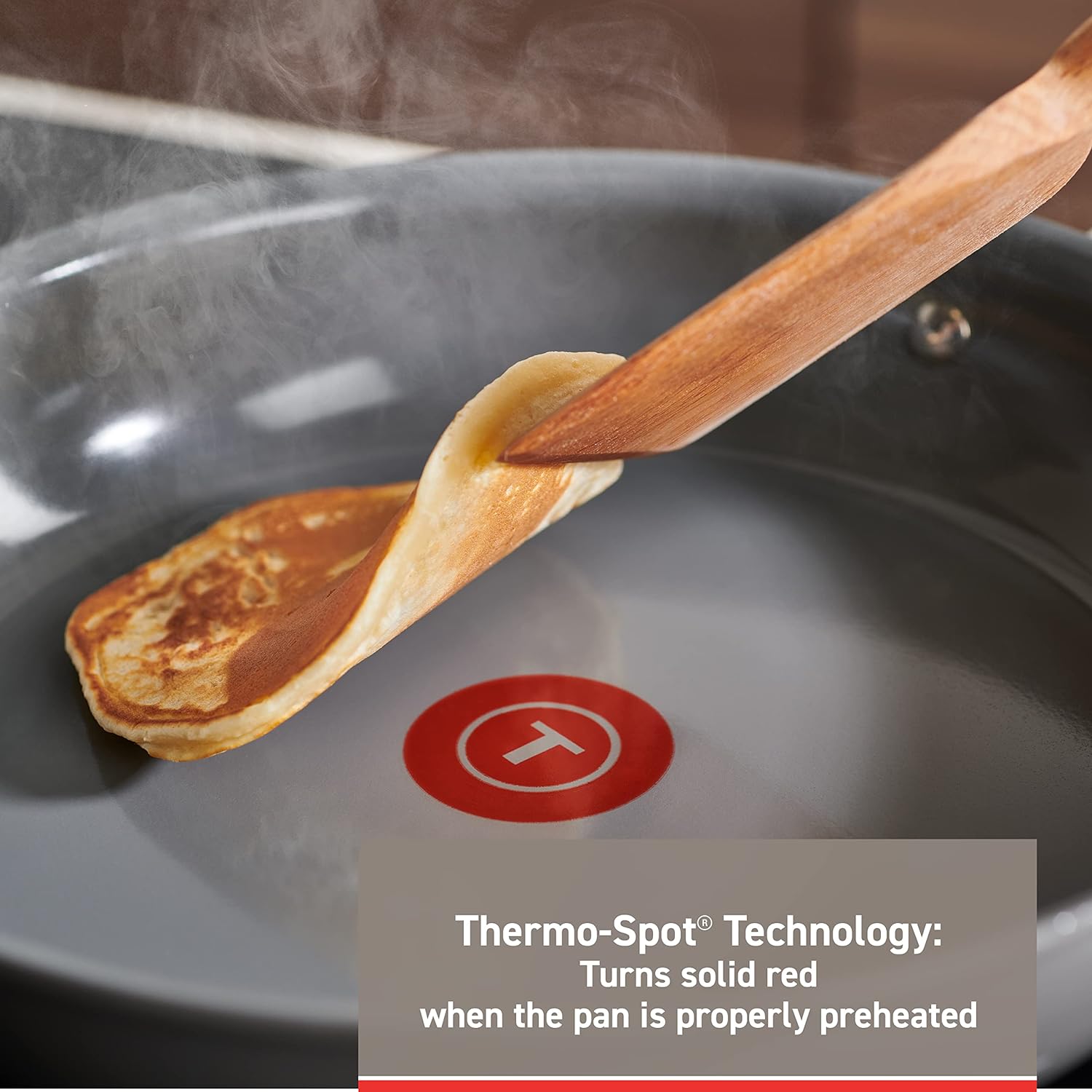
T-fal ceramic cookware is designed to provide a nonstick cooking surface without relying on the same coating technology used in every traditional nonstick pan. The cookware usually combines a metal body, commonly aluminum, with a ceramic-based interior coating. The metal body spreads heat, while the coated surface helps food release more easily.
The term ceramic nonstick usually describes a thin coating rather than a pan made entirely from solid ceramic. Many ceramic coatings use silica-based materials. These materials form a smooth surface that can help reduce sticking during normal cooking.
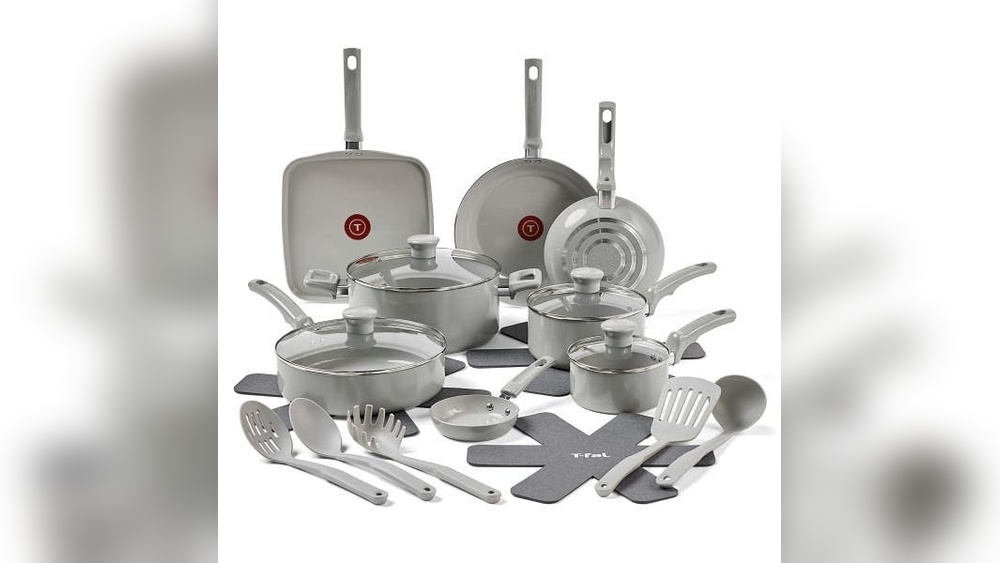
T-fal offers several cookware collections, including ceramic-coated options. Their appearance, handle construction, base design, and cooking features can differ. Therefore, the instructions for one collection should not automatically be applied to another.
This distinction matters because cookware safety depends on more than its brand name. The coating formula, manufacturing quality, intended temperature range, and condition of the pan all affect how it should be used.
Source: m.media-amazon.com
Metal cookware body
The body provides strength and helps transfer heat from the stove to the food. Aluminum is commonly used because it heats quickly and distributes heat well.
Ceramic-based interior
The interior coating creates a smoother cooking surface and helps reduce food sticking.
Nonstick cooking function
The surface can make it easier to cook delicate foods and clean the pan after use.
Model-specific construction
Handles, lids, exterior finishes, and induction bases vary across T-fal collections. These differences affect care and oven-use instructions.
Is Ceramic Coating the Same as Traditional Teflon?
No. Ceramic nonstick coatings and traditional PTFE-based nonstick coatings use different coating technologies. PTFE stands for polytetrafluoroethylene, a synthetic fluoropolymer used to create low-friction nonstick surfaces. Teflon is a registered brand name associated with PTFE products.
Ceramic nonstick coatings generally use silica-based technology rather than a conventional PTFE coating. However, shoppers should not assume that a product is PFAS-free just because its label says ceramic. The exact coating formula and the manufacturer’s chemical disclosures are more useful than the marketing name alone.
This difference is especially important for people who want to avoid all PFAS. They should look for an explicit statement covering the complete PFAS family, including PTFE, rather than relying only on a PFOA-free label.
Ceramic nonstick
Usually uses a silica-based coating and is often marketed as an alternative to conventional PTFE nonstick cookware.
PTFE nonstick
Uses a fluoropolymer coating that provides nonstick performance. PTFE is a member of the broader PFAS chemical family.
Is T-fal Ceramic Cookware Free From PFAS and PFOA?
This is one of the most important questions for shoppers who are concerned about cookware chemicals. T-fal’s US use and care documentation describes its ceramic cookware as PFOA-free. The company also states that its cookware has been manufactured without lead and cadmium in its coatings and enamel for more than two decades.
However, PFOA-free does not mean PFAS-free. PFOA is one chemical within a much larger group called per- and polyfluoroalkyl substances, or PFAS. PTFE is another member of that group. A product can therefore be free of PFOA while still using PTFE.
The distinction is important because consumers often use these terms as if they mean the same thing. They do not. If your goal is to avoid PFOA specifically, a PFOA-free statement addresses that particular chemical. If your goal is to avoid the entire PFAS family, you need a broader product-specific disclosure.
An independent product-information review published by PFAS Authority in 2026 examined several ceramic cookware collections, including T-fal products. It reported that some T-fal ceramic listings did not identify their coating chemistry or provide a specific PFAS-free statement. The review also distinguished certain T-fal collections from other ranges for which chemical disclosures were available.
That review used publicly available product information and a model-based scoring method. It did not report laboratory testing that proved the presence of PFAS in those pans. Therefore, the absence of a PFAS-free statement should not be treated as proof that a product contains PFAS. It means that the available disclosure is not enough to establish that it is free from the entire group.
Source: m.media-amazon.com
PFOA-free
Means the manufacturer states that the cookware does not contain PFOA. It does not automatically establish that every PFAS chemical is absent.
PTFE-free
Means the product is made without PTFE. This is a more specific statement about one fluoropolymer.
PFAS-free
Is a broader claim covering the PFAS chemical family. Look for a clear statement that defines the scope of the claim.
Lead and cadmium-free
Addresses two different metals. T-fal states that its cookware coatings and enamel have been manufactured without lead and cadmium for more than 20 years.
What Does the FDA Say About PFAS in Nonstick Cookware?
The US Food and Drug Administration explains that certain PFAS substances are authorized for specific food-contact uses, including some nonstick cookware coatings. According to the FDA, the manufacturing process polymerizes the coating material and binds it to the cookware surface. Studies reviewed by the agency indicate that negligible amounts of PFAS from these coatings can migrate into food.
This information provides useful context, but it does not establish the chemical composition of every T-fal ceramic pan. The FDA’s explanation concerns specified food-contact substances and their intended uses. It should not be treated as a blanket certification of every coating or product model.
For consumers, the practical lesson is to separate regulatory information from product-specific claims. Check the exact cookware model and use its manufacturer’s documentation when evaluating the coating.
FDA food-contact information
The FDA explains that certain authorized PFAS-based nonstick coatings have very low potential for migration into food when properly manufactured.
Product-specific evidence
An FDA explanation about a chemical class does not independently verify the ingredients or condition of a particular T-fal pan.
What If You Want Completely PFAS-Free Cookware?
If avoiding all PFAS is your main concern, do not rely on a ceramic label or a PFOA-free statement. Ask the manufacturer whether the exact model is free of PFAS, including PTFE, and whether that statement covers the entire cooking surface and any other relevant coatings.
Uncoated stainless steel and properly maintained cast iron are alternatives that do not require a synthetic nonstick interior coating. They have different cooking and maintenance needs, but they remove the uncertainty associated with a nonstick coating formula.
Uncoated stainless steel
A durable option without a nonstick interior coating. Food may stick unless the pan is heated and used correctly.
Cast iron
Provides a naturally seasoned cooking surface when maintained correctly. It is heavier and requires attention to moisture and seasoning.
Verified ceramic cookware
Can be considered when the manufacturer provides a clear, product-specific PFAS-free statement.
Can T-fal Ceramic Cookware Release Harmful Chemicals?
T-fal ceramic cookware is intended for food preparation, but safe use depends on following the product’s instructions. No cookware coating should be treated as indestructible. Excessive heat, physical damage, and poor cleaning habits can shorten the life of the surface.
A common concern is whether the coating releases harmful substances into food. The answer depends on the actual coating chemistry, its condition, and how the cookware is used. A properly manufactured food-contact coating used as directed is different from a badly overheated or deteriorating surface.
Ceramic coatings are often selected because they provide a different nonstick technology from conventional PTFE coatings. However, ceramic does not mean that a pan can never degrade or that every product is free from every potentially unwanted chemical.
The best approach is to prevent overheating, avoid harsh cleaning tools, and stop using cookware that shows serious coating failure. These habits reduce unnecessary wear and help maintain a sound cooking surface.
Source: cdn.upload-sitecenter.shop
Overheating
Excessive heat can damage nonstick coatings, cause discoloration, and burn oil or food residue onto the surface.
Coating deterioration
A badly damaged coating may lose its release properties and begin to peel or flake.
Poor cleaning
Abrasive pads and harsh cleaning products can wear down the cooking surface.
Incorrect product use
Using a pan beyond its documented heat, oven, or burner limits can damage its components.
Is It Dangerous to Overheat a Ceramic Pan?
Overheating is not a good cooking practice, even when a pan has a ceramic coating. An empty pan can heat up very quickly, especially on a powerful gas burner or induction cooktop. Excessive heat may reduce the coating’s useful life and cause oil residue to burn.
T-fal recommends moderate cooking temperatures for its nonstick cookware rather than unnecessary high heat. Its general care instructions also warn against leaving empty pans on heated burners or allowing them to boil dry.
For everyday meals, medium or medium-low heat is often enough. When a recipe calls for high heat, check whether your specific cookware model is approved for that use instead of assuming that all ceramic-coated pans have the same temperature limits.
Start with food or cooking ingredients
Avoid leaving an empty pan on a hot burner. Add the appropriate ingredients or a small amount of cooking oil before heating when the recipe requires it.
Control the burner
Use a heat level suitable for the recipe and cookware. Do not allow a gas flame to extend around the sides of the pan.
Watch the cooking process
Do not leave cookware unattended while heating, especially when using an empty or nearly empty pan.
What Happens When a Ceramic Coating Starts to Peel?
Peeling is a sign that the cooking surface has deteriorated. It may result from repeated overheating, scratching, abrasive cleaning, or normal wear over time. Once the coating begins to separate from the pan, its original cooking performance cannot be assumed.
A tiny surface mark does not necessarily mean the pan has become dangerous. T-fal’s care guidance explains that slight surface marks or abrasions can occur during normal use. However, visible flaking, extensive peeling, or large areas of exposed metal are reasons to stop using the pan for food preparation.
Do not try to repair a nonstick coating with household paint, glue, seasoning oil, or another surface treatment. These methods do not restore the original food-contact finish. Replace a pan when the coating has clearly failed.
Minor surface marks
Small cosmetic marks may occur during ordinary use. Check whether the surface remains smooth and intact.
Deep scratches
Deep scratches can damage the coating and make the pan harder to clean. Consider replacing it if the damage affects the cooking surface.
Peeling or flaking
Stop cooking with the pan and replace it rather than continuing to use a deteriorating coating.
How to Use T-fal Ceramic Cookware Safely
Correct use is one of the simplest ways to protect a ceramic nonstick pan. You do not need complicated equipment or special cleaning chemicals. A few careful habits can help maintain the surface and reduce avoidable damage.
Before cooking, identify the exact T-fal model and read its use and care instructions. Pay particular attention to heat limits, oven compatibility, dishwasher guidance, and approved utensils. These details can differ between product collections.
Source: ceramices.com
1. Wash before the first use
Wash the pan with warm water and mild dish soap. Use a soft sponge, rinse it well, and dry it with a clean towel.
2. Apply a small amount of oil when appropriate
For frying or sautéing, use a little cooking oil if recommended by the product instructions. Avoid cooking sprays that can leave a difficult-to-remove residue.
3. Choose moderate heat
Use low or medium heat for most daily cooking. Avoid unnecessary high-temperature preheating.
4. Select gentle utensils
Use silicone, wood, or suitable plastic utensils. Avoid knives and sharp metal tools on the coated surface.
5. Let the pan cool
Allow hot cookware to cool before washing. Sudden temperature changes may place stress on the pan.
6. Clean it gently
Wash with mild dish soap and a nonabrasive sponge. Rinse and dry the cookware after cleaning.
7. Store it carefully
Avoid stacking heavy pots directly on the ceramic surface. Use soft pan protectors or cloth between cookware pieces.
Which Utensils Are Safe for T-fal Ceramic Pans?
Silicone, wood, and suitable plastic utensils are generally the best choices for T-fal ceramic cookware. They help reduce scratches and protect the surface during daily cooking.
Although some ceramic surfaces are described as scratch-resistant, that does not mean they are immune to damage. Repeated contact with sharp or rough metal tools can shorten the life of the coating.
A silicone spatula is useful for scrambled eggs and delicate fish. A wooden spoon works well for sauces and vegetables. These simple tools provide enough flexibility for most home cooking tasks.
Silicone utensils
Flexible and gentle on coated surfaces. Choose utensils rated for the temperatures involved.
Wooden utensils
Useful for stirring, mixing, and turning food without unnecessary scraping.
Plastic utensils
Suitable when the material is heat-resistant and approved for the cooking task.
Sharp metal utensils
Best avoided because they can scratch or damage the coating.
How Should You Clean T-fal Ceramic Cookware?
Hand washing is a practical way to preserve the coating. Once the pan has cooled, remove loose food with warm water, then wash it with mild dish soap and a soft sponge.
Avoid steel wool, abrasive scouring pads, and harsh cleaning powders. These can damage the finish or make it lose its smooth feel. If food is stuck, soak the cooled pan in warm soapy water before cleaning.
Some T-fal cookware may be labeled dishwasher-safe. However, dishwasher-safe does not always mean that repeated dishwasher use is the best option for long-term coating care. Follow the instructions for your exact model.
For light food residue
Use warm water, mild dish soap, and a soft sponge.
For stubborn residue
Soak the cooled pan in warm soapy water before gently wiping it clean.
For grease buildup
Use mild dish soap and avoid aggressive scrubbing or harsh chemical cleaners.
Are T-fal Ceramic Pans Safe in the Oven?
Some T-fal cookware can be used in an oven, but oven safety depends on the exact model and its handle construction. A ceramic interior alone does not establish the oven temperature limit of the complete pan.
T-fal’s US cookware care instructions list different oven limits based on handle materials. Cookware with phenolic plastic handles is generally rated up to 350 degrees Fahrenheit. Models with stainless steel handles and silicone inserts are generally rated up to 400 degrees Fahrenheit, while models with handles made entirely of aluminum or stainless steel may be rated up to 500 degrees Fahrenheit.
These are general manufacturer instructions, not a universal rating for every ceramic collection. Some aluminum cookware with a ceramic interior is specifically excluded from broiler use. Always check the product’s own packaging and manual before placing it in an oven.
Glass lids may also have a lower temperature limit than the pan itself. If the cookware has detachable handles, those handles may need to be removed before oven use.
Source: cookwareguider.com
Plastic or phenolic handles
The general T-fal care guidance lists a maximum oven temperature of 350 degrees Fahrenheit for these handle types.
Stainless steel handles with silicone inserts
The general guidance lists an oven limit of 400 degrees Fahrenheit.
All-metal handles
The general guidance lists an oven limit of 500 degrees Fahrenheit when the handles are entirely aluminum or stainless steel.
Broiler use
Do not use nonstick aluminum cookware, including ceramic-interior models, under the broiler according to the US care instructions.
Can You Use T-fal Ceramic Cookware on Induction?
Only T-fal ceramic cookware designed with an induction-compatible base should be used on an induction cooktop. The ceramic interior itself does not make a pan induction-compatible.
Some collections include a magnetic base that allows the cooktop to heat the pan. Other aluminum cookware may work on gas or standard electric stoves but not on induction.
Check the product packaging or manufacturer’s model specifications before buying. A simple magnet test can also help: if a magnet sticks firmly to the bottom of the pan, the base is generally suitable for induction cooking. However, a weak magnetic response or an unsuitable base size can still affect performance.
Check the induction label
Look for an explicit induction-compatible statement on the packaging or product documentation.
Inspect the bottom
Check for a magnetic stainless steel base or another documented induction-compatible construction.
Use the correct burner size
The pan base should meet the minimum size requirements of your induction cooktop.
T-fal Ceramic Cookware Safety Compared With Other Cookware
T-fal ceramic cookware is not the only option for people who want to reduce sticking or avoid certain nonstick chemicals. Stainless steel, cast iron, and conventional PTFE-coated cookware each have different advantages and limitations.
The right choice depends on what you want to avoid. Someone who values easy cleanup may prefer ceramic nonstick. Someone who wants to avoid all nonstick coatings may prefer stainless steel or cast iron. No single material is best for every cooking task.
Source: cdn.upload-sitecenter.shop
T-fal ceramic cookware
Offers convenient food release and easy cleanup. Its exact PFAS status should be checked by product model.
Stainless steel cookware
Does not need a nonstick coating. It is durable and useful for searing, browning, and everyday cooking, but food can stick.
Cast iron cookware
Provides a durable cooking surface when seasoned and maintained. It is heavy and requires proper drying and storage.
Traditional PTFE nonstick cookware
Provides effective food release but uses a coating that belongs to the PFAS family. It should not be overheated.
Comparison Table: Ceramic, Stainless Steel, and Cast Iron
The following table compares common cookware choices based on their cooking surfaces, maintenance needs, and suitability for people who want to avoid nonstick coatings.
Ceramic nonstick
Food release: Generally easy. Maintenance: Gentle cleaning and careful utensil use. Coating: Present. Chemical status: Depends on the exact coating and manufacturer disclosure.
Stainless steel
Food release: Depends on cooking technique. Maintenance: Relatively simple. Coating: Not required for uncoated models. Chemical status: No nonstick coating to evaluate.
Cast iron
Food release: Improves with seasoning. Maintenance: Requires drying and seasoning care. Coating: Traditional seasoning rather than a factory-applied nonstick coating. Chemical status: Depends on the product and any additional enamel or finish.
PTFE nonstick
Food release: Very easy. Maintenance: Avoid overheating and scratches. Coating: PTFE-based. Chemical status: PTFE belongs to the PFAS family.
Which Option Should You Choose?
Choose T-fal ceramic cookware if you want an easy-release surface for eggs, pancakes, vegetables, and other everyday meals, and you are comfortable following the care instructions and checking the coating disclosures.
Choose uncoated stainless steel if avoiding factory-applied nonstick coatings is your main priority. It takes some practice to prevent food from sticking, but it can handle many cooking tasks and does not depend on a nonstick finish.
Choose cast iron if you prefer a heavy, durable pan and do not mind maintaining its seasoning. It is useful for searing and stovetop-to-oven cooking when the specific model permits it.
For easy daily cooking
Ceramic nonstick can be convenient when its chemical composition and care requirements meet your preferences.
For avoiding nonstick coatings
Uncoated stainless steel is a straightforward option.
For long-term durability
Cast iron and stainless steel can last for many years with suitable care.
Common Mistakes That Can Reduce Cookware Safety
Many cookware problems begin with small habits that seem harmless. Leaving a pan empty on a hot burner, using a metal fork to scrape food, or cleaning with steel wool can slowly damage the surface.
Avoiding these mistakes helps preserve the coating and reduces the chance of using cookware after it has deteriorated. It also makes everyday cooking more predictable.
Source: m.media-amazon.com
Heating an empty pan
An empty pan can heat quickly and may exceed the intended cooking temperature. Avoid prolonged preheating.
Using sharp metal tools
Knives, forks, and sharp spatulas can scratch or gouge the cooking surface.
Scrubbing with steel wool
Steel wool and abrasive pads can wear down the coating and should be avoided.
Pouring cold water into a hot pan
Sudden temperature changes can stress the cookware. Allow it to cool before washing.
Using the wrong oven setting
A pan that is safe for normal oven use may not be safe under a broiler. Follow the exact model instructions.
Ignoring visible damage
Continuing to use a pan with substantial peeling or flaking is not a good idea. Replace it instead.
Assuming every ceramic pan is PFAS-free
Ceramic describes a coating category, not a complete chemical disclosure. Verify the exact product.
How Often Should You Replace T-fal Ceramic Cookware?
There is no single replacement schedule that applies to every T-fal ceramic pan. The useful life depends on cooking frequency, temperature, cleaning habits, storage, and the condition of the coating.
A pan used every morning may wear faster than one used occasionally. The more useful approach is to inspect the cooking surface rather than replace cookware based only on its age.
If food begins sticking more often, the surface becomes rough, or the coating visibly peels, investigate the condition of the pan. Extensive coating failure is a reason to replace it.
Inspect the interior
Look for peeling, flaking, deep scratches, or areas where the coating has separated.
Check cooking performance
Notice whether food sticks unusually often despite proper heat control and cleaning.
Replace damaged cookware
Do not attempt to restore a failing factory-applied coating with household repair products.
Frequently Asked Questions
Q
Is T-fal ceramic cookware safe for everyday cooking?
Yes, T-fal ceramic cookware can be suitable for everyday cooking when it is used according to the manufacturer’s instructions and the coating remains in good condition. Use moderate heat, gentle utensils, and nonabrasive cleaning tools. Check the exact model’s coating information if you have concerns about PFAS or PTFE.
Q
Is T-fal ceramic cookware completely PFAS-free?
A general PFOA-free statement does not prove that cookware is free of all PFAS. T-fal’s US care documentation describes its ceramic cookware as PFOA-free, but consumers who want to avoid the entire PFAS family should seek an explicit PFAS-free statement for their exact product model. Do not assume that every T-fal ceramic collection has identical coating chemistry.
Q
Does T-fal ceramic cookware contain PFOA?
T-fal describes its ceramic cookware as PFOA-free in its US care documentation. The company also states that its cookware has been manufactured without lead and cadmium in its coatings and enamel for more than 20 years. For confirmation about a particular set, check its packaging and product-specific documentation.
Q
Can I use metal utensils on T-fal ceramic cookware?
Wooden, silicone, and suitable plastic utensils are the better choices for long-term care. Some ceramic surfaces may resist minor scratches, but sharp metal tools can still damage the coating. Avoid knives, forks, and rough-edged spatulas.
Q
Is scratched T-fal ceramic cookware dangerous?
A small surface mark does not automatically mean that the pan is dangerous. However, deep scratches, extensive peeling, and visible flakes indicate that the coating has deteriorated. Stop using cookware with substantial coating failure and replace it rather than trying to repair the surface.
Q
Can I cook eggs in T-fal ceramic pans without oil?
The nonstick surface can make cooking eggs with little or no oil easier. However, a small amount of suitable cooking oil can help preserve performance and reduce sticking. Use low or medium heat and avoid overheating the empty pan.
Q
Can T-fal ceramic cookware go in the dishwasher?
Dishwasher compatibility varies by product. Some T-fal cookware is dishwasher-safe, but hand washing with mild dish soap and a soft sponge is generally a better way to preserve the coating. Check the instructions for your exact collection before using a dishwasher.
Q
Can T-fal ceramic cookware go in the oven?
Some models are oven-safe, but the temperature limit depends on the handles, lids, and overall construction. T-fal’s general US instructions list different limits for plastic, silicone-insert, and all-metal handles. Some ceramic-interior aluminum cookware must not be used under the broiler. Always check the exact model’s manual.
✦ Wrapping Up
Conclusion
T-fal ceramic cookware can be a practical and suitable option for everyday home cooking when used and maintained correctly. Its nonstick surface can make meal preparation and cleanup easier, especially when cooking eggs, fish, vegetables, and other delicate foods. Like other coated cookware, it needs proper care to maintain its performance.
The biggest issue for chemical-conscious shoppers is understanding the difference between PFOA-free, PTFE-free, and PFAS-free. T-fal’s US care information describes its ceramic cookware as PFOA-free, but that statement alone does not establish that every model is free of all PFAS. Product-specific coating information is essential if avoiding the entire PFAS family is your goal.
For safer daily use, avoid empty-pan heating, choose moderate temperatures, use gentle utensils, and wash the cookware without abrasive tools. Inspect the cooking surface regularly and replace pans that show substantial peeling or flaking.
If you prefer cookware without a factory-applied nonstick coating, uncoated stainless steel and cast iron are reasonable alternatives. Ultimately, the best cookware is the one whose materials, cooking performance, and care requirements match your needs.
💡 Key Takeaway
Before purchasing or using T-fal ceramic cookware, identify the exact model and read its official care instructions. Confirm whether its coating is specifically described as PFAS-free if that matters to you. Keep the pan below its stated heat limits, use silicone or wooden utensils, clean it gently, and replace it if the coating begins to peel or flake.