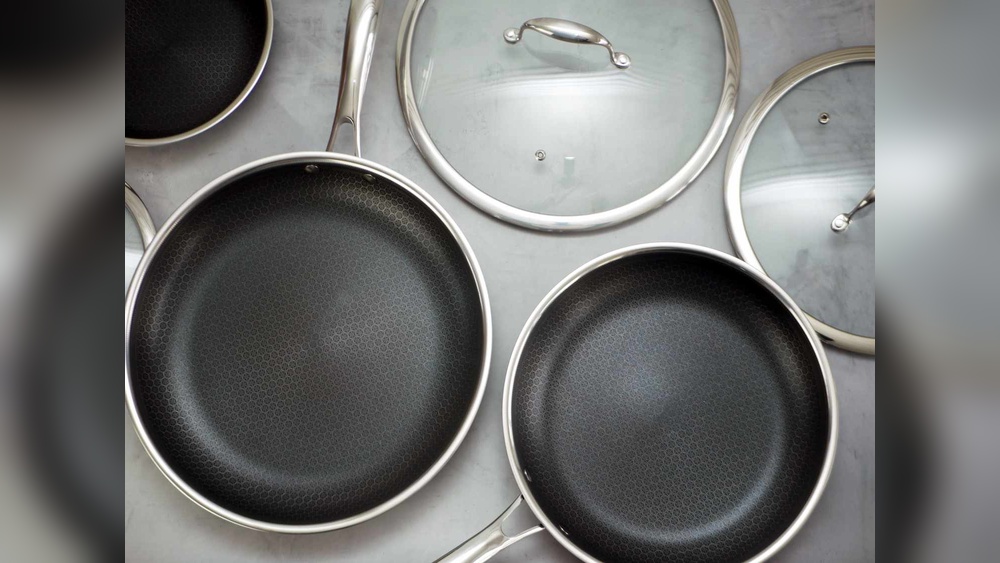
HexClad cookware combines stainless steel, an aluminum core, and a ceramic-reinforced nonstick coating in a hybrid cooking surface.
For home cooks in the United States, cookware must handle weeknight dinners, weekend breakfasts, and everything from eggs to seared steak. HexClad aims to combine the browning ability of stainless steel with the easy food release of nonstick cookware. Its pans use a distinctive raised metal pattern over a coated cooking surface.
The main materials are stainless steel and aluminum, along with a nonstick coating that HexClad describes as ceramic reinforced. The exact construction can vary by product line and model. Understanding these layers helps you judge how the cookware heats, how to care for it, and whether its material choices suit your kitchen.
A key distinction is that a hybrid pan is not simply bare stainless steel or a traditional nonstick pan. The raised steel pattern and the coated areas serve different roles. The result is a cooking surface designed to balance food release, heat distribution, and resistance to everyday wear, although no coating lasts forever.
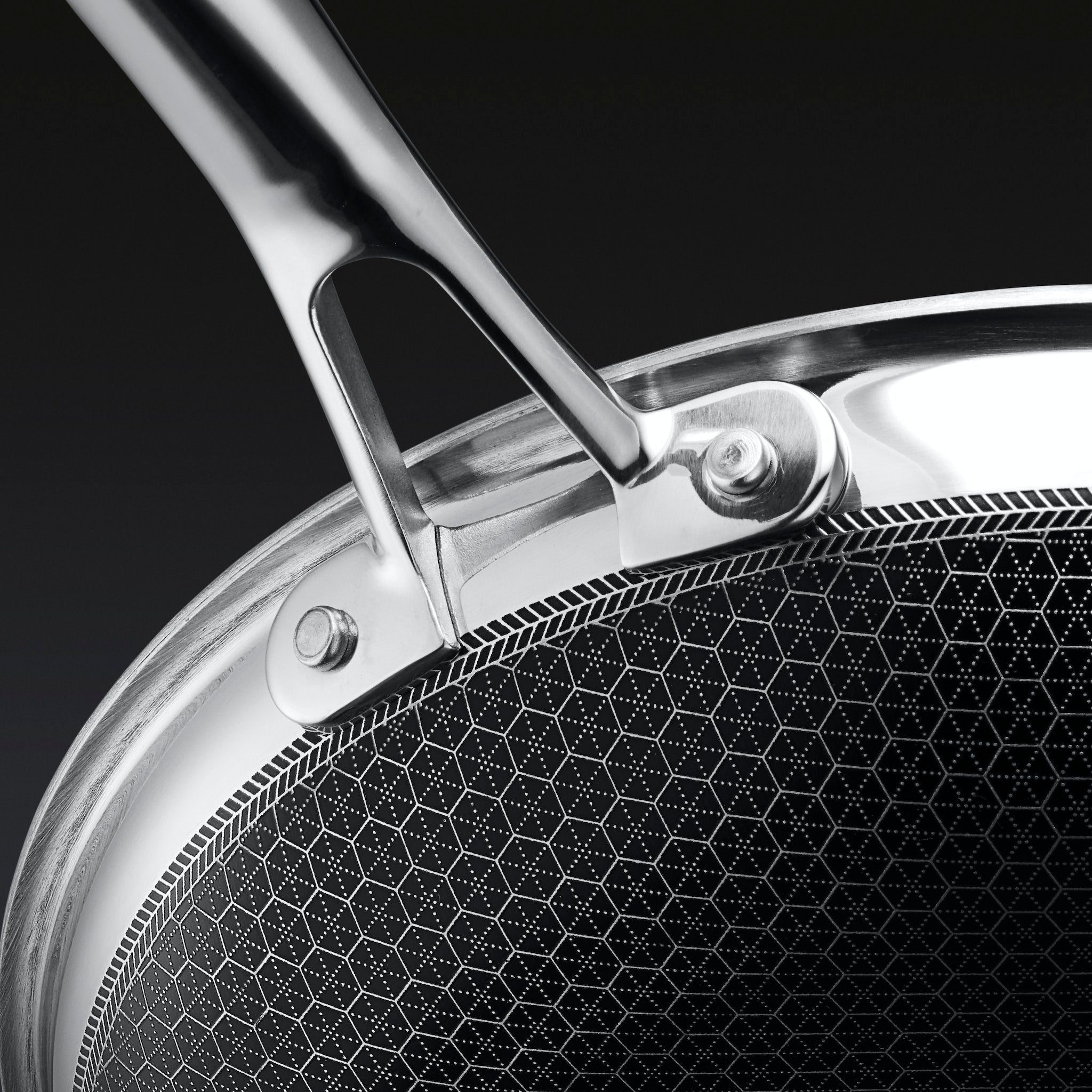
HexClad cookware is made from a combination of stainless steel, aluminum, and a nonstick coating. These materials work together in a layered design rather than acting as one solid substance. The raised metal pattern gives the cookware its recognizable look and helps protect parts of the cooking surface from direct contact with utensils.
The exact details depend on the product. HexClad frying pans, saucepans, woks, and other pieces may differ in construction, size, and handle design. For a specific item, the manufacturer’s current specifications are the best source for confirming its materials and care limits.
The most useful way to understand HexClad is to separate the pan into three main elements: the stainless steel surface pattern, the aluminum heat-conducting layer, and the nonstick coating. Each serves a different purpose.
Source: storage.googleapis.com
Stainless steel
Forms the raised metal pattern and contributes strength, corrosion resistance, and a durable cooking surface.
Aluminum
Helps spread heat across the base and cooking area, supporting more even cooking than a poorly conducting single-layer pan.
Nonstick coating
Covers designated areas of the cooking surface to help food release more easily and make cleanup simpler.
Why Does HexClad Use More Than One Material?
No single cookware material excels at every task. Stainless steel is strong and useful for browning, but food can stick when the pan is not used properly. Aluminum transfers heat well, but it is softer than stainless steel and is not always the ideal exposed cooking surface. Nonstick coatings help with delicate foods, but they can wear over time.
HexClad combines these features in one pan. The design attempts to give cooks the heat response of an aluminum-supported pan, the raised structure of stainless steel, and easier food release from the coated areas. The trade-off is that the pan still has a coating that needs care.
For browning
The stainless steel pattern offers exposed metal contact points that can support browning when the pan is heated and used correctly.
For heat control
The aluminum layer helps distribute heat, although burner size, pan thickness, and cooking technique also affect results.
For food release
The coated areas help reduce sticking, especially when the pan is clean and used within its care instructions.
How the HexClad Hybrid Cooking Surface Works
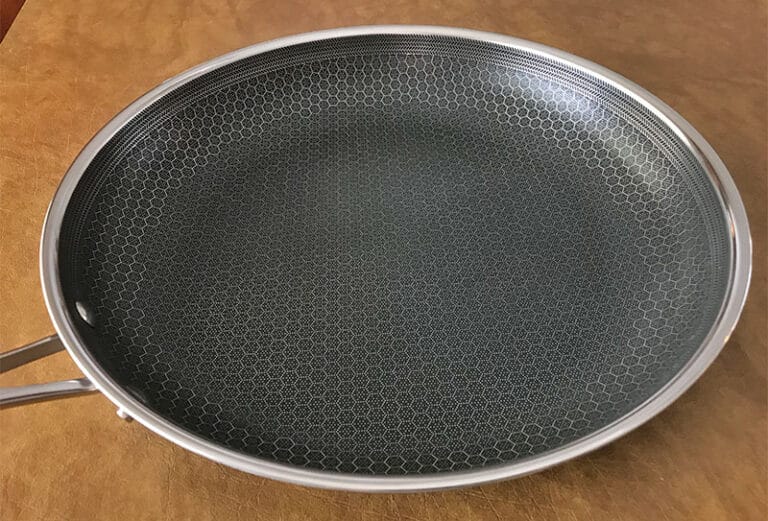
The hybrid cooking surface is the defining feature of HexClad cookware. It uses a raised stainless steel pattern with nonstick-coated areas between the raised sections. This arrangement creates a surface that is different from both a smooth nonstick pan and a conventional stainless steel skillet.
Think of the raised pattern as a series of small metal ridges. These ridges create contact points for food and utensils, while the coated sections help food release. The design is intended to balance searing and nonstick performance, but the results still depend on the food, temperature, oil, and cooking method.
A hybrid surface does not mean food can never stick. Eggs, cheese, sugary sauces, and delicate fish may still cling if the pan is cold, overheated, dirty, or used without suitable cooking fat. A hybrid pan also cannot duplicate every feature of a fully bare stainless steel skillet because the coating changes how the surface interacts with food.
Source: cookwareguider.com
Raised stainless steel pattern
Creates a textured metal surface designed to provide durability and support contact with food and cooking tools.
Recessed coated areas
Provide nonstick properties that can make everyday cooking and cleanup easier.
Combined surface
Offers a compromise between conventional stainless steel and traditional coated nonstick cookware rather than eliminating their trade-offs.
Does the HexClad Pattern Mean the Pan Is Fully Scratchproof?
No. The raised stainless steel pattern may help shield portions of the coating from direct contact, but it does not make the entire pan immune to scratches or wear. Metal utensils, abrasive pads, repeated impacts, and harsh cleaning methods can still damage the cooking surface.
The raised pattern is a design feature, not a guarantee that the coating will remain unchanged for life. Follow the care instructions supplied with your specific pan, and replace cookware if its coating becomes badly damaged or begins to peel.
Use sensible utensils
Choose utensils allowed by the manufacturer’s instructions and avoid cutting food inside the pan.
Avoid aggressive scrubbing
Use a soft sponge and suitable dish soap instead of steel wool or harsh abrasives unless the instructions explicitly allow a particular cleaning method.
What Type of Stainless Steel Does HexClad Use?
Stainless steel is an iron-based alloy that contains chromium. Chromium helps form a thin protective oxide layer on the metal, which improves its resistance to rust and corrosion. Other elements, such as nickel, may be present depending on the grade.
HexClad uses stainless steel in its hybrid construction, but shoppers should not assume that every component uses the same grade. The cooking surface, exterior, handles, and other parts may have different material specifications. Check the documentation for the exact product if the steel grade or alloy composition matters to you.
Stainless steel is valued in cookware because it is strong, durable, and generally resistant to corrosion under normal kitchen conditions. It also tolerates routine cooking temperatures well. However, stainless steel does not automatically make the whole pan uncoated or scratchproof.
Source: prudentreviews.com
Is HexClad the Same as Stainless Steel Cookware?
Not exactly. Traditional stainless steel cookware often has a bare stainless steel cooking surface, sometimes combined with aluminum or copper layers for heat distribution. HexClad adds a nonstick coating to designated areas of its raised stainless steel pattern.
This difference affects cooking and care. Bare stainless steel can develop fond, the browned bits left after searing, which are useful for making pan sauces. A hybrid pan may also brown food, but the coated areas create a different cooking surface and may change how fond develops and releases.
If you want a cooking surface without a nonstick coating, look for cookware specifically described as uncoated stainless steel. Do not rely on the words stainless steel alone to identify the surface material.
Traditional stainless steel
Often suits cooks who want an uncoated metal surface and are comfortable managing preheating, oil, and food release.
HexClad hybrid cookware
Suits cooks who want exposed stainless steel patterning alongside coated areas designed to make food release easier.
What Is the Aluminum Core Used For?
Aluminum is used because it conducts heat much more readily than stainless steel. In cookware, an aluminum layer can help spread heat across the base and reduce the temperature differences that may occur with a less conductive metal alone.
This matters when you cook foods that need steady heat, such as pancakes, vegetables, chicken, or sauces. A pan that spreads heat well can reduce cold spots, although the burner, pan diameter, food quantity, and cooking technique remain important.
HexClad cookware is commonly described as having an aluminum core or aluminum layer within its construction. The precise layer arrangement and thickness can vary, so a general description should not be treated as a complete technical specification for every product.
Source: prudentreviews.com
Does Aluminum Touch the Food?
In layered cookware, aluminum is generally enclosed by other materials rather than serving as the exposed cooking surface. HexClad’s hybrid surface is designed around stainless steel and coated cooking areas, not bare aluminum as the primary food-contact surface.
If you need to confirm the exact materials in a particular pan, consult the current manufacturer’s specifications. This is especially useful when checking a product for a material restriction or comparing it with a pan that has a fully exposed aluminum surface.
Heat transfer
Aluminum helps move heat through the pan more effectively than stainless steel alone.
Layer protection
The surrounding cookware materials separate the core from direct food contact in the intended construction.
What Is HexClad’s Nonstick Coating Made Of?
HexClad describes its nonstick cooking surface as a ceramic-reinforced coating. This coating is a key part of the hybrid design because it helps food release from the areas between the raised stainless steel pattern.
The term ceramic-reinforced describes a coating designed with ceramic-related components or reinforcement. It does not mean that the entire pan is made from ceramic, nor does it establish that the coating consists only of natural minerals. A coating can contain multiple ingredients that serve different functions.
The precise chemical formulation may not be fully described in general product summaries. Anyone who needs to verify a specific substance should review the manufacturer’s current material disclosures for the exact product rather than infer the full formula from a marketing term.
Source: cookwareguider.com
Is HexClad Ceramic Cookware?
HexClad is better described as hybrid cookware with a ceramic-reinforced nonstick coating than as solid ceramic cookware. Ceramic cookware commonly refers to either ceramic-based cooking vessels or metal pans with a ceramic-derived coating. Those categories are not interchangeable.
HexClad’s underlying construction uses metal, including stainless steel and aluminum. The coating is only one part of the pan, so the cookware should not be treated as a solid ceramic pot or skillet.
Solid ceramic cookware
Uses ceramic material as the body of the cooking vessel.
Ceramic-coated cookware
Uses a ceramic-related coating over a different base material, often metal.
HexClad hybrid cookware
Combines metal construction and a raised stainless steel pattern with a ceramic-reinforced nonstick surface.
Is the Coating PTFE-Based or PTFE-Free?
This question deserves a model-specific answer. PTFE, or polytetrafluoroethylene, is a fluoropolymer commonly used in nonstick coatings. The word ceramic alone does not prove that a coating is free of PTFE or other fluorinated compounds.
HexClad has described its products as using a ceramic-reinforced nonstick coating and has made product-specific claims about coating chemistry. However, formulations and product statements can change. For a current purchase, check the exact pan’s official product page and written material disclosures to verify whether it is advertised as PTFE-free and whether the statement applies to the entire product line.
Do not treat PTFE-free, PFOA-free, PFAS-free, and non-toxic as identical claims. They describe different things, and one does not automatically establish the others. PFOA is a particular chemical that has been used in some manufacturing processes; PTFE is a different substance, while PFAS is a broad category of fluorinated chemicals.
PTFE-free
Means the stated product or material is represented as not containing PTFE. Check the scope and basis of the claim.
PFOA-free
Refers to PFOA specifically and does not, by itself, prove that PTFE or all PFAS are absent.
PFAS-free
Is a broader claim whose meaning depends on the definition, testing method, and product scope used.
Is HexClad Cookware Safe to Use?
Cookware safety depends on the actual materials, the condition of the pan, and how it is used. Stainless steel and aluminum are widely used in cookware, while the nonstick coating has its own temperature limits and care requirements.
A material list alone cannot establish that a product is safe under every condition. The correct approach is to follow the manufacturer’s instructions, avoid overheating, keep the cooking surface in good condition, and verify any chemical-related claim that matters to your household.
For everyday cooking, use the pan within its specified temperature range and do not leave it empty over high heat. An empty pan can heat much faster than one containing food or liquid, which raises the risk of overheating the cooking surface.
Source: housekeepingmaster.com
Can You Overheat HexClad?
Yes. Like other coated cookware, HexClad can be damaged by excessive heat. High heat can cause food to burn, create stubborn residue, and shorten the useful life of a nonstick coating. The safe temperature limit depends on the product and whether the pan is used on a stovetop or in an oven.
Use low to medium heat for most routine cooking unless the product instructions recommend otherwise. For searing, increase heat carefully and avoid leaving an empty pan unattended. Always verify the oven-safe limit for the exact pan and lid, since their limits may differ.
Heat the pan carefully
Avoid prolonged preheating while the pan is empty, especially over a powerful burner.
Follow oven limits
Check the maximum temperature for the pan, lid, and handles before placing cookware in the oven.
Stop if the coating is damaged
If the coating peels, flakes, or shows substantial deterioration, stop using the pan and consult the manufacturer’s guidance.
Does Scratched Nonstick Cookware Become Dangerous?
A scratch does not automatically mean that a pan will cause harm, but it can signal that the coating has worn or been damaged. Deep scratches, peeling, and loose flakes are reasons to stop using the cookware and seek replacement guidance from the manufacturer.
The correct response depends on the coating type and the extent of the damage. Do not assume that the raised steel pattern prevents every form of coating wear. Routine inspection and sensible care are more useful than relying on the pan’s appearance alone.
Inspect the cooking surface
Look for peeling, flaking, deep grooves, or areas where the coating appears to have separated.
Do not scrape off damaged areas
Avoid abrasive attempts to remove the coating. Contact the manufacturer for product-specific advice.
How to Care for HexClad Cookware
Good care helps preserve the hybrid cooking surface and keeps food residue from building up around its raised pattern. Even durable cookware can lose performance if it is repeatedly overheated, scrubbed with harsh abrasives, or stored carelessly.
Start with the instructions supplied with your specific product. Dishwasher suitability, recommended utensils, seasoning guidance, and oven limits can vary by model, so a general rule should not override the manufacturer’s directions.
For routine cleaning, allow the pan to cool before washing unless the instructions state otherwise. Use warm water, mild dish soap, and a nonabrasive sponge. If food sticks, soak the pan or use the approved cleaning method rather than scraping aggressively at the coated surface.
Source: cslinterior.com
Use moderate heat
Avoid unnecessary high heat and prolonged empty-pan preheating.
Choose suitable utensils
Use utensils permitted by the manufacturer and avoid cutting food directly in the pan.
Clean the raised pattern gently
Remove food residue without using harsh pads that may damage the coating.
Prevent storage damage
If pans are stacked, use suitable pan protectors to reduce rubbing and scratches.
Check the warranty terms
Review the exact warranty for coverage, exclusions, proof of purchase, and any care requirements.
Does HexClad Need Seasoning?
Some cookware products have seasoning instructions, but the need and method depend on the model. Do not automatically apply the same seasoning process used for cast iron or carbon steel to a coated hybrid pan.
If the manufacturer recommends seasoning a particular HexClad product, follow its stated steps. Avoid using excessive heat or unapproved oils, since improper treatment can leave residue or harm the surface.
Check the product instructions
Use the manufacturer’s current guidance to determine whether seasoning is needed and how to do it.
Do not assume all pans are alike
Cast iron, carbon steel, bare stainless steel, and coated hybrid cookware have different care needs.
HexClad vs. Other Cookware Materials
HexClad sits between conventional stainless steel and traditional nonstick cookware in terms of construction. It combines exposed metal patterning with coated areas, while other cookware types may use a single material or a simpler layered design.
The right choice depends on how you cook. Someone who frequently makes eggs may value easy food release, while someone who sears meat and builds pan sauces may prefer an uncoated stainless steel skillet. A cook who wants a lightweight pan may also weigh the total construction and handle design before buying.
Source: prudentreviews.com
Material Comparison Table
The table below compares common cookware types by their main materials, practical strengths, and key limits. Individual products vary, so use it as a general guide rather than a substitute for a manufacturer’s specification.
HexClad hybrid
Uses stainless steel patterning, an aluminum heat-conducting layer, and a ceramic-reinforced nonstick coating. It aims to balance browning and food release, but the coating still requires care.
Uncoated stainless steel
Uses stainless steel, often with an aluminum or copper core. It can support browning and pan sauces, but food release depends heavily on heat management and cooking technique.
Traditional nonstick
Uses a metal body with a nonstick coating. It can be convenient for delicate foods, but coating wear and temperature limits remain important.
Cast iron
Uses thick iron that retains heat well. It is heavy and usually needs specific cleaning and seasoning practices when uncoated.
Ceramic-coated cookware
Usually uses a metal body with a ceramic-related nonstick coating. The coating’s performance and lifespan depend on its formula and care.
Which Material Is Best for Your Kitchen?
There is no single best cookware material for every kitchen. HexClad may appeal to cooks who want one pan for several tasks and prefer a hybrid surface. Uncoated stainless steel may suit people who want to avoid nonstick coatings, while traditional nonstick cookware may be attractive for cooks who prioritize easy food release at a lower initial cost.
Before choosing, consider your regular meals, cooktop, cleaning habits, preferred utensils, and willingness to replace cookware when its coating wears out. These practical factors matter more than a claim that one material is universally superior.
Choose HexClad if
You want a hybrid metal-and-coated surface and are willing to follow its care requirements.
Choose uncoated stainless steel if
You prefer a bare metal cooking surface and are comfortable learning how to manage sticking.
Choose traditional nonstick if
Easy food release is your priority and you understand that the coating has a limited service life.
Common Misconceptions About HexClad Materials
Several common claims about hybrid cookware can cause confusion. The most reliable approach is to separate the material used in the pan’s body from the coating applied to its cooking surface.
Words such as hybrid, ceramic, stainless steel, and nonstick describe different features. None of them, by itself, proves that a pan is indestructible, contains no chemicals of concern, or performs better than every alternative.
Source: cookwareguider.com
Misconception: HexClad is made entirely of stainless steel
Correction: Its hybrid construction includes an aluminum layer and a nonstick coating as well as stainless steel.
Misconception: Ceramic-reinforced means solid ceramic
Correction: The term refers to the coating description, not the entire body of the pan.
Misconception: The raised pattern makes the pan scratchproof
Correction: The pattern may help protect some coated areas, but it does not eliminate wear or damage.
Misconception: PFOA-free means PFAS-free
Correction: PFOA is one specific chemical. A claim about it does not automatically establish the absence of all PFAS or PTFE.
Misconception: A hybrid pan never needs oil
Correction: Some foods still benefit from oil, and proper preheating and temperature control can affect sticking.
How to Verify a Material Claim Before Buying
If a specific material is a deciding factor, check the official product page and current care documentation for the exact model and size. Look for clear statements about the cooking surface, core materials, coating chemistry, temperature limits, and any stated chemical exclusions.
For claims about PTFE, PFOA, or PFAS, read the wording carefully. A statement may apply to a particular coating, product line, or manufacturing period rather than every item sold under the same brand. If the available information is unclear, ask the manufacturer for written clarification before purchasing.
Identify the exact product
Record the model name and size so you are comparing the right specifications.
Read the full claim
Check whether the claim concerns the coating, the pan body, a specific chemical, or the entire product.
Confirm current guidance
Use current manufacturer documentation rather than relying only on older reviews or general descriptions.
Frequently Asked Questions
Q
What is HexClad cookware made of?
HexClad cookware combines stainless steel, an aluminum core or layer, and a ceramic-reinforced nonstick coating. The stainless steel forms the raised surface pattern, aluminum helps distribute heat, and the coating supports food release. Exact construction details may vary by product.
Q
Is HexClad cookware made of aluminum or stainless steel?
It uses both materials in a layered construction. Stainless steel is part of the hybrid cooking surface, while aluminum helps transfer heat through the pan. The cooking surface also includes a nonstick coating, so HexClad is not simply a bare stainless steel pan.
Q
Does HexClad contain PTFE?
Do not determine PTFE content from the word ceramic alone. Coating chemistry and manufacturer claims should be checked against current documentation for the exact product. If PTFE-free cookware is essential to your decision, request clear confirmation from the manufacturer before buying.
Q
Is HexClad cookware PFAS-free?
A general description of a ceramic-reinforced coating does not establish that the entire product is free of every PFAS. PTFE, PFOA, and PFAS are not interchangeable terms. Review the current product-specific statement and its scope before treating a PFAS-free claim as verified.
Q
Is HexClad cookware safe for everyday cooking?
Use HexClad according to its manufacturer’s temperature, cleaning, and utensil instructions. Avoid overheating an empty pan, and inspect the coating for peeling or substantial damage. Material composition alone cannot guarantee safe use under every condition.
Q
Can I use metal utensils with HexClad?
The raised stainless steel pattern is designed to provide durable metal contact points, but that does not mean the entire surface is immune to damage. Check the instructions for your exact model and avoid cutting food in the pan or using utensils in ways that could scrape or damage the coating.
Q
Is HexClad better than regular stainless steel cookware?
The answer depends on your cooking needs. HexClad combines stainless steel patterning with coated areas to help balance browning and food release. Uncoated stainless steel offers a bare metal cooking surface and can be useful for building pan sauces, but it generally requires more attention to heat and sticking.
Q
Does HexClad cookware need special cleaning?
Use the care method specified for your product. In general, mild dish soap, warm water, and a nonabrasive sponge are sensible starting points. Avoid aggressive scrubbing and prolonged high heat, and follow the manufacturer’s instructions for dishwasher use, seasoning, and storage.
✦ Wrapping Up
Conclusion
HexClad cookware is made from a combination of stainless steel, aluminum, and a ceramic-reinforced nonstick coating. The stainless steel creates the raised hybrid pattern, the aluminum layer helps distribute heat, and the coated areas help food release. These materials work together to give the pan a different cooking surface from traditional stainless steel or standard nonstick cookware.
The most important detail is that HexClad remains coated cookware. Its raised steel pattern does not make it fully scratchproof, and the term ceramic-reinforced does not reveal every ingredient in the coating. If you are comparing products based on PTFE, PFOA, or PFAS content, confirm the current claims for the exact model instead of treating those terms as equivalent.
For everyday use, choose cookware based on your cooking style and material preferences. Follow the temperature and cleaning instructions, avoid overheating an empty pan, and replace cookware when its coating is badly damaged.
💡 Key Takeaway
Before buying HexClad, check the exact product’s current material and coating disclosures, confirm any chemical-related claims that matter to you, and review its care instructions so the pan suits your kitchen and cooking habits.