Stainless steel cookware made in the USA includes select collections from Heritage Steel, All-Clad, and other manufacturers with documented domestic production. Check the origin of each specific product before buying.
If you are shopping for stainless steel cookware in the United States, you may want pans that are built here rather than imported. Perhaps you are replacing an old skillet, setting up your first apartment, or choosing a cookware set for family meals. The challenge is that a brand can be American-owned without making every pot and pan in the United States.
The best way to find American-made stainless steel cookware is to check the exact collection, product page, and country-of-origin statement. Some manufacturers make selected cookware lines in the USA, while others sell imported products or use different production locations for different items. A clear origin claim matters more than an American flag on the box.
This guide explains which brands are worth investigating, what their manufacturing claims mean, and how to judge stainless steel quality. It also covers cookware construction, induction compatibility, maintenance, price, and common labeling mistakes. The goal is to help you make a practical choice without confusing domestic manufacturing with brand ownership or marketing.
Several manufacturers offer stainless steel cookware made in the United States, but the claim must be checked at the product or collection level. Heritage Steel is one of the most relevant brands to investigate, and All-Clad is another established name associated with domestic production for selected cookware lines. The country of origin can vary by product, so a brand name alone is not enough to confirm where an item was made.
For a useful starting point, look at Heritage Steel’s stainless steel cookware collections and All-Clad’s product listings. Read the manufacturing details for the exact pan, pot, or set you intend to buy. If the listing does not clearly identify the production location, ask the manufacturer or retailer for written confirmation before placing your order.
This distinction is important because stainless steel cookware can involve several stages of production. A company may source raw steel from one country, bond metal layers in another, form the pan somewhere else, and package the finished product in the United States. The final country-of-origin claim depends on the applicable rules and the facts of the manufacturing process.
Source: m.media-amazon.com
Heritage Steel
A strong candidate for shoppers seeking American-made stainless steel cookware. Review the specific product details and the manufacturer’s current origin statements.
All-Clad
Known for bonded stainless steel cookware, including collections manufactured in the United States. Check the country of origin for the exact collection and item rather than assuming every product is domestic.
Other American manufacturers
Smaller cookware makers and specialty manufacturers may offer domestically produced stainless steel pieces. Verify that the product itself is made in the USA rather than merely designed or sold by a US company.
Heritage Steel: A Brand to Investigate First
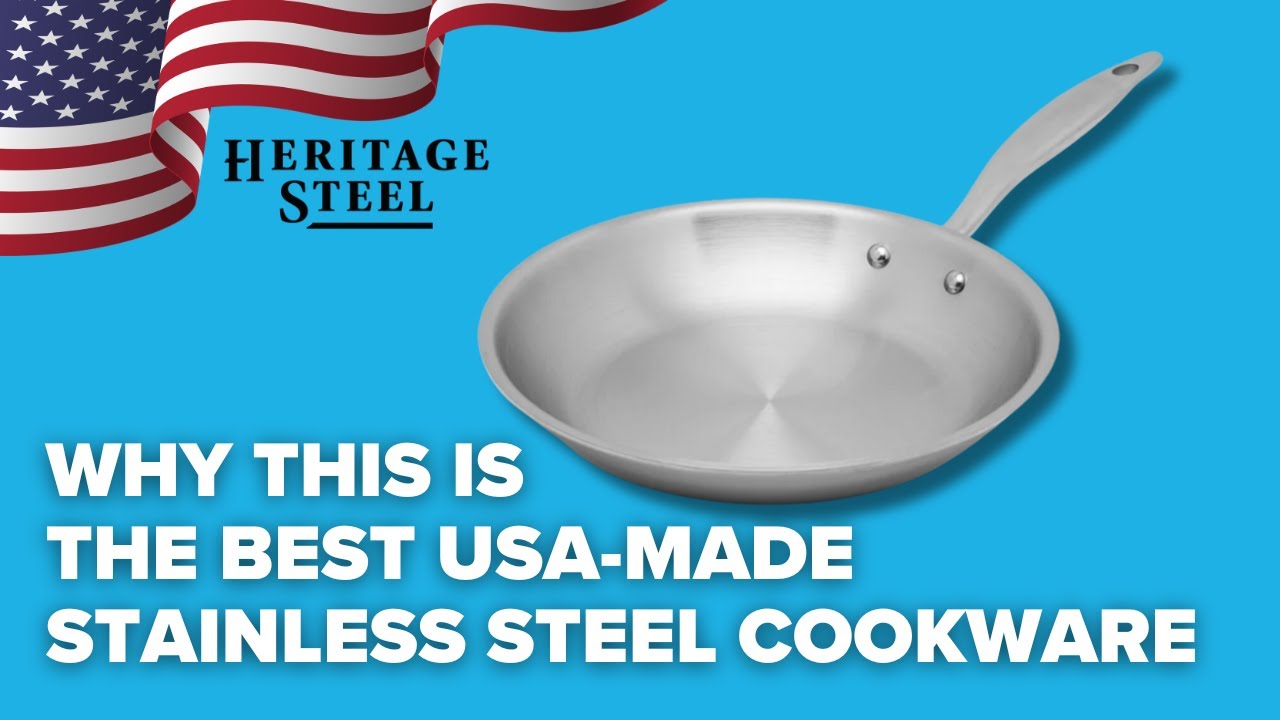
Heritage Steel focuses on stainless steel cookware and is commonly associated with US manufacturing. Its products are worth examining if domestic production is one of your main buying requirements. Before purchasing, confirm the current origin statement for the specific collection, because product details and manufacturing arrangements can change.
Compare the construction, number of bonded layers, handle design, available sizes, and warranty. A pan that suits your daily cooking habits may offer better value than a large set filled with pieces you rarely use.
Best use
Consider this brand when you want to investigate domestically manufactured stainless steel cookware from a company focused on the category.
What to verify
Check the exact product’s manufacturing location, construction details, induction compatibility, and current warranty.
All-Clad: Check the Collection Before Buying
All-Clad is associated with bonded-metal cookware and has a long-standing presence in the American cookware market. Selected collections are manufactured in the United States, but the brand’s full assortment should not automatically be treated as American-made. Different products and accessories may have different origins.
Look for explicit country-of-origin information on the product page or packaging. If you are considering a set, verify the claim for the set itself and check whether all included pieces share the same manufacturing origin. Do not assume that an American-made skillet guarantees that every accessory in a bundle was produced domestically.
Best use
Compare its US-manufactured collections when you want bonded stainless steel cookware from an established manufacturer.
What to verify
Confirm the exact collection, item origin, included accessories, and applicable warranty terms.
How to Verify That Cookware Is Really Made in America
The most reliable approach is to verify the origin of the exact product rather than relying on the manufacturer’s nationality. An American company can sell imported cookware, and an imported brand may offer a limited product line made in the United States. The product’s manufacturing statement is the key detail.
In the United States, the Federal Trade Commission oversees advertising claims such as Made in USA. An unqualified claim generally requires that the product be all or virtually all made in the United States, including significant processing and the product’s components. Qualified claims may describe a more limited domestic contribution, such as assembly or particular manufacturing steps.
Cookware can be especially confusing because its materials may come from several places. Stainless steel, aluminum cores, handles, lids, and packaging may have different origins. Do not interpret a statement such as designed in America, assembled in America, or made with American materials as equivalent to an unqualified Made in USA claim.
Source: wiloria.com
Read the official product page
Look for an explicit manufacturing-location statement for the exact model or collection. A general company history is not enough.
Check the packaging
Review the country-of-origin label on the product or its packaging when available. Compare it with the retailer’s description.
Ask a direct question
If the origin is unclear, ask customer service where the finished cookware is manufactured and whether the statement applies to every piece in the set.
Keep a record
Save the product page or written answer if domestic manufacturing is a requirement for your purchase.
What Common Origin Labels Actually Mean
A country-of-origin statement tells you more than a patriotic design or a brand’s mailing address. However, wording still matters. Some labels describe the product’s full origin, while others identify only where a particular production step occurred.
Made in USA
An unqualified claim is generally subject to the FTC’s all-or-virtually-all standard. It is not simply a statement that the company has a US office.
Assembled in USA
This indicates assembly in the United States but does not, by itself, establish that the cookware’s materials and major manufacturing stages are domestic.
Designed in USA
This describes design work, not necessarily the place where the finished pan was manufactured.
American company
Ownership or headquarters location does not establish the manufacturing origin of a particular product.
What If the Retailer and Manufacturer Disagree?
Treat a conflict between the retailer’s listing and the manufacturer’s current documentation as a reason to pause. Product pages can contain old descriptions, copied marketing language, or details that apply to another model. Ask the manufacturer to confirm the origin of the precise item number, then retain the response.
Match the model number
Make sure the origin statement refers to the same pan, set, size, and collection you plan to purchase.
Avoid unsupported assumptions
If the manufacturer cannot confirm the origin, classify the product as unverified instead of treating it as American-made.
What Makes Stainless Steel Cookware Good Quality?
Country of origin and cooking performance are separate questions. A pan made in the United States still needs sound construction, suitable materials, and a design that fits your stove and cooking habits. The best choice combines a verified origin with features you will use every day.
Stainless steel is an iron-based alloy that contains chromium. Chromium helps form a thin protective surface layer that resists rust and corrosion. Many cookware products also use nickel and other elements to improve corrosion resistance, forming performance, and durability.
Bare stainless steel does not conduct heat as well as aluminum or copper. For this reason, many quality stainless steel pans use bonded layers. A conductive core spreads heat through the cooking surface, while stainless steel provides the food-contact surface and a durable exterior.
Source: heritagesteel.us
Stainless steel grade
Grades such as 304 and 316 are common in corrosion-resistant applications, while 18/10 and 18/8 describe approximate chromium and nickel percentages in many stainless steel products. These labels alone do not prove overall cookware quality.
Bonded construction
Clad cookware joins stainless steel with a conductive core such as aluminum. The number of layers is only one factor; thickness, bonding quality, and design also matter.
Handle design
A secure handle with a comfortable shape makes lifting and pouring easier. Check how the handle attaches and whether it becomes hot during use.
Lid fit
A well-fitting lid helps control moisture and cooking time. Confirm whether lids are included and whether their materials and origin meet your preferences.
Tri-Ply Versus Five-Ply Stainless Steel
Tri-ply cookware usually has three bonded layers, often stainless steel on the outside and inside with aluminum between them. Five-ply cookware uses five layers, which may combine several stainless steel and conductive-metal sheets. The exact material arrangement varies by manufacturer.
More layers do not automatically mean better cooking. A well-designed tri-ply skillet can work very well for eggs, vegetables, and everyday meals. Five-ply cookware may offer different heat retention or structural properties, but performance depends on the complete design rather than the layer count alone.
Choose tri-ply when
You want versatile cookware for daily cooking and prefer a balance of weight, heat response, and price.
Consider five-ply when
You prefer a particular pan’s thickness, weight, or construction and can verify that it suits your stove and cooking style.
Does Stainless Steel Grade Matter?
The grade can affect corrosion resistance, magnetic behavior, and other material properties, but it is not a complete measure of performance. The cooking core, pan thickness, shape, finish, and construction all influence how cookware behaves on the stove.
The terms 18/10 and 18/8 commonly refer to approximate chromium and nickel content. They do not mean that a pan has ten layers or eight layers. Also, not every stainless steel surface has the same composition, and a marketing description may not disclose the grade of every component.
For general cooking
Look for clear material specifications and a well-built cooking surface instead of buying solely on a grade number.
For special material needs
If you have a known nickel sensitivity or another medical concern, consult an appropriate health professional and review the manufacturer’s material information. Do not assume that all stainless steel cookware has identical nickel content.
How to Choose American-Made Stainless Steel Cookware
Start with the meals you cook most often, then choose the pieces that fit those tasks. A person who makes eggs and grilled cheese every morning may need a skillet first, while someone who cooks pasta and soup several times a week may benefit more from a stockpot and saucepan. Buying individual pieces can reduce waste if you do not need a full set.
Next, confirm the manufacturing origin, material construction, and stove compatibility. If you use an induction cooktop, the base must be magnetic and suitable for induction. A stainless steel label alone does not guarantee compatibility, because some stainless steel alloys are not sufficiently magnetic.
Finally, compare the full cost, including lids, shipping, and any pieces you may need to buy separately. A large set may appear less expensive per piece, but the savings matter only if you will use the extra pans. Check warranty exclusions and the return policy before committing to an expensive purchase.
Source: kitchenbap.com
For everyday meals
Start with a medium skillet and a saucepan. Add a larger sauté pan or stockpot when your cooking routine calls for it.
For induction cooking
Look for explicit induction compatibility and verify the base design for the specific product.
For a small kitchen
Choose pieces that stack or nest safely, have practical lid storage, and cover more than one cooking task.
For a long-term purchase
Compare construction, replacement availability, warranty coverage, and the manufacturer’s care instructions.
A Practical Buying Checklist
Use this checklist before ordering cookware marketed as American-made. It helps separate the origin claim from the product’s actual usefulness.
Step 1: Verify the origin
Find an explicit statement for the exact model or ask the manufacturer for confirmation.
Step 2: Inspect the construction
Check whether the pan is fully clad or has a bonded base, and review the listed materials.
Step 3: Check the stove
Confirm compatibility with gas, electric, glass-top, or induction cooking as applicable.
Step 4: Compare practical features
Review pan diameter, weight, handle comfort, lid fit, oven limits, and dishwasher guidance.
Step 5: Review the purchase terms
Check shipping costs, returns, warranty coverage, and whether replacement lids or individual pieces are available.
Should You Buy a Set or Individual Pieces?
A set can make sense when you are furnishing a kitchen from scratch and will use most of the included pieces. It may also give you matching handles, lids, and finishes. Before buying, list the sizes and types of pans you actually need and compare that list with the contents of the set.
Individual pieces are often the more practical route when you already own usable cookware. You can prioritize a skillet or saucepan from a verified US-made collection and add other items over time. This approach also lets you compare different designs without replacing every pot in your kitchen.
Choose a set
When you need several pans at once and the set’s pieces, materials, and origins meet your requirements.
Choose individual pieces
When you need only one or two items, want to manage the budget, or prefer to verify each item’s manufacturing origin separately.
American-Made Cookware Compared With Imported Cookware
Cookware made in the United States is not automatically better than cookware made elsewhere. Domestic manufacturing may matter to you because of your preference for US production, supply-chain transparency, or support for American jobs. Those are valid purchasing priorities, but they do not replace an assessment of material quality and construction.
Imported cookware can also use high-quality stainless steel and carefully bonded layers. Some products offer strong warranties, useful designs, and reliable performance at a lower price. The meaningful comparison is between the specific products, not between countries as a whole.
If you are deciding between a domestic and imported pan, compare the origin documentation, construction, weight, cooking surface, compatibility, warranty, and total cost. Use the same checklist for both. That gives you a more useful comparison than assuming a country label predicts every aspect of quality.
Source: madeintheusamatters.com
Domestic manufacturing
May suit buyers who prioritize US production, but the exact origin claim still needs verification.
Imported manufacturing
May offer suitable materials and construction at different price points. Assess the individual product rather than dismissing it based on origin.
Best overall decision
Balance documented origin, cooking needs, product construction, warranty, and price.
Does Made in USA Mean Better Quality?
No. A manufacturing location does not, by itself, establish that cookware heats more evenly, lasts longer, or resists damage better. Those results depend on the materials, design, manufacturing process, and how the pan is used and cared for.
A verified US-made product can still be a poor fit if it is too heavy, incompatible with your stove, or outside your budget. Likewise, a well-designed imported product may meet your needs. Treat domestic origin as one decision factor, not a substitute for the rest of the evaluation.
What origin tells you
It helps establish where the product was manufactured under the applicable origin rules.
What origin does not tell you
It does not independently prove cooking performance, service life, chemical composition, or warranty quality.
How to Care for Stainless Steel Pots and Pans
Good care helps stainless steel cookware stay useful for years. Follow the instructions for your particular pan, because handle materials, bonded construction, lids, and finishes can have different temperature and cleaning limits. Avoid assuming that every stainless steel product is oven-safe or dishwasher-safe at the same temperature.
For routine cooking, preheat the pan over moderate heat and add the appropriate cooking fat when the recipe calls for it. Stainless steel can stick when the pan is too cool, when the surface is overloaded, or when food is moved before it has developed enough browning. Practice helps you learn how your particular pan responds.
After cooking, let the pan cool enough for safe handling before cleaning it. Sudden temperature changes can warp cookware or damage some components. Warm water, dish soap, and a nonabrasive sponge are usually a sensible starting point for routine cleaning.
Source: images.squarespace-cdn.com
For stuck-on food
Soak the pan in warm water, then loosen residue with a suitable sponge or nonabrasive scrubber. Follow the manufacturer’s cleaning guidance.
For rainbow-colored marks
Heat-related discoloration can occur on stainless steel. A cleaner approved for the surface may help restore its appearance.
For water spots
Dry the pan after washing. If spots remain, a manufacturer-approved method using a mild acidic cleaner may help.
For warped cookware
Avoid rapid heating and cooling. If a pan rocks badly or has a damaged base, stop using it on a glass cooktop until you have assessed whether it remains safe and stable.
How to Reduce Food Sticking
Stainless steel is not a nonstick coating, so technique matters. Start with a clean pan and use moderate heat rather than immediately turning the burner to high. If appropriate for the food, add oil after preheating and give the food time to brown before trying to turn or lift it.
Do not rely on a single water-drop test as a guarantee of ideal temperature. Pan size, burner output, oil type, and the food itself affect the result. If the oil begins to smoke heavily, reduce the heat and allow the pan to cool as needed before continuing.
Use moderate heat
Many everyday cooking tasks do not require maximum burner output, especially with cookware that has a conductive core.
Avoid overcrowding
Too much food can lower the surface temperature and release moisture, which interferes with browning.
Use suitable utensils
Metal utensils are generally compatible with bare stainless steel, but follow any specific surface or finish restrictions from the manufacturer.
Is Stainless Steel Cookware Safe?
Stainless steel cookware is widely used for ordinary home cooking. However, material composition varies, and small amounts of metals can migrate into food under some conditions. Acidic foods, prolonged cooking, and the condition and composition of the cookware can affect metal release.
People with a known nickel allergy or a medical reason to limit particular metals should not assume that every stainless steel pan is suitable for them. Review the manufacturer’s material disclosures and seek advice from a qualified health professional when a specific medical restriction applies. Do not use visibly damaged or severely corroded cookware without checking the manufacturer’s guidance.
Read material disclosures
Look for details on the cooking surface and any coatings or additional materials.
Follow heat limits
Respect the stated limits for pans, handles, lids, and oven use.
Avoid unsupported safety claims
The phrase Made in USA describes origin, not a universal guarantee about every material or every user’s health needs.
Common Mistakes When Shopping for US-Made Cookware
The most common mistake is treating the brand’s country of origin as proof of where every item is manufactured. A company may have domestic factories and still sell products made elsewhere. Confirm the specific pan or set rather than relying on a broad brand statement.
Another mistake is paying extra for a large set without checking its contents. If you mostly use one skillet and one saucepan, a large bundle may tie up money in cookware that sits in a cabinet. Compare individual-piece prices with the full set and include shipping in the calculation.
Buyers can also focus too much on layer count or grade labels. These details matter, but they do not tell the whole story. Pan thickness, core material, base shape, handle comfort, and stove compatibility can have a greater practical effect on how the cookware fits your routine.
Source: m.media-amazon.com
Mistake: Trusting the flag on the box
Correction: Find the explicit origin statement and confirm that it applies to the exact product.
Mistake: Assuming every item in a set has the same origin
Correction: Check the set description and ask about any accessories with separate manufacturing locations.
Mistake: Equating more layers with better performance
Correction: Compare the actual construction, weight, heat response, and warranty.
Mistake: Ignoring induction compatibility
Correction: Confirm that the particular base is suitable for your cooktop before buying.
Mistake: Treating origin as a safety certification
Correction: Review material information and care instructions separately from the country-of-origin claim.
A Simple Way to Compare Two Pans
Suppose you are comparing two 10-inch stainless steel skillets. One has a clearly documented US manufacturing origin and costs more, while the other is imported and costs less. Compare their construction, weight, handle design, stove compatibility, warranty, and return terms before deciding whether the price difference fits your priorities.
For a hypothetical example, if the domestic skillet costs $150 and the imported skillet costs $100, the difference is $50. That extra amount may be worthwhile if domestic manufacturing is important to you and the products otherwise meet your needs. The calculation does not prove that the more expensive pan will last longer or cook better.
Compare like with like
Use similar pan sizes and construction types so that the price comparison is meaningful.
Separate fact from preference
Origin documentation is a factual check; how much you value domestic manufacturing is a personal decision.
Research Notes and Useful Next Questions
A useful guide to American-made stainless steel cookware should distinguish product-origin evidence from general brand reputation. Manufacturer statements and product documentation are the most relevant evidence for a particular item’s origin. Retailer listings can help with initial discovery, but conflicting or vague descriptions should be confirmed directly with the manufacturer.
This article provides a practical selection framework rather than a live audit of every cookware model on the US market. Product ranges, manufacturing arrangements, and labeling can change. Before purchasing, verify current documentation for the exact item and retain the response if its origin is essential to your decision.
Source: i.ytimg.com
Question: Which exact models are made in the USA?
Reader stage: Before purchase. Evidence needed: Current manufacturer product pages or written confirmation for the precise model. Priority: High.
Question: Will the pan work on induction?
Reader stage: Product selection. Evidence needed: The product’s current compatibility statement and base specifications. Priority: High when using induction.
Question: Is a set better value than individual pieces?
Reader stage: Budget planning. Evidence needed: Current prices, included pieces, shipping, and the buyer’s actual cooking needs. Priority: Medium.
Question: What does Made in USA legally mean?
Reader stage: Origin verification. Evidence needed: Current Federal Trade Commission guidance on origin claims. Priority: High.
Question: Does stainless steel contain nickel?
Reader stage: Material selection. Evidence needed: Manufacturer material disclosures and qualified health advice when a medical restriction applies. Priority: High for buyers with a known sensitivity.
How This Guide Evaluates Evidence
Documented claims include general material characteristics and the US rules governing origin advertising. Manufacturer-origin claims should be checked against current product-specific documentation. No hands-on cookware tests, laboratory measurements, current price survey, or exhaustive model-by-model factory audit are claimed here.
The named brands are starting points for research, not a guarantee that every product they sell is made in America. The practical recommendation is to verify the origin first, then assess construction and usability. This approach reduces the risk of buying an imported product when domestic manufacturing is a firm requirement.
Evidence type
Manufacturer statements, product specifications, and applicable official labeling guidance should support origin and construction claims.
Research limitation
Without current confirmation for each model, exact product-origin conclusions and current availability should remain unverified.
Next action
Shortlist a few pans, verify their manufacturing origin, and compare the features that matter for your stove and cooking habits.
Frequently Asked Questions
Q
What stainless steel cookware is made in the USA?
Heritage Steel and selected All-Clad collections are useful starting points for finding stainless steel cookware manufactured in the United States. Confirm the country of origin for the exact product, because a brand may offer items made in different locations.
Q
Is all All-Clad stainless steel cookware made in the USA?
You should not assume that every All-Clad product is made in the United States. Manufacturing origin can vary across collections and products. Check the exact item listing, packaging, or manufacturer confirmation before purchasing.
Q
Is Heritage Steel cookware made in America?
Heritage Steel is a relevant brand for shoppers looking for US-manufactured stainless steel cookware. Verify the current manufacturing statement for the exact collection and item, and review the product specifications before ordering.
Q
What does Made in USA mean for cookware?
The Federal Trade Commission generally requires an unqualified Made in USA claim to meet its all-or-virtually-all standard. The assessment considers the product’s components, processing, and manufacturing. A statement such as designed in the USA or assembled in the USA does not automatically mean the finished cookware qualifies for an unqualified claim.
Q
Is American-made stainless steel cookware better than imported cookware?
Not necessarily. Country of origin alone does not prove that a pan heats more evenly or lasts longer. Compare construction, material specifications, handle design, stove compatibility, warranty, and price. Choose domestic manufacturing when it aligns with your priorities, but evaluate the product on its own merits.
Q
Can I use American-made stainless steel cookware on an induction stove?
Many stainless steel pans work with induction, but not all stainless steel alloys are magnetic enough for induction cooking. Check the manufacturer’s compatibility statement for the exact model. If the information is unclear, ask the manufacturer before buying.
Q
Is tri-ply stainless steel cookware better than five-ply cookware?
Neither construction is automatically better. Tri-ply often offers a useful balance of heat distribution, weight, and cost, while five-ply designs vary in their material arrangement and thickness. Compare the actual pan, not just the number of layers.
Q
Does Made in USA mean the cookware is non-toxic?
No. Country of origin is not a universal health or chemical-safety certification. Review the cookware’s material disclosures and care instructions. If you have a known nickel sensitivity or another medical restriction, seek appropriate professional advice and confirm that the product suits your needs.
✦ Wrapping Up
Conclusion
If you want stainless steel cookware made in the USA, begin with manufacturers such as Heritage Steel and selected All-Clad collections, then verify the precise product’s manufacturing origin. Do not rely on an American company name, a flag, or a general statement about domestic design. The strongest purchasing decision rests on current, product-specific evidence.
Once the origin is confirmed, compare the pan’s construction, conductive core, weight, handle design, stove compatibility, care requirements, and warranty. Buy a set only if you will use most of its pieces; otherwise, start with one or two essential pans. A clear checklist makes it easier to choose cookware that meets both your domestic-manufacturing preference and your daily cooking needs.
💡 Key Takeaway
Before you order, select two or three cookware models, confirm each one’s country of origin directly with the manufacturer, and compare construction, induction compatibility, warranty, and total cost.