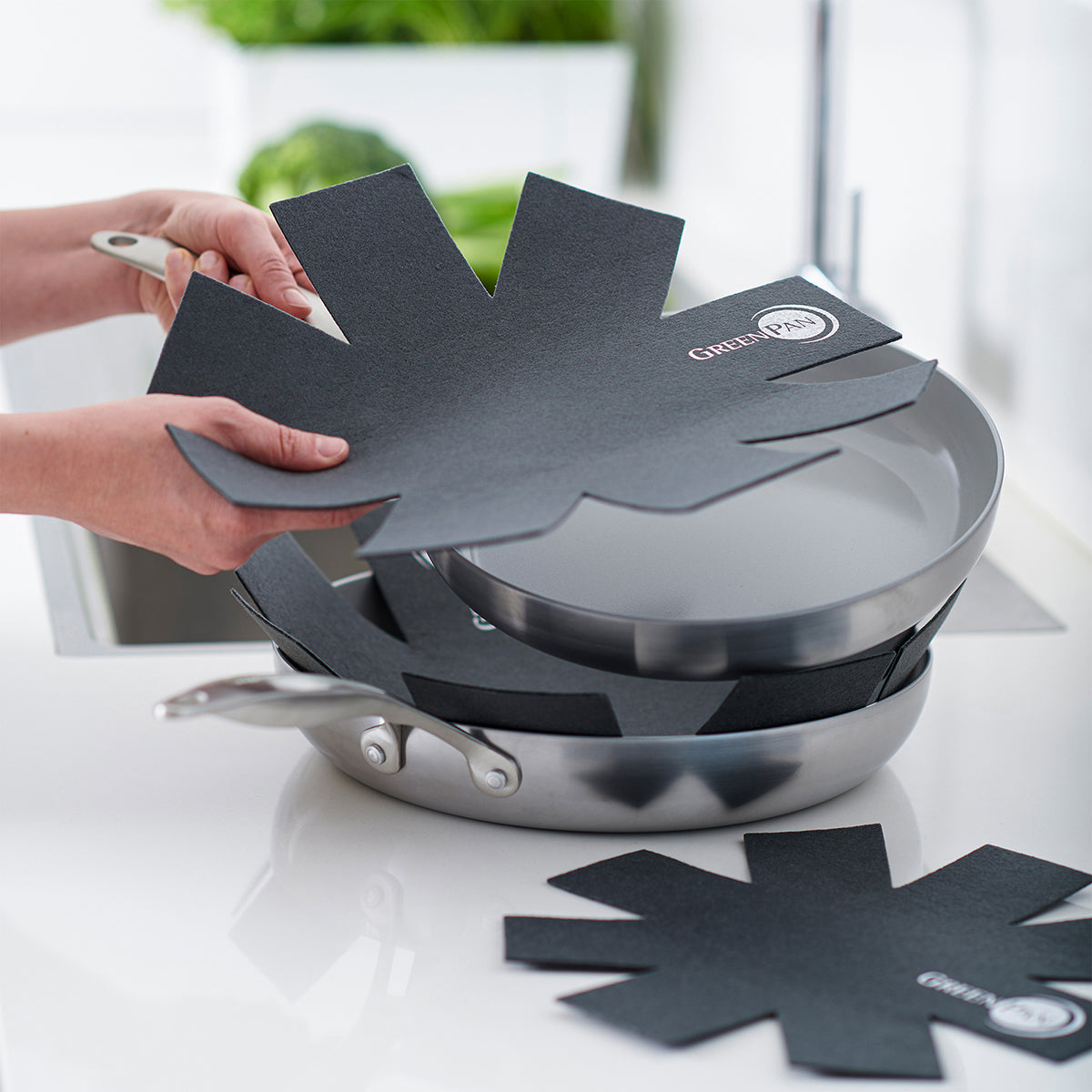
Cookware protectors are soft or flexible pads placed between stacked pots and pans to help prevent scratches, chips, and surface wear during storage.
In American kitchens, cabinet space can be tight, especially in apartments, condos, and family homes with several pots and pans. Stacking cookware saves room, but metal handles, rough pan bottoms, and hard rims can rub against nearby pieces. Cookware protectors create a cushion between those surfaces and help keep your cookware in better shape.
These pads come in materials such as felt, fabric, silicone, and other flexible compounds. Some are round, while others have a star-shaped or flower-shaped design that fits between different pan sizes. The best option depends on your cookware, storage setup, cleaning habits, and whether you need protection from scratches, slipping, or both.
Cookware protectors are simple storage accessories, not cleaning products or coatings that restore a damaged pan. They work best when the cookware is clean and dry, the pads fit properly, and the stack stays stable. They can help reduce everyday wear, but they cannot prevent every dent, chip, or scratch.
Cookware protectors are pads, liners, or separators designed to sit between pieces of cookware when you store them together. Their main job is to create a soft barrier between surfaces that might otherwise rub, scrape, or knock against each other. You may also see them sold as pot and pan protectors, cookware separators, or pan stacking pads.
Think of a protector as a small cushion for your kitchen equipment. When you place one between two pans, it helps keep their hard surfaces apart. This can reduce friction and limit the small marks that build up when cookware moves in a crowded cabinet.
Most protectors are removable and do not attach permanently to the pan. You place one inside a pot or on top of a pan before adding another piece. Some designs also fit between lids and cookware, which can help prevent rattling and contact marks.
Cookware protectors are especially useful when you stack several pans in one cabinet or drawer. They are not essential for every kitchen, but they can be a practical addition when your storage space is limited or your cookware has a finish that needs extra care.
Source: culinaryedge.com
Scratch prevention
A soft barrier helps limit direct contact between pan surfaces, rims, and other hard parts.
Space-saving storage
Protectors let you stack compatible cookware while reducing the risk of surface damage.
Noise reduction
A pad can reduce clinking and rattling when pans or lids shift slightly in a cabinet.
Surface care
Separating cookware may help preserve its appearance, especially when the finish is prone to visible marks.
Are Cookware Protectors the Same as Pan Liners?
The terms can overlap, but they do not always mean the same thing. A cookware protector usually refers to a removable pad used during storage. A pan liner may refer to a protective layer placed inside cookware for a specific task, so the intended use matters.
Always check the product description. A storage pad is not automatically safe to place inside a hot pan while cooking, and a baking liner is not necessarily designed to cushion stacked cookware.
Storage protector
Designed to sit between cookware pieces when they are not in use.
Cooking liner
Designed for a particular cooking or baking task and used only within its stated temperature and food-contact limits.
Why Do You Need Cookware Protectors?
Cookware protectors help reduce the wear that can happen when pans share a cabinet or drawer. Even if you handle each pan carefully while cooking, moving a stack to reach the bottom pan can cause the pieces to rub together. A separator adds a buffer during these routine movements.
The value of that buffer depends on the type of cookware you own. A bare stainless steel pan may tolerate normal use well, but its polished finish can still develop scuffs. A nonstick pan has a functional coating that needs careful handling, while enameled cookware can chip if hard pieces strike its edges.
Protectors can also help when you store glass lids with metal rims or place lids inside pots. A suitable pad reduces direct contact and may limit small marks caused by shifting. It does not make glass unbreakable, so lids still need stable support and careful handling.
For a renter with a small kitchen, the main benefit may be being able to stack cookware without using a separate shelf for every pan. For someone with a premium cookware set, preserving the finish may matter more. In both cases, the goal is controlled storage rather than a guarantee that cookware will remain flawless.
Source: culinarycrafted.com
They help limit scratches
A suitable pad keeps hard surfaces apart and reduces rubbing when stacked cookware moves.
They support organized cabinets
Separators make it easier to store multiple pans in a compact space without direct contact.
They protect visible finishes
They may help reduce marks on polished stainless steel, coated cookware, and decorative enamel.
They help separate lids
A pad between a lid and a pan can reduce contact and noise during storage.
Which Types of Cookware Benefit Most?
Nonstick cookware is a strong candidate for careful separation because damage to its cooking surface can affect how it performs. Ceramic-coated pans also need protection from hard impacts and rough contact. A protector helps during storage, although it cannot prevent damage caused by metal utensils, overheating, or poor cleaning habits.
Enameled cast iron can also benefit from separators because chips in its enamel may occur when heavy pieces strike one another. Polished stainless steel may show fewer marks when stored with a barrier, while bare cast iron benefits mainly from keeping its surfaces from scraping against other cookware and from storing it dry.
For heavy Dutch ovens or large cast-iron skillets, a pad alone may not solve every storage problem. Consider the weight of the stack and whether the bottom piece can safely support it. If the cookware feels unstable, store the pieces separately.
Nonstick and ceramic-coated pans
Use a clean, smooth protector to reduce contact with other pans and hard edges.
Enameled cookware
Protect rims and exterior surfaces from direct impact, while avoiding unstable stacks.
Stainless steel
Use separators if you want to reduce visible scuffs on polished surfaces.
Cast iron
Keep the cookware dry and use a protector only if it does not trap moisture against the metal.
Types of Cookware Protectors and Their Materials
Cookware protectors differ in softness, grip, moisture resistance, and ease of cleaning. The right material depends on what you store and how often you use it. A soft pad may provide a gentle barrier, while a washable silicone separator may be more practical for a kitchen where spills and frequent cleaning are common.
Do not assume that every product described as a pan protector has the same features. Thickness, surface texture, shape, and stated care instructions vary. Read the product details and choose a pad that fits your cookware without bunching up or leaving hard edges exposed.
Source: walmart.com
Felt protectors
Soft felt pads are often used between pans because they cushion contact and are easy to place. They are best kept clean and dry, as they can absorb moisture and may be harder to wash thoroughly than silicone.
Fabric protectors
Quilted or woven fabric pads provide a soft barrier and may be washable if the care label permits. Their performance depends on the fabric, stitching, thickness, and ability to dry fully.
Silicone protectors
Flexible silicone pads can offer grip and are often easier to rinse or wipe clean. Check the manufacturer’s cleaning instructions and keep in mind that not every silicone protector is intended for oven use or contact with hot cookware.
Foam protectors
Some storage pads use foam or foam-like materials to cushion contact. Their durability and resistance to heat, moisture, and compression depend on the material, so follow the product’s stated use.
Custom-shaped protectors
Some sets include different sizes or petal-shaped edges to fit pans of different widths. The extra coverage can help protect rims, provided the pad remains flat and does not interfere with stable stacking.
Felt vs. Silicone Cookware Protectors
Felt is a practical choice for dry cabinets because it is soft and easy to place between pans. It may be less convenient if it becomes greasy or damp, since cleaning and drying can take more care. A felt pad should not be stored against wet cookware.
Silicone is often a better fit for people who prefer a washable, flexible separator. Its grip may help limit slipping, but the pad must still fit the pan and remain flat. Silicone can also collect grease or food residue, so regular cleaning matters.
Neither material is automatically best for every kitchen. If your main concern is a delicate coated surface and your cabinets stay dry, felt may work well. If you want a reusable pad that is easy to rinse, a suitable silicone design may be more convenient.
Choose felt when
You need a soft barrier for clean, dry cookware and prefer a lightweight pad.
Choose silicone when
You value easy cleaning, flexibility, and a grippy surface for storage.
Check either material when
You need a specific size, want to protect a delicate finish, or plan to use the pad in a way beyond ordinary storage.
How to Use Cookware Protectors Correctly
Using cookware protectors is simple, but a few basic steps help them work as intended. Start with clean, dry cookware and select a pad that covers the area where two pieces might touch. The pad should lie flat rather than fold, bunch up, or create an uneven surface.
Before stacking a pan, check its rim, base, and handle. A protector cannot shield every part of a pan if a long handle or raised edge rests against the next piece. Change the stacking arrangement if a hard part presses directly against a delicate surface.
The stack should remain stable when you place or remove a pan. If a protector slips out, curls at the edge, or makes the cookware wobble, use a better-fitting size or store the pieces separately. Safe storage is more important than fitting every pan into one cabinet.
Source: lecreuset.ca
Step 1: Clean the cookware
Remove grease, food residue, and grit that could rub against the surface. Follow the cookware maker’s cleaning instructions.
Step 2: Dry every piece
Make sure the pan, lid, and handle area are dry before stacking. This is especially important for bare cast iron and other materials that may be affected by trapped moisture.
Step 3: Choose the right pad
Pick a protector that covers the contact area without extending so far that it folds or catches on a handle.
Step 4: Place it flat
Set the pad inside the lower pan or between the two pieces. Smooth out folds and keep the protector centered.
Step 5: Stack with care
Lower the next pan gently instead of sliding it across the surface. Avoid placing heavy cookware on pieces that cannot safely support the load.
Step 6: Check the result
Confirm that the cookware sits level and does not rock or slide. Adjust the pad or change the storage layout if needed.
How to Store Pot Lids With Protectors
Lids can be awkward to store because their rims, knobs, and glass surfaces may touch nearby cookware. A correctly sized pad between a lid and pan can reduce direct contact, but it should not leave the lid perched at an angle.
For glass lids, avoid pressure on the glass and keep the lid supported evenly. If the knob causes the lid to rock or the stack becomes unstable, store the lid vertically in a rack or in a separate compartment instead.
Check the knob
Make sure it does not push against the base or cooking surface of another pan.
Support glass evenly
Avoid setups that place concentrated pressure on the glass or leave the lid tilted.
Use a rack when needed
A lid organizer may work better than stacking when you have several lids or limited cabinet depth.
How to Choose the Right Cookware Protectors
The best cookware protector is one that fits your pans, suits the surface you want to protect, and stays in place during normal storage. You do not need the largest set or the thickest pad if a simpler design covers the contact points. Start with the sizes of the cookware you actually stack.
Measure the inside diameter of your pans and consider their shape. A wide skillet may need a larger protector than a small saucepan, while a shallow pan may work better with a thinner pad. If you stack pans with different widths, a set containing several sizes can be more useful than a pack of identical circles.
Next, consider how you clean and store your cookware. A washable pad may suit a busy family kitchen, while a soft felt separator may be enough for a dry cabinet. The material should be suitable for the intended storage use and should not shed, leave residue, or create an unstable stack.
Source: kitchenbap.com
Size and coverage
Choose a diameter that covers the likely contact area. For irregular pans, check whether the shape protects the rim and inner surface.
Material
Match the pad to your cleaning habits, moisture conditions, and cookware finish.
Thickness
A pad needs enough cushioning for the intended use but should not make the stack unstable or force pans apart at an angle.
Cleaning instructions
Check whether the pad can be hand-washed, machine-washed, or wiped clean, and allow it to dry fully before reuse.
Set quantity
Count how many pans and lids you store in stacks. Buy enough separators for the contact points you want to protect rather than assuming one pad will cover every item.
Cookware Protector Comparison Table
Use this table to compare common protector materials by their practical strengths and limits. These are general material characteristics, not a guarantee that every product made from a material will perform the same way.
Felt
Best for dry storage and gentle cushioning. Main limitation: it may absorb moisture and can be harder to clean after grease or food residue gets on it.
Fabric
Best for soft, reusable separation when the pad can be cleaned as directed. Main limitation: washing and drying needs depend on the fabric and stitching.
Silicone
Best for flexible, washable separation and grip. Main limitation: texture, thickness, and cleaning needs vary, and storage use does not imply heat-safe cooking use.
Foam
Best for cushioning when the material is designed for the task. Main limitation: compression, moisture resistance, and durability are product-specific.
A Simple Example for a Small American Kitchen
Imagine you live in an apartment with one deep skillet, two saucepans, a stockpot, and several lids. You want to store the pans in one cabinet without allowing their cooking surfaces to rub against each other.
You could place a correctly sized protector between the skillet and the next pan, then use additional pads between the saucepans. The stockpot should support only a stable load, and the lids may fit better in a separate rack if their knobs make the stack uneven.
This approach keeps the storage plan simple. You protect the contact points that matter most without forcing every item into one tall stack.
Start with the pans you stack most
Prioritize the pieces that rub against each other every day.
Keep heavy items low
Place heavier cookware on a stable base and avoid loading delicate pieces beneath it.
Separate awkward lids
Use a lid rack if pads alone cannot keep them level and secure.
Cookware Protectors for Nonstick, Ceramic, Stainless Steel, and Cast Iron
Different cookware surfaces have different care needs, so the way you use a protector should match the material. The pad reduces contact during storage, but it does not replace the cleaning and handling rules supplied by the cookware maker. Always check those instructions when a coating or finish needs special care.
For nonstick pans, the goal is to avoid unnecessary rubbing and contact with hard edges. Place a clean, smooth protector between pans and lift pieces apart when removing them. If a coating is already peeling, flaking, or badly damaged, a protector will not repair it.
Ceramic-coated cookware also benefits from gentle storage. The term ceramic-coated usually refers to a coating over a metal base, not a pan made entirely from ceramic. Avoid impacts, rough handling, and storage arrangements that press hard objects against the cooking surface.
Stainless steel is generally sturdy, but polished finishes can show scuffs. Separators can help keep pans from rubbing against each other, although they cannot prevent every mark from regular use. For bare cast iron, keeping the pan dry is essential; do not allow a damp fabric or felt pad to sit against the metal for long periods.
Enameled cast iron needs special attention around edges and rims because enamel can chip if hard cookware strikes it. Use a pad that stays flat and does not make the stack unstable. If a piece is heavy or difficult to lift safely, separate storage may be the better choice.
Source: kitchenbap.com
Nonstick cookware
Use a clean, soft separator and avoid sliding pans across each other.
Ceramic-coated cookware
Prevent hard contact and follow the maker’s instructions for cleaning and storage.
Stainless steel cookware
Use protectors to reduce visible rubbing marks, especially on polished finishes.
Bare cast iron
Dry thoroughly before storage and check that the protector does not trap moisture.
Enameled cast iron
Protect edges from impacts and avoid stacking arrangements that place excess weight on lower pieces.
Can Cookware Protectors Damage a Pan?
A suitable protector should help reduce contact damage, but a dirty, damp, rough, or poorly fitted pad can cause problems. Grit trapped between the pad and pan may rub against the finish, while moisture held against bare iron can contribute to rust. A pad that slips out can also leave cookware unprotected.
Inspect protectors from time to time. Replace any that are torn, heavily stained, shedding fibers, permanently warped, or no longer lying flat. If you see marks on a pan, clean it according to the manufacturer’s guidance and check whether the pad or storage arrangement contributed to the problem.
Keep pads clean
Remove dust, crumbs, and grit that could scratch or soil cookware.
Avoid trapped moisture
Dry both the cookware and protector before stacking.
Replace worn pads
Discard protectors that have rough edges, tears, or a shape that no longer fits.
How to Clean and Maintain Cookware Protectors
Cookware protectors need care because they sit close to surfaces used for food preparation. Dust, grease, and crumbs can collect on them over time. Cleaning the pads helps prevent that residue from transferring back to clean cookware.
The correct method depends on the material and the product’s care instructions. Do not assume that a silicone pad is dishwasher-safe or that a fabric pad can go in a washing machine simply because it looks washable. Follow the label or manufacturer’s directions.
After cleaning, let each protector dry fully before placing it between cookware. This matters for all materials, but it is especially important when storing bare cast iron or keeping pads in a closed cabinet with limited airflow. A damp pad can create an unwanted source of moisture.
Source: amazon.co.uk
Felt and fabric
Remove loose debris and clean according to the care instructions. Do not return a damp pad to a stack of cookware.
Silicone
Wash or wipe the pad as directed, paying attention to grooves where grease may collect. Rinse away cleaning residue and dry it before use.
Foam or specialty materials
Use only approved cleaning methods, since some materials may break down or lose their shape when exposed to unsuitable heat or chemicals.
All protectors
Inspect for tears, rough spots, residue, odors, and changes in shape. Replace a pad that no longer offers a clean, stable barrier.
How Often Should You Clean Them?
There is no single cleaning schedule for every kitchen. Check protectors whenever you wash and put away cookware, and clean them when you see residue, dust, or stains. If a pad touches a greasy pan exterior or falls onto a dirty cabinet shelf, clean it before reusing it.
In a dry cabinet with clean cookware, protectors may need little attention beyond routine inspection. In a busy household where pans are used daily, more frequent checks can help catch dirt and wear before they affect the cookware.
Inspect during storage
Look for debris, dampness, and any pad that has shifted out of place.
Clean after visible contamination
Do not put a greasy or dirty separator between freshly cleaned pans.
Allow full drying
Wait until the pad is dry before returning it to a closed stack or drawer.
Common Cookware Protector Mistakes to Avoid
Most storage problems come from poor fit, trapped dirt, moisture, or unstable stacking rather than from the idea of using a protector itself. A few simple checks can prevent these issues. The goal is to keep cookware separated without creating a new storage hazard.
One common mistake is treating every pad as heatproof. A product intended for cabinet storage may not be suitable for a hot pan, an oven, or direct contact with a burner. Never leave a storage protector inside cookware while cooking unless the manufacturer specifically approves that exact use.
Another mistake is stacking too much cookware in one pile. Even if every pan has a separator, the total weight can make the stack awkward to lift or cause a lower piece to shift. Keep heavy cookware low and store pieces separately when the arrangement feels unstable.
Source: walmart.com
Using a pad while cooking
Storage protectors are not cooking accessories by default. Remove them before heating cookware unless the product’s instructions clearly permit the intended use.
Stacking damp cookware
Moisture trapped between a pan and pad can create odor or corrosion concerns, especially with bare cast iron.
Choosing a pad that is too small
A small separator may leave rims or cooking surfaces exposed to direct contact.
Ignoring worn edges
Torn or rough material may fail to cushion the surfaces and can collect dirt.
Forcing a tall stack into a cabinet
A crowded or leaning stack may tip when you remove one piece. Use a rack or separate storage instead.
Assuming protectors repair damage
They help reduce future contact but cannot restore a scratched coating, repair chipped enamel, or remove dents.
Troubleshooting: When a Protector Does Not Work Well
If pans still develop marks, first inspect the separator and the way the cookware is stacked. Small particles, exposed metal edges, and movement can defeat the pad’s purpose. Change one part of the setup at a time so you can identify the likely cause.
The pan still gets scratched
Check for grit, rough stitching, exposed handles, or a pad that does not cover the contact area. Clean or replace the protector and adjust the stack.
The pad keeps slipping
Try a better-fitting shape or a suitable non-slip design. If the stack remains unstable, stop stacking those pieces.
The pad smells musty
Remove it from storage, clean it as directed, and let it dry fully. Replace it if the odor remains or the material shows signs of damage.
Rust appears on bare cast iron
Remove the damp protector, dry the cookware, and follow the pan maker’s care guidance. Review the storage conditions before stacking again.
A lid rocks on the stack
Do not rely on a pad to correct an uneven fit. Store the lid in a rack or separate space where it can rest securely.
Frequently Asked Questions
Q
What are cookware protectors used for?
Cookware protectors are used to separate pots, pans, and lids during storage. They help reduce scratches, scuffs, chips from contact, and rattling when cookware is stacked in a cabinet or drawer.
They work best when the cookware is clean and dry, the pad fits the pieces, and the stack remains stable. They cannot prevent every kind of damage.
Q
Do cookware protectors work with nonstick pans?
Yes. A clean, smooth cookware protector can help reduce contact between nonstick pans and other cookware. This can help limit scratches caused by stacking and moving pans around in storage.
Use the protector only for storage unless its manufacturer states otherwise. It does not prevent damage caused by overheating, unsuitable utensils, or abrasive cleaning.
Q
Are felt or silicone cookware protectors better?
Neither material is best for every situation. Felt offers soft cushioning and works well in dry storage, while silicone is often easier to wash and may provide more grip.
Choose based on your cookware, cabinet conditions, cleaning preferences, and the product’s stated care instructions. Make sure the pad lies flat and does not make the stack unstable.
Q
Can I use cookware protectors in the oven?
Do not put a cookware storage protector in the oven unless its manufacturer explicitly approves that use and provides suitable temperature limits. A pad designed to sit between cold pans in a cabinet may not be safe under cooking heat.
Remove storage pads before heating cookware. If you need an oven liner or baking accessory, select a product specifically designed for that purpose.
Q
Can cookware protectors prevent rust?
Cookware protectors are not rust-prevention products. A clean, dry pad may help separate stored pieces, but a damp protector can hold moisture against bare metal and contribute to rust.
For cast iron, dry the pan completely and follow its care instructions before storage. Inspect the protector for dampness and avoid leaving wet fabric or felt against the metal.
Q
How many cookware protectors do I need?
The number depends on how many pans and lids you stack and which surfaces might touch. Usually, you need a suitable separator at each contact point you want to protect.
Count your stacked pieces and check their sizes before buying a set. A variety of sizes may be more useful than several identical pads if your cookware ranges from small saucepans to wide skillets.
Q
Can I make my own cookware protectors?
You can make simple storage separators from clean, soft material that will not shed fibers or scratch cookware. However, a homemade pad may not offer the same durability, fit, grip, or washability as a purpose-made protector.
Avoid materials with rough seams, loose threads, metal parts, sticky coatings, or unknown chemical finishes. Make sure the homemade separator stays flat, remains clean and dry, and is used only for storage.
✦ Wrapping Up
Conclusion
Cookware protectors are simple pads that help keep pots, pans, and lids from rubbing against each other during storage. They are useful in small kitchens, crowded cabinets, and homes where cookware needs extra care. Felt, fabric, silicone, and other materials can all serve this purpose when their design suits the job.
The right protector depends on your cookware and storage habits. Choose a size that covers the contact area, keep the pad clean and dry, and avoid unstable stacks. For heavy cast iron, fragile glass lids, or awkward cookware shapes, separate storage may be safer than stacking.
A protector is a small part of good cookware care. Combined with proper cleaning, thorough drying, and careful handling, it can help reduce avoidable storage damage and keep your kitchen more organized.
💡 Key Takeaway
Before buying cookware protectors, measure the pans you stack most often, choose a suitable material, and check that each pad stays clean, dry, flat, and stable between your cookware.