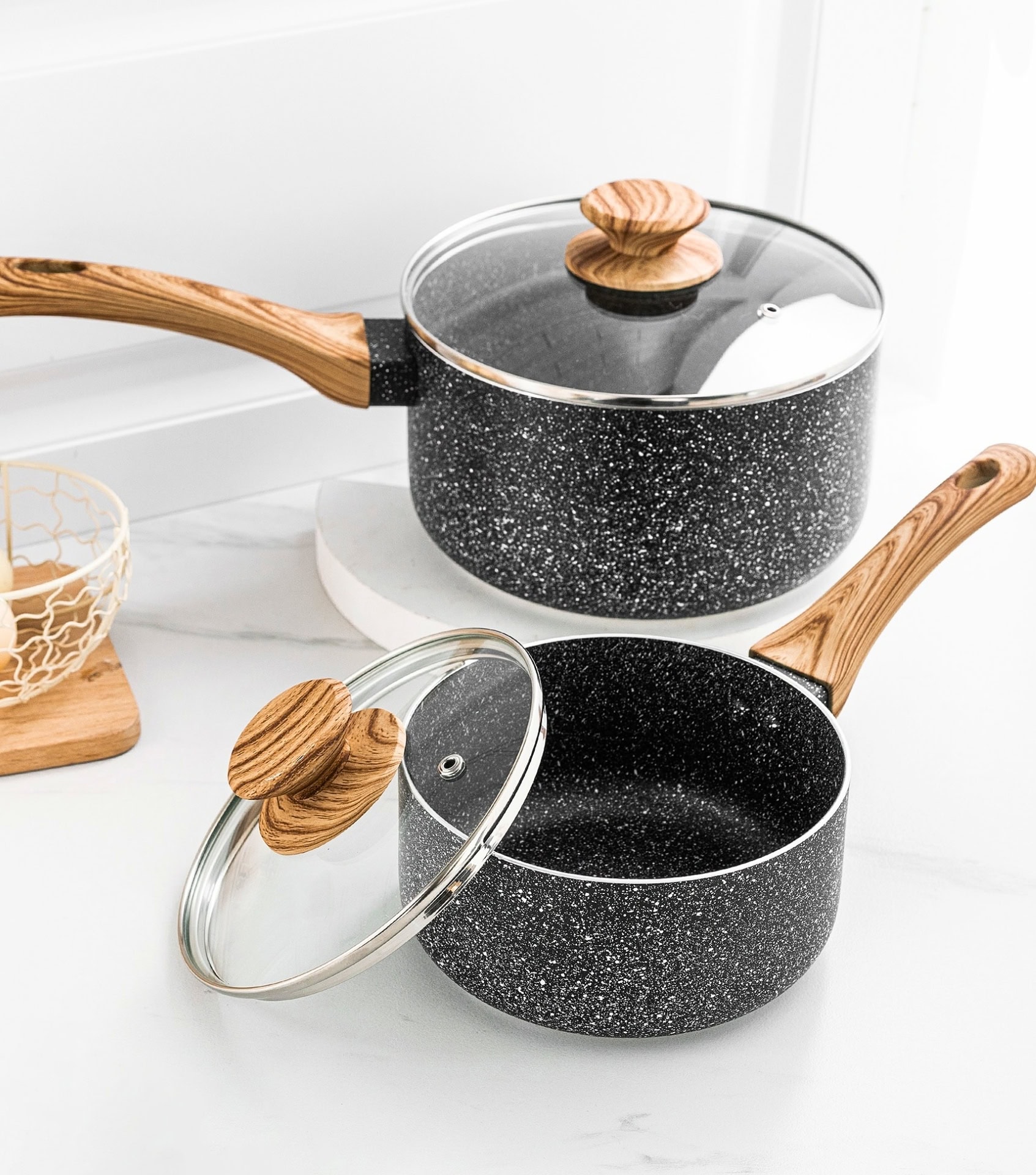
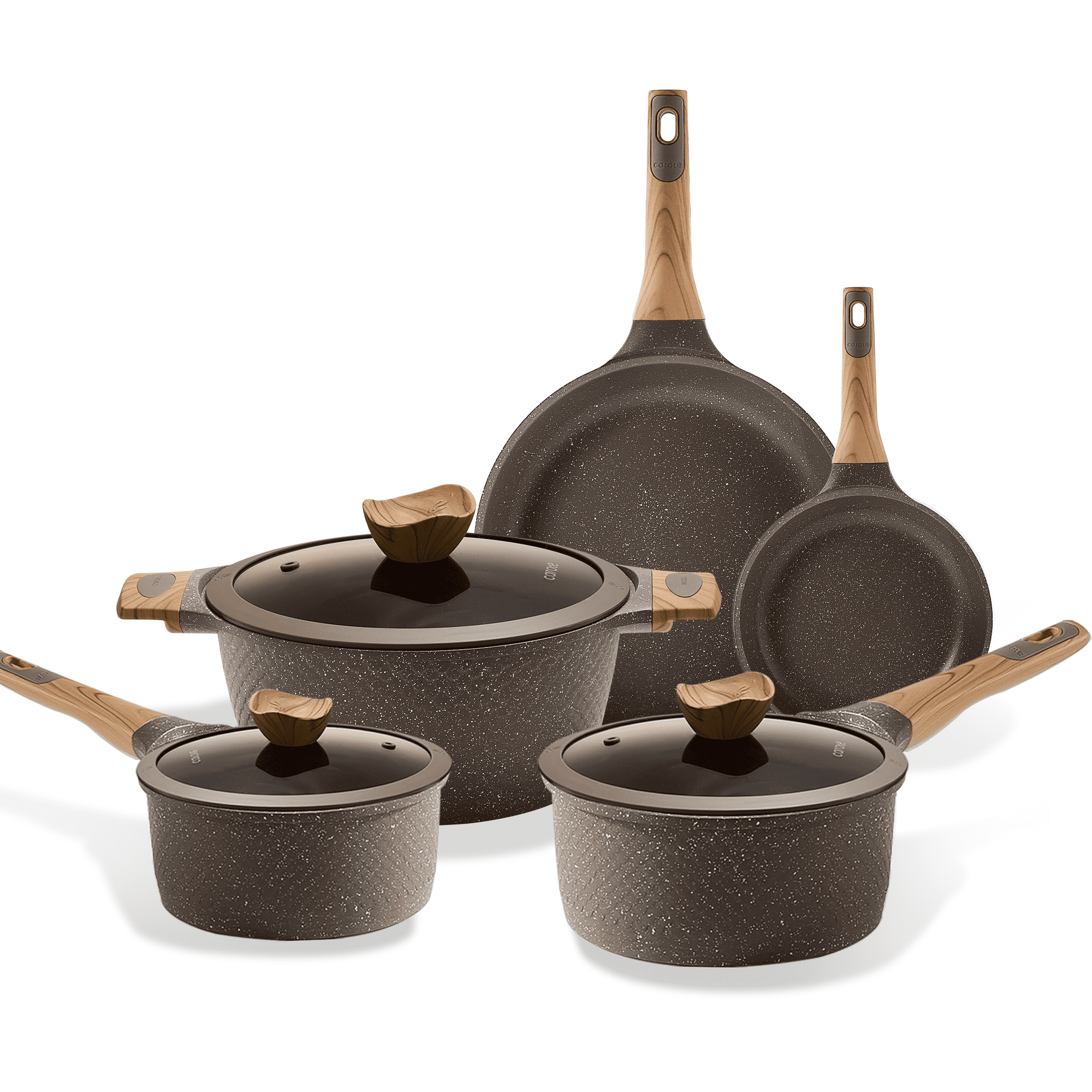
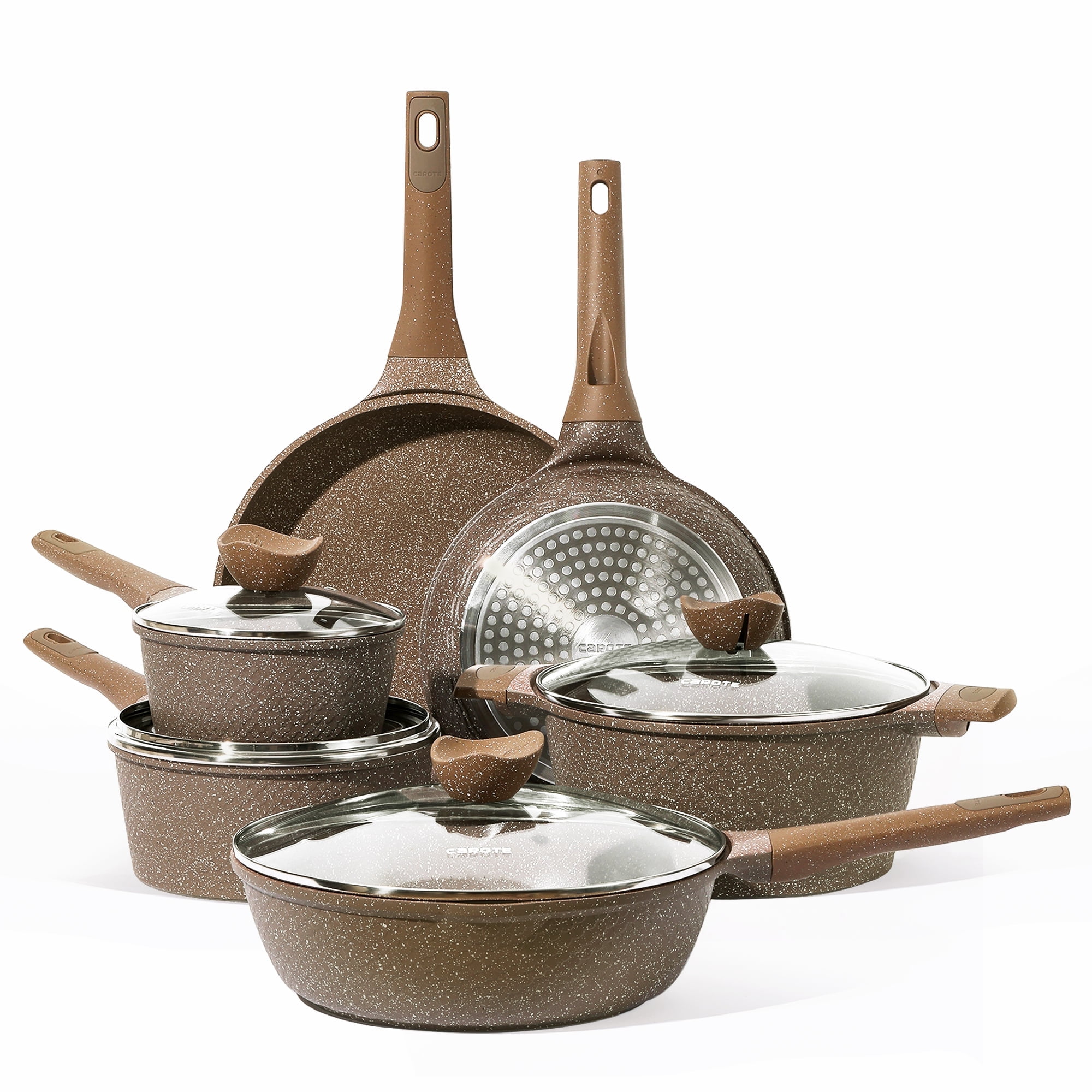
Granite cookware is usually made from aluminum or another metal with a speckled, stone-like nonstick coating. It generally does not contain a solid layer of natural granite rock.
When shopping for pots and pans in the United States, you may see granite cookware in big-box stores, kitchen shops, and online marketplaces. Its dark, speckled surface looks like natural stone, but the name describes the finish more often than the material beneath it. Knowing what is inside the pan helps you choose cookware that fits your cooking habits and budget.
Most granite-style cookware combines a metal body, often aluminum, with a decorative and functional coating. Depending on the brand and model, that coating may use a PTFE-based nonstick system or a ceramic-based system. The exact formula can vary, so the product label and manufacturer documentation matter more than the word granite alone.
This guide explains the main materials, how they work, what affects safety, and how to care for granite cookware. It also clears up common claims about natural stone, toxic chemicals, induction compatibility, and durability. The goal is to help you understand the pan you are buying rather than rely on its name or appearance.
Granite cookware is generally made from a metal body covered with a decorative, nonstick coating that resembles granite stone. Manufacturers commonly use aluminum for the body, although other metals or layered constructions may appear in different products. The speckled finish gives the pan a stone-like look without requiring a solid granite cooking surface.
The word granite can be confusing because natural granite is a hard rock made from minerals such as quartz and feldspar. Most pans sold under the granite cookware label do not use a thick piece of this rock as their main cooking surface. Instead, the name usually refers to the coating’s color, texture, or marketing category.
A typical pan has three practical parts: the main body that spreads heat, the surface coating that helps food release, and the handle and fittings that make the pan usable. Some models also have a separate base designed to improve heat distribution or support induction cooking. The exact construction varies by manufacturer and product line.
Source: thekitcheneye.com
Metal body
Often aluminum, which transfers heat quickly and is relatively lightweight. Some cookware uses stainless steel or other metal layers.
Nonstick surface
A manufactured coating that can be PTFE-based, ceramic-based, or another documented nonstick formulation.
Stone-like finish
Speckles and mottled colors create the appearance of granite. They do not prove that the pan contains natural granite.
Handle and base
These may include stainless steel, aluminum, plastic, silicone, or other materials, depending on the design.
Does Granite Cookware Contain Real Granite?
Usually, the cooking surface is not a solid slab of granite. A granite-style pan is better understood as coated metal cookware with a stone-inspired appearance. Some products may use mineral particles or other additives in a coating, but their presence and amount cannot be determined from the name alone.
What the name tells you
It usually signals the appearance or product category, not a complete list of ingredients.
What the name does not tell you
It does not establish the coating chemistry, the metal alloy, or whether the product has been tested for particular contaminants.
The Main Materials Used in Granite Cookware
The material beneath the coating affects how a pan heats, how much it weighs, and how well it holds its shape. The coating affects food release and the care the pan needs. These parts work together, but they serve different purposes.
Two pans can look nearly identical while using different metal bodies and nonstick formulas. That is why a useful comparison starts with the full product specifications rather than the granite label.
Source: m.media-amazon.com
Aluminum
A common choice for the pan body because it heats quickly, weighs relatively little, and is easy to shape into pots and skillets.
Stainless steel
May appear in handles, bonded bases, or layered cookware. Some designs combine stainless steel with an aluminum core to balance strength and heat transfer.
PTFE-based coating
A fluoropolymer nonstick surface used in many conventional nonstick pans. Some granite-style products use this type of coating.
Ceramic-based coating
Often marketed as ceramic or ceramic nonstick. It commonly uses a sol-gel coating system rather than a solid ceramic cooking vessel.
Mineral pigments and additives
May contribute to a speckled appearance or coating properties. The exact ingredients depend on the manufacturer’s formula.
Why Aluminum Is Common
Aluminum transfers heat well, which helps a pan respond quickly when you change the burner setting. Its low weight also makes a skillet easier to lift when you are cooking eggs, vegetables, or a quick weeknight meal. Aluminum can be shaped into many sizes at a relatively practical cost.
However, aluminum alone does not explain how a granite-style pan performs. The thickness of the body, the shape of the base, the coating, and the stove all affect the result. A thin pan can develop hot spots even when its metal conducts heat well.
Main advantage
Fast heat response and a lighter feel than many heavy steel or cast-iron pans.
Main limitation
Performance and resistance to warping depend on the pan’s construction, thickness, and use.
What the Granite Coating Does
The coating creates the surface that touches the food. Its main job is to reduce sticking and make cleanup easier. The speckled pattern may resemble stone, but the pattern itself does not reveal whether the coating is PTFE-based, ceramic-based, or another type.
Manufacturers may use several coating layers, with different layers serving as a primer, a structural layer, or the final cooking surface. Not every product uses the same number of layers or the same formula. Claims such as diamond-infused, stone-derived, or extra durable need model-specific documentation to explain what they mean in practice.
Food release
A suitable nonstick coating helps eggs, pancakes, and other delicate foods release with less effort.
Easy cleaning
A smooth surface can reduce the need for vigorous scrubbing.
Wear over time
Repeated heating, abrasion, and poor care can reduce nonstick performance.
Is Granite Cookware PTFE or Ceramic?
Granite cookware can use different nonstick technologies, so you cannot identify its coating from its appearance alone. Some granite-style pans use a PTFE-based coating, while others use a ceramic-based nonstick coating. The words granite, stone, and diamond do not establish the formula.
This distinction matters if you are choosing cookware because you want to avoid a particular chemical group or prefer a certain care routine. Look for the exact model’s materials statement, coating description, and manufacturer guidance. If the information is unclear, ask the manufacturer rather than treating a broad marketing phrase as proof.
Source: openhousegallery.org
PTFE-based nonstick
PTFE is a fluoropolymer commonly used to make food-release surfaces. Its presence does not automatically mean a pan is unsafe when used according to its instructions.
Ceramic-based nonstick
Often uses a sol-gel coating that can contain silica-based components. It is not the same thing as a pan made entirely from fired ceramic.
Unspecified stone coating
If the product page only says granite or stone, the available description may not establish the coating’s chemical composition.
What Does PFOA-Free Mean?
PFOA-free means that the manufacturer makes a claim about the presence or use of perfluorooctanoic acid, a chemical historically associated with the production of some fluoropolymer coatings. It does not necessarily mean the pan is free of PTFE or every other substance in the broader PFAS group.
If your goal is to avoid all PFAS, a PFOA-free statement alone is not enough to establish that the product meets your goal. Check for an explicit statement about PFAS and ask what the manufacturer includes in that term. Definitions and testing methods may differ, so clear documentation is more useful than a short advertising claim.
Read the full claim
Separate statements about PFOA, PTFE, and PFAS instead of treating them as interchangeable.
Check the scope
Look for the exact product model and any available testing details, not just a claim about a brand’s entire range.
Is Ceramic Nonstick the Same as Natural Stone?
No. Ceramic nonstick usually refers to a manufactured coating, often based on sol-gel chemistry. Natural stone is a geological material, and a speckled ceramic-style coating does not mean that the pan is made from a solid stone surface. Both terms need to be read in the context of the product’s actual construction.
Ceramic-coated metal
A metal body carries a thin manufactured coating that provides the cooking surface.
Solid ceramic cookware
The vessel itself is made from ceramic material rather than metal covered by a thin nonstick layer.
Is Granite Cookware Safe to Use?
Granite-style cookware can be suitable for everyday cooking when its materials are appropriate for food contact and the pan is used according to the manufacturer’s directions. Safety depends on the actual coating, the body material, the product’s quality, and how the pan is heated and maintained. The granite label alone does not prove that a product is safe or unsafe.
For most buyers, the useful approach is to identify the coating, follow the heat limits, and avoid cookware with damaged surfaces or unclear sourcing. In the United States, the Food and Drug Administration regulates food-contact substances under applicable federal requirements. A seller’s general safety statement is not the same as independent evidence for every possible claim.
No single label answers every question about a pan’s composition. If you need to avoid a specific substance, such as PTFE or a particular metal, choose a product with a clear material disclosure that directly addresses that concern. When the information is missing, do not assume that the word natural, granite, or eco-friendly settles the question.
Source: m.media-amazon.com
Follow the heat limit
Use the temperature range listed in the product instructions. Avoid heating an empty coated pan for a long time.
Inspect the cooking surface
If the coating is peeling, flaking, or badly damaged, stop using the pan and check the manufacturer’s advice about replacement.
Choose suitable utensils
Wood, silicone, and other utensils approved for the coating can help limit scratches.
Read specific material claims
Confirm the exact model’s coating and relevant testing or compliance information if a particular chemical is a concern.
Can Granite Cookware Release Harmful Fumes?
Some nonstick coatings can release hazardous fumes if overheated. PTFE-coated cookware is especially important to keep within its recommended temperature range because severe overheating can cause the coating to break down and produce fumes. Birds are particularly sensitive to these fumes, so households with pet birds should take extra care around nonstick cookware.
Use the pan on an appropriate burner, avoid prolonged preheating while empty, and follow the manufacturer’s temperature limits. If a pan has been severely overheated and you notice smoke or unusual fumes, turn off the heat if it is safe to do so, ventilate the area, and move people and pets away. Seek urgent medical or veterinary advice if symptoms develop.
Reduce overheating risk
Use low or medium heat for routine cooking unless the manufacturer specifically permits a different setting.
Do not ignore smoke
Smoke, a strong unusual odor, or visible coating damage is a reason to stop cooking and assess the situation safely.
Does Granite Cookware Contain Lead?
The granite name does not tell you whether a product contains lead or other unwanted contaminants. Composition can differ among brands, factories, and product lines. For a properly documented product, consult its food-contact compliance information and any applicable test reports rather than relying on appearance or country-of-origin assumptions.
If you suspect a product is counterfeit, has no traceable manufacturer, or makes unsupported safety claims, choose a better-documented alternative. Do not use a damaged pan simply because the original purchase price was high.
Look for traceable details
Check the manufacturer, model number, instructions, and accessible compliance statements.
Treat test claims carefully
A meaningful report should identify the product or material tested and explain what the test covers.
How Does Granite Cookware Compare With Other Types?
Granite-style cookware is mainly a nonstick option, so the most useful comparisons are with other common cooking surfaces. Aluminum affects heat transfer, while the coating affects sticking and care. Stainless steel and cast iron have different strengths because they generally rely less on a fragile nonstick surface.
The right choice depends on what you cook, how much maintenance you want, and whether you prioritize easy food release, searing, long service life, or avoiding particular coating materials. The table below summarizes typical differences; individual products can vary with construction and quality.
Source: images.thdstatic.com
For delicate foods
A sound nonstick granite-style pan can make eggs and pancakes easier to cook and release.
For high-heat searing
Uncoated stainless steel or cast iron may be a better fit when the cookware is designed for high heat and strong browning.
For long-term surface durability
Uncoated metal cookware avoids the gradual wear of a nonstick layer, although it has its own cleaning and cooking trade-offs.
Granite Cookware vs. Stainless Steel
Granite-style nonstick cookware usually needs less oil to release delicate foods and can be easy to clean. Stainless steel takes more attention to preheating and fat use, but it can handle many browning tasks and does not depend on a nonstick coating for food release.
If you regularly sear meat, deglaze a pan, or want a surface that can tolerate metal utensils, uncoated stainless steel may be more practical. If quick eggs and easy cleanup are your main goals, a nonstick pan can be more convenient.
Granite-style nonstick
Best suited to low- to medium-heat everyday tasks and foods that tend to stick.
Stainless steel
Useful for browning, pan sauces, and cooking methods that benefit from a durable uncoated surface.
Granite Cookware vs. Cast Iron
Cast iron is much heavier than most aluminum-based granite-style pans. When properly heated, cast iron can retain heat well and is useful for searing and oven cooking when the specific pan permits it. Bare cast iron needs seasoning and sensible drying to help protect it from rust.
Granite-style cookware is often easier to lift and clean, but its coating may wear out over time. Cast iron can last for many years with proper care, while a coated pan may need replacement when its nonstick surface deteriorates.
Choose granite-style cookware
When low sticking, lighter weight, and easy cleanup are more important than a surface built for heavy use.
Choose cast iron
When you value heat retention, searing, and a cooking surface that can be maintained without a factory-applied nonstick coating.
Granite Cookware vs. Ceramic Nonstick
Granite cookware and ceramic nonstick cookware are not always separate categories. A product marketed as granite may itself have a ceramic-based coating, while another may use PTFE. The meaningful comparison is between the exact coating systems rather than the words printed on the box.
If avoiding PTFE is your goal, verify that the specific pan uses a non-PTFE coating. If you also want to avoid PFAS, look for a clear statement that addresses the broader group. Neither a ceramic appearance nor a stone-like pattern proves the answer by itself.
Compare the ingredients
Look for the documented coating chemistry rather than assuming that granite and ceramic always mean different materials.
Compare care instructions
Both types may need gentle utensils, controlled heat, and careful cleaning to preserve their surface.
Advantages and Limitations of Granite Cookware
Granite-style cookware can be a useful everyday option, especially when you want a lightweight pan that releases food with little effort. Its practical value comes from the metal body and the nonstick surface, not from a proven advantage of natural granite. Its limitations also come mainly from the coating and the quality of the pan’s construction.
No nonstick pan stays in its original condition forever. How long a granite-style surface lasts depends on the coating formula, frequency of use, heat exposure, utensils, cleaning habits, and storage. A higher price or a more elaborate speckled finish does not guarantee a longer service life.
Source: sustainablejungle.com
Easy food release
Useful for eggs, fish, pancakes, and other foods that can cling to an uncoated surface.
Simple cleanup
Food often comes away with a soft sponge and mild dish soap when the coating is in good condition.
Lightweight handling
Many aluminum-based models are easier to lift and move than heavy cast-iron cookware.
Limited coating life
The cooking surface can lose its release properties or become damaged with repeated use.
Heat restrictions
Many models are intended for low or medium heat and may not suit intense searing or prolonged empty preheating.
Marketing ambiguity
The granite label alone does not disclose the full composition or prove that a pan is free of particular chemicals.
Is Granite Cookware Worth Buying?
Granite-style cookware can be worth buying if your main tasks are everyday frying, reheating, making eggs, or cooking foods that benefit from easy release. It is less suitable if you regularly use very high heat, prefer metal utensils, or want cookware that does not depend on a coating for its cooking performance.
Before buying, compare the exact materials, stove compatibility, oven limit, care instructions, and replacement policy. A simple pan with clear documentation may be a better choice than a product with a long list of vague claims.
Good fit
Home cooks who value easy food release, low-effort cleanup, and a relatively light pan.
Consider another material
Cooks who often sear at high temperatures, use metal tools, or want a cooking surface that does not rely on a nonstick coating.
How to Care for Granite Cookware
Gentle care helps preserve a granite-style nonstick surface. The most useful habits are controlling heat, using suitable utensils, letting the pan cool before washing, and avoiding harsh scrubbing. Always follow the instructions for the specific model because dishwasher and oven limits can differ.
Treat the coating as a functional surface, not an indestructible layer of stone. A pan may still look attractive after its food-release performance has started to decline, so pay attention to how it cooks as well as how it looks.
Source: i5.walmartimages.com
Use low or medium heat
Choose a setting that cooks the food without prolonged overheating. Follow the product’s stated limits.
Use gentle utensils
Wood, silicone, or other approved tools help reduce scratches and wear.
Wash with mild soap
Use a soft sponge or cloth rather than steel wool, abrasive pads, or harsh scouring products.
Avoid sudden temperature changes
Let a hot pan cool before placing it in cold water to reduce thermal stress and the risk of warping.
Store with care
If pans are stacked, place a suitable protective liner between them to help prevent scratches.
Can Granite Cookware Go in the Dishwasher?
Some granite-style pans are labeled dishwasher-safe, while others require handwashing. Even when a manufacturer permits dishwasher use, repeated exposure to strong detergents and high temperatures may shorten the life of some nonstick surfaces. Handwashing with mild soap is often a sensible way to protect the coating.
Check the care label for the exact model rather than assuming that every pan in the granite category has the same instructions. Also check whether the handle, lid, or attached fittings have separate limits.
If dishwasher use is allowed
Follow the manufacturer’s loading and cleaning instructions, and avoid contact with other items that could scratch the surface.
If the instructions are unclear
Handwash the pan gently until the manufacturer confirms the approved cleaning method.
When Should You Replace Granite Cookware?
Consider replacing a coated pan when the surface is peeling, flaking, deeply scratched, or no longer releases food as intended despite normal care. Also assess the handle, base, and overall shape. A loose handle, severe warping, or other structural damage can make a pan difficult or unsafe to use.
Minor cosmetic changes do not always mean that a pan must be discarded immediately. However, visible coating failure or damage that affects cooking is a good reason to stop using it and check the manufacturer’s replacement advice. Do not try to restore a factory nonstick coating with household oils, abrasives, or improvised chemical treatments.
Check the coating
Look for peeling, flaking, deep scratches, or a marked loss of food-release performance.
Check the structure
Inspect for a loose handle, unstable base, or warping that prevents safe use on the stove.
Can You Use Granite Cookware on an Induction Stove?
Granite cookware works on an induction stove only if its base is compatible with induction. Induction cooktops heat suitable magnetic cookware through an electromagnetic field, so the appearance of the cooking surface does not determine compatibility. A pan with an aluminum body may need a magnetic stainless steel base or another compatible construction.
Check the product packaging or manufacturer’s specifications for an explicit induction-compatible statement. You can also hold a magnet against the outside bottom of the pan; a firm attraction is a useful preliminary clue, although the manufacturer remains the best source for compatibility and performance details.
The base should also sit flat on the cooking zone and match the cooktop’s size requirements. A pan that is technically magnetic may still perform poorly if its base is warped or too small for the burner.
Source: i5.walmartimages.com
Look for an induction symbol
Use the symbol or written compatibility statement supplied by the manufacturer.
Check the base
A magnetic base and a flat, suitable contact surface help the pan work correctly.
Do not judge by appearance
A speckled stone finish does not prove that the cookware will work on induction.
Is Granite Cookware Oven-Safe?
Oven safety depends on the entire pan, including its coating, handle, lid, and fittings. A metal body alone does not mean that the complete pan can safely go in the oven. Plastic or silicone components and certain coatings may have lower temperature limits than the body itself.
Check the maximum oven temperature and whether the lid has a separate limit. If the manufacturer does not provide clear oven guidance, do not assume that the pan is safe for oven use.
Check the complete assembly
Verify the pan, handle, lid, and any removable parts before placing the cookware in an oven.
Respect the lowest limit
When components have different temperature limits, follow the restriction that applies to the part being used.
How to Choose Granite Cookware
Choose granite-style cookware by checking the details that affect daily use, not just the color or number of pieces in a set. The body material, coating type, heat limits, and compatibility should match your kitchen. Clear documentation also makes it easier to decide whether a product meets your material preferences.
For a household in the United States, a useful starting point is to list the meals you cook most often and the stove you use. Then compare a few specific models against those needs. A large set is not necessarily better value if several pieces rarely leave the cabinet.
Source: m.media-amazon.com
Identify the coating
Look for a clear description of PTFE, ceramic-based nonstick, or another coating technology.
Confirm the body material
Check whether the pan uses aluminum, stainless steel, or a layered construction.
Verify stove compatibility
Make sure the product is approved for gas, electric, glass-top, or induction cooking as needed.
Read heat and oven limits
Check the maximum recommended cooking temperature, oven rating, and any restrictions on empty preheating.
Review care instructions
Find out whether the pan requires handwashing and which utensils are permitted.
Check the warranty and replacement terms
Understand what the manufacturer covers and whether damage to the nonstick coating is excluded.
Questions to Ask Before Buying
A seller should be able to identify the product model and provide basic information about its construction and use. If a claim matters to your decision, ask for an answer that addresses that specific claim. General words such as safe, natural, healthy, or stone-coated do not replace material details.
What is the exact coating?
Ask whether it is PTFE-based, ceramic-based, or another system.
Is the product explicitly PFAS-free?
If avoiding PFAS is important, seek a clear statement about the specific model and the scope of the claim.
What is the maximum recommended heat?
Confirm the limit for stovetop use and any separate oven restrictions.
Which stove types are supported?
Verify induction or other cooktop compatibility in the official specifications.
How should the pan be cleaned?
Check whether the manufacturer permits dishwasher use and which cleaning tools are suitable.
Frequently Asked Questions
Q
Is granite cookware made from real granite?
Usually, no. Most granite cookware is made from metal, often aluminum, with a manufactured coating that has a speckled stone-like appearance. Some formulas may include mineral particles, but the word granite does not establish that natural granite forms the cooking surface.
Q
Is granite cookware aluminum?
Many granite-style pans have an aluminum body because aluminum heats quickly and keeps the cookware relatively light. However, not every model uses the same construction. Check the manufacturer’s material specifications to confirm the body and base materials.
Q
Is granite cookware the same as Teflon?
Not necessarily. Teflon is a brand associated with PTFE-based nonstick products, while granite is a broad cookware marketing term. Some granite-style pans use PTFE-based coatings, while others use ceramic-based or different coating systems. The exact model’s documentation is the best way to identify the surface.
Q
Is granite cookware free of PFAS?
The name granite does not prove that a pan is PFAS-free. Some products may use PTFE-based coatings, which belong to the broader PFAS family under common definitions, while others use different technologies. If you want to avoid PFAS, look for an explicit, model-specific statement and clarify what the manufacturer means by PFAS-free.
Q
Does granite cookware scratch easily?
The coating can scratch or wear if it is exposed to metal utensils, abrasive cleaning tools, repeated overheating, or rough storage. The rate of wear depends on the particular coating and how the pan is used. Wood or suitable silicone utensils, gentle washing, and protective liners between stacked pans can help reduce damage.
Q
Can granite cookware be used on a glass-top stove?
Many granite-style pans can be used on a glass-top electric stove if the manufacturer permits it and the base is flat and suitable. Avoid dragging cookware across the glass because this can cause scratches. Follow the cooktop and pan instructions, especially when lifting or moving a heavy pot.
Q
Is granite cookware better than stainless steel?
Neither is better for every task. Granite-style nonstick cookware is often easier for eggs and quick cleanup, while uncoated stainless steel is useful for browning, pan sauces, and cooking without a factory-applied nonstick layer. Choose based on your cooking methods, heat needs, and willingness to maintain the surface.
Q
How long does granite cookware last?
There is no single lifespan that applies to every granite-style pan. Service life depends on the coating formula, build quality, frequency of use, heat exposure, and care. Replace the pan when its surface is peeling or badly damaged, or when structural problems make it unsafe to use.
✦ Wrapping Up
Conclusion
Granite cookware is usually made from aluminum or another metal with a manufactured nonstick coating that looks like natural stone. The body provides structure and heat transfer, while the coating helps food release and makes cleaning easier. Most products sold under this name are not made from solid granite.
The most important detail is the exact coating. Some granite-style pans use PTFE-based nonstick technology, while others use ceramic-based systems or different formulas. The appearance and name alone cannot confirm whether a pan is PFAS-free, induction-compatible, or suitable for high-heat cooking.
For everyday use, choose a pan with clear material details, follow the stated temperature limits, use suitable utensils, and clean it gently. If you want to avoid a specific substance, verify that the manufacturer addresses it directly for the model you plan to buy.
💡 Key Takeaway
Before buying granite cookware, check three things: the body material, the exact nonstick coating, and the manufacturer’s heat and care instructions. Those details tell you far more than the granite label.