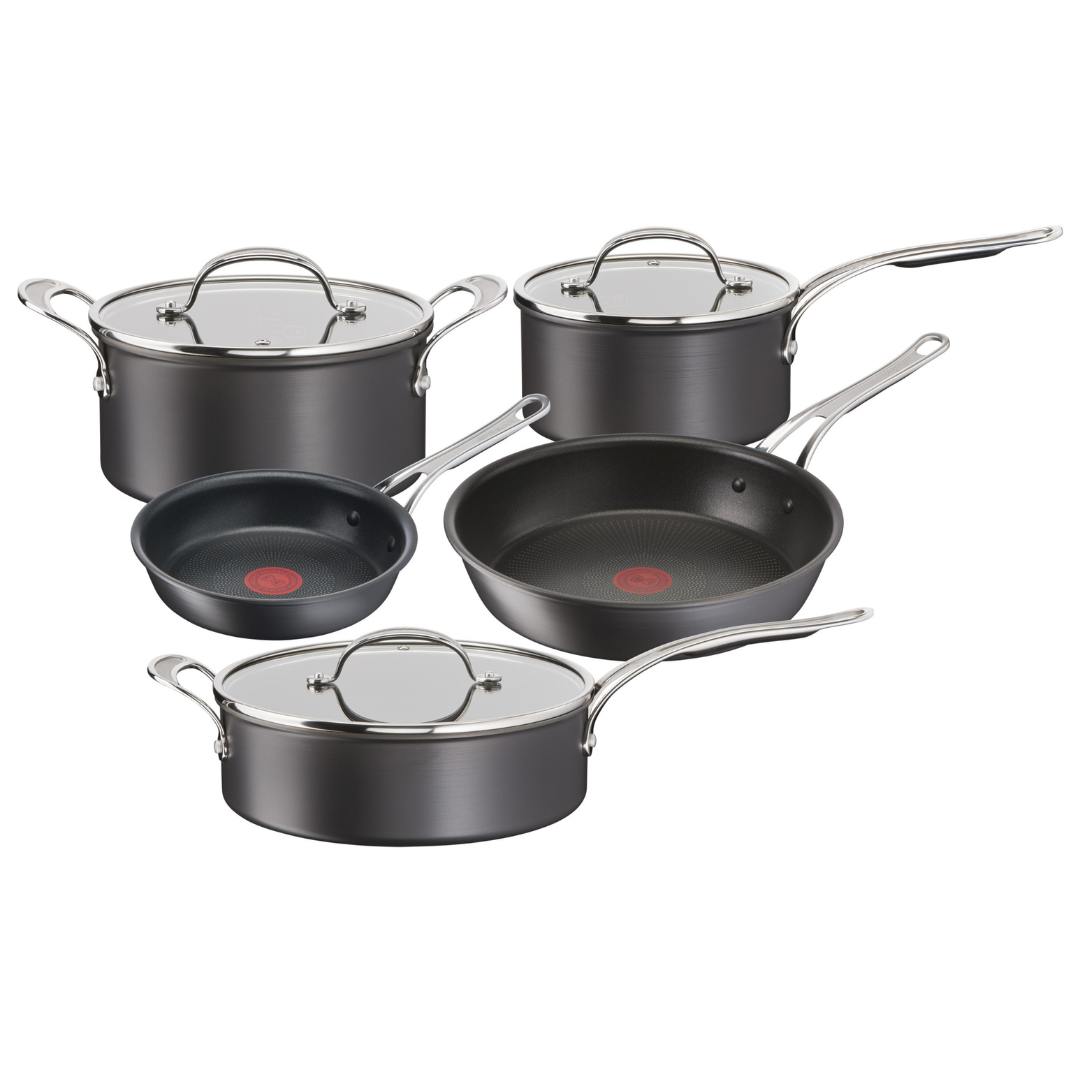
Jamie Oliver is closely associated with Tefal cookware, including stainless steel, hard anodized aluminum, and nonstick pans. The exact pieces he uses can vary by kitchen and cooking task.
When home cooks in the United States look for a new frying pan, saucepan, or complete cookware set, they often turn to chefs for ideas. Jamie Oliver is a popular source of cooking advice, and his long-running partnership with Tefal gives shoppers a clear place to start. The partnership began in 2003 and has grown to include several cookware styles and other kitchen tools.
The key detail is that Jamie Oliver works with Tefal to develop and promote cookware, but that does not mean every pan in his private kitchen is known or publicly confirmed. His cooking demonstrations also feature different tools for different jobs. A stainless steel pan, a nonstick skillet, and a deep casserole each serve a different purpose, so it makes sense to look at the full range rather than assume he uses one set for everything.
For American shoppers, the most useful approach is to understand which Jamie Oliver by Tefal ranges are available, how their materials differ, and which features matter for everyday cooking. Product names, designs, warranties, and cooktop compatibility can vary by country. Before buying, check the exact model sold in the United States and read its care instructions.
Jamie Oliver is best known for his long-standing cookware partnership with Tefal. The brand and chef have worked together since 2003, first focusing on frying pans and later expanding into broader cookware and kitchenware categories. Their shared goal is to help people cook fresh meals at home with practical tools.
The Jamie Oliver by Tefal range has included stainless steel pans, hard anodized aluminum cookware, nonstick frying pans, and Ingenio cookware with removable handles. Different ranges have different designs and features. Not every collection is sold in every market, and products may change over time.
Tefal’s official collection pages describe the ranges and include comments attributed to Jamie about the cookware. Those pages establish his connection to the brand and the types of pans developed under the partnership. They do not provide a complete inventory of every item he owns or uses in private.
A separate question is what viewers see in cooking videos. A pan used in a demonstration may be part of his branded collection, but identifying the precise model requires a clear view, a product reference, or a reliable description. A similar shape or color alone is not enough to confirm the model.
Source: images.squarespace-cdn.com
Stainless steel cookware
A practical choice for browning meat, cooking vegetables, reducing sauces, and serving food straight from the pan when the design permits.
Hard anodized aluminum cookware
Designed for regular cooking, with an aluminum body that spreads heat and a hardened exterior surface. Some versions also have a nonstick interior.
Nonstick frying pans
Useful for eggs, pancakes, delicate fish, and other foods that may stick to an uncoated surface.
Ingenio cookware
A space-saving range with detachable handles on compatible pieces. The removable design can make storage and some cooking transitions easier.
Does Jamie Oliver Use Tefal Pans at Home?
Yes, there is direct support for his association with Tefal cookware at home. On Tefal’s official Jamie Oliver collection page, Oliver describes the pans as his go-to choice for everyday cooking. This is a statement presented by the brand as part of their partnership.
That statement should not be stretched into a claim that every pan in his home is made by Tefal. Professional chefs use tools for many reasons, and their kitchens may contain different products for different tasks. The sound conclusion is that Tefal is a documented part of his cookware identity, while a complete private-kitchen inventory is not established.
What is documented
The long-running partnership, the Jamie Oliver by Tefal collection, and his public endorsement of the cookware for everyday cooking.
What is not fully established
Every exact pan model he owns, the full contents of his private kitchen, and whether he uses only Tefal cookware.
Is Jamie Oliver’s Cookware the Same in Every Country?
No. The collection name may be shared across markets, but the available products and specifications can differ. A pan sold in the United Kingdom or Australia may have a different product code, handle design, coating description, or warranty from a product sold in the United States.
American shoppers should compare the full model number rather than rely on a product photograph alone. Check the listed materials, the stated oven-safe temperature, the compatible cooktops, and the included lids and handles. These details matter more than a familiar name on the box.
Check the model number
Use the exact product code shown by the seller or manufacturer to find the matching manual and specifications.
Check local terms
Confirm that the warranty and return policy apply to your US purchase, especially when a product is imported.
The Main Jamie Oliver by Tefal Cookware Types
The collection is not one single type of pan. It covers several materials and designs, each with its own strengths. Choosing among them is easier when you match the pan to the meals you prepare most often.
A busy US household may need a nonstick skillet for breakfast, a stainless steel frying pan for searing chicken, and a saucepan for oatmeal or pasta sauce. You do not need to buy every range to cook well. A few pieces that match your routine can be more useful than a large set filled with pans you rarely reach for.
Source: adamsdc.co.za
Cook’s Classics
A range associated with practical, everyday cooking. Specific versions may use hard anodized aluminum and nonstick interiors, so check the exact model.
Stainless steel
A versatile option for browning, building pan sauces, and handling many savory dishes. It usually needs more attention to preheating and oil than nonstick cookware.
Ingenio
A cookware system designed around removable handles on compatible pieces. Its stackable design can be helpful in small apartments and crowded cabinets.
Cook’s Direct and similar practical ranges
Some models offer features such as pouring edges, measuring marks, deeper shapes, or draining lids. The feature list varies by product.
Stainless Steel Pans for Everyday Cooking
Stainless steel is a strong choice for cooks who want a durable pan without a nonstick coating on the cooking surface. It works well for browning meat, sautéing vegetables, and making a sauce from the browned bits left in the pan. Those browned bits, often called fond, can add depth to a sauce when loosened with liquid.
Stainless steel is not automatically nonstick. Food can cling if the pan is too cool, the surface is dry, or the cook tries to turn food before it has released. Preheating and using an appropriate amount of fat can help, but the method differs from cooking with a coated skillet.
For a US kitchen, stainless steel can be a useful main pan if you cook steak, chicken, mushrooms, or pan sauces often. It also suits people who prefer to avoid a coated cooking surface. Look for a stable base and a handle that feels secure when the pan is full.
Best for
Searing, sautéing, pan sauces, and regular stovetop use.
Main trade-off
It takes practice to limit sticking, especially with eggs or other delicate foods.
Care tip
Let the pan cool enough to handle safely before cleaning, and follow the manufacturer’s advice on detergents and stain removal.
Hard Anodized Aluminum Cookware
Hard anodized aluminum cookware uses an aluminum body whose outer surface has been treated through an electrochemical process. This treatment creates a harder surface than untreated aluminum. The cookware may also have a separate nonstick coating on the cooking side, depending on the model.
The aluminum body helps spread heat, which can make the pan useful for everyday meals. A coated version can also make foods such as eggs, pancakes, and fish easier to release. However, hard anodizing and nonstick coating are not the same thing: one describes a treated surface, while the other describes a cooking-surface layer.
If you are considering a Jamie Oliver by Tefal hard anodized pan, check its actual interior coating and care instructions. Do not assume every pan in a hard anodized range has identical construction. Product details can change across collections and markets.
Best for
Everyday frying, sautéing, simmering, and meals where easy cleanup is a priority.
Main trade-off
A coated version needs care to protect its cooking surface and may eventually need replacement.
Care tip
Avoid sharp utensils and sudden temperature changes when the product instructions warn against them.
Nonstick Cookware and Tefal Temperature Indicators
Nonstick cookware is useful when easy food release and quick cleanup matter most. Jamie Oliver by Tefal ranges have included pans with nonstick interiors, including versions described by the brand as reinforced with titanium particles. That wording refers to the coating design; it does not mean the pan is made entirely of titanium.
Some Tefal pans include Thermo-Signal technology. On models equipped with this feature, a marked area changes appearance as the pan heats, giving the cook a visual cue about when to begin cooking. The exact design and instructions depend on the product, so read the manual for the pan you own.
A temperature indicator is a guide, not a replacement for cooking judgment. Different foods need different heat levels, and a pan can continue getting hotter after the indicator changes. Use the appropriate heat setting for the food and avoid leaving an empty coated pan over high heat.
Source: jamieolivercookware.com
When Is a Nonstick Pan the Better Choice?
A nonstick skillet is especially handy for eggs, omelets, pancakes, and delicate fish. These foods can tear or stick when a pan is poorly suited to the job or when the cook uses too little fat. Nonstick cookware can make these meals easier for beginners and busy families.
For tasks that depend on a deep brown crust, a stainless steel or other suitable uncoated pan may be a better fit. Many cooks keep both types because no single surface is ideal for every dish. A small collection with different strengths can be more practical than trying to make one skillet do everything.
Use it for
Eggs, pancakes, delicate fish, and quick meals where food release matters.
Use moderate heat
Follow the product’s temperature limits and avoid heating an empty pan for an extended period.
Protect the surface
Use suitable utensils, avoid abrasive scouring tools, and replace a pan when its surface is badly damaged.
Are Titanium-Reinforced Nonstick Pans Made of Titanium?
Usually, no. In cookware descriptions, titanium-reinforced or titanium-infused nonstick refers to the coating formulation, not a solid titanium pan. The body may be aluminum or another material, with a separate nonstick layer on the inside.
The words alone do not prove that a pan lasts longer than every competing pan. Actual life depends on the coating design, the way the pan is used, the cooking temperature, and cleaning habits. Compare the care instructions and warranty for the exact product instead of relying on a material label alone.
Read the construction details
Look for separate descriptions of the pan body, cooking surface, and exterior finish.
Avoid broad durability claims
A reinforced coating may be designed for wear resistance, but it is not immune to damage.
Jamie Oliver Ingenio Cookware: What Makes It Different?
The defining feature of Ingenio cookware is its detachable handle on compatible pieces. Instead of leaving a long handle attached to every pan, the cook removes it when the design allows. This can help the pans stack more neatly and free up cabinet space.
A removable handle may also make it easier to move compatible cookware between the stovetop, oven, refrigerator, or table, but only when the specific pan, handle, lid, and intended use permit it. Not every component has the same heat limit, and a handle that is safe for stovetop use may need to be removed before oven use.
This design can be valuable in smaller US kitchens, including apartments, dorm-style spaces, and homes with limited storage. It is not automatically better for everyone. Some cooks prefer a fixed handle because it is always attached and feels familiar when lifting a hot pan.
Source: images.bauerhosting.com
Advantages of Detachable-Handle Cookware
The main advantage is flexibility. Stacked pans take up less space when their handles are removed, and compatible pieces can be easier to arrange in a cabinet or drawer. A removable handle can also keep a protruding grip from getting in the way when the pan is stored.
Before buying a set, check how many handles are included. Some cookware systems use one or more handles across several pans, so the included quantity matters when cooking multiple dishes at once. Make sure the handle is designed for the exact pan series rather than assuming every removable handle fits every product.
Space-saving storage
Pans can stack more closely when the handles are detached and the shapes are designed to nest.
Flexible cooking
Compatible pieces may move between cooking and storage stages when the manufacturer’s instructions allow it.
Check the included parts
Confirm the number of pans, handles, lids, and any removable accessories before purchasing.
What to Check Before Using a Removable Handle
A detachable handle must be locked into place correctly before you lift a pan. Follow the product’s instructions for attaching and releasing it, and do not lift a hot or heavy pan if the handle feels loose. The handle and its locking parts should be clean and free of damage.
Never assume that a removable handle, plastic lid, or glass lid can go into the oven simply because the pan itself is oven-safe. Each component can have a different temperature limit. Confirm the instructions for the full setup before moving cookware into an oven.
Test the connection before lifting
Follow the locking procedure and make sure the handle is securely attached.
Respect component limits
Check separate oven and heat instructions for the pan, handle, lid, and accessories.
Which Jamie Oliver Cookware Should You Choose for a US Kitchen?
The best choice depends on what you cook, the type of stove you have, and the space available in your kitchen. The Jamie Oliver name can help you identify a product family, but the construction and features of the exact model should guide your decision.
For many households, a small starter collection works well: one skillet, one saucepan, and one larger pan for family meals. You can add more pieces as you learn what you use most. This avoids paying for duplicate pan sizes or specialty pieces that stay in the cabinet.
The table below compares common cookware types by practical use. It is a general guide to materials and designs, not a claim that every model in the Jamie Oliver by Tefal range has the same specifications.
Source: tefal-support.com.au
For eggs and pancakes
Consider a nonstick skillet with a size suited to your usual portions.
For steak and pan sauces
Consider stainless steel if you want to brown food and build flavor from the pan’s browned bits.
For small cabinets
Consider Ingenio or another nesting design if its handle system and included parts fit your routine.
For soups and family meals
Choose a deeper saucepan, sauté pan, or casserole that holds the quantity you normally prepare.
Cookware Comparison by Cooking Task
Use this comparison to narrow your choices before looking at individual product pages. A pan’s size, weight, base design, and handle shape can matter just as much as its material. If possible, compare the actual dimensions and listed weight rather than judging from a photograph.
Nonstick aluminum
Good for eggs and quick everyday meals. It offers easy release but needs care to protect the cooking surface.
Stainless steel
Good for searing and sauces. It is versatile and durable but requires attention to heat and food release.
Hard anodized aluminum
Good for regular stovetop cooking. Check whether the model has a nonstick interior and what care it requires.
Removable-handle cookware
Good for compact storage and flexible handling. Confirm that the handle and cookware are compatible.
Check Your Stove Before You Buy
Cooktop compatibility is one of the most important checks for US shoppers. Gas and many electric stoves can work with a wide range of pan bases, while induction cooktops require cookware with a magnetic base. A product that works on a gas stove may not work on induction.
Look for an explicit statement that the exact model is induction-compatible if you have an induction range. Do not rely only on a stainless steel exterior or the Jamie Oliver by Tefal name. If the product manual does not make compatibility clear, ask the manufacturer or seller before ordering.
Gas
Check the pan’s base stability and use a flame that does not climb far up the sides.
Electric coil or smooth-top electric
Use a pan with a suitable flat base and follow the stove maker’s care guidance to avoid scratching glass surfaces.
Induction
Confirm explicit induction compatibility for the exact model.
How to Care for Jamie Oliver by Tefal Cookware
Good care helps cookware stay useful for longer, but the right method depends on the material and model. Stainless steel, nonstick aluminum, and detachable-handle systems do not all need the same treatment. The manufacturer’s instructions should take priority over generic kitchen advice.
Let a hot pan cool to a safe temperature before washing it, unless its manual gives different instructions. Sudden temperature changes can damage some cookware or cause hot water to splash. Avoid immersing a hot pan in cold water just to speed up cleanup.
Use the right utensils and cleaning tools for the surface. Nonstick coatings can be damaged by sharp metal tools or abrasive pads, while stainless steel can usually tolerate more vigorous cleaning when the product instructions allow it. If a pan has removable parts, clean and store those parts as directed.
Source: tefal.com.au
Care for Nonstick Pans
Use low to medium heat for most everyday nonstick tasks unless the instructions for your exact pan say otherwise. Avoid leaving an empty pan over a hot burner, and do not use it to preheat for a long time. Overheating can damage the coating and may release hazardous fumes from overheated PTFE-based cookware.
Choose utensils that the manufacturer approves, such as wood, silicone, or suitable heat-resistant materials. Clean the pan with a soft sponge and a suitable dish detergent. If food sticks more than it used to, inspect the surface and review your heat and cleaning habits rather than scrubbing harder.
Avoid prolonged empty heating
Add food or suitable cooking fat as directed and use an appropriate heat setting.
Skip harsh abrasives
Use non-abrasive cleaning tools unless the manual clearly permits another method.
Replace damaged cookware
If a coated surface is peeling or badly deteriorated, stop using the pan and follow the manufacturer’s replacement guidance.
Care for Stainless Steel
Stainless steel can develop discoloration, water spots, or stuck-on food. These marks do not always mean the pan is damaged. Soaking the pan after it cools and using a cleaner approved for stainless steel can help remove ordinary residue.
For better food release, preheat the pan appropriately and add cooking fat when needed. Avoid forcing food loose before it has browned and released naturally. These simple steps can make stainless steel easier to use without treating it like a nonstick pan.
Clean after cooling
Use warm water and dish soap, then follow the product instructions for tougher marks.
Prevent avoidable sticking
Match the heat to the food and allow meat or vegetables time to brown before turning.
Common Mistakes When Buying Celebrity Chef Cookware
A chef’s endorsement can help shoppers discover cookware, but it should not replace a careful comparison. The most common mistake is buying a set because a familiar name is on the packaging without checking the materials, dimensions, and care needs.
Another mistake is assuming that a large set is better value for every household. A set may include several small saucepans but lack the deep pan or skillet you need most. Compare the included pieces with your own cooking habits before paying for a bundle.
It is also easy to confuse marketing terms with a guarantee of performance. Words such as professional, reinforced, durable, or premium need to be read alongside the actual construction, warranty, and care requirements. No cookware surface is immune to poor use or normal wear.
Source: m.media-amazon.com
Mistake: assuming every pan is the same
Correct approach: compare the exact model number, materials, coating, and included components.
Mistake: ignoring cooktop compatibility
Correct approach: verify that the pan works with your gas, electric, ceramic, or induction stove.
Mistake: expecting nonstick cookware to last forever
Correct approach: follow the care instructions and plan to replace a coated pan when its surface is no longer in good condition.
Mistake: relying on a product photo
Correct approach: check the written specifications, model code, and manual before buying.
Mistake: assuming imported products have US warranty coverage
Correct approach: confirm the seller’s return policy and the manufacturer’s local warranty terms.
How Much Should You Spend?
There is no single price that makes a pan a good purchase. Cost depends on size, construction, the number of pieces, the type of coating, and the market where the product is sold. Prices and availability can change, so compare current US listings for the exact model rather than relying on a price quoted in another country.
A simple way to judge value is to divide the purchase into the pieces you will actually use. If a five-piece set contains one skillet and four items you rarely need, a smaller set or a single pan may be a better fit. A larger set makes more sense when you regularly cook several dishes at once or need to replace most of your cookware.
Start with your most-used pan
If you cook eggs daily, a good skillet may matter more than a large set of saucepans.
Compare the whole package
Check pan sizes, lids, handles, warranty coverage, and return terms.
Think about replacement
A low initial price may not be the best value if the pan does not fit your cooking needs or care habits.
A Simple Buying Checklist for American Home Cooks
Before choosing a Jamie Oliver by Tefal pan or another cookware line, take a moment to compare your needs with the product details. This is especially useful when a retailer uses a broad collection name but sells several models with different features.
The goal is to buy cookware that fits your stove, storage space, and normal meals. You do not need to copy a chef’s entire kitchen to benefit from the same practical ideas. Start with one or two pieces that solve real problems in your cooking routine.
Source: images.squarespace-cdn.com
1. Decide what you cook most
Choose a skillet for eggs and quick meals, stainless steel for searing and pan sauces, or a deeper pan for soups and family dishes.
2. Confirm the material
Distinguish the pan body from its cooking surface. Aluminum, stainless steel, hard anodized finishes, and nonstick coatings describe different parts or properties.
3. Check your cooktop
Confirm the exact model supports your stove, particularly if you use induction.
4. Review heat limits
Read the maximum oven temperature and confirm whether lids and removable handles must be taken off.
5. Compare dimensions
Check the diameter, depth, weight, and handle length to make sure the pan fits your burners and storage.
6. Read care instructions
Confirm how to clean the surface, which utensils are suitable, and whether the product is labeled dishwasher-safe.
7. Check the seller
Confirm that the product is genuine, the model details match the listing, and the return and warranty terms suit your purchase.
A Practical Starter Set
For someone setting up a first kitchen, three pieces can cover many common meals: a medium nonstick skillet, a stainless steel frying pan, and a saucepan with a lid. The nonstick skillet handles eggs and pancakes, the stainless steel pan handles browning and sauces, and the saucepan covers grains, vegetables, and smaller batches of soup.
Add a larger sauté pan or casserole if you often make pasta sauces, stews, curries, or one-pan family dinners. If storage is tight, a compatible removable-handle system may help. Choose the sizes based on the number of people you usually cook for, not the largest meal you might make once a year.
For one or two people
A medium skillet and a small or medium saucepan may cover many everyday tasks.
For a family
A larger skillet or deep sauté pan can help when cooking several servings at once.
For limited storage
Consider nesting pans or detachable handles, but confirm that the complete set meets your cooking needs.
Frequently Asked Questions
Q
What cookware brand does Jamie Oliver use?
Jamie Oliver has a long-running partnership with Tefal, and the co-branded collection is known as Jamie Oliver by Tefal. The partnership began in 2003 and includes cookware in several styles, such as stainless steel and nonstick designs. This public association does not establish that every item in his private kitchen comes from Tefal.
Q
Does Jamie Oliver use stainless steel or nonstick pans?
The Jamie Oliver by Tefal collection includes both stainless steel and nonstick cookware. Stainless steel is useful for browning and pan sauces, while nonstick pans can make eggs, pancakes, and delicate foods easier to cook. The best option depends on the dish, and the exact pan used in a particular cooking demonstration should be confirmed before identifying its model.
Q
Are Jamie Oliver by Tefal pans available in the United States?
Availability depends on the specific range, model, and seller. Some products marketed in the United Kingdom or Australia may not be offered through the same channels in the United States. Check current US retailer listings, model numbers, cooktop compatibility, shipping terms, and warranty coverage before ordering an imported product.
Q
What is special about Jamie Oliver Ingenio cookware?
Ingenio cookware uses detachable handles on compatible pieces. This design can help pans stack more compactly and may make it easier to move a compatible pan between cooking and storage. Check the instructions for the exact set, including how to lock the handle and whether the pan, handle, and lid have different oven or heat limits.
Q
Are Jamie Oliver nonstick pans safe to use?
Use any nonstick pan according to its specific manufacturer’s instructions. Avoid prolonged empty heating, respect the stated heat limits, and use utensils and cleaning tools suitable for the surface. Overheated PTFE-based cookware can release hazardous fumes, so keep coated pans at suitable temperatures and do not leave them unattended over high heat. If the coating is peeling or badly damaged, stop using the pan and follow the manufacturer’s replacement guidance.
Q
Is hard anodized cookware the same as nonstick cookware?
No. Hard anodized describes a treatment applied to an aluminum surface, while nonstick describes a cooking-surface property usually created by a separate coating. A hard anodized pan may also have a nonstick interior, but this depends on the model. Read the product specifications to understand both the body material and the interior finish.
Q
Can Jamie Oliver by Tefal cookware go in the oven?
Some models and components may be oven-safe, but there is no single temperature limit for the entire collection. The pan, handle, lid, and other accessories can have different restrictions. Check the manual for your exact model before putting any part in the oven, and remove detachable handles when the instructions require it.
Q
Is Jamie Oliver cookware worth buying?
It may be worth considering if the specific pan has the material, size, features, and care requirements you want. The brand association alone does not prove that a product is better than every alternative. Compare construction, cooktop compatibility, included parts, warranty, and current price with similar cookware before deciding.
✦ Wrapping Up
Conclusion
Jamie Oliver is closely linked to Tefal cookware through a partnership that began in 2003. The Jamie Oliver by Tefal collection includes several types of pans, including stainless steel, hard anodized aluminum, nonstick cookware, and Ingenio designs with detachable handles. These options serve different cooking needs, so the useful question is not just which brand Jamie uses, but which type of pan suits your kitchen.
For many US home cooks, a nonstick skillet, a stainless steel frying pan, and a saucepan make a practical starting point. Add a deeper pan or a space-saving cookware system if your meals or storage needs call for it. Check current model specifications, stove compatibility, care requirements, and warranty terms before buying, especially when shopping across country borders.
The main lesson is simple: choose cookware for the way you cook. Jamie Oliver’s Tefal partnership can give you a helpful starting point, but a pan earns its place in your kitchen through its fit, function, and care needs rather than its celebrity connection alone.
💡 Key Takeaway
Start by choosing the pan you use most often, then compare the exact Jamie Oliver by Tefal model with similar options for material, cooktop compatibility, cleaning, storage, and warranty. Buy only after confirming that the product fits your cooking routine.