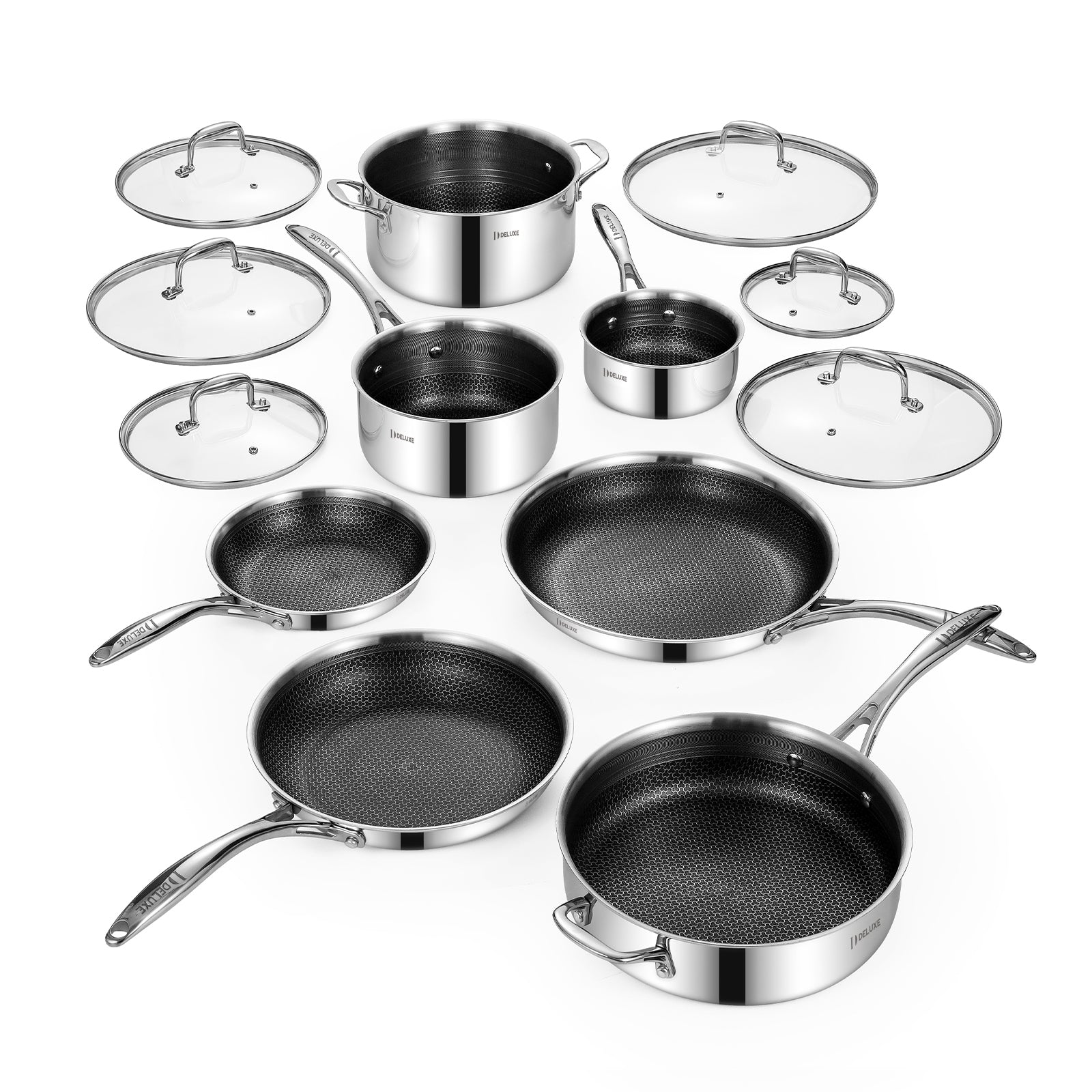
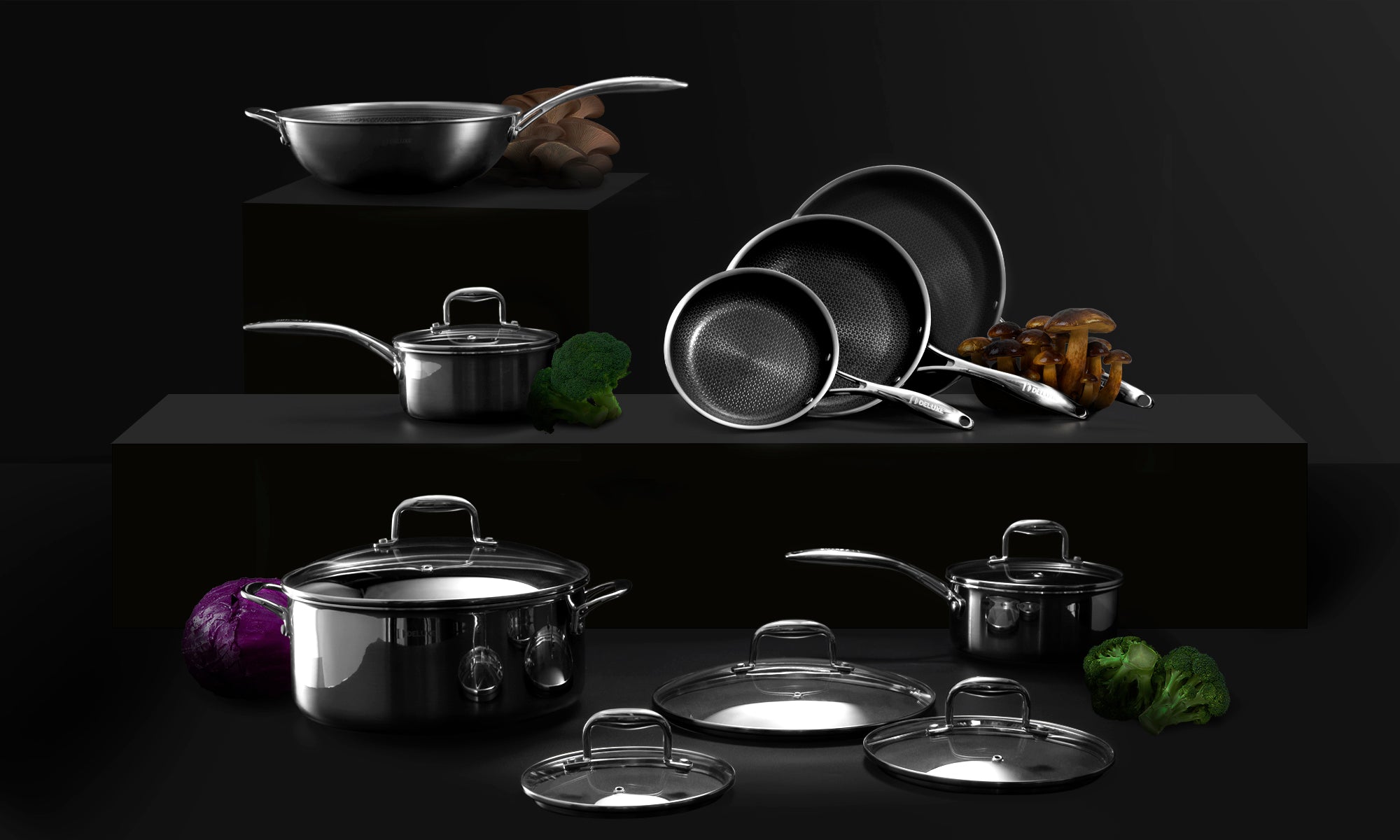
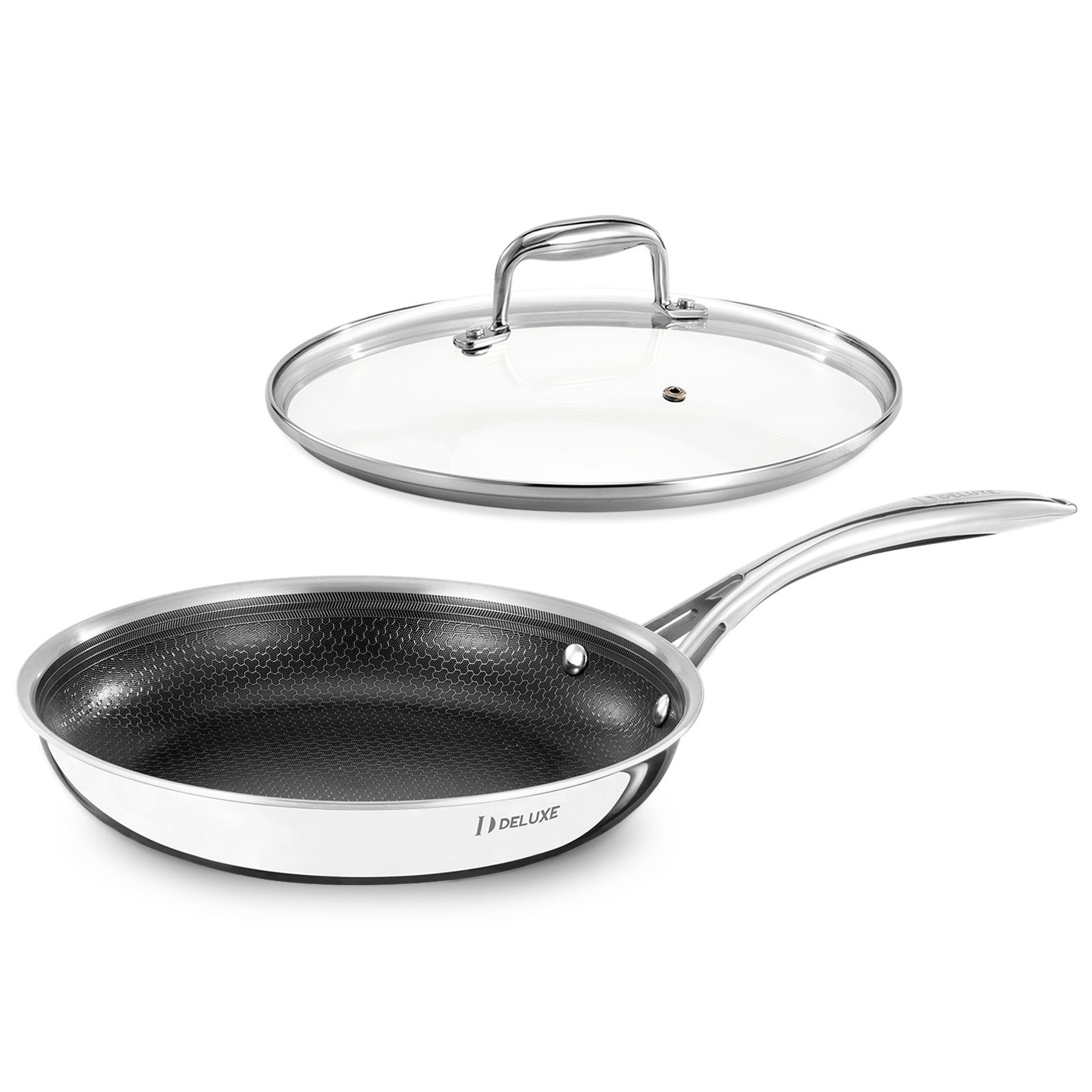
Hybrid cookware combines features of stainless steel and nonstick cookware, often using a raised metal pattern over a nonstick coating.
If you cook in an American kitchen, you may want one pan for weeknight eggs, seared chicken, grilled cheese, and weekend steak. Traditional nonstick pans release food with little effort, while stainless steel pans can build a rich brown crust. Hybrid cookware aims to bring some of these benefits together in one pan.
The term hybrid cookware describes cookware that blends two or more surface or construction features. Many popular designs use a stainless steel cooking surface with a raised pattern that protects parts of a nonstick coating. Other products use different combinations, including ceramic-based nonstick coatings. The exact design matters because the word hybrid alone does not tell you what materials touch your food or how the pan should be used.
Hybrid cookware can be useful if you want easier food release and the option to brown meat in the same pan. However, it does not remove every drawback of stainless steel or nonstick cookware. Cooking results, coating life, heat limits, cleaning needs, and price depend on the specific product. Checking the manufacturer’s material details is the best way to decide whether a hybrid pan fits your kitchen.
Hybrid cookware is a type of cookware that combines features of different materials or cooking surfaces. In a common design, a stainless steel pan has a raised metal grid or pattern over a coated cooking surface. The raised sections provide direct metal contact, while the coated areas help food release.
Think of the design as a road with raised metal ridges and smooth lanes between them. Food can touch both types of surface as it cooks. This arrangement aims to offer some of the browning associated with stainless steel and some of the convenience associated with nonstick cookware.
Not every hybrid pan uses the same structure. Some products combine stainless steel with a conventional PTFE-based coating, while others use a ceramic-based nonstick coating or a different surface treatment. Some manufacturers also use the word hybrid for cookware with multiple metal layers. Always read the material description instead of relying on the product name.
Hybrid cookware is not a single standardized material category. Two pans sold under this label may differ in coating chemistry, base metal, thickness, heat performance, and care requirements. Those differences can matter more than the word hybrid itself.
Source: ideluxecookware.com
Stainless steel structure
Many hybrid pans use stainless steel for the body or raised surface pattern. It can provide a durable cooking structure and support browning where food contacts exposed metal.
Nonstick areas
Recessed or exposed coated areas help reduce sticking. The type of coating determines its care needs, heat limits, and material considerations.
Layered construction
Some designs use several metal layers to spread heat. A layered base is a separate feature from the hybrid surface pattern, although a pan may have both.
How Does the Raised Pattern Work?
In a patterned hybrid pan, raised metal ridges and recessed coated areas form a combined cooking surface. The metal ridges contact food directly, while the coating in the lower areas helps reduce sticking. The pattern may also shield some coated areas from direct contact with utensils.
That protection has limits. Food, spatulas, cleaning tools, and repeated heating can still wear the coating. A raised pattern also does not guarantee that food will never stick. Eggs, fish, and other delicate foods may still need suitable heat, enough cooking fat, and careful handling.
Metal contact
Exposed metal can help brown foods when the pan is heated and used correctly.
Coated contact
Nonstick areas can make cooking and cleanup easier, particularly with foods that tend to cling.
Design matters
The height, spacing, and shape of the pattern affect how food contacts the surface. No pattern guarantees better results in every cooking task.
Is Hybrid Cookware the Same as Clad Cookware?
No. Clad cookware refers to cookware made by bonding layers of metal together, often stainless steel around an aluminum or copper core. These layers help conduct and spread heat. Hybrid cookware usually refers to a combination of cooking-surface features, although some hybrid products also have clad construction.
A stainless steel pan can be fully clad without having a nonstick coating. Likewise, a hybrid pan can have a layered base and a patterned surface. When comparing products, check both the body construction and the cooking-surface materials.
Clad cookware
Focuses on bonded metal layers that influence heat distribution and cooking performance.
Hybrid cookware
Usually focuses on combining surface types or cooking features, often exposed metal and nonstick areas.
What Materials Are Used in Hybrid Cookware?
Hybrid cookware can use several materials, and each one serves a different purpose. Stainless steel often provides the structural body or raised cooking pattern. Aluminum may sit inside the base to spread heat, while a nonstick coating helps reduce food adhesion.
The exact combination varies by brand and model. A stainless steel exterior does not prove that the entire cooking surface is stainless steel. Likewise, the word ceramic does not mean a pan is made entirely from ceramic. Many ceramic nonstick pans use a metal body with a thin ceramic-based coating.
If you want to know what touches your food, look for the manufacturer’s description of the interior cooking surface. If you want to know how evenly a pan heats, examine the base and body construction as well. These are separate questions, and a good answer to one does not automatically answer the other.
Source: ideluxecookware.com
Stainless steel
Provides strength and corrosion resistance. Its cooking behavior depends on the surface finish, pan temperature, and cooking technique.
Aluminum
Conducts heat well and may be used in the base or body to improve heat spread. It may be enclosed within other metal layers.
PTFE-based nonstick coating
PTFE is a fluoropolymer used in many nonstick coatings. A product with this coating is not accurately described as PFAS-free.
Ceramic-based nonstick coating
Often uses a silica-based coating system. The term ceramic-coated does not mean the pan is free of every synthetic ingredient, so check the manufacturer’s material statement.
Handles and lids
Handles may be metal, plastic, or another material, and lids may use glass or metal. These parts affect oven limits and handling.
Does Hybrid Cookware Contain PTFE or PFAS?
Some hybrid cookware contains PTFE, while other products use different nonstick systems. You cannot determine the coating chemistry from the word hybrid, the stainless steel pattern, or the exterior finish alone.
PTFE belongs to a broad group of chemicals known as PFAS. If avoiding PFAS is a priority, look for an explicit statement from the manufacturer about the finished product and its coating. A claim such as PFOA-free is narrower than PFAS-free because PFOA is only one member of the broader group.
A ceramic-coated label is also not a complete material disclosure. Ask what the manufacturer means by ceramic, and check whether the company provides a clear statement about PTFE and PFAS. If the information is unclear, do not assume the product meets a specific chemical restriction.
For PTFE avoidance
Choose a product whose manufacturer clearly states that its cooking surface does not contain PTFE.
For PFAS avoidance
Look for a specific PFAS-free claim that covers the relevant finished cookware and coating, rather than relying only on PFOA-free wording.
For material transparency
Review the official product specifications and care guide. Contact the manufacturer if the coating description leaves important questions unanswered.
What Are the Benefits of Hybrid Cookware?
The main appeal of hybrid cookware is that it tries to combine easier food release with the ability to brown ingredients. That can be useful when you cook several kinds of food and do not want to switch pans for every task. Still, the benefits depend on the design and how you use it.
For a busy household, one versatile skillet can save cabinet space. You might use it to brown ground beef for tacos, cook chicken for a rice bowl, or prepare vegetables for a quick dinner. The same pan may also handle foods that benefit from a less sticky surface, although delicate foods can still require care.
Hybrid cookware may also be a practical middle ground for people who find bare stainless steel difficult to use but want more metal contact than a fully coated skillet provides. It does not eliminate the need to learn heat control, and it may not outperform a dedicated pan at every task.
Source: ideluxecookware.com
Versatile cooking
A hybrid skillet can handle many everyday jobs, from browning meat to cooking vegetables and preparing simple pan sauces.
Potentially easier cleanup
The coated areas may help release stuck-on food. Cleanup still depends on cooking temperature, ingredients, coating condition, and the manufacturer’s cleaning instructions.
Possible coating protection
A raised metal pattern may reduce direct contact between utensils and some recessed coated areas, but it cannot prevent all scratches or wear.
Fewer pan changes
A single hybrid pan may cover several tasks, which can help cooks with limited storage space.
Multiple cooktop options
Some hybrid pans work on gas, electric, glass-ceramic, and induction cooktops. Compatibility must be confirmed for the exact model.
Can Hybrid Cookware Sear Meat?
Yes, many hybrid pans can brown meat, but the result depends on the pan’s design, heat response, surface contact, and the amount of moisture in the food. Stainless steel contact areas can support browning when the pan is hot enough and the meat has a dry surface.
A patterned cooking surface may have less continuous metal contact than a smooth stainless steel pan. That can affect how a large steak browns. For a strong crust, avoid crowding the pan, dry the meat before cooking, and allow moisture to evaporate instead of piling up.
If you regularly sear thick steaks or cook large batches, a dedicated stainless steel or cast iron pan may be a better tool. If you mainly cook small portions of chicken, burgers, and vegetables, a hybrid pan may offer enough browning for everyday meals.
Preheat with care
Follow the manufacturer’s heat guidance and avoid prolonged heating of an empty coated pan.
Dry the ingredients
Surface moisture slows browning. Pat meat dry and cook in batches when needed.
Choose the right pan
For frequent high-heat searing, compare hybrid cookware with uncoated stainless steel and cast iron before deciding.
Is Hybrid Cookware Good for Eggs and Fish?
Hybrid cookware can cook eggs and fish, but a patterned surface may not release delicate foods as easily as a smooth, well-maintained nonstick pan. Eggs can settle into the lower parts of a pattern, and fish skin can catch on surface ridges if the pan is too cool or the fish is moved too soon.
Use moderate heat, a small amount of suitable cooking fat, and a clean surface. Let fish cook until it releases more easily before trying to turn it. If your main goal is making omelets or cooking fragile fish fillets with very little oil, a dedicated smooth nonstick skillet may be simpler.
For eggs
Use gentle heat and enough fat to support release, especially if the pan is new to you.
For fish
Dry the surface, avoid moving the fillet too early, and use a broad spatula.
What Are the Disadvantages of Hybrid Cookware?
Hybrid cookware has trade-offs. It may cost more than a basic nonstick skillet, can be heavier than expected, and may not match the performance of a specialized pan for every cooking task. The surface pattern can also make cleaning more involved when oil or food collects between the raised sections.
The coating remains a key consideration. Even when metal ridges help shield parts of the surface, the coated areas can wear through normal use. A hybrid label does not mean the pan will last forever or that you can use metal tools without risk.
Another drawback is that performance claims can be hard to compare. One brand may emphasize browning, while another focuses on easy release or coating durability. Unless the claims come with clear test methods and conditions, avoid assuming that one hybrid design is better than another based on advertising alone.
Source: hellskitchenstore.com
Higher initial price
Some hybrid sets cost more than simple cookware. Compare the number of useful pieces, construction, warranty terms, and expected care needs rather than the piece count alone.
Cleaning can take longer
Raised patterns may trap residue. A soft brush or nonabrasive sponge can help reach recessed areas without damaging the coating.
The coating can wear
The nonstick layer is still a wear item. Follow utensil, cleaning, and heat guidance to help preserve it.
Browning may vary
A patterned surface may not provide the same continuous contact as a smooth stainless steel pan.
Marketing terms can confuse
Hybrid, nonstick, ceramic, and stainless steel describe different features. Check the full specifications to understand what you are buying.
Does Hybrid Cookware Last Longer Than Regular Nonstick?
It may last longer in some designs, but the word hybrid is not proof of longer service life. Raised metal sections can help protect parts of a coating from direct utensil contact. The coating can still degrade from heat, abrasion, cleaning, and repeated use.
A fair comparison requires information about the exact products, their coating systems, and the conditions under which they were tested. A longer warranty can provide useful information about the manufacturer’s stated coverage, but it does not establish that the pan will remain nonstick for that entire period.
To compare expected value, consider the purchase price, warranty exclusions, how often you cook, and whether the manufacturer sells individual replacement pans. A less expensive skillet that meets your needs may offer better value than a costly set with pieces you rarely use.
Check warranty limits
Look for exclusions related to normal wear, overheating, misuse, and cosmetic changes.
Inspect the coating
Replace a pan when the surface is seriously damaged or no longer functions as intended, following the manufacturer’s guidance.
Avoid unsupported lifespan claims
Do not assume that a hybrid pan will last a fixed number of years without reliable model-specific evidence.
Hybrid Cookware vs. Stainless Steel vs. Traditional Nonstick
The best comparison starts with your cooking habits. Hybrid cookware tries to balance easy food release and browning, traditional nonstick focuses on reducing sticking, and uncoated stainless steel offers a durable metal cooking surface that can support browning and pan sauces.
No material wins every task. A nonstick skillet is often convenient for eggs, pancakes, and delicate foods. Stainless steel is a strong option for searing and making pan sauces. Hybrid cookware sits between these uses, but the actual results depend on the design, surface condition, and cooking technique.
Source: checkcharm.com
Best for low-stick convenience
A traditional nonstick skillet is often the easiest choice for delicate foods and cooks who want simple cleanup.
Best for metal-surface cooking
Uncoated stainless steel is well suited to browning, deglazing, and long-term use when properly cared for.
Best for a mixed approach
Hybrid cookware may suit people who want some nonstick help and metal contact in one pan.
Comparison Table: Which Pan Fits Your Needs?
Use this table as a general guide. It compares common cookware types rather than every product on the market. Specific construction and coating details can change the result.
Hybrid cookware
Food release: moderate to good, depending on the coating and surface. Browning: often good, but patterned contact may differ from smooth metal. Care: follow coating-specific instructions. Main trade-off: combines features but may not excel at every task.
Traditional nonstick
Food release: usually very good when the coating is in good condition. Browning: adequate for many everyday meals but often not the first choice for intense searing. Care: avoid overheating and damaging utensils. Main trade-off: convenient but the coating can wear.
Uncoated stainless steel
Food release: depends heavily on heat, fat, and technique. Browning: very good for many foods. Care: generally tolerates normal scrubbing better than coated pans. Main trade-off: takes practice to prevent sticking.
Cast iron
Food release: improves with seasoning and use. Browning: very good when heated correctly. Care: may need drying and seasoning maintenance. Main trade-off: heavy and slower to respond to heat changes.
Carbon steel
Food release: improves with seasoning. Browning: very good for many cooking tasks. Care: requires suitable drying and seasoning. Main trade-off: needs maintenance and can react to long cooking with acidic foods.
Should You Buy Hybrid Cookware or Two Separate Pans?
Two separate pans can be a better choice if you often cook foods that need very different surfaces. A small nonstick skillet can handle eggs and pancakes, while an uncoated stainless steel skillet can brown meat and build pan sauces. Each pan can focus on the job it does best.
A hybrid pan may be more practical if cabinet space is tight or you want to own fewer pieces. It can also suit a cook who regularly makes mixed meals and values convenience. The deciding factor is not how many features the pan advertises, but whether those features match the food you cook most often.
Choose one hybrid pan
Consider it when storage is limited and you want one skillet for a broad mix of everyday cooking.
Choose two dedicated pans
Consider a nonstick skillet plus stainless steel if you frequently cook delicate eggs and also want strong searing performance.
Is Hybrid Cookware Safe to Use?
Hybrid cookware can be used safely when it is made for food contact and handled according to its manufacturer’s instructions. Safety depends on the actual materials, the condition of the surface, the temperature, and the way you cook. The word hybrid alone is not a safety certification.
For PTFE-coated cookware, overheating is a key concern. PTFE coatings can release hazardous fumes when severely overheated, and birds are especially sensitive to these fumes. Never leave a coated pan heating unattended, and follow the product’s temperature limits. Do not heat an empty coated pan for a long time or use it in a way the manufacturer does not permit.
The same practical rule applies to other coated cookware: avoid exceeding the stated heat limits and stop using a pan that has serious surface damage. A scratched pan is not automatically proof of an acute poisoning event, but damaged coatings can affect cooking performance and may be a reason to replace the pan according to the manufacturer’s guidance.
Handles, lids, and oven limits also matter. A pan may be oven-safe while its lid or handle has a lower temperature limit. If the instructions do not clearly state the safe oven temperature, do not guess. Use another pan with a documented limit for high-heat oven work.
Source: hexclad.com
Use suitable heat
Follow the model’s temperature limits and avoid leaving a coated pan unattended over a burner.
Check the coating type
Read the material disclosure if you have concerns about PTFE, PFAS, or ceramic-based coatings.
Protect the surface
Use the recommended utensils and cleaning tools. Avoid abrasive products unless the manufacturer explicitly permits them.
Follow oven guidance
Check the pan, handle, lid, and knob limits separately when the manufacturer provides different ratings.
Consider pets
Keep birds away from kitchens where cookware could be severely overheated, and follow veterinary or poison-control guidance if exposure is suspected.
Is Hybrid Cookware Better for Health Than Nonstick Cookware?
There is no universal basis for saying hybrid cookware is healthier than traditional nonstick cookware. If both use a similar PTFE-based coating, the raised pattern does not automatically change the chemical properties of that coating. A ceramic-based hybrid product may have a different coating system, but the label alone does not establish that it is safer in every situation.
If your goal is to reduce contact with synthetic nonstick coatings, consider uncoated stainless steel, cast iron, or carbon steel. These alternatives have different cooking and maintenance needs, and they are not free of every possible material-related concern. For a specific health or chemical restriction, choose cookware with clear material disclosures rather than relying on broad marketing claims.
For clear material information
Check the exact coating, interior material, and manufacturer statements for the model you plan to buy.
For coating-free cooking
Consider uncoated stainless steel, cast iron, or carbon steel if you are comfortable with their cooking techniques and care requirements.
For uncertainty
Ask the manufacturer for written material information rather than assuming that a hybrid label means chemical-free.
How to Use Hybrid Cookware Correctly
Hybrid cookware works best when you treat it according to its actual surface materials. A pan with exposed stainless steel and coated areas needs care that protects the coating while allowing the metal surface to do its job. Start with the manufacturer’s manual, especially if you are switching from cast iron or fully coated nonstick cookware.
The first few uses are a good time to learn how the pan responds to heat. A burner that works well for a thin nonstick skillet may heat a thicker hybrid pan differently. Start with moderate heat, adjust as needed, and avoid assuming that a high burner setting will improve browning.
Learn the pan’s heat response before trying more demanding recipes. Avoid prolonged empty heating.
Add cooking fat when useful
A suitable amount of oil or butter can support browning and food release, even on a coated surface.
Avoid crowding
Leave room for moisture to escape when browning meat or vegetables.
How to Cook Without Sticking
Sticking usually reflects a mix of heat, moisture, surface condition, and food choice. If eggs or meat cling to your hybrid pan, first check that the surface is clean and the pan is not overheated. Then adjust the temperature and use an appropriate amount of cooking fat.
For meat, pat the surface dry before cooking and allow the first side to brown before trying to turn it. For eggs, use lower heat and avoid scraping the food across the raised pattern. If the coating has worn or the surface is damaged, cooking technique may not solve the problem.
Food sticks immediately
Check for residue, unsuitable heat, and insufficient cooking fat. Try a smaller batch and adjust the heat before changing pans.
Food sticks after several months
Inspect the coating for wear and review cleaning habits. Normal use can reduce nonstick performance over time.
Food burns before browning
Lower the heat and allow more time. High heat can burn food without creating the even crust you want.
How to Clean Hybrid Cookware
Let the pan cool before cleaning unless its manufacturer gives specific instructions otherwise. Sudden temperature changes can stress cookware and may cause warping. Wash the pan with warm water, dish soap, and a soft sponge or suitable brush.
If food collects between the raised sections, soak the cooled pan briefly in warm, soapy water. Use a soft brush to lift residue from the grooves. Avoid steel wool, harsh abrasive powders, and sharp tools unless the product’s care guide specifically permits them.
Dishwasher safety varies by model. Even when a manufacturer permits dishwasher use, handwashing may help preserve the finish and reduce exposure to strong detergents. Dry the pan before storing it, and place a protective layer between stacked pans if the manufacturer recommends this to prevent surface damage.
For stuck-on food
Soak the cooled pan and use a nonabrasive brush to remove residue from recessed areas.
For grease buildup
Use warm water and dish soap rather than harsh cleaners that may damage the surface.
For storage
Avoid sliding heavy pans across the cooking surface. Use pan protectors if stacking is necessary.
How to Choose the Right Hybrid Cookware
The right hybrid cookware depends on what you cook, the stove you own, your preferred materials, and your budget. Start with the pan you need most often instead of buying a large set simply because it includes many pieces. A single skillet may tell you more about whether the surface suits your cooking style than a full collection will.
Look beyond the outer finish and product photos. The useful details are the interior surface materials, base construction, stated heat limits, compatible cooktops, cleaning guidance, warranty, and replacement options. If a manufacturer does not explain a key feature clearly, treat that uncertainty as part of your buying decision.
Source: ideluxecookware.com
Cooking surface
Confirm whether the pan uses PTFE, a ceramic-based coating, exposed stainless steel, or a combination of these materials.
Cooktop compatibility
For induction, look for an explicit compatibility statement. A stainless steel exterior alone does not guarantee that a pan will work on induction.
Weight and balance
Consider the full pan’s weight, handle shape, and balance. A pan that is difficult to lift may be inconvenient for everyday cooking.
Oven limits
Check the maximum oven temperature for the pan and any separate limits for the lid, handle, or knob.
Warranty and replacement
Review the warranty exclusions and see whether the manufacturer sells individual pans, lids, or other replacement parts.
Total value
Compare the cost with the pieces you will actually use, the care needed, and the availability of replacement cookware.
Is Hybrid Cookware Suitable for Induction?
Some hybrid cookware works on induction cooktops, but not every model does. Induction requires a compatible magnetic base. A pan can have a stainless steel body or surface pattern and still lack a base that performs properly on an induction hob.
Check the official product listing or manual for the induction symbol or an explicit compatibility statement. If you already own the pan, follow the manufacturer’s compatibility instructions rather than relying only on appearance. A magnet test can offer a rough clue about magnetic attraction, but it does not establish the pan’s overall induction performance.
Before buying
Confirm compatibility with your specific cooktop and check any restrictions on pan size or base shape.
For even heating
Look for a flat base and clear construction details. Compatible cookware can still vary in heat distribution.
Should You Buy a Hybrid Cookware Set or a Single Pan?
A single hybrid skillet is a sensible starting point if you are unsure whether you like the cooking surface. You can use it for common meals and assess how well it browns food, releases eggs, and cleans up after dinner. This also limits the cost if the design does not suit your routine.
A set can make sense when its pieces match your real cooking needs. Count the useful pans, lids, and sizes instead of focusing on the advertised piece total. Some sets include accessories or small items that do not replace the main cookware you need.
If you cook for a large family, prepare meals in batches, or use several burners at once, pan size and capacity may matter more than the surface pattern. Check dimensions and usable cooking area before choosing a set.
Choose a single pan
Start small if you want to test the surface, weight, cleanup, and browning performance.
Choose a set
Buy a set when its pan sizes, lids, and construction match the meals you cook most often.
Compare usable pieces
Check the included sizes and accessories, along with the return policy and warranty.
Common Hybrid Cookware Buying Mistakes
The biggest mistake is assuming that every hybrid pan has the same surface, safety profile, or cooking performance. The term covers several designs, so a decision based on the category name alone can lead to a poor fit. Review the exact product specifications before comparing prices.
Another mistake is expecting a hybrid surface to replace every pan in your kitchen. A hybrid skillet may be versatile, but it may not match a dedicated nonstick pan for fragile eggs or a heavy cast iron skillet for some high-heat searing tasks. Choose based on your regular meals rather than a promise that one pan can do everything.
Finally, do not treat metal ridges as permission to use any utensil or cleaning tool. Raised metal areas may protect parts of the coating, but the coated sections can still be scratched or worn. Use the care instructions supplied with the exact product.
Source: mygrinderguide.com
Mistake: assuming all hybrid pans are PFAS-free
Correction: check the exact coating chemistry and look for clear, product-specific material statements.
Mistake: buying based only on piece count
Correction: compare the sizes and pieces you will actually use, plus warranty and replacement options.
Mistake: expecting zero sticking
Correction: manage heat, dry food when needed, use suitable cooking fat, and keep the surface clean.
Mistake: assuming every model is induction-safe
Correction: verify compatibility in the official specifications.
Mistake: using excessive heat to improve browning
Correction: follow the manufacturer’s heat limits and adjust technique rather than overheating a coated pan.
Mistake: using abrasive tools on the surface
Correction: clean raised patterns with a soft brush or nonabrasive sponge unless the manual says otherwise.
How to Tell When a Hybrid Pan Needs Replacing
Consider replacing a hybrid pan when its coating is extensively damaged, peeling, or no longer performs as intended. Follow the manufacturer’s instructions for damaged cookware because the correct response can depend on the coating and construction.
Discoloration by itself does not always mean a pan is unsafe or unusable. Heat marks and changes in appearance can occur during normal cooking, but severe warping, a loose handle, a damaged lid, or a deteriorating cooking surface deserve attention. Do not continue using a pan with a structural defect that could cause a spill or burn.
If sticking increases, first check for built-up residue and review your cooking method. If cleaning does not restore performance and the coating is visibly worn, replacing the pan may be more practical than trying aggressive cleaning methods that could make the damage worse.
Visible coating damage
Check the manufacturer’s guidance when the coating flakes, peels, or shows substantial wear.
Structural damage
Stop using cookware with a loose handle, serious warping, or another defect that makes handling unsafe.
Persistent sticking
Rule out residue and heat issues before deciding that the pan has reached the end of its useful life.
Research Notes and Next-Question Gap Map
This guide uses general cookware material knowledge and practical analysis to explain the hybrid category. It does not claim laboratory testing, firsthand cooking trials, or independent durability measurements for the pictured products. Product-specific performance should be checked against the current manufacturer’s specifications and care instructions.
The following gap map separates reasonable next questions from verified search-demand evidence. These questions are inferred from the decisions a buyer needs to make. No Search Console data, live People Also Ask results, customer support records, or supplied site map were available in this task, so search demand and competitor coverage have not been independently established.
The useful editorial contribution is the distinction between surface design, metal-layer construction, and coating chemistry. That distinction helps readers avoid treating hybrid as a standardized material or a guarantee of safety, durability, or performance.
Source: checkcharm.com
Question: Is hybrid cookware PFAS-free?
Reader stage: material selection. Basis: inferred next need. Search demand: not verified. Competitor coverage: not checked. Reader benefit: learn to verify the exact coating rather than relying on a broad label. Evidence needed: current manufacturer material disclosures. Priority: high. Placement: materials and safety sections.
Question: Does hybrid cookware work on induction?
Reader stage: before purchase. Basis: inferred next need. Search demand: not verified. Competitor coverage: not checked. Reader benefit: avoid buying incompatible cookware. Evidence needed: model-specific induction specifications. Priority: high. Placement: buying guide.
Question: How do you clean the raised pattern?
Reader stage: after purchase. Basis: inferred next need. Search demand: not verified. Competitor coverage: not checked. Reader benefit: remove residue without damaging the coating. Evidence needed: product care manuals. Priority: medium. Placement: use and care section.
Question: Is hybrid cookware worth the extra cost?
Reader stage: purchase decision. Basis: inferred next need. Search demand: not verified. Competitor coverage: not checked. Reader benefit: compare a hybrid pan with dedicated stainless steel and nonstick options. Evidence needed: current prices, model-specific warranties, and reliable comparative tests. Priority: high. Placement: comparison and buying guide.
Question: Does hybrid cookware last longer than nonstick?
Reader stage: purchase decision and replacement. Basis: inferred next need. Search demand: not verified. Competitor coverage: not checked. Reader benefit: understand that a raised pattern does not prove longer coating life. Evidence needed: standardized durability testing for comparable models. Priority: medium. Placement: disadvantages section.
Frequently Asked Questions
Q
What is hybrid cookware in simple terms?
Hybrid cookware combines features of different cookware materials or surface types. A common design uses a raised stainless steel pattern with nonstick coating in recessed areas. The goal is to combine some of the browning ability of metal with easier food release.
Q
Is hybrid cookware better than regular nonstick cookware?
Not for every task. Hybrid cookware may offer more metal contact for browning, while a smooth nonstick skillet is often easier for eggs, pancakes, and delicate foods. The better choice depends on the exact design and what you cook most often.
Q
Is hybrid cookware safe for everyday cooking?
Hybrid cookware can be suitable for everyday cooking when the product is intended for food use and handled according to its instructions. Check the coating type, follow heat limits, avoid severe overheating, and replace cookware with serious surface or structural damage. The term hybrid alone does not establish a safety rating.
Q
Does hybrid cookware contain Teflon?
Some hybrid cookware uses PTFE-based nonstick coatings, while other products use different coating systems. Teflon is a brand associated with PTFE-based nonstick products, but the surface pattern alone does not tell you which coating a pan uses. Check the manufacturer’s exact material disclosure.
Q
Can you use metal utensils on hybrid cookware?
Only if the manufacturer explicitly permits them for that model. Raised metal ridges may help protect some coated areas, but they do not make every part of the surface scratch-proof. Silicone, wood, or other approved utensils are often the more cautious choice.
Q
Can hybrid cookware go in the dishwasher?
Dishwasher safety varies by product. Check the manual for the pan, lid, and handles rather than assuming the whole set is dishwasher-safe. Handwashing with warm water, dish soap, and a soft sponge may help preserve the surface.
Q
Can hybrid cookware be used in the oven?
Some hybrid pans are oven-safe, but the maximum temperature depends on the model and its components. A lid, knob, or handle may have a lower heat limit than the pan itself. Follow the manufacturer’s instructions and do not guess when a temperature limit is unclear.
Q
Is hybrid cookware good for induction stoves?
Some models are induction-compatible, but not all hybrid cookware works on induction. Check the official product specifications for an explicit induction statement. A stainless steel appearance alone is not enough to confirm compatibility.
Q
Why does food stick to my hybrid pan?
Food may stick because of excess moisture, unsuitable heat, insufficient cooking fat, residue, or a worn coating. Start by cleaning the pan, using moderate heat, and adjusting your cooking method. If the surface is visibly damaged or performance does not improve, consult the manufacturer’s replacement guidance.
Q
Is hybrid cookware worth buying?
Hybrid cookware may be worth buying if you want one pan for a mix of browning and easier food release. It may be less attractive if you mainly cook delicate eggs, need a dedicated high-heat searing pan, or want to avoid coated surfaces entirely. Compare the exact materials, care requirements, price, warranty, and cooktop compatibility before making a choice.
✦ Wrapping Up
Conclusion
Hybrid cookware combines features of different cookware materials, most often stainless steel and a nonstick cooking surface. Its raised metal pattern and coated areas aim to provide a middle ground between browning and easy food release. That design can make everyday cooking more flexible, especially when you want one pan for several common meals.
However, hybrid cookware is not a single standardized material, and the label does not guarantee superior durability, universal cooktop compatibility, or a particular chemical profile. The coating, base construction, temperature limits, and care instructions all affect how a pan performs. A dedicated nonstick skillet may still be easier for eggs, while uncoated stainless steel may be a better choice for frequent searing and pan sauces.
The most useful approach is to start with your cooking habits. Identify the foods you prepare most often, check the materials and instructions for the exact model, and compare the cost with other pan types. If you are unsure, buying one hybrid skillet before investing in a full set can help you decide whether the surface suits your kitchen.
💡 Key Takeaway
Before buying hybrid cookware, verify the interior coating, induction compatibility, oven limits, utensil guidance, cleaning instructions, and warranty. Choose a hybrid pan for a useful mix of cooking tasks, not because the label promises that it is nonstick, scratch-proof, or safer than every alternative.